 Add to Chrome
 Add to Firefox
 Add to Edge
Interactive Navigation with Adaptive Non-prehensile Mobile Manipulation
Oct 17, 2024


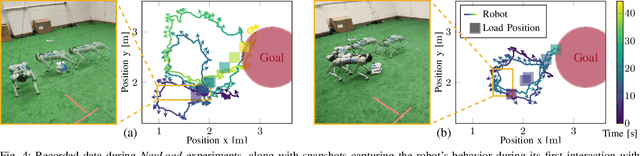
This paper introduces a framework for interactive navigation through adaptive non-prehensile mobile manipulation. A key challenge in this process is handling objects with unknown dynamics, which are difficult to infer from visual observation. To address this, we propose an adaptive dynamics model for common movable indoor objects via learned SE(2) dynamics representations. This model is integrated into Model Predictive Path Integral (MPPI) control to guide the robot's interactions. Additionally, the learned dynamics help inform decision-making when navigating around objects that cannot be manipulated.Our approach is validated in both simulation and real-world scenarios, demonstrating its ability to accurately represent object dynamics and effectively manipulate various objects. We further highlight its success in the Navigation Among Movable Objects (NAMO) task by deploying the proposed framework on a dynamically balancing mobile robot, Shmoobot. Project website: https://cmushmoobot.github.io/AdaptivePushing/.

Learning Smooth Humanoid Locomotion through Lipschitz-Constrained Policies
Oct 15, 2024

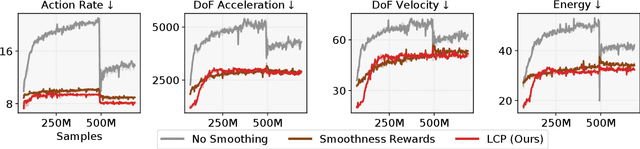
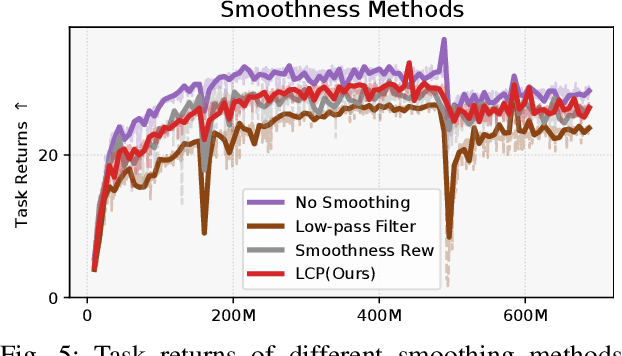
Reinforcement learning combined with sim-to-real transfer offers a general framework for developing locomotion controllers for legged robots. To facilitate successful deployment in the real world, smoothing techniques, such as low-pass filters and smoothness rewards, are often employed to develop policies with smooth behaviors. However, because these techniques are non-differentiable and usually require tedious tuning of a large set of hyperparameters, they tend to require extensive manual tuning for each robotic platform. To address this challenge and establish a general technique for enforcing smooth behaviors, we propose a simple and effective method that imposes a Lipschitz constraint on a learned policy, which we refer to as Lipschitz-Constrained Policies (LCP). We show that the Lipschitz constraint can be implemented in the form of a gradient penalty, which provides a differentiable objective that can be easily incorporated with automatic differentiation frameworks. We demonstrate that LCP effectively replaces the need for smoothing rewards or low-pass filters and can be easily integrated into training frameworks for many distinct humanoid robots. We extensively evaluate LCP in both simulation and real-world humanoid robots, producing smooth and robust locomotion controllers. All simulation and deployment code, along with complete checkpoints, is available on our project page: https://lipschitz-constrained-policy.github.io.
Traversability-Aware Legged Navigation by Learning from Real-World Visual Data
Oct 14, 2024The enhanced mobility brought by legged locomotion empowers quadrupedal robots to navigate through complex and unstructured environments. However, optimizing agile locomotion while accounting for the varying energy costs of traversing different terrains remains an open challenge. Most previous work focuses on planning trajectories with traversability cost estimation based on human-labeled environmental features. However, this human-centric approach is insufficient because it does not account for the varying capabilities of the robot locomotion controllers over challenging terrains. To address this, we develop a novel traversability estimator in a robot-centric manner, based on the value function of the robot's locomotion controller. This estimator is integrated into a new learning-based RGBD navigation framework. The framework develops a planner that guides the robot in avoiding obstacles and hard-to-traverse terrains while reaching its goals. The training of the navigation planner is directly performed in the real world using a sample efficient reinforcement learning method. Through extensive benchmarking, we demonstrate that the proposed framework achieves the best performance in accurate traversability cost estimation and efficient learning from multi-modal data (the robot's color and depth vision, and proprioceptive feedback) for real-world training. Using the proposed method, a quadrupedal robot learns to perform traversability-aware navigation through trial and error in various real-world environments with challenging terrains that are difficult to classify using depth vision alone.
CurricuLLM: Automatic Task Curricula Design for Learning Complex Robot Skills using Large Language Models
Sep 27, 2024Curriculum learning is a training mechanism in reinforcement learning (RL) that facilitates the achievement of complex policies by progressively increasing the task difficulty during training. However, designing effective curricula for a specific task often requires extensive domain knowledge and human intervention, which limits its applicability across various domains. Our core idea is that large language models (LLMs), with their extensive training on diverse language data and ability to encapsulate world knowledge, present significant potential for efficiently breaking down tasks and decomposing skills across various robotics environments. Additionally, the demonstrated success of LLMs in translating natural language into executable code for RL agents strengthens their role in generating task curricula. In this work, we propose CurricuLLM, which leverages the high-level planning and programming capabilities of LLMs for curriculum design, thereby enhancing the efficient learning of complex target tasks. CurricuLLM consists of: (Step 1) Generating sequence of subtasks that aid target task learning in natural language form, (Step 2) Translating natural language description of subtasks in executable task code, including the reward code and goal distribution code, and (Step 3) Evaluating trained policies based on trajectory rollout and subtask description. We evaluate CurricuLLM in various robotics simulation environments, ranging from manipulation, navigation, and locomotion, to show that CurricuLLM can aid learning complex robot control tasks. In addition, we validate humanoid locomotion policy learned through CurricuLLM in real-world. The code is provided in https://github.com/labicon/CurricuLLM
Berkeley Humanoid: A Research Platform for Learning-based Control
Jul 31, 2024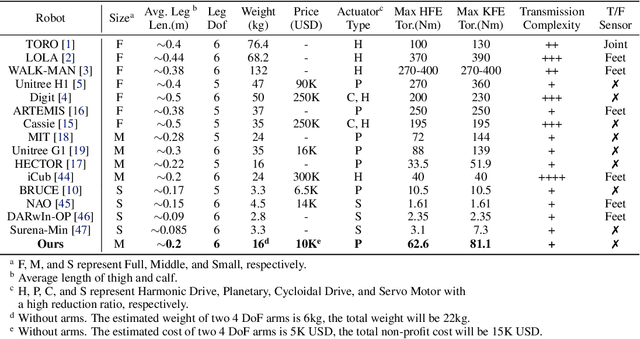
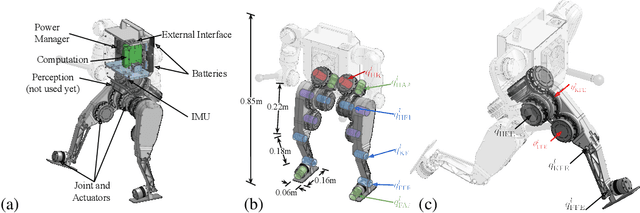
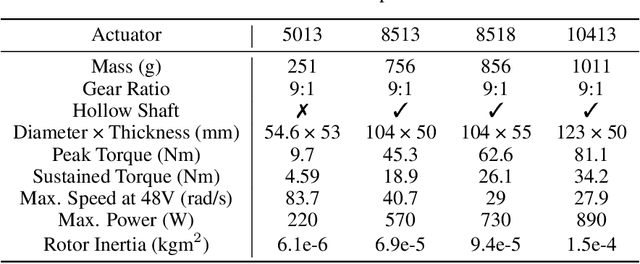
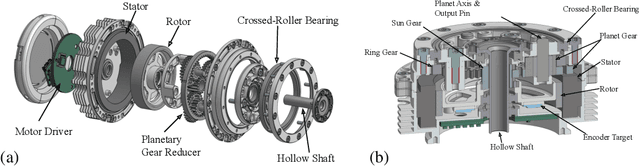
We introduce Berkeley Humanoid, a reliable and low-cost mid-scale humanoid research platform for learning-based control. Our lightweight, in-house-built robot is designed specifically for learning algorithms with low simulation complexity, anthropomorphic motion, and high reliability against falls. The robot's narrow sim-to-real gap enables agile and robust locomotion across various terrains in outdoor environments, achieved with a simple reinforcement learning controller using light domain randomization. Furthermore, we demonstrate the robot traversing for hundreds of meters, walking on a steep unpaved trail, and hopping with single and double legs as a testimony to its high performance in dynamical walking. Capable of omnidirectional locomotion and withstanding large perturbations with a compact setup, our system aims for scalable, sim-to-real deployment of learning-based humanoid systems. Please check http://berkeley-humanoid.com for more details.
HiLMa-Res: A General Hierarchical Framework via Residual RL for Combining Quadrupedal Locomotion and Manipulation
Jul 09, 2024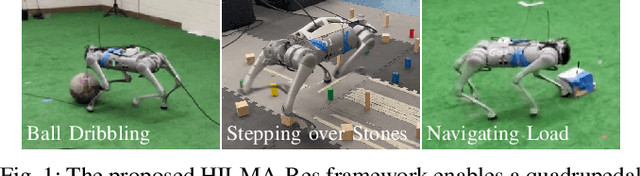

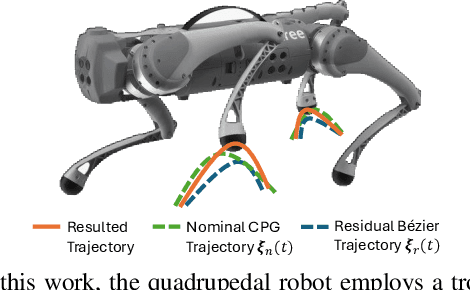
This work presents HiLMa-Res, a hierarchical framework leveraging reinforcement learning to tackle manipulation tasks while performing continuous locomotion using quadrupedal robots. Unlike most previous efforts that focus on solving a specific task, HiLMa-Res is designed to be general for various loco-manipulation tasks that require quadrupedal robots to maintain sustained mobility. The novel design of this framework tackles the challenges of integrating continuous locomotion control and manipulation using legs. It develops an operational space locomotion controller that can track arbitrary robot end-effector (toe) trajectories while walking at different velocities. This controller is designed to be general to different downstream tasks, and therefore, can be utilized in high-level manipulation planning policy to address specific tasks. To demonstrate the versatility of this framework, we utilize HiLMa-Res to tackle several challenging loco-manipulation tasks using a quadrupedal robot in the real world. These tasks span from leveraging state-based policy to vision-based policy, from training purely from the simulation data to learning from real-world data. In these tasks, HiLMa-Res shows better performance than other methods.
DiffuseLoco: Real-Time Legged Locomotion Control with Diffusion from Offline Datasets
Apr 30, 2024

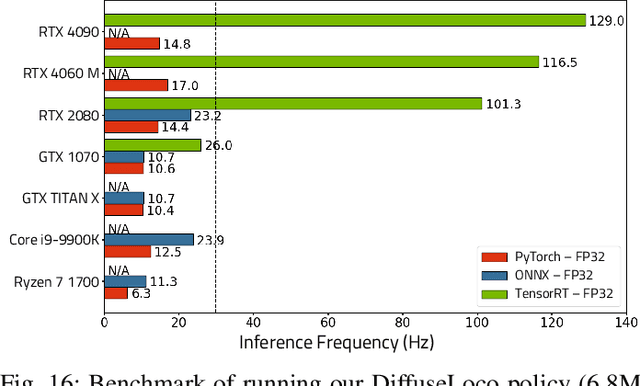

This work introduces DiffuseLoco, a framework for training multi-skill diffusion-based policies for dynamic legged locomotion from offline datasets, enabling real-time control of diverse skills on robots in the real world. Offline learning at scale has led to breakthroughs in computer vision, natural language processing, and robotic manipulation domains. However, scaling up learning for legged robot locomotion, especially with multiple skills in a single policy, presents significant challenges for prior online reinforcement learning methods. To address this challenge, we propose a novel, scalable framework that leverages diffusion models to directly learn from offline multimodal datasets with a diverse set of locomotion skills. With design choices tailored for real-time control in dynamical systems, including receding horizon control and delayed inputs, DiffuseLoco is capable of reproducing multimodality in performing various locomotion skills, zero-shot transfer to real quadrupedal robots, and it can be deployed on edge computing devices. Furthermore, DiffuseLoco demonstrates free transitions between skills and robustness against environmental variations. Through extensive benchmarking in real-world experiments, DiffuseLoco exhibits better stability and velocity tracking performance compared to prior reinforcement learning and non-diffusion-based behavior cloning baselines. The design choices are validated via comprehensive ablation studies. This work opens new possibilities for scaling up learning-based legged locomotion controllers through the scaling of large, expressive models and diverse offline datasets.
Long-horizon Locomotion and Manipulation on a Quadrupedal Robot with Large Language Models
Apr 08, 2024


We present a large language model (LLM) based system to empower quadrupedal robots with problem-solving abilities for long-horizon tasks beyond short-term motions. Long-horizon tasks for quadrupeds are challenging since they require both a high-level understanding of the semantics of the problem for task planning and a broad range of locomotion and manipulation skills to interact with the environment. Our system builds a high-level reasoning layer with large language models, which generates hybrid discrete-continuous plans as robot code from task descriptions. It comprises multiple LLM agents: a semantic planner for sketching a plan, a parameter calculator for predicting arguments in the plan, and a code generator to convert the plan into executable robot code. At the low level, we adopt reinforcement learning to train a set of motion planning and control skills to unleash the flexibility of quadrupeds for rich environment interactions. Our system is tested on long-horizon tasks that are infeasible to complete with one single skill. Simulation and real-world experiments show that it successfully figures out multi-step strategies and demonstrates non-trivial behaviors, including building tools or notifying a human for help.
Learning Visual Quadrupedal Loco-Manipulation from Demonstrations
Mar 29, 2024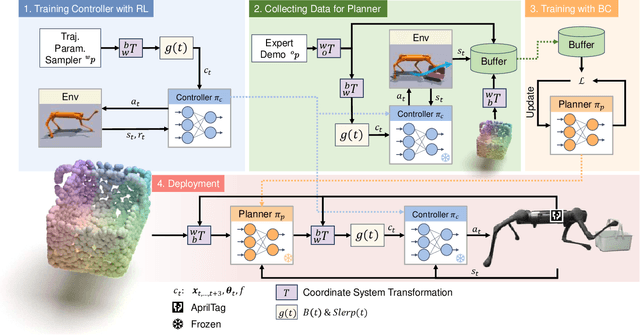
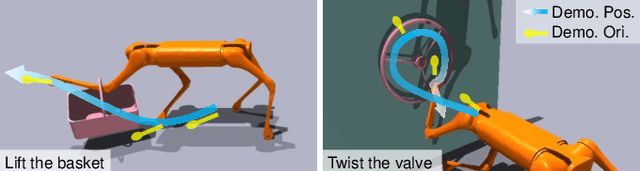
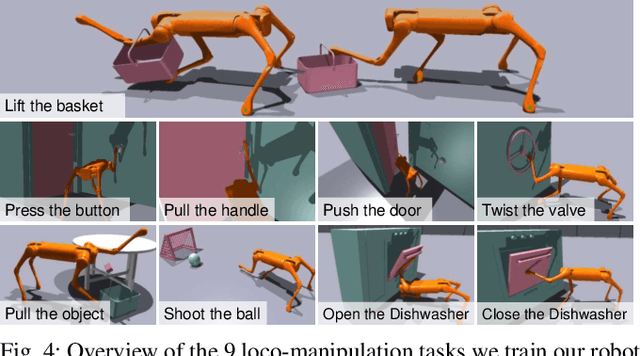
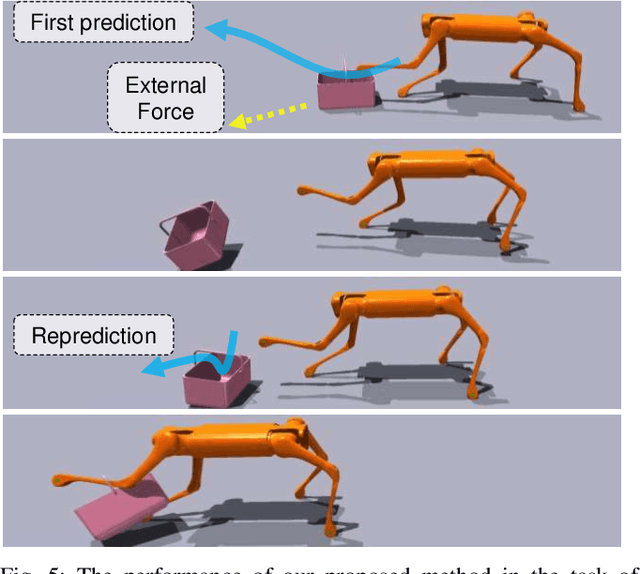
Quadruped robots are progressively being integrated into human environments. Despite the growing locomotion capabilities of quadrupedal robots, their interaction with objects in realistic scenes is still limited. While additional robotic arms on quadrupedal robots enable manipulating objects, they are sometimes redundant given that a quadruped robot is essentially a mobile unit equipped with four limbs, each possessing 3 degrees of freedom (DoFs). Hence, we aim to empower a quadruped robot to execute real-world manipulation tasks using only its legs. We decompose the loco-manipulation process into a low-level reinforcement learning (RL)-based controller and a high-level Behavior Cloning (BC)-based planner. By parameterizing the manipulation trajectory, we synchronize the efforts of the upper and lower layers, thereby leveraging the advantages of both RL and BC. Our approach is validated through simulations and real-world experiments, demonstrating the robot's ability to perform tasks that demand mobility and high precision, such as lifting a basket from the ground while moving, closing a dishwasher, pressing a button, and pushing a door. Project website: https://zhengmaohe.github.io/leg-manip
Adaptive Energy Regularization for Autonomous Gait Transition and Energy-Efficient Quadruped Locomotion
Mar 29, 2024
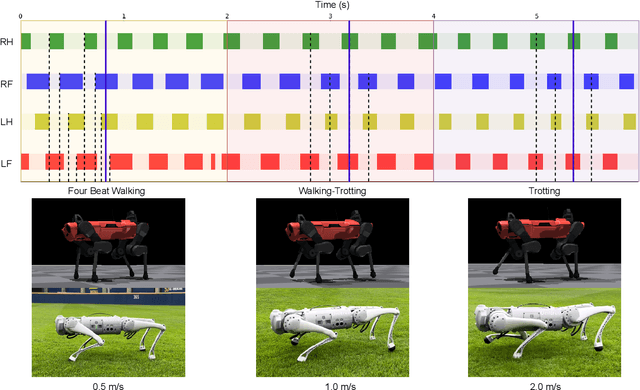
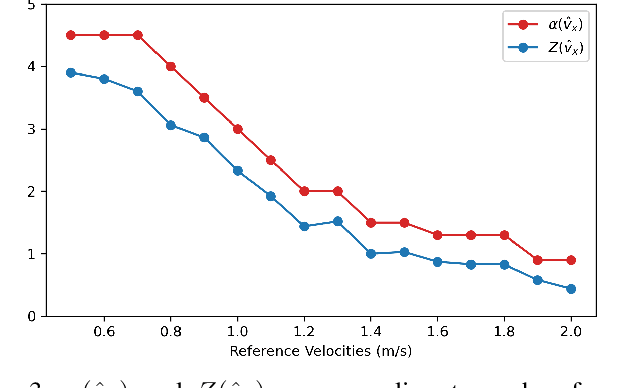

In reinforcement learning for legged robot locomotion, crafting effective reward strategies is crucial. Pre-defined gait patterns and complex reward systems are widely used to stabilize policy training. Drawing from the natural locomotion behaviors of humans and animals, which adapt their gaits to minimize energy consumption, we propose a simplified, energy-centric reward strategy to foster the development of energy-efficient locomotion across various speeds in quadruped robots. By implementing an adaptive energy reward function and adjusting the weights based on velocity, we demonstrate that our approach enables ANYmal-C and Unitree Go1 robots to autonomously select appropriate gaits, such as four-beat walking at lower speeds and trotting at higher speeds, resulting in improved energy efficiency and stable velocity tracking compared to previous methods using complex reward designs and prior gait knowledge. The effectiveness of our policy is validated through simulations in the IsaacGym simulation environment and on real robots, demonstrating its potential to facilitate stable and adaptive locomotion.