 Add to Chrome
 Add to Firefox
 Add to Edge
VeinCast: Physics-Guided Dynamic Field Graphs with Graph-Conditioned Fusion for Global Medium-Range Weather Forecasting
Aug 10, 2026
Global medium-range weather forecasting requires modeling structured yet state-dependent interactions among heterogeneous atmospheric fields. Existing data-driven models largely learn these interactions implicitly, whereas equation-level physical constraints may inherit approximation and model-form biases. We present VeinCast, a physics-guided dynamic field graph and graph-conditioned fusion framework that jointly forecasts 69 surface and upper-air fields. Within each local window, its Physics-Guided Dynamic Field Graph combines predefined atmospheric relations with state-dependent Top-K residual edges and adapts Earth-window attention using the resulting graph context. Graph-Conditioned Latent Fusion further employs graph context and source-node centrality to guide field-to-latent aggregation, while bounded feedback preserves field-specific information. On the $1.5^\circ$ ERA5 benchmark, VeinCast demonstrates competitive forecasting performance across all 69 meteorological fields at lead times of up to 14 days, compared with representative global weather forecasting models including FuXi, Pangu-Weather, GraphCast, FengWu, and ARROW. Ablations confirm that the two modules provide complementary gains, demonstrating the effectiveness of relational-level physical guidance for data-driven weather forecasting.

MemPrism: Task-Conditioned Relational Memory Views for Long-Horizon Agents
Aug 07, 2026Long-horizon agents rely on memory to reuse experiences, yet existing memory systems often assume that evidence can be directly consumed through a fixed representation. This leads to representation mismatch, where relevant information is available but not organized for the current decision. To this end, we propose MemPrism, a task-conditioned relational memory framework that separates persistent experience storage from decision-time working memory. MemPrism records interactions as the event stream and dynamically constructs relational views according to the current task context. A lightweight view policy selects the relation structure, evidence range, outcome condition, and granularity, while a deterministic composer and render transform historical facts into a temporary optical working-memory view for a frozen task policy. Experiments on long-horizon embodied and web-agent benchmarks show that MemPrism consistently improves the task performance, especially as trajectories become longer, while reducing memory token consumption. Furthermore, the learned view policy transfers across different VLMs without additional adaptation, demonstrating the effectiveness of task-conditioned relational views as a general memory interface for agents.
GRAIN: Molecules Are Not the Right Granularity -- Active-Ingredient Modeling for Safe Medication Recommendation
Jul 30, 2026Medication recommendation from electronic health records must balance predictive accuracy against the risk of adverse drug-drug interactions (DDIs) under polypharmacy. Existing safety-aware recommenders operate at one of two granularities: the drug code, which treats each medication as an indivisible token, or the molecular substructure, which is finer than pharmacological interaction knowledge is actually organized. We argue that the active ingredient is the missing granularity, and introduce GRAIN, a medication recommendation framework built around it. GRAIN encodes longitudinal patient trajectories (diagnoses, procedures, past medications) with a selective state space backbone that handles long, irregular visit sequences in linear time. On top of it we introduce a joint objective unifying three knowledge sources aligned to a common medication vocabulary: a drug-level DDI graph, an ingredient-level DDI graph obtained by normalizing medication codes to active ingredients via RxNorm, and an EHR-derived co-prescription graph. A proportional controller adapts the accuracy-safety trade-off to the observed validation DDI rate rather than fixing it a priori. Under strictly matched settings -- identical preprocessing, cohort, vocabulary, split, and evaluation code -- GRAIN improves over a re-implemented MambaHealth baseline on MIMIC-IV across all standard multi-label metrics (Jaccard 0.4488 to 0.4983, PRAUC 0.6911 to 0.7485, F1 0.5989 to 0.6453) while reducing the drug-level DDI rate from 0.1875 to 0.0948. We further define an ingredient-level DDI rate, a safety measure invisible to drug-code-level evaluation. The results indicate that ingredient-level normalization recovers predictive signal erased by code-level aggregation, and that it is complementary to, rather than in competition with, accurate sequence modeling.
Beyond Safe Data: Pretraining-Stage Alignment with Regular Safety Reflection
Jun 17, 2026To achieve deeper safety alignment for large language models (LLMs), recent efforts have studied how to push safety interventions earlier into the pretraining stage, primarily by filtering unsafe data or rewriting it into safer forms. We argue that pretraining-stage alignment should go beyond making the data safe: LLMs may compose seemingly benign knowledge and capabilities into unsafe behaviors. To this end, we propose Safety Reflection Pretraining, a pretraining-stage alignment method which regularly inserts short safety reflections into pretraining corpora to integrate self-monitoring directly into language modeling, establishing a foundational capability that is subsequently reinforced by compatible post-training. Our experiments with 1.7B models pretrained on FineWeb-Edu show that Safety Reflection Pretraining improves safety classification accuracy and substantially reduces the success rates of inference-stage and finetuning attacks. Complementary to our real-world experiments, we also introduce a fully controlled synthetic environment, MedSafetyWorld, with a clear definition of safety and a reasoning structure under which models can easily generalize unsafe behaviors from safe data. Ablations in MedSafetyWorld further demonstrate a clear advantage of Safety Reflection Pretraining in preventing models from acting on unsafe behaviors generalized from safe data, compared with data filtering and rewriting. Taken together, our findings suggest that pretraining alignment should not only make the training data safe, but also shape the behaviors that models are likely to acquire from safe data.
FlyMirage: A Fully Automated Generation Pipeline for Diverse and Scalable UAV Flight Data via Generative World Model
May 19, 2026In the field of Vision-Language Navigation (VLN), aerial datasets remain limited in their ability to combine scale, diversity, and realism, often relying on either costly real-world scenes or visually limited simulations. To address these challenges, we introduce FlyMirage, a highly scalable and fully automated data generation pipeline for aerial VLN. Our approach leverages large language models (LLM) as an environment designer to promote scene diversity, paired with a generative world model that instantiates these designs into high-fidelity 3D Gaussian Splatting (3DGS) scenes. To substantially reduce human labor and ensure the feasibility of flight data, FlyMirage automates scene exploration and semantic information acquisition, and further integrates a dynamically feasible planner for uncrewed aerial vehicle (UAV) trajectory generation. Utilizing this toolchain, we generate a large-scale, diverse, and photorealistic aerial VLN dataset, with dynamically feasible flying trajectories, designed to support the development of next-generation embodied navigation models.
Flying in Clutter on Monocular RGB by Learning in 3D Radiance Fields with Domain Adaptation
Dec 19, 2025Modern autonomous navigation systems predominantly rely on lidar and depth cameras. However, a fundamental question remains: Can flying robots navigate in clutter using solely monocular RGB images? Given the prohibitive costs of real-world data collection, learning policies in simulation offers a promising path. Yet, deploying such policies directly in the physical world is hindered by the significant sim-to-real perception gap. Thus, we propose a framework that couples the photorealism of 3D Gaussian Splatting (3DGS) environments with Adversarial Domain Adaptation. By training in high-fidelity simulation while explicitly minimizing feature discrepancy, our method ensures the policy relies on domain-invariant cues. Experimental results demonstrate that our policy achieves robust zero-shot transfer to the physical world, enabling safe and agile flight in unstructured environments with varying illumination.
EfficientIML: Efficient High-Resolution Image Manipulation Localization
Sep 10, 2025With imaging devices delivering ever-higher resolutions and the emerging diffusion-based forgery methods, current detectors trained only on traditional datasets (with splicing, copy-moving and object removal forgeries) lack exposure to this new manipulation type. To address this, we propose a novel high-resolution SIF dataset of 1200+ diffusion-generated manipulations with semantically extracted masks. However, this also imposes a challenge on existing methods, as they face significant computational resource constraints due to their prohibitive computational complexities. Therefore, we propose a novel EfficientIML model with a lightweight, three-stage EfficientRWKV backbone. EfficientRWKV's hybrid state-space and attention network captures global context and local details in parallel, while a multi-scale supervision strategy enforces consistency across hierarchical predictions. Extensive evaluations on our dataset and standard benchmarks demonstrate that our approach outperforms ViT-based and other SOTA lightweight baselines in localization performance, FLOPs and inference speed, underscoring its suitability for real-time forensic applications.
Sing it, Narrate it: Quality Musical Lyrics Translation
Oct 29, 2024
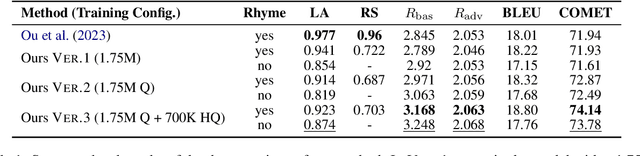
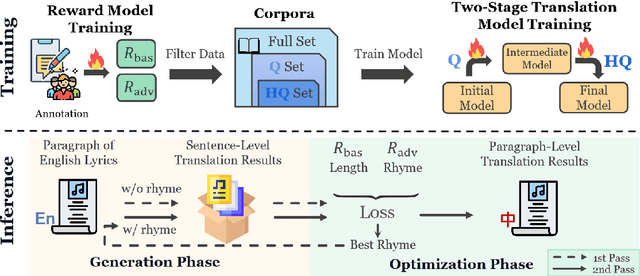
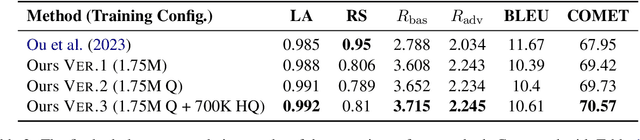
Translating lyrics for musicals presents unique challenges due to the need to ensure high translation quality while adhering to singability requirements such as length and rhyme. Existing song translation approaches often prioritize these singability constraints at the expense of translation quality, which is crucial for musicals. This paper aims to enhance translation quality while maintaining key singability features. Our method consists of three main components. First, we create a dataset to train reward models for the automatic evaluation of translation quality. Second, to enhance both singability and translation quality, we implement a two-stage training process with filtering techniques. Finally, we introduce an inference-time optimization framework for translating entire songs. Extensive experiments, including both automatic and human evaluations, demonstrate significant improvements over baseline methods and validate the effectiveness of each component in our approach.
Harmon: Whole-Body Motion Generation of Humanoid Robots from Language Descriptions
Oct 16, 2024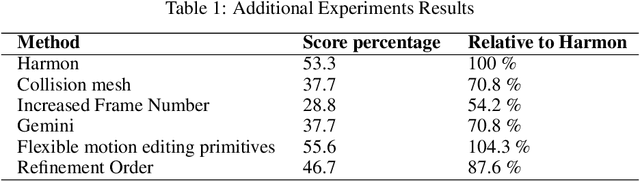
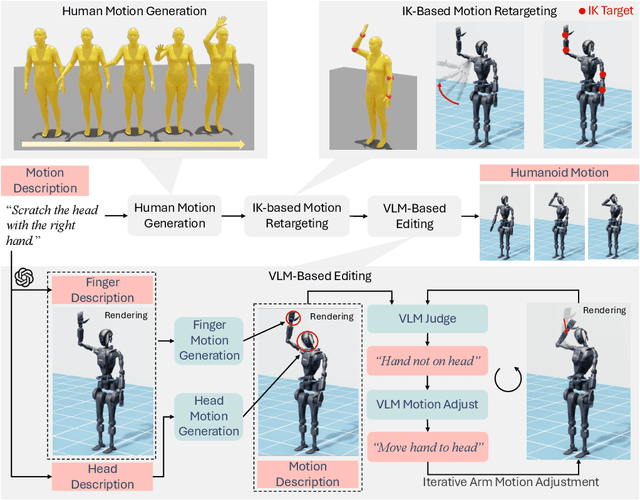
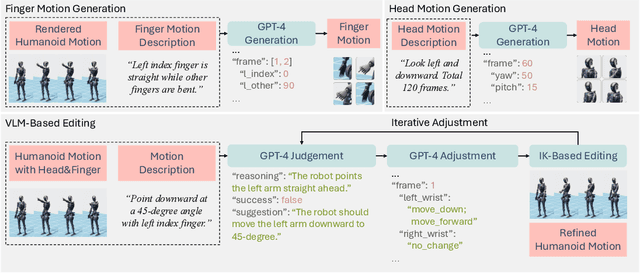
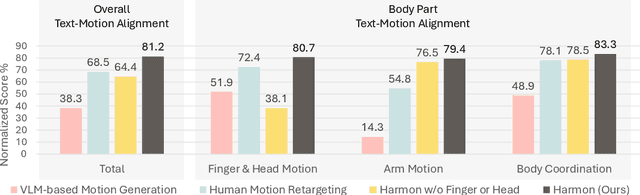
Humanoid robots, with their human-like embodiment, have the potential to integrate seamlessly into human environments. Critical to their coexistence and cooperation with humans is the ability to understand natural language communications and exhibit human-like behaviors. This work focuses on generating diverse whole-body motions for humanoid robots from language descriptions. We leverage human motion priors from extensive human motion datasets to initialize humanoid motions and employ the commonsense reasoning capabilities of Vision Language Models (VLMs) to edit and refine these motions. Our approach demonstrates the capability to produce natural, expressive, and text-aligned humanoid motions, validated through both simulated and real-world experiments. More videos can be found at https://ut-austin-rpl.github.io/Harmon/.
OKAMI: Teaching Humanoid Robots Manipulation Skills through Single Video Imitation
Oct 15, 2024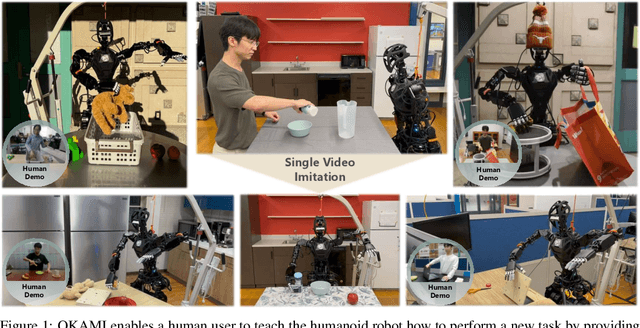


We study the problem of teaching humanoid robots manipulation skills by imitating from single video demonstrations. We introduce OKAMI, a method that generates a manipulation plan from a single RGB-D video and derives a policy for execution. At the heart of our approach is object-aware retargeting, which enables the humanoid robot to mimic the human motions in an RGB-D video while adjusting to different object locations during deployment. OKAMI uses open-world vision models to identify task-relevant objects and retarget the body motions and hand poses separately. Our experiments show that OKAMI achieves strong generalizations across varying visual and spatial conditions, outperforming the state-of-the-art baseline on open-world imitation from observation. Furthermore, OKAMI rollout trajectories are leveraged to train closed-loop visuomotor policies, which achieve an average success rate of 79.2% without the need for labor-intensive teleoperation. More videos can be found on our website https://ut-austin-rpl.github.io/OKAMI/.