 Add to Chrome
 Add to Firefox
 Add to Edge
PILA: Plug-and-Play Insertion for LLM-native Advertising
Jul 28, 2026
How to monetize large language models (LLMs) by naturally integrating sponsored content into their responses, known as LLM-native advertising, has recently emerged as a critical problem. However, existing solutions entangle advertising with content generation inside a single model, which is incompatible with modern API-only or workflow-based LLM applications and inevitably compromises the original response quality. To address this, we propose PILA, which reformulates ad insertion as a conditional response rewriting problem and decouples it from the upstream service as a lightweight sidecar module. PILA is model-agnostic and can be seamlessly integrated with existing LLM services without modifying the base model or its workflow. It also exposes a controllable trade-off between user-side naturalness and ad-side exposure, offering a practical interface for downstream pricing and deployment. Experiments across diverse upstream models show that \pila consistently improves ad effectiveness while preserving response quality, highlighting its promise as a practical solution for LLM-native advertising.

TopoRetarget: Interaction-Preserving Retargeting for Dexterous Manipulation
Jun 15, 2026Human hand-object demonstrations provide dense reference motions for training dexterous manipulation reinforcement learning (RL) policies through reference tracking. However, to use such demonstrations for RL policy learning, retargeting must preserve hand pose and task-relevant hand-object contact structure. Otherwise, contact and feasibility artifacts can degrade downstream RL policy performance. We introduce TopoRetarget, an interaction-preserving retargeting framework that uses a single set of parameters across diverse retargeting conditions while maintaining task-relevant hand-object interaction and adapting human demonstrations to dexterous robot hands. The method constructs a sparse interaction graph over hand and object keypoints and optimizes distance-weighted Laplacian deformation with directional consistency, kinematic constraints, and penetration handling. Evaluations show that the generated references improve both interaction fidelity and policy learning: TopoRetarget achieves the best contact precision and alignment over all baselines on the ContactPose Dataset, improves Pen-Spin training success by 40.6 percentage points over the existing baseline methods, and enables zero-shot transfer to Wuji Hand hardware on cube reorientation and pen spinning.
Data-driven Head Motion Generation through Natural Gaze-Head Coordination
May 25, 2026We present the first data-driven approach to model temporal gaze-head coordination from large-scale in-the-wild facial videos. To obtain training data for generalizable learning, we propose an automatic pipeline that extracts natural yet diverse gaze and head motions with off-the-shelf appearance-based gaze estimators. To capture the probabilistic correlation and temporal dynamics of gaze-head coordination, we build our model on a generative conditional Variational Autoencoder for plausible yet diverse gaze-conditioned head motion generations. We further apply our framework to gaze-controlled facial video generation, where we enable video generation with natural and realistic head motion correlated to the input gaze - an aspect that has not been emphasized before. Human evaluation and quantitative comparisons demonstrate our method's effectiveness and validate our design choices, with evaluators showing statistically significant preference for our approach over baseline methods.
TRACER: Verifiable Generative Provenance for Multimodal Tool-Using Agents
May 11, 2026Multimodal large language models increasingly solve vision-centric tasks by calling external tools for visual inspection, OCR, retrieval, calculation, and multi-step reasoning. Current tool-using agents usually expose the executed tool trajectory and the final answer, but they rarely specify which tool observation supports each generated claim. We call this missing claim-level dependency structure the provenance gap. The gap makes tool use hard to verify and hard to optimize, because useful evidence, redundant exploration, and unsupported reasoning are mixed in the same trajectory. We introduce TRACER, a framework for verifiable generative provenance in multimodal tool-using agents. Instead of adding citations after generation, TRACER generates each answer sentence together with a structured provenance record that identifies the supporting tool turn, evidence unit, and semantic support relation. Its relation space contains Quotation, Compression, and Inference, covering direct reuse, faithful condensation, and grounded derivation. TRACER verifies each record through schema checking, tool-turn alignment, source authenticity, and relation rationality, and then converts verified provenance into traceability constraints and provenance-derived local credit for reinforcement learning. We further construct TRACE-Bench, a benchmark for sentence-level provenance reconstruction from coarse multimodal tool trajectories. On TRACE-Bench, simply adding tools often introduces noise. With Qwen3-VL-8B, TRACER reaches 78.23% answer accuracy and 95.72% summary accuracy, outperforming the strongest closed-source tool-augmented baseline by 23.80 percentage points. Compared with tool-only supervised fine-tuning, it also reduces total test-set tool calls from 4949 to 3486. These results show that reliable multimodal tool reasoning depends on provenance-aware use of observations, not on more tool calls alone.
Does LLM Alignment Really Need Diversity? An Empirical Study of Adapting RLVR Methods for Moral Reasoning
Mar 11, 2026Reinforcement learning with verifiable rewards (RLVR) has achieved remarkable success in logical reasoning tasks, yet whether large language model (LLM) alignment requires fundamentally different approaches remains unclear. Given the apparent tolerance for multiple valid responses in moral reasoning, a natural hypothesis is that alignment tasks inherently require diversity-seeking distribution-matching algorithms rather than reward-maximizing policy-based methods. We conduct the first comprehensive empirical study comparing both paradigms on MoReBench. To enable stable RLVR training, we build a rubric-grounded reward pipeline by training a Qwen3-1.7B judge model. Contrary to our hypothesis, we find that distribution-matching approaches do not demonstrate significant advantages over reward-maximizing methods as expected on alignment tasks. Through semantic visualization mapping high-reward responses to semantic space, we demonstrate that moral reasoning exhibits more concentrated high-reward distributions than mathematical reasoning, where diverse solution strategies yield similarly high rewards. This counter-intuitive finding explains why mode-seeking optimization proves equally or more effective for alignment tasks. Our results suggest that alignment tasks do not inherently require diversity-preserving algorithms, and standard reward-maximizing RLVR methods can effectively transfer to moral reasoning without explicit diversity mechanisms.
Wallbounce : Push wall to navigate with Contact-Implicit MPC
Nov 03, 2024
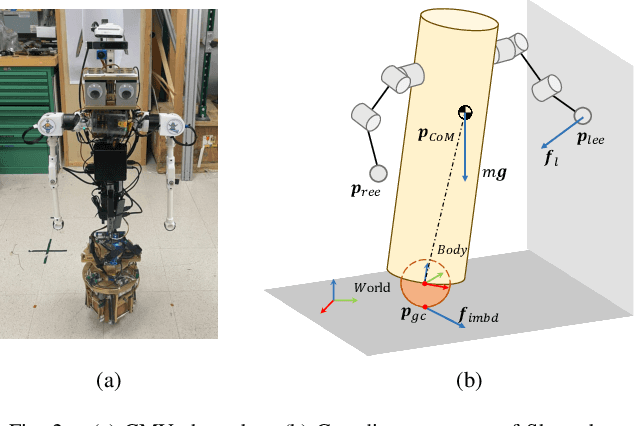
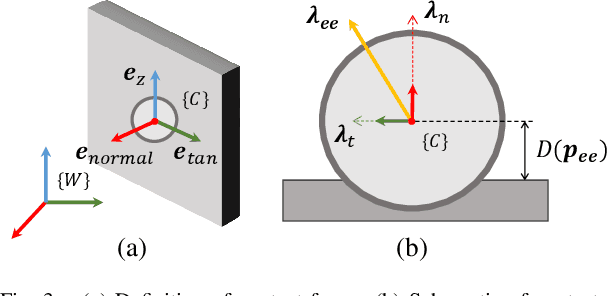
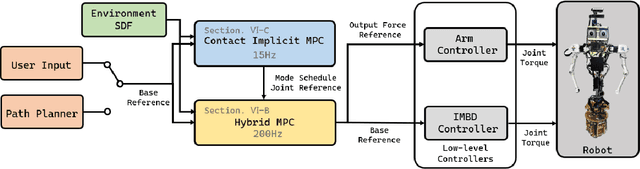
In this work, we introduce a framework that enables highly maneuverable locomotion using non-periodic contacts. This task is challenging for traditional optimization and planning methods to handle due to difficulties in specifying contact mode sequences in real-time. To address this, we use a bi-level contact-implicit planner and hybrid model predictive controller to draft and execute a motion plan. We investigate how this method allows us to plan arm contact events on the shmoobot, a smaller ballbot, which uses an inverse mouse-ball drive to achieve dynamic balancing with a low number of actuators. Through multiple experiments we show how the arms allow for acceleration, deceleration and dynamic obstacle avoidance that are not achievable with the mouse-ball drive alone. This demonstrates how a holistic approach to locomotion can increase the control authority of unique robot morpohologies without additional hardware by leveraging robot arms that are typically used only for manipulation. Project website: https://cmushmoobot.github.io/Wallbounce
Ubiquitous Field Transportation Robots with Robust Wheel-Leg Transformable Modules
Oct 24, 2024

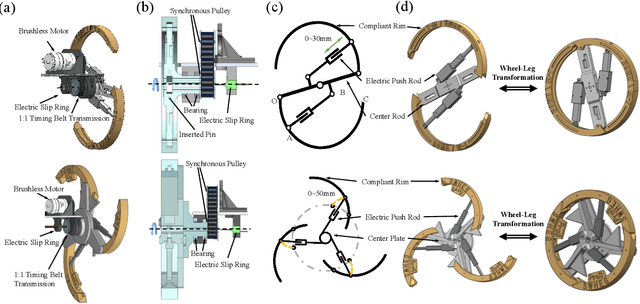

This paper introduces two field transportation robots. Both robots are equipped with transformable wheel-leg modules, which can smoothly switch between operation modes and can work in various challenging terrains. SWhegPro, with six S-shaped legs, enables transporting loads in challenging uneven outdoor terrains. SWhegPro3, featuring four three-impeller wheels, has surprising stair-climbing performance in indoor scenarios. Different from ordinary gear-driven transformable mechanisms, the modular wheels we designed driven by self-locking electric push rods can switch modes accurately and stably with high loads, significantly improving the load capacity of the robot in leg mode. This study analyzes the robot's wheel-leg module operation when the terrain parameters change. Through the derivation of mathematical models and calculations based on simplified kinematic models, a method for optimizing the robot parameters and wheel-leg structure parameters is finally proposed.The design and control strategy are then verified through simulations and field experiments in various complex terrains, and the working performance of the two field transportation robots is calculated and analyzed by recording sensor data and proposing evaluation methods.
Interactive Navigation with Adaptive Non-prehensile Mobile Manipulation
Oct 17, 2024


This paper introduces a framework for interactive navigation through adaptive non-prehensile mobile manipulation. A key challenge in this process is handling objects with unknown dynamics, which are difficult to infer from visual observation. To address this, we propose an adaptive dynamics model for common movable indoor objects via learned SE(2) dynamics representations. This model is integrated into Model Predictive Path Integral (MPPI) control to guide the robot's interactions. Additionally, the learned dynamics help inform decision-making when navigating around objects that cannot be manipulated.Our approach is validated in both simulation and real-world scenarios, demonstrating its ability to accurately represent object dynamics and effectively manipulate various objects. We further highlight its success in the Navigation Among Movable Objects (NAMO) task by deploying the proposed framework on a dynamically balancing mobile robot, Shmoobot. Project website: https://cmushmoobot.github.io/AdaptivePushing/.
Wheelchair Maneuvering with a Single-Spherical-Wheeled Balancing Mobile Manipulator
Apr 19, 2024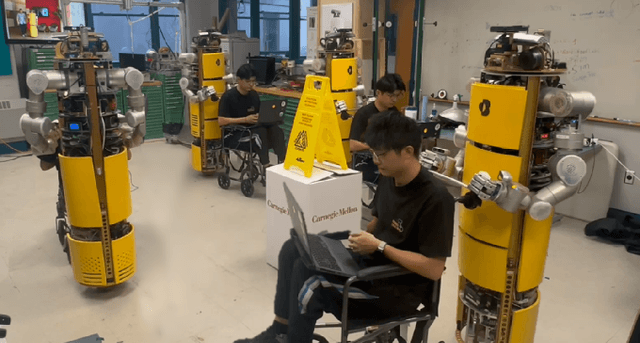
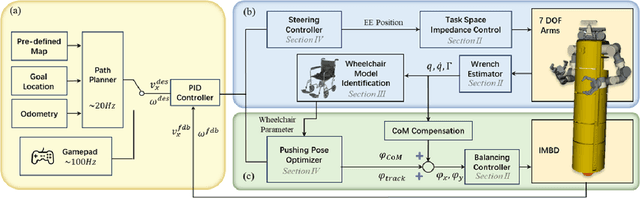
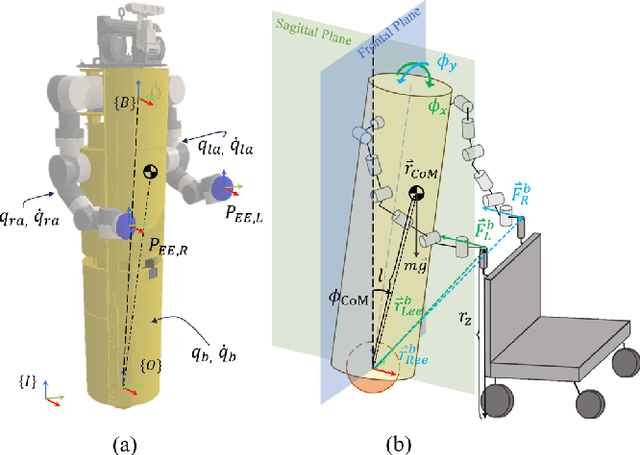
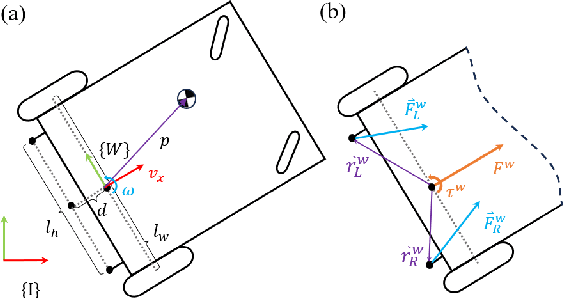
In this work, we present a control framework to effectively maneuver wheelchairs with a dynamically stable mobile manipulator. Wheelchairs are a type of nonholonomic cart system, maneuvering such systems with mobile manipulators (MM) is challenging mostly due to the following reasons: 1) These systems feature nonholonomic constraints and considerably varying inertial parameters that require online identification and adaptation. 2) These systems are widely used in human-centered environments, which demand the MM to operate in potentially crowded spaces while ensuring compliance for safe physical human-robot interaction (pHRI). We propose a control framework that plans whole-body motion based on quasi-static analysis to maneuver heavy nonholonomic carts while maintaining overall compliance. We validated our approach experimentally by maneuvering a wheelchair with a bimanual mobile manipulator, the CMU ballbot. The experiments demonstrate the proposed framework is able to track desired wheelchair velocity with loads varying from 11.8 kg to 79.4 kg at a maximum linear velocity of 0.45 m/s and angular velocity of 0.3 rad/s. Furthermore, we verified that the proposed method can generate human-like motion smoothness of the wheelchair while ensuring safe interactions with the environment.
The state-of-the-art in Cardiac MRI Reconstruction: Results of the CMRxRecon Challenge in MICCAI 2023
Apr 01, 2024

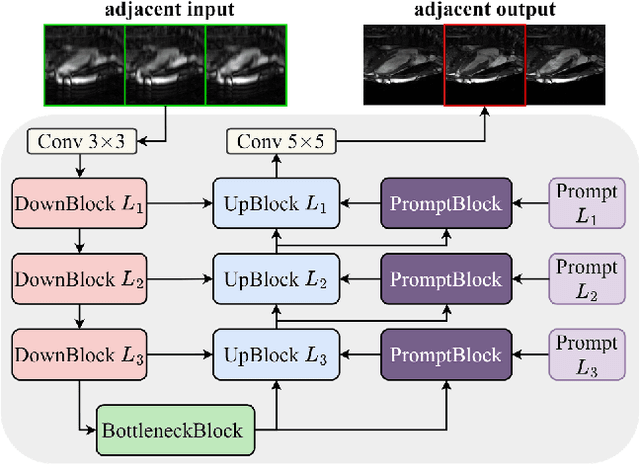

Cardiac MRI, crucial for evaluating heart structure and function, faces limitations like slow imaging and motion artifacts. Undersampling reconstruction, especially data-driven algorithms, has emerged as a promising solution to accelerate scans and enhance imaging performance using highly under-sampled data. Nevertheless, the scarcity of publicly available cardiac k-space datasets and evaluation platform hinder the development of data-driven reconstruction algorithms. To address this issue, we organized the Cardiac MRI Reconstruction Challenge (CMRxRecon) in 2023, in collaboration with the 26th International Conference on MICCAI. CMRxRecon presented an extensive k-space dataset comprising cine and mapping raw data, accompanied by detailed annotations of cardiac anatomical structures. With overwhelming participation, the challenge attracted more than 285 teams and over 600 participants. Among them, 22 teams successfully submitted Docker containers for the testing phase, with 7 teams submitted for both cine and mapping tasks. All teams use deep learning based approaches, indicating that deep learning has predominately become a promising solution for the problem. The first-place winner of both tasks utilizes the E2E-VarNet architecture as backbones. In contrast, U-Net is still the most popular backbone for both multi-coil and single-coil reconstructions. This paper provides a comprehensive overview of the challenge design, presents a summary of the submitted results, reviews the employed methods, and offers an in-depth discussion that aims to inspire future advancements in cardiac MRI reconstruction models. The summary emphasizes the effective strategies observed in Cardiac MRI reconstruction, including backbone architecture, loss function, pre-processing techniques, physical modeling, and model complexity, thereby providing valuable insights for further developments in this field.