 Add to Chrome
 Add to Firefox
 Add to Edge
Interactive Multimodal Fusion with Temporal Modeling
Mar 13, 2025
This paper presents our method for the estimation of valence-arousal (VA) in the 8th Affective Behavior Analysis in-the-Wild (ABAW) competition. Our approach integrates visual and audio information through a multimodal framework. The visual branch uses a pre-trained ResNet model to extract spatial features from facial images. The audio branches employ pre-trained VGG models to extract VGGish and LogMel features from speech signals. These features undergo temporal modeling using Temporal Convolutional Networks (TCNs). We then apply cross-modal attention mechanisms, where visual features interact with audio features through query-key-value attention structures. Finally, the features are concatenated and passed through a regression layer to predict valence and arousal. Our method achieves competitive performance on the Aff-Wild2 dataset, demonstrating effective multimodal fusion for VA estimation in-the-wild.

Recognition-Synergistic Scene Text Editing
Mar 11, 2025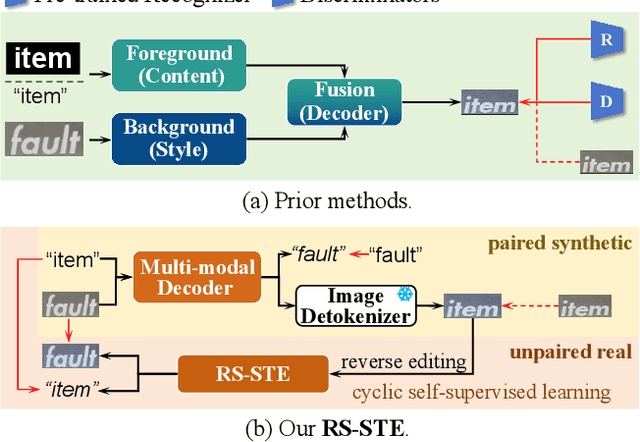
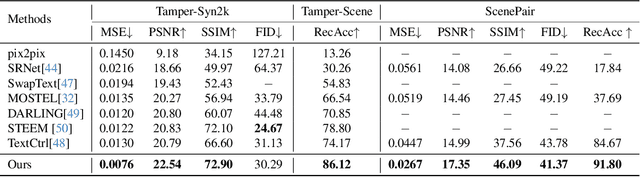
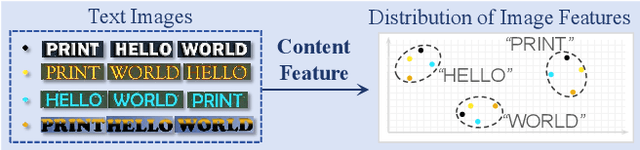
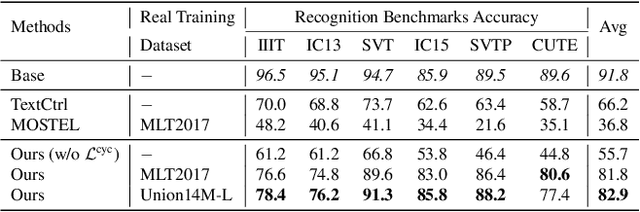
Scene text editing aims to modify text content within scene images while maintaining style consistency. Traditional methods achieve this by explicitly disentangling style and content from the source image and then fusing the style with the target content, while ensuring content consistency using a pre-trained recognition model. Despite notable progress, these methods suffer from complex pipelines, leading to suboptimal performance in complex scenarios. In this work, we introduce Recognition-Synergistic Scene Text Editing (RS-STE), a novel approach that fully exploits the intrinsic synergy of text recognition for editing. Our model seamlessly integrates text recognition with text editing within a unified framework, and leverages the recognition model's ability to implicitly disentangle style and content while ensuring content consistency. Specifically, our approach employs a multi-modal parallel decoder based on transformer architecture, which predicts both text content and stylized images in parallel. Additionally, our cyclic self-supervised fine-tuning strategy enables effective training on unpaired real-world data without ground truth, enhancing style and content consistency through a twice-cyclic generation process. Built on a relatively simple architecture, \mymodel achieves state-of-the-art performance on both synthetic and real-world benchmarks, and further demonstrates the effectiveness of leveraging the generated hard cases to boost the performance of downstream recognition tasks. Code is available at https://github.com/ZhengyaoFang/RS-STE.
ASurvey: Spatiotemporal Consistency in Video Generation
Feb 25, 2025Video generation, by leveraging a dynamic visual generation method, pushes the boundaries of Artificial Intelligence Generated Content (AIGC). Video generation presents unique challenges beyond static image generation, requiring both high-quality individual frames and temporal coherence to maintain consistency across the spatiotemporal sequence. Recent works have aimed at addressing the spatiotemporal consistency issue in video generation, while few literature review has been organized from this perspective. This gap hinders a deeper understanding of the underlying mechanisms for high-quality video generation. In this survey, we systematically review the recent advances in video generation, covering five key aspects: foundation models, information representations, generation schemes, post-processing techniques, and evaluation metrics. We particularly focus on their contributions to maintaining spatiotemporal consistency. Finally, we discuss the future directions and challenges in this field, hoping to inspire further efforts to advance the development of video generation.
Improving Value-based Process Verifier via Structural Prior Injection
Feb 21, 2025In the Large Language Model(LLM) reasoning scenario, people often estimate state value via Monte Carlo sampling. Though Monte Carlo estimation is an elegant method with less inductive bias, noise and errors are inevitably introduced due to the limited sampling. To handle the problem, we inject the structural prior into the value representation and transfer the scalar value into the expectation of a pre-defined categorical distribution, representing the noise and errors from a distribution perspective. Specifically, by treating the result of Monte Carlo sampling as a single sample from the prior ground-truth Binomial distribution, we quantify the sampling error as the mismatch between posterior estimated distribution and ground-truth distribution, which is thus optimized via distribution selection optimization. We test the performance of value-based process verifiers on Best-of-N task and Beam search task. Compared with the scalar value representation, we show that reasonable structural prior injection induced by different objective functions or optimization methods can improve the performance of value-based process verifiers for about 1$\sim$2 points at little-to-no cost. We also show that under different structural prior, the verifiers' performances vary greatly despite having the same optimal solution, indicating the importance of reasonable structural prior injection.
A Similarity Paradigm Through Textual Regularization Without Forgetting
Feb 20, 2025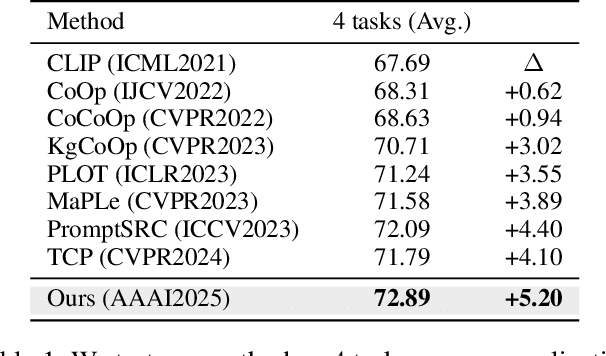
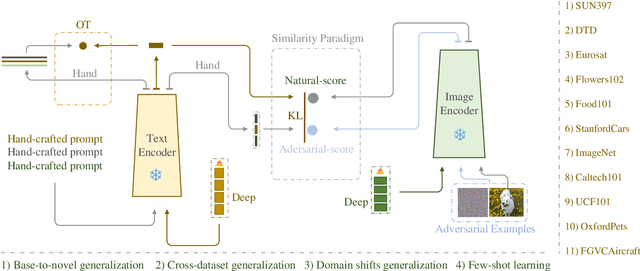
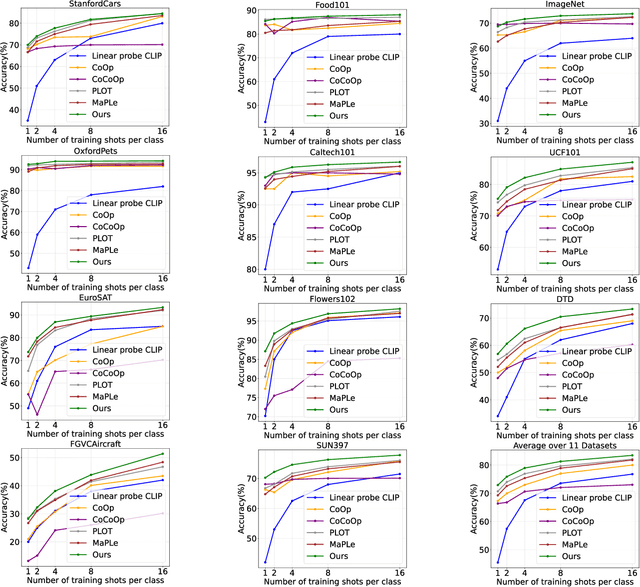
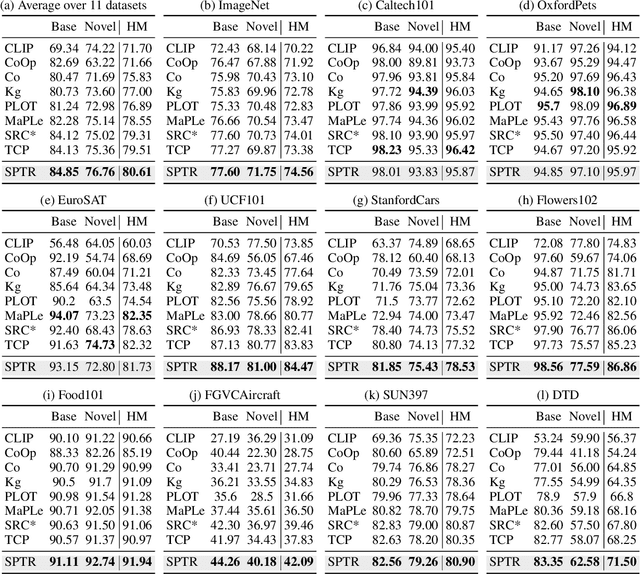
Prompt learning has emerged as a promising method for adapting pre-trained visual-language models (VLMs) to a range of downstream tasks. While optimizing the context can be effective for improving performance on specific tasks, it can often lead to poor generalization performance on unseen classes or datasets sampled from different distributions. It may be attributed to the fact that textual prompts tend to overfit downstream data distributions, leading to the forgetting of generalized knowledge derived from hand-crafted prompts. In this paper, we propose a novel method called Similarity Paradigm with Textual Regularization (SPTR) for prompt learning without forgetting. SPTR is a two-pronged design based on hand-crafted prompts that is an inseparable framework. 1) To avoid forgetting general textual knowledge, we introduce the optimal transport as a textual regularization to finely ensure approximation with hand-crafted features and tuning textual features. 2) In order to continuously unleash the general ability of multiple hand-crafted prompts, we propose a similarity paradigm for natural alignment score and adversarial alignment score to improve model robustness for generalization. Both modules share a common objective in addressing generalization issues, aiming to maximize the generalization capability derived from multiple hand-crafted prompts. Four representative tasks (i.e., non-generalization few-shot learning, base-to-novel generalization, cross-dataset generalization, domain generalization) across 11 datasets demonstrate that SPTR outperforms existing prompt learning methods.
GiGL: Large-Scale Graph Neural Networks at Snapchat
Feb 20, 2025Recent advances in graph machine learning (ML) with the introduction of Graph Neural Networks (GNNs) have led to a widespread interest in applying these approaches to business applications at scale. GNNs enable differentiable end-to-end (E2E) learning of model parameters given graph structure which enables optimization towards popular node, edge (link) and graph-level tasks. While the research innovation in new GNN layers and training strategies has been rapid, industrial adoption and utility of GNNs has lagged considerably due to the unique scale challenges that large-scale graph ML problems create. In this work, we share our approach to training, inference, and utilization of GNNs at Snapchat. To this end, we present GiGL (Gigantic Graph Learning), an open-source library to enable large-scale distributed graph ML to the benefit of researchers, ML engineers, and practitioners. We use GiGL internally at Snapchat to manage the heavy lifting of GNN workflows, including graph data preprocessing from relational DBs, subgraph sampling, distributed training, inference, and orchestration. GiGL is designed to interface cleanly with open-source GNN modeling libraries prominent in academia like PyTorch Geometric (PyG), while handling scaling and productionization challenges that make it easier for internal practitioners to focus on modeling. GiGL is used in multiple production settings, and has powered over 35 launches across multiple business domains in the last 2 years in the contexts of friend recommendation, content recommendation and advertising. This work details high-level design and tools the library provides, scaling properties, case studies in diverse business settings with industry-scale graphs, and several key lessons learned in employing graph ML at scale on large social data. GiGL is open-sourced at https://github.com/snap-research/GiGL.
Towards Text-Image Interleaved Retrieval
Feb 18, 2025Current multimodal information retrieval studies mainly focus on single-image inputs, which limits real-world applications involving multiple images and text-image interleaved content. In this work, we introduce the text-image interleaved retrieval (TIIR) task, where the query and document are interleaved text-image sequences, and the model is required to understand the semantics from the interleaved context for effective retrieval. We construct a TIIR benchmark based on naturally interleaved wikiHow tutorials, where a specific pipeline is designed to generate interleaved queries. To explore the task, we adapt several off-the-shelf retrievers and build a dense baseline by interleaved multimodal large language model (MLLM). We then propose a novel Matryoshka Multimodal Embedder (MME), which compresses the number of visual tokens at different granularity, to address the challenge of excessive visual tokens in MLLM-based TIIR models. Experiments demonstrate that simple adaption of existing models does not consistently yield effective results. Our MME achieves significant improvements over the baseline by substantially fewer visual tokens. We provide extensive analysis and will release the dataset and code to facilitate future research.
Optimizing Preference Alignment with Differentiable NDCG Ranking
Oct 17, 2024Aligning large language models with human preferences improves interaction quality and safety by ensuring outputs better reflect human values. A promising strategy involves Reinforcement Learning from Human Feedback (RLHF), starting with collecting and ranking responses generated by a supervised fine-tuning model to refine alignment. Current methods (DPO) focus on learning from pairwise preference data, categorizing responses into preferred and less preferred pairs, and optimizing by maximizing pairwise margins. Recent studies have uncovered a substantial discrepancy between the theoretical aspirations of preference learning and its real-world results. Current preference alignment techniques underperform expectations, with ranking accuracies below $60\%$ on standard datasets. This suggests existing methods inadequately capture ideal preference relationships within sequences. To address this challenge, this paper introduces \underline{D}irect \underline{R}anking \underline{P}reference \underline{O}ptimization (DRPO), a novel method that views human preference alignment as a Learning-to-Rank (LTR) task. DRPO leverages NDCG, a widely used LTR metric, to optimize the ranking of responses within lists based on preference data, thereby enhancing ranking accuracies. Due to the nondifferentiability of NDCG, we propose diffNDCG loss, a differentiable approximation facilitated by a sorting network to simulate NDCG. Furthermore, to improve the quality of generated response, we propose a novel margin-based Adaptive Rank Policy Score. Extensive experiments have shown that DRPO outperforms existing baseline methods, enhancing the quality of the generated responses.
Prompting Video-Language Foundation Models with Domain-specific Fine-grained Heuristics for Video Question Answering
Oct 12, 2024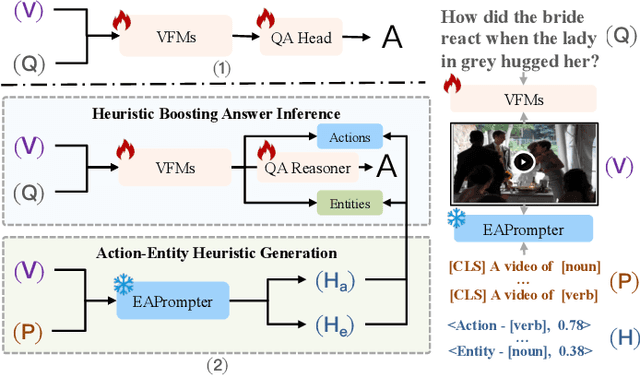
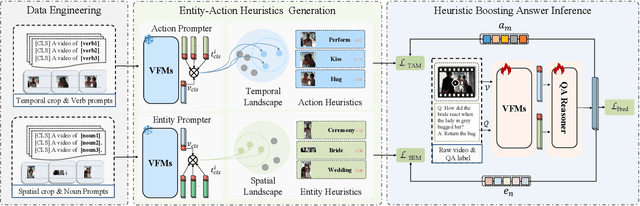
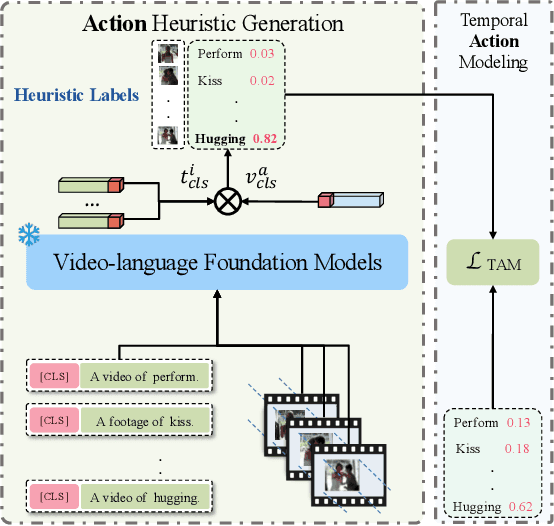
Video Question Answering (VideoQA) represents a crucial intersection between video understanding and language processing, requiring both discriminative unimodal comprehension and sophisticated cross-modal interaction for accurate inference. Despite advancements in multi-modal pre-trained models and video-language foundation models, these systems often struggle with domain-specific VideoQA due to their generalized pre-training objectives. Addressing this gap necessitates bridging the divide between broad cross-modal knowledge and the specific inference demands of VideoQA tasks. To this end, we introduce HeurVidQA, a framework that leverages domain-specific entity-action heuristics to refine pre-trained video-language foundation models. Our approach treats these models as implicit knowledge engines, employing domain-specific entity-action prompters to direct the model's focus toward precise cues that enhance reasoning. By delivering fine-grained heuristics, we improve the model's ability to identify and interpret key entities and actions, thereby enhancing its reasoning capabilities. Extensive evaluations across multiple VideoQA datasets demonstrate that our method significantly outperforms existing models, underscoring the importance of integrating domain-specific knowledge into video-language models for more accurate and context-aware VideoQA.
* IEEE Transactions on Circuits and Systems for Video Technology
Multi-granularity Contrastive Cross-modal Collaborative Generation for End-to-End Long-term Video Question Answering
Oct 12, 2024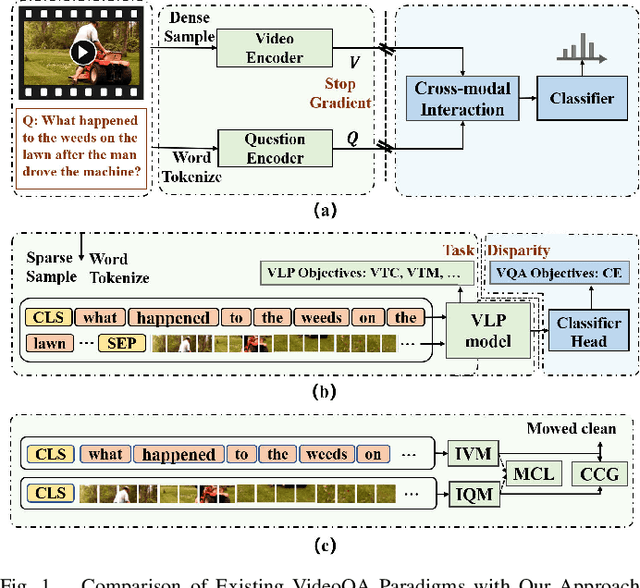
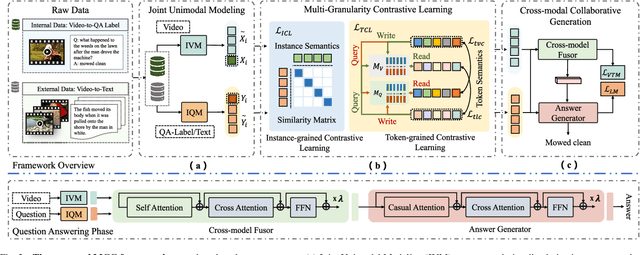
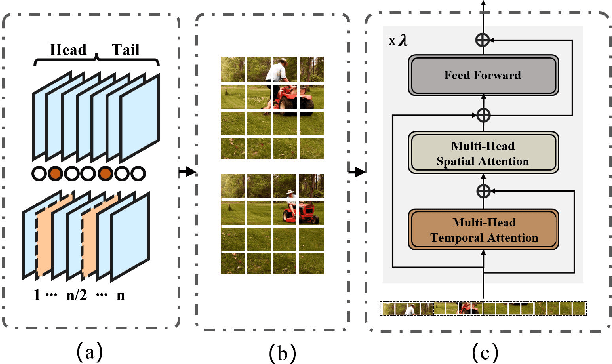
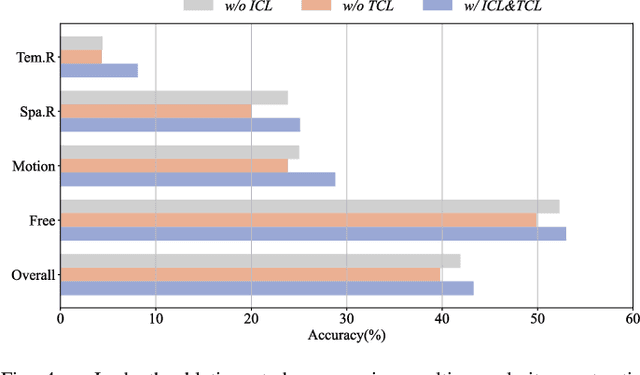
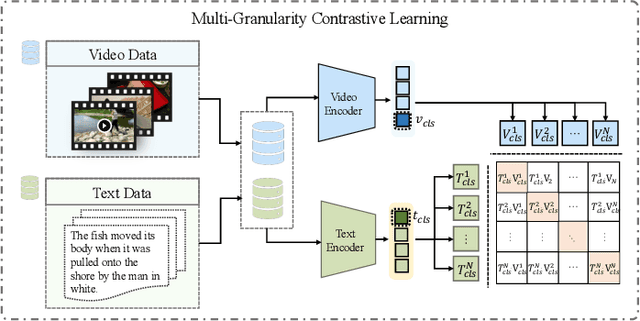
Long-term Video Question Answering (VideoQA) is a challenging vision-and-language bridging task focusing on semantic understanding of untrimmed long-term videos and diverse free-form questions, simultaneously emphasizing comprehensive cross-modal reasoning to yield precise answers. The canonical approaches often rely on off-the-shelf feature extractors to detour the expensive computation overhead, but often result in domain-independent modality-unrelated representations. Furthermore, the inherent gradient blocking between unimodal comprehension and cross-modal interaction hinders reliable answer generation. In contrast, recent emerging successful video-language pre-training models enable cost-effective end-to-end modeling but fall short in domain-specific ratiocination and exhibit disparities in task formulation. Toward this end, we present an entirely end-to-end solution for long-term VideoQA: Multi-granularity Contrastive cross-modal collaborative Generation (MCG) model. To derive discriminative representations possessing high visual concepts, we introduce Joint Unimodal Modeling (JUM) on a clip-bone architecture and leverage Multi-granularity Contrastive Learning (MCL) to harness the intrinsically or explicitly exhibited semantic correspondences. To alleviate the task formulation discrepancy problem, we propose a Cross-modal Collaborative Generation (CCG) module to reformulate VideoQA as a generative task instead of the conventional classification scheme, empowering the model with the capability for cross-modal high-semantic fusion and generation so as to rationalize and answer. Extensive experiments conducted on six publicly available VideoQA datasets underscore the superiority of our proposed method.
* Transactions on Image Processing