 Add to Chrome
 Add to Firefox
 Add to Edge
DyG$^2$T: Modeling Object Dynamics with 3D Gaussian Temporal-Spatial Particle Graph Transformer
Aug 19, 2026
Modeling object dynamics from limited visual observations is a fundamental problem for enabling accurate motion trajectory prediction in embodied interaction scenarios. Existing dynamics modeling methods first compress reconstructed particle representations into sparse Key Points and model their evolution using locally constrained interactions, thereby discarding fine-grained local details and obscuring discriminative interaction modeling across spatial and temporal scales, leading to drifting trajectories and inaccurate appearance prediction. To tackle these issues, we propose DyG$^2$T, a dynamics modeling framework that infers object motion trajectories by spatially completing and temporally discriminating Key Point representations and modeling multi-scale interaction over particle graphs. Spatially, DyG$^2$T enriches each Key Point by aggregating neighboring raw particle positions to recover fine-grained local details, while explicitly encoding relative offsets among Key Points to enhance geometric structure perception. Temporally, we introduce a Temporal Disentangling Network (TDN) to identify dominant cross-frame variations in latent space and amplify inter-frame differences, yielding temporally discriminative representations that are subsequently aggregated via Temporal Attention to capture frame-wise temporal evolution cues. For comprehensive interaction modeling, a Particle Graph Transformer leverages global attention to preserve discriminative long-range dependencies among Key Points, mitigating representation homogenization induced by locality-constrained modeling and providing a robust basis for accurate trajectory prediction. Experiments on both synthetic and real-world datasets demonstrate that DyG$^2$T achieves accurate dynamics modeling and reasoning, and exhibits strong cross-object and real-world generalization.

OBBSeg: Irregular Lesion Segmentation under Oriented Bounding Box Annotations
Jul 07, 2026Pixel-level annotation remains a major bottleneck in medical image segmentation, making weak supervision an attractive yet under-constrained alternative. We propose OBBSeg, an intermediate supervision paradigm guided by Oriented Bounding Boxes (OBBs) that bridges the gap between full and weak supervision. By jointly encoding spatial extent and orientation, OBBs provide compact geometric supervision that better aligns with elongated or anisotropic lesions, reducing the ambiguity of coarse box annotations. To mitigate the inherent rectangular bias of OBBs, we introduce a Mask-to-OBB loss, a differentiable formulation that enforces geometric consistency between predicted masks and OBB regions. Furthermore, we incorporate prompt-driven semantic guidance through two complementary modules-PAFE and DBFE-which enhance foreground representation and suppress background interference. Extensive experiments on 13 datasets across 5 imaging modalities show that OBBSeg not only outperforms existing weakly supervised methods but also achieves performance comparable to fully supervised approaches, demonstrating its potential for efficient and scalable medical image segmentation. The code is available at https://github.com/StarLxc3/OBBSeg.
When LLMs Develop Languages: Symbolic Communication for Efficient Multi-Agent Reasoning
Jun 28, 2026Chain-of-Thought (CoT) improves large language models (LLMs) on difficult reasoning tasks, but it often incurs long natural-language rationales that are poorly aligned with efficient machine reasoning. We propose Communicative Language Symbolism Routing (CLSR), a test-time framework in which multiple LLM agents autonomously invent, evolve, and share compact Language Symbolism Frameworks (LSFs), while a latent-free router adaptively selects and composes these languages per query to optimize the accuracy-token trade-off. Unlike prompt optimization that refines surface instructions, CLSR treats each LSF as a reusable symbolic protocol with compact symbols, usage rules, and a message-passing contract, and improves it through an evolutionary loop driven by correctness and token cost. At inference time, the router may invoke a single low-cost LSF call, ensemble multiple LSFs, or execute a multi-round LSF composition protocol on harder queries. Across challenging benchmarks, CLSR reduces latency-oriented generated token completion by $3\sim 6\times$ compared to standard CoT while maintaining accuracy. We further derive an information-theoretic lower bound on token cost under arbitrary symbolism and show that, under an interpreter-realizability premise, multi-round LSF protocols conditionally subsume program-execution pipelines. Code is publicly available (https://github.com/pzqpzq/LSF_MDia).
ActiveScope: Actively Seeking and Correcting Perception for MLLMs
Jun 23, 2026Multimodal Large Language Models (MLLMs) have demonstrated impressive vision-language understanding, yet still struggle with fine-grained perception in high-resolution images. While existing training-free methods typically rely on attention-based localization or coarse-to-fine search, they are often misled by distractors and fail to locate multiple targets. Our investigation attributes these failures to Contextual Dominance, where salient distractors overwhelm target attention and cause inaccurate localization, and Semantic Bias, where global semantics cause the model to fixate on the most salient concept, resulting in incomplete localization in multi-object scenarios. Built on these insights, we propose ActiveScope, a training-free framework that enhances MLLMs by actively seeking and correcting perception. ActiveScope features two modules. The Semantic Anchor Localization (SAL) utilizes fine-grained semantic anchors to independently localize key targets, thereby mitigating semantic bias. The Interference-Suppressed Refinement (ISR) refines localization by suppressing attention on salient distractions to overcome contextual dominance. Extensive experiments on high-resolution image understanding benchmarks demonstrate that ActiveScope outperforms existing training-free methods (e.g., 96.34 percent accuracy on $V^{*}$ Bench), validating the superiority of the active search and self-correction paradigm. Our code is available at https://github.com/jasmine-ww/ActiveScope.
Adaptive Recurrent Message Passing for Test Time Computing on Graphs
Jun 21, 2026Pre-trained foundation models have demonstrated remarkable success in many domains, enabling a unified backbone to generalize across diverse downstream tasks. However, extending this paradigm to graph learning remains challenging due to the intrinsic mismatch between graph data and fixed architectural designs. In this work, we show that this limitation can be overcome via recurrent graph models. To achieve this, we conduct a systematic theoretical analysis, rigorously deriving step dependence as a necessary and sufficient condition for an adaptively convergent recurrent process. Building on this foundation, we propose AdaR, an Adaptive Recurrent graph model, empowering flexible test-time computing on various downstream tasks without changing model parameters. To enable adaptive inference, AdaR explicitly encodes normalized step information and representation-target relations into the recurrent updates. To ensure convergence of the recurrent process, AdaR employs gradient-based supervision signals that guide representation updates throughout the recurrence. Empirical results demonstrate that AdaR consistently outperforms strong baselines in both inductive and transductive settings.
Enhancing LLMs for Graph Tasks via Graph-aware LoRA Generation
Jun 21, 2026Graph neural networks (GNNs) tightly couple their input-output parameters to dataset-specific feature spaces and target sets, exhibiting limited transferability across different datasets. In contrast, language models (LMs) generalize flexibly via a unified input-output interface, motivating recent attempts to adapt LMs to graph tasks. However, existing methods struggle to encode whole-graph information, leading to potential information loss and suboptimal graph understanding. In this work, we propose a novel weight-level information injection paradigm for adapting LMs to graph tasks. This paradigm injects whole-graph information by generating task-specific weight updates that interact directly with hidden representations. Instantiating this paradigm following low-rank adaptation (LoRA), we introduce GaRA, a Graph-aware LoRA generation model. GaRA constructs low-rank weight updates conditioned on the original graph structures and constrains the norm of the generated updates, thus injecting whole-graph information and avoiding the optimization bias in the weight generation. Empirical studies demonstrate that GaRA consistently outperforms baselines on zero-shot graph learning tasks.
Locate-then-Sparsify: Attribution Guided Sparse Strategy for Visual Hallucination Mitigation
Mar 17, 2026Despite the significant advancements in Large Vision-Language Models (LVLMs), their tendency to generate hallucinations undermines reliability and restricts broader practical deployment. Among the hallucination mitigation methods, feature steering emerges as a promising approach that reduces erroneous outputs in LVLMs without increasing inference costs. However, current methods apply uniform feature steering across all layers. This heuristic strategy ignores inter-layer differences, potentially disrupting layers unrelated to hallucinations and ultimately leading to performance degradation on general tasks. In this paper, we propose a plug-and-play framework called Locate-Then-Sparsify for Feature Steering (LTS-FS), which controls the steering intensity according to the hallucination relevance of each layer. We first construct a synthetic dataset comprising token-level and sentence-level hallucination cases. Based on this dataset, we introduce an attribution method based on causal interventions to quantify the hallucination relevance of each layer. With the attribution scores across layers, we propose a layerwise strategy that converts these scores into feature steering intensities for individual layers, enabling more precise adjustments specifically on hallucination-relevant layers. Extensive experiments across multiple LVLMs and benchmarks demonstrate that our LTS-FS framework effectively mitigates hallucination while preserving strong performance.
Divide-and-Conquer: Tree-structured Strategy with Answer Distribution Estimator for Goal-Oriented Visual Dialogue
Feb 09, 2025Goal-oriented visual dialogue involves multi-round interaction between artificial agents, which has been of remarkable attention due to its wide applications. Given a visual scene, this task occurs when a Questioner asks an action-oriented question and an Answerer responds with the intent of letting the Questioner know the correct action to take. The quality of questions affects the accuracy and efficiency of the target search progress. However, existing methods lack a clear strategy to guide the generation of questions, resulting in the randomness in the search process and inconvergent results. We propose a Tree-Structured Strategy with Answer Distribution Estimator (TSADE) which guides the question generation by excluding half of the current candidate objects in each round. The above process is implemented by maximizing a binary reward inspired by the ``divide-and-conquer'' paradigm. We further design a candidate-minimization reward which encourages the model to narrow down the scope of candidate objects toward the end of the dialogue. We experimentally demonstrate that our method can enable the agents to achieve high task-oriented accuracy with fewer repeating questions and rounds compared to traditional ergodic question generation approaches. Qualitative results further show that TSADE facilitates agents to generate higher-quality questions.
Expanding Sparse Tuning for Low Memory Usage
Nov 04, 2024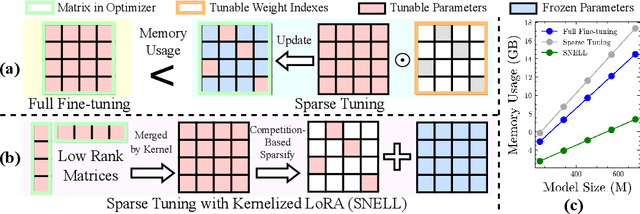

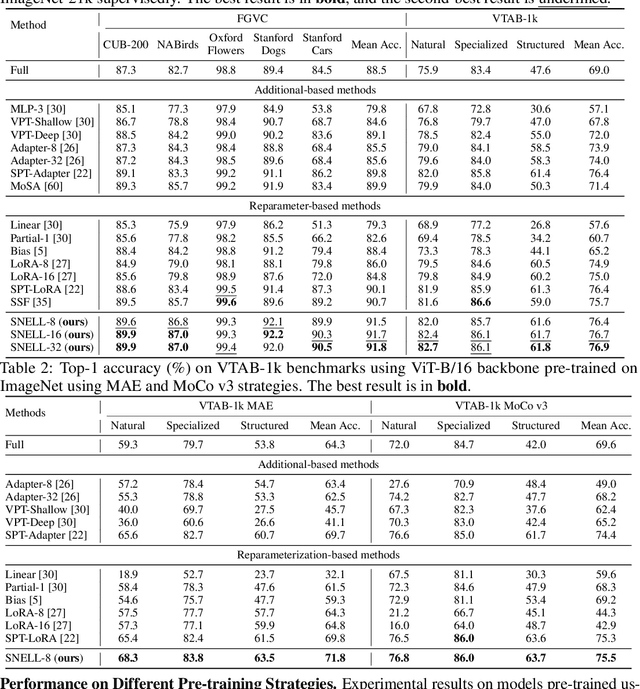
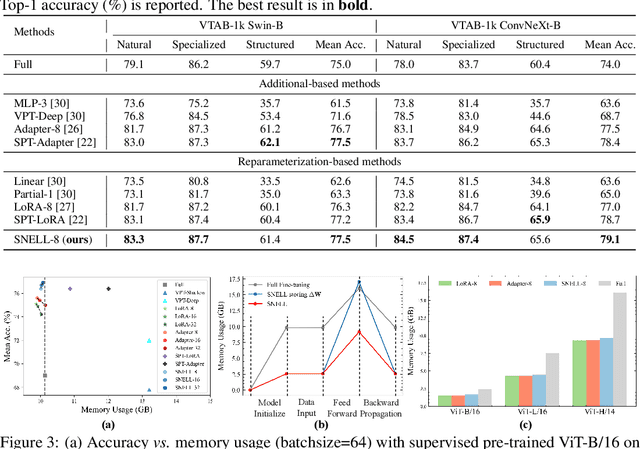
Parameter-efficient fine-tuning (PEFT) is an effective method for adapting pre-trained vision models to downstream tasks by tuning a small subset of parameters. Among PEFT methods, sparse tuning achieves superior performance by only adjusting the weights most relevant to downstream tasks, rather than densely tuning the whole weight matrix. However, this performance improvement has been accompanied by increases in memory usage, which stems from two factors, i.e., the storage of the whole weight matrix as learnable parameters in the optimizer and the additional storage of tunable weight indexes. In this paper, we propose a method named SNELL (Sparse tuning with kerNELized LoRA) for sparse tuning with low memory usage. To achieve low memory usage, SNELL decomposes the tunable matrix for sparsification into two learnable low-rank matrices, saving from the costly storage of the whole original matrix. A competition-based sparsification mechanism is further proposed to avoid the storage of tunable weight indexes. To maintain the effectiveness of sparse tuning with low-rank matrices, we extend the low-rank decomposition by applying nonlinear kernel functions to the whole-matrix merging. Consequently, we gain an increase in the rank of the merged matrix, enhancing the ability of SNELL in adapting the pre-trained models to downstream tasks. Extensive experiments on multiple downstream tasks show that SNELL achieves state-of-the-art performance with low memory usage, endowing PEFT with sparse tuning to large-scale models. Codes are available at https://github.com/ssfgunner/SNELL.
Towards Dynamic Message Passing on Graphs
Oct 31, 2024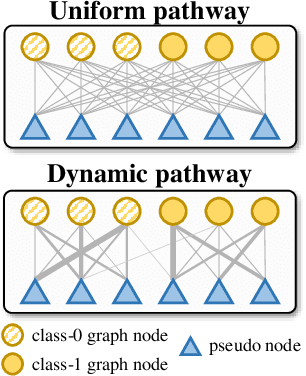
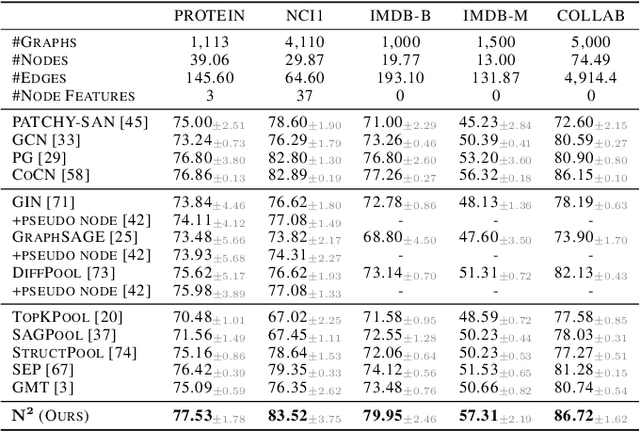
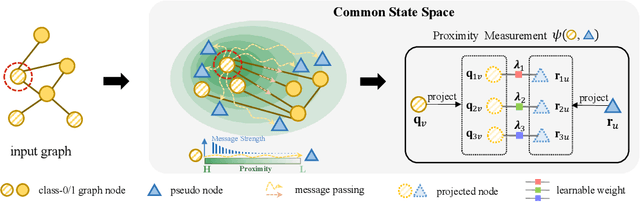
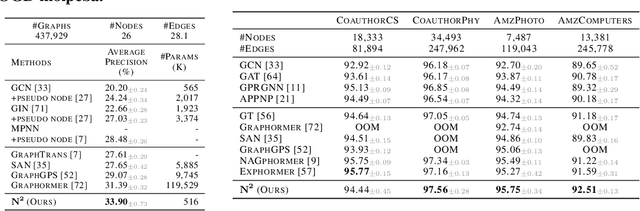
Message passing plays a vital role in graph neural networks (GNNs) for effective feature learning. However, the over-reliance on input topology diminishes the efficacy of message passing and restricts the ability of GNNs. Despite efforts to mitigate the reliance, existing study encounters message-passing bottlenecks or high computational expense problems, which invokes the demands for flexible message passing with low complexity. In this paper, we propose a novel dynamic message-passing mechanism for GNNs. It projects graph nodes and learnable pseudo nodes into a common space with measurable spatial relations between them. With nodes moving in the space, their evolving relations facilitate flexible pathway construction for a dynamic message-passing process. Associating pseudo nodes to input graphs with their measured relations, graph nodes can communicate with each other intermediately through pseudo nodes under linear complexity. We further develop a GNN model named $\mathtt{\mathbf{N^2}}$ based on our dynamic message-passing mechanism. $\mathtt{\mathbf{N^2}}$ employs a single recurrent layer to recursively generate the displacements of nodes and construct optimal dynamic pathways. Evaluation on eighteen benchmarks demonstrates the superior performance of $\mathtt{\mathbf{N^2}}$ over popular GNNs. $\mathtt{\mathbf{N^2}}$ successfully scales to large-scale benchmarks and requires significantly fewer parameters for graph classification with the shared recurrent layer.