 Add to Chrome
 Add to Firefox
 Add to Edge
Qwen3 Technical Report
May 14, 2025
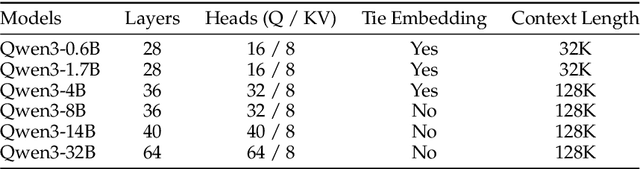
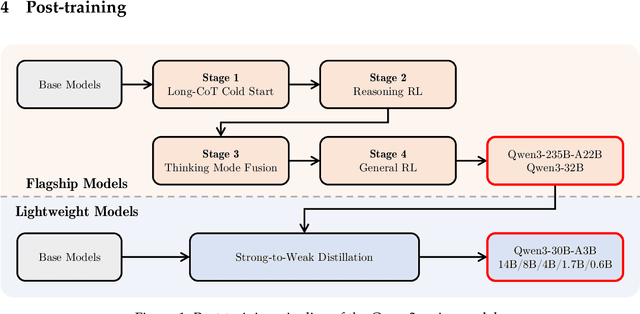

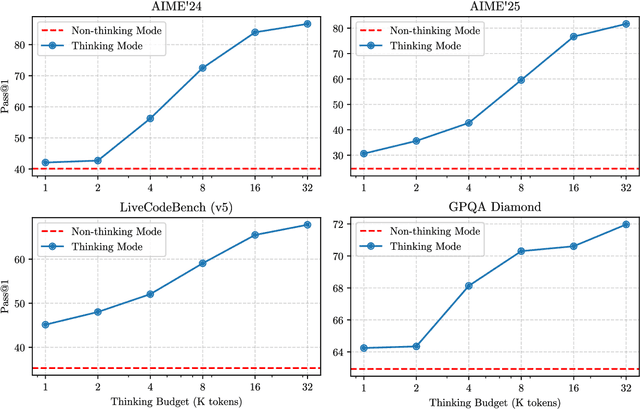
In this work, we present Qwen3, the latest version of the Qwen model family. Qwen3 comprises a series of large language models (LLMs) designed to advance performance, efficiency, and multilingual capabilities. The Qwen3 series includes models of both dense and Mixture-of-Expert (MoE) architectures, with parameter scales ranging from 0.6 to 235 billion. A key innovation in Qwen3 is the integration of thinking mode (for complex, multi-step reasoning) and non-thinking mode (for rapid, context-driven responses) into a unified framework. This eliminates the need to switch between different models--such as chat-optimized models (e.g., GPT-4o) and dedicated reasoning models (e.g., QwQ-32B)--and enables dynamic mode switching based on user queries or chat templates. Meanwhile, Qwen3 introduces a thinking budget mechanism, allowing users to allocate computational resources adaptively during inference, thereby balancing latency and performance based on task complexity. Moreover, by leveraging the knowledge from the flagship models, we significantly reduce the computational resources required to build smaller-scale models, while ensuring their highly competitive performance. Empirical evaluations demonstrate that Qwen3 achieves state-of-the-art results across diverse benchmarks, including tasks in code generation, mathematical reasoning, agent tasks, etc., competitive against larger MoE models and proprietary models. Compared to its predecessor Qwen2.5, Qwen3 expands multilingual support from 29 to 119 languages and dialects, enhancing global accessibility through improved cross-lingual understanding and generation capabilities. To facilitate reproducibility and community-driven research and development, all Qwen3 models are publicly accessible under Apache 2.0.

Gated Attention for Large Language Models: Non-linearity, Sparsity, and Attention-Sink-Free
May 10, 2025Gating mechanisms have been widely utilized, from early models like LSTMs and Highway Networks to recent state space models, linear attention, and also softmax attention. Yet, existing literature rarely examines the specific effects of gating. In this work, we conduct comprehensive experiments to systematically investigate gating-augmented softmax attention variants. Specifically, we perform a comprehensive comparison over 30 variants of 15B Mixture-of-Experts (MoE) models and 1.7B dense models trained on a 3.5 trillion token dataset. Our central finding is that a simple modification-applying a head-specific sigmoid gate after the Scaled Dot-Product Attention (SDPA)-consistently improves performance. This modification also enhances training stability, tolerates larger learning rates, and improves scaling properties. By comparing various gating positions and computational variants, we attribute this effectiveness to two key factors: (1) introducing non-linearity upon the low-rank mapping in the softmax attention, and (2) applying query-dependent sparse gating scores to modulate the SDPA output. Notably, we find this sparse gating mechanism mitigates 'attention sink' and enhances long-context extrapolation performance, and we also release related $\href{https://github.com/qiuzh20/gated_attention}{codes}$ and $\href{https://huggingface.co/QwQZh/gated_attention}{models}$ to facilitate future research.
PolyMath: Evaluating Mathematical Reasoning in Multilingual Contexts
Apr 30, 2025In this paper, we introduce PolyMath, a multilingual mathematical reasoning benchmark covering 18 languages and 4 easy-to-hard difficulty levels. Our benchmark ensures difficulty comprehensiveness, language diversity, and high-quality translation, making it a highly discriminative multilingual mathematical benchmark in the era of reasoning LLMs. We conduct a comprehensive evaluation for advanced LLMs and find that even Qwen-3-235B-A22B-Thinking and Gemini-2.5-pro, achieve only 54.6 and 52.2 benchmark scores, with about 40% accuracy under the highest level From a language perspective, our benchmark reveals several key challenges of LLMs in multilingual reasoning: (1) Reasoning performance varies widely across languages for current LLMs; (2) Input-output language consistency is low in reasoning LLMs and may be correlated with performance; (3) The thinking length differs significantly by language for current LLMs. Additionally, we demonstrate that controlling the output language in the instructions has the potential to affect reasoning performance, especially for some low-resource languages, suggesting a promising direction for improving multilingual capabilities in LLMs.
Tree-based Models for Vertical Federated Learning: A Survey
Apr 03, 2025Tree-based models have achieved great success in a wide range of real-world applications due to their effectiveness, robustness, and interpretability, which inspired people to apply them in vertical federated learning (VFL) scenarios in recent years. In this paper, we conduct a comprehensive study to give an overall picture of applying tree-based models in VFL, from the perspective of their communication and computation protocols. We categorize tree-based models in VFL into two types, i.e., feature-gathering models and label-scattering models, and provide a detailed discussion regarding their characteristics, advantages, privacy protection mechanisms, and applications. This study also focuses on the implementation of tree-based models in VFL, summarizing several design principles for better satisfying various requirements from both academic research and industrial deployment. We conduct a series of experiments to provide empirical observations on the differences and advances of different types of tree-based models.
Wan: Open and Advanced Large-Scale Video Generative Models
Mar 26, 2025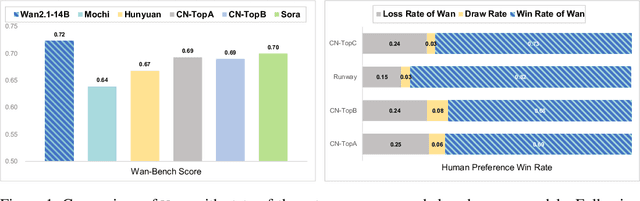
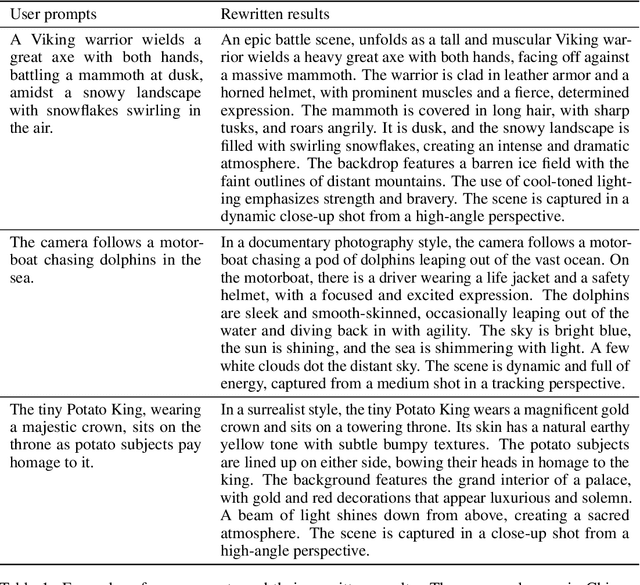

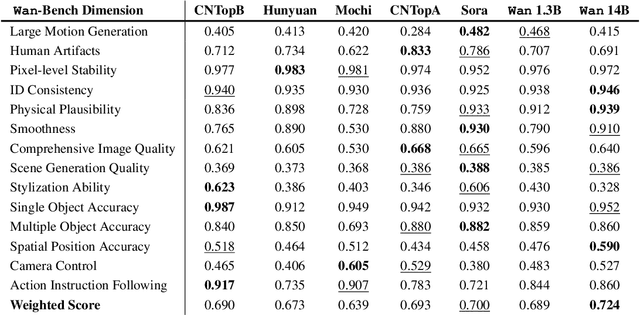
This report presents Wan, a comprehensive and open suite of video foundation models designed to push the boundaries of video generation. Built upon the mainstream diffusion transformer paradigm, Wan achieves significant advancements in generative capabilities through a series of innovations, including our novel VAE, scalable pre-training strategies, large-scale data curation, and automated evaluation metrics. These contributions collectively enhance the model's performance and versatility. Specifically, Wan is characterized by four key features: Leading Performance: The 14B model of Wan, trained on a vast dataset comprising billions of images and videos, demonstrates the scaling laws of video generation with respect to both data and model size. It consistently outperforms the existing open-source models as well as state-of-the-art commercial solutions across multiple internal and external benchmarks, demonstrating a clear and significant performance superiority. Comprehensiveness: Wan offers two capable models, i.e., 1.3B and 14B parameters, for efficiency and effectiveness respectively. It also covers multiple downstream applications, including image-to-video, instruction-guided video editing, and personal video generation, encompassing up to eight tasks. Consumer-Grade Efficiency: The 1.3B model demonstrates exceptional resource efficiency, requiring only 8.19 GB VRAM, making it compatible with a wide range of consumer-grade GPUs. Openness: We open-source the entire series of Wan, including source code and all models, with the goal of fostering the growth of the video generation community. This openness seeks to significantly expand the creative possibilities of video production in the industry and provide academia with high-quality video foundation models. All the code and models are available at https://github.com/Wan-Video/Wan2.1.
Qwen2.5-1M Technical Report
Jan 26, 2025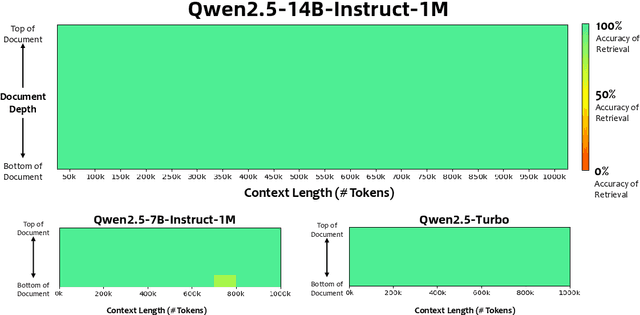

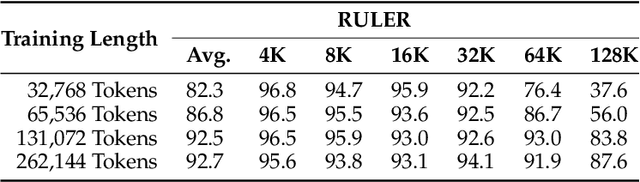
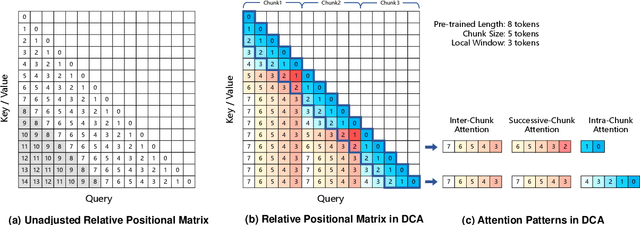
We introduce Qwen2.5-1M, a series of models that extend the context length to 1 million tokens. Compared to the previous 128K version, the Qwen2.5-1M series have significantly enhanced long-context capabilities through long-context pre-training and post-training. Key techniques such as long data synthesis, progressive pre-training, and multi-stage supervised fine-tuning are employed to effectively enhance long-context performance while reducing training costs. To promote the use of long-context models among a broader user base, we present and open-source our inference framework. This framework includes a length extrapolation method that can expand the model context lengths by at least four times, or even more, without additional training. To reduce inference costs, we implement a sparse attention method along with chunked prefill optimization for deployment scenarios and a sparsity refinement method to improve precision. Additionally, we detail our optimizations in the inference engine, including kernel optimization, pipeline parallelism, and scheduling optimization, which significantly enhance overall inference performance. By leveraging our inference framework, the Qwen2.5-1M models achieve a remarkable 3x to 7x prefill speedup in scenarios with 1 million tokens of context. This framework provides an efficient and powerful solution for developing applications that require long-context processing using open-source models. The Qwen2.5-1M series currently includes the open-source models Qwen2.5-7B-Instruct-1M and Qwen2.5-14B-Instruct-1M, as well as the API-accessed model Qwen2.5-Turbo. Evaluations show that Qwen2.5-1M models have been greatly improved in long-context tasks without compromising performance in short-context scenarios. Specifically, the Qwen2.5-14B-Instruct-1M model significantly outperforms GPT-4o-mini in long-context tasks and supports contexts eight times longer.
Demons in the Detail: On Implementing Load Balancing Loss for Training Specialized Mixture-of-Expert Models
Jan 21, 2025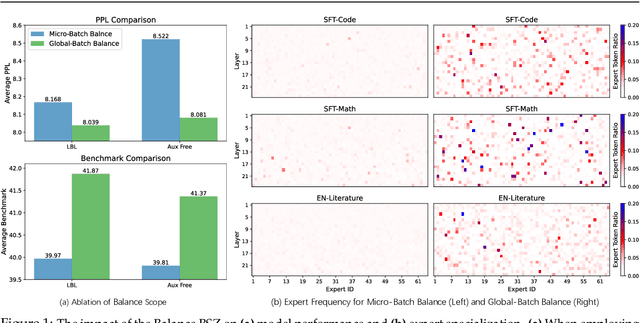
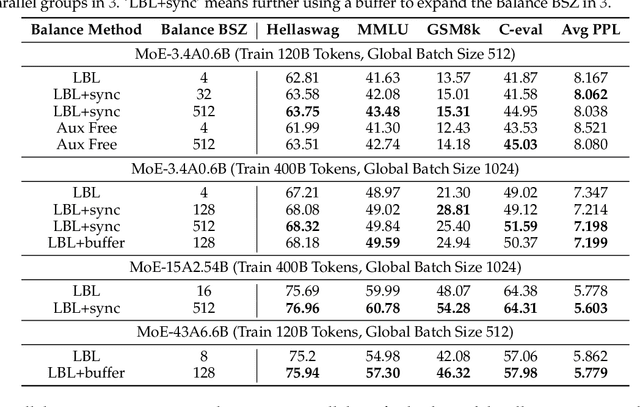
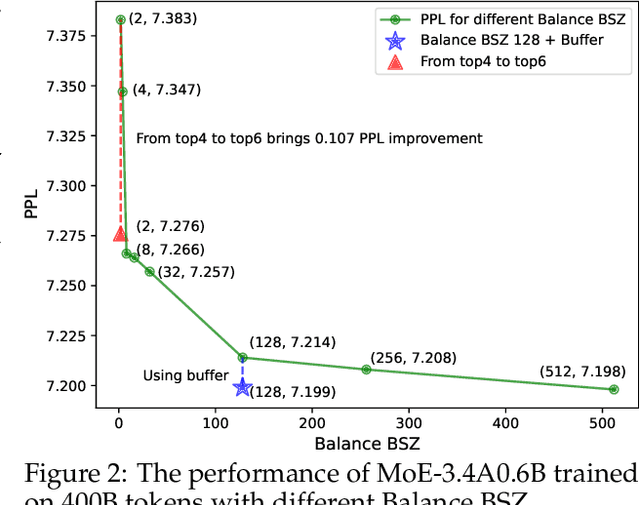

This paper revisits the implementation of $\textbf{L}$oad-$\textbf{b}$alancing $\textbf{L}$oss (LBL) when training Mixture-of-Experts (MoEs) models. Specifically, LBL for MoEs is defined as $N_E \sum_{i=1}^{N_E} f_i p_i$, where $N_E$ is the total number of experts, $f_i$ represents the frequency of expert $i$ being selected, and $p_i$ denotes the average gating score of the expert $i$. Existing MoE training frameworks usually employ the parallel training strategy so that $f_i$ and the LBL are calculated within a $\textbf{micro-batch}$ and then averaged across parallel groups. In essence, a micro-batch for training billion-scale LLMs normally contains very few sequences. So, the micro-batch LBL is almost at the sequence level, and the router is pushed to distribute the token evenly within each sequence. Under this strict constraint, even tokens from a domain-specific sequence ($\textit{e.g.}$, code) are uniformly routed to all experts, thereby inhibiting expert specialization. In this work, we propose calculating LBL using a $\textbf{global-batch}$ to loose this constraint. Because a global-batch contains much more diverse sequences than a micro-batch, which will encourage load balance at the corpus level. Specifically, we introduce an extra communication step to synchronize $f_i$ across micro-batches and then use it to calculate the LBL. Through experiments on training MoEs-based LLMs (up to $\textbf{42.8B}$ total parameters and $\textbf{400B}$ tokens), we surprisingly find that the global-batch LBL strategy yields excellent performance gains in both pre-training perplexity and downstream tasks. Our analysis reveals that the global-batch LBL also greatly improves the domain specialization of MoE experts.
Towards Robust and Realistic Human Pose Estimation via WiFi Signals
Jan 16, 2025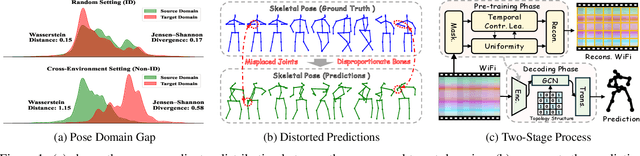
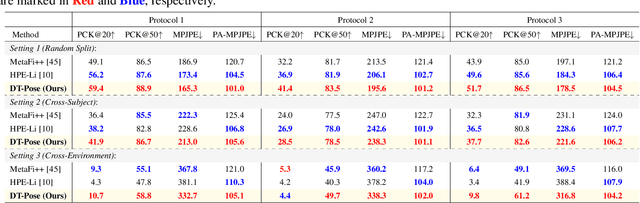
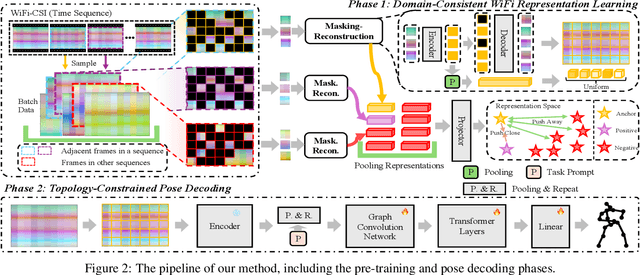
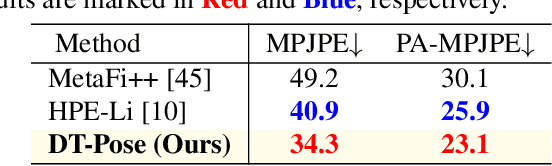
Robust WiFi-based human pose estimation is a challenging task that bridges discrete and subtle WiFi signals to human skeletons. This paper revisits this problem and reveals two critical yet overlooked issues: 1) cross-domain gap, i.e., due to significant variations between source-target domain pose distributions; and 2) structural fidelity gap, i.e., predicted skeletal poses manifest distorted topology, usually with misplaced joints and disproportionate bone lengths. This paper fills these gaps by reformulating the task into a novel two-phase framework dubbed DT-Pose: Domain-consistent representation learning and Topology-constrained Pose decoding. Concretely, we first propose a temporal-consistent contrastive learning strategy with uniformity regularization, coupled with self-supervised masking-reconstruction operations, to enable robust learning of domain-consistent and motion-discriminative WiFi-specific representations. Beyond this, we introduce a simple yet effective pose decoder with task prompts, which integrates Graph Convolution Network (GCN) and Transformer layers to constrain the topology structure of the generated skeleton by exploring the adjacent-overarching relationships among human joints. Extensive experiments conducted on various benchmark datasets highlight the superior performance of our method in tackling these fundamental challenges in both 2D/3D human pose estimation tasks.
The Lessons of Developing Process Reward Models in Mathematical Reasoning
Jan 13, 2025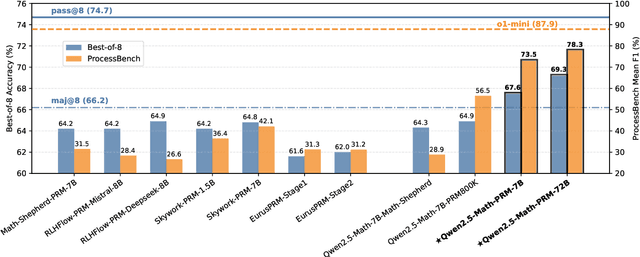
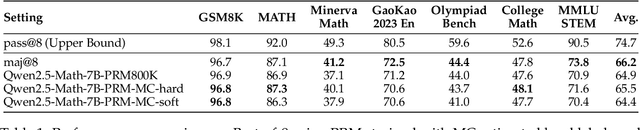


Process Reward Models (PRMs) emerge as a promising approach for process supervision in mathematical reasoning of Large Language Models (LLMs), which aim to identify and mitigate intermediate errors in the reasoning processes. However, the development of effective PRMs faces significant challenges, particularly in data annotation and evaluation methodologies. In this paper, through extensive experiments, we demonstrate that commonly used Monte Carlo (MC) estimation-based data synthesis for PRMs typically yields inferior performance and generalization compared to LLM-as-a-judge and human annotation methods. MC estimation relies on completion models to evaluate current-step correctness, leading to inaccurate step verification. Furthermore, we identify potential biases in conventional Best-of-N (BoN) evaluation strategies for PRMs: (1) The unreliable policy models generate responses with correct answers but flawed processes, leading to a misalignment between the evaluation criteria of BoN and the PRM objectives of process verification. (2) The tolerance of PRMs of such responses leads to inflated BoN scores. (3) Existing PRMs have a significant proportion of minimum scores concentrated on the final answer steps, revealing the shift from process to outcome-based assessment in BoN Optimized PRMs. To address these challenges, we develop a consensus filtering mechanism that effectively integrates MC estimation with LLM-as-a-judge and advocates a more comprehensive evaluation framework that combines response-level and step-level metrics. Based on the mechanisms, we significantly improve both model performance and data efficiency in the BoN evaluation and the step-wise error identification task. Finally, we release a new state-of-the-art PRM that outperforms existing open-source alternatives and provides practical guidelines for future research in building process supervision models.
ACE++: Instruction-Based Image Creation and Editing via Context-Aware Content Filling
Jan 07, 2025


We report ACE++, an instruction-based diffusion framework that tackles various image generation and editing tasks. Inspired by the input format for the inpainting task proposed by FLUX.1-Fill-dev, we improve the Long-context Condition Unit (LCU) introduced in ACE and extend this input paradigm to any editing and generation tasks. To take full advantage of image generative priors, we develop a two-stage training scheme to minimize the efforts of finetuning powerful text-to-image diffusion models like FLUX.1-dev. In the first stage, we pre-train the model using task data with the 0-ref tasks from the text-to-image model. There are many models in the community based on the post-training of text-to-image foundational models that meet this training paradigm of the first stage. For example, FLUX.1-Fill-dev deals primarily with painting tasks and can be used as an initialization to accelerate the training process. In the second stage, we finetune the above model to support the general instructions using all tasks defined in ACE. To promote the widespread application of ACE++ in different scenarios, we provide a comprehensive set of models that cover both full finetuning and lightweight finetuning, while considering general applicability and applicability in vertical scenarios. The qualitative analysis showcases the superiority of ACE++ in terms of generating image quality and prompt following ability. Code and models will be available on the project page: https://ali-vilab. github.io/ACE_plus_page/.