 Add to Chrome
 Add to Firefox
 Add to Edge
Wan-Image: Pushing the Boundaries of Generative Visual Intelligence
Apr 21, 2026
We present Wan-Image, a unified visual generation system explicitly engineered to paradigm-shift image generation models from casual synthesizers into professional-grade productivity tools. While contemporary diffusion models excel at aesthetic generation, they frequently encounter critical bottlenecks in rigorous design workflows that demand absolute controllability, complex typography rendering, and strict identity preservation. To address these challenges, Wan-Image features a natively unified multi-modal architecture by synergizing the cognitive capabilities of large language models with the high-fidelity pixel synthesis of diffusion transformers, which seamlessly translates highly nuanced user intents into precise visual outputs. It is fundamentally powered by large-scale multi-modal data scaling, a systematic fine-grained annotation engine, and curated reinforcement learning data to surpass basic instruction following and unlock expert-level professional capabilities. These include ultra-long complex text rendering, hyper-diverse portrait generation, palette-guided generation, multi-subject identity preservation, coherent sequential visual generation, precise multi-modal interactive editing, native alpha-channel generation, and high-efficiency 4K synthesis. Across diverse human evaluations, Wan-Image exceeds Seedream 5.0 Lite and GPT Image 1.5 in overall performance, reaching parity with Nano Banana Pro in challenging tasks. Ultimately, Wan-Image revolutionizes visual content creation across e-commerce, entertainment, education, and personal productivity, redefining the boundaries of professional visual synthesis.

Wan: Open and Advanced Large-Scale Video Generative Models
Mar 26, 2025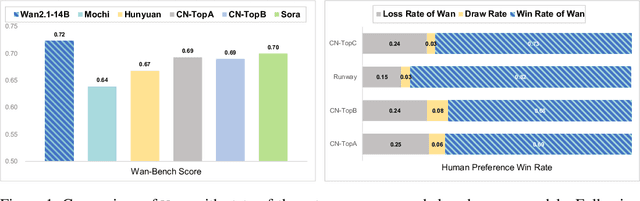
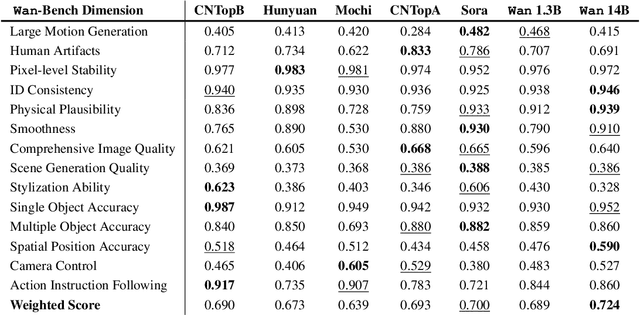
This report presents Wan, a comprehensive and open suite of video foundation models designed to push the boundaries of video generation. Built upon the mainstream diffusion transformer paradigm, Wan achieves significant advancements in generative capabilities through a series of innovations, including our novel VAE, scalable pre-training strategies, large-scale data curation, and automated evaluation metrics. These contributions collectively enhance the model's performance and versatility. Specifically, Wan is characterized by four key features: Leading Performance: The 14B model of Wan, trained on a vast dataset comprising billions of images and videos, demonstrates the scaling laws of video generation with respect to both data and model size. It consistently outperforms the existing open-source models as well as state-of-the-art commercial solutions across multiple internal and external benchmarks, demonstrating a clear and significant performance superiority. Comprehensiveness: Wan offers two capable models, i.e., 1.3B and 14B parameters, for efficiency and effectiveness respectively. It also covers multiple downstream applications, including image-to-video, instruction-guided video editing, and personal video generation, encompassing up to eight tasks. Consumer-Grade Efficiency: The 1.3B model demonstrates exceptional resource efficiency, requiring only 8.19 GB VRAM, making it compatible with a wide range of consumer-grade GPUs. Openness: We open-source the entire series of Wan, including source code and all models, with the goal of fostering the growth of the video generation community. This openness seeks to significantly expand the creative possibilities of video production in the industry and provide academia with high-quality video foundation models. All the code and models are available at https://github.com/Wan-Video/Wan2.1.