 Add to Chrome
 Add to Firefox
 Add to Edge
Video = World + Event Stream
Jul 16, 2026
We present Wan-Streamer v0.3, which reframes our native-streaming interaction model under a single organizing view: a video is a world plus an event stream. The world is the persistent context in which a video unfolds, including the environment, scene, subjects, ambient acoustic conditions, voice characteristics, and other relatively stable conditions. The event stream is everything that changes over time within that world, including scene or environmental changes, subject behavior, speech, and other sounds. This yields a general-purpose pretraining task over large amounts of real video: given a world and incoming input, predict how the world moves, changes, and responds in real time. The resulting competence can be specialized to a broad family of real-time downstream tasks. We instantiate it on real-time full-duplex audio-visual interaction, where the event stream is the agent's speech together with free-form behavior. Functionally, the model's multimodal understanding process is vision-language-action-like: it maps multimodal user input to language-form speech and behavior actions. Wan-Streamer v0.3 preserves the v0.2 operating point: 640x368 video at 25 FPS, a 160 ms streaming unit, approximately 200 ms model-side response latency, and approximately 550 ms total interaction latency under a 350 ms bidirectional network budget.

Wan-Streamer v0.2: Higher Resolution, Same Latency
Jul 05, 2026We present Wan-Streamer v0.2, a latency-preserving upgrade of the native-streaming, end-to-end audio-visual interaction model. v0.2 keeps the v0.1 modeling formulation, but raises the interactive output stream from 192x336 to 640x368 while preserving approximately 200 ms model-side signal-to-signal latency at 25 FPS. The higher-resolution stream supports scene-grounded mid-shot agents whose posture, gaze, hands, nearby objects, and local scene layout remain legible during real-time conversation. To support the larger visual stream without adding user-visible delay, v0.2 keeps the thinker as a single-GPU low-latency path for streaming perception, the short language/state Transformer pass that builds the generation cache, and final decoding. The performer becomes a multi-GPU Ulysses-style context-parallel group for the expensive next-unit latent generation. Each performer rank writes incoming K/V into a pre-sharded local cache. The long high-resolution latent video sequence is split across ranks for denoising and gathered through Ulysses communication, while the much shorter audio latent sequence is generated without sequence sharding. In this split, the thinker's language/state computation reaches the performer only as K/V conditioning, so no separate language sequence has to be communicated inside the performer group. This concentrates additional hardware on visual generation while preserving the compact thinker-performer boundary, keeping total remote interaction latency at approximately 550 ms when a 350 ms bidirectional network budget is included.
Wan-Streamer v0.1: End-to-end Real-time Interactive Foundation Models
Jun 25, 2026We present Wan-Streamer, a native-streaming, end-to-end interactive foundation model designed from the ground up for real-time, low-latency, full-duplex audio-visual interaction. Wan-Streamer seamlessly models language, audio, and video as both input and output within a single Transformer, where the sequence is represented as interleaved visual, audio, and text input tokens together with visual, audio, and text output tokens, coordinated by block-causal attention for incremental streaming. Unlike cascaded interactive systems that rely on separate VAD, ASR, language, TTS, audio-driven animation, or video-generation modules, Wan-Streamer does not rely on external language, speech, avatar, or video-generation modules: perception, reasoning, generation, response timing, turn management, and cross-modal synchronization are learned jointly within one unified model, reducing pipeline latency and error accumulation. To support natural audio-visual responsiveness, we redesign the entire stack around streamability, including causal encoders, causal decoders, block-causal attention, and low-latency multimodal token scheduling, enabling streaming units as short as 160 ms at 25 fps. Wan-Streamer achieves approximately 200 ms model-side response latency and approximately 550 ms total interaction latency when combined with 350 ms bidirectional network latency, supporting sub-second duplex audio-visual communication. These results position Wan-Streamer as a unified, end-to-end, multimodal interactive foundation model for low-latency streaming interaction.
Wan-Image: Pushing the Boundaries of Generative Visual Intelligence
Apr 21, 2026We present Wan-Image, a unified visual generation system explicitly engineered to paradigm-shift image generation models from casual synthesizers into professional-grade productivity tools. While contemporary diffusion models excel at aesthetic generation, they frequently encounter critical bottlenecks in rigorous design workflows that demand absolute controllability, complex typography rendering, and strict identity preservation. To address these challenges, Wan-Image features a natively unified multi-modal architecture by synergizing the cognitive capabilities of large language models with the high-fidelity pixel synthesis of diffusion transformers, which seamlessly translates highly nuanced user intents into precise visual outputs. It is fundamentally powered by large-scale multi-modal data scaling, a systematic fine-grained annotation engine, and curated reinforcement learning data to surpass basic instruction following and unlock expert-level professional capabilities. These include ultra-long complex text rendering, hyper-diverse portrait generation, palette-guided generation, multi-subject identity preservation, coherent sequential visual generation, precise multi-modal interactive editing, native alpha-channel generation, and high-efficiency 4K synthesis. Across diverse human evaluations, Wan-Image exceeds Seedream 5.0 Lite and GPT Image 1.5 in overall performance, reaching parity with Nano Banana Pro in challenging tasks. Ultimately, Wan-Image revolutionizes visual content creation across e-commerce, entertainment, education, and personal productivity, redefining the boundaries of professional visual synthesis.
AIBench: Evaluating Visual-Logical Consistency in Academic Illustration Generation
Mar 31, 2026Although image generation has boosted various applications via its rapid evolution, whether the state-of-the-art models are able to produce ready-to-use academic illustrations for papers is still largely unexplored. Directly comparing or evaluating the illustration with VLM is native but requires oracle multi-modal understanding ability, which is unreliable for long and complex texts and illustrations. To address this, we propose AIBench, the first benchmark using VQA for evaluating logic correctness of the academic illustrations and VLMs for assessing aesthetics. In detail, we designed four levels of questions proposed from a logic diagram summarized from the method part of the paper, which query whether the generated illustration aligns with the paper on different scales. Our VQA-based approach raises more accurate and detailed evaluations on visual-logical consistency while relying less on the ability of the judger VLM. With our high-quality AIBench, we conduct extensive experiments and conclude that the performance gap between models on this task is significantly larger than general ones, reflecting their various complex reasoning and high-density generation ability. Further, the logic and aesthetics are hard to optimize simultaneously as in handcrafted illustrations. Additional experiments further state that test-time scaling on both abilities significantly boosts the performance on this task.
GenAgent: Scaling Text-to-Image Generation via Agentic Multimodal Reasoning
Jan 26, 2026We introduce GenAgent, unifying visual understanding and generation through an agentic multimodal model. Unlike unified models that face expensive training costs and understanding-generation trade-offs, GenAgent decouples these capabilities through an agentic framework: understanding is handled by the multimodal model itself, while generation is achieved by treating image generation models as invokable tools. Crucially, unlike existing modular systems constrained by static pipelines, this design enables autonomous multi-turn interactions where the agent generates multimodal chains-of-thought encompassing reasoning, tool invocation, judgment, and reflection to iteratively refine outputs. We employ a two-stage training strategy: first, cold-start with supervised fine-tuning on high-quality tool invocation and reflection data to bootstrap agent behaviors; second, end-to-end agentic reinforcement learning combining pointwise rewards (final image quality) and pairwise rewards (reflection accuracy), with trajectory resampling for enhanced multi-turn exploration. GenAgent significantly boosts base generator(FLUX.1-dev) performance on GenEval++ (+23.6\%) and WISE (+14\%). Beyond performance gains, our framework demonstrates three key properties: 1) cross-tool generalization to generators with varying capabilities, 2) test-time scaling with consistent improvements across interaction rounds, and 3) task-adaptive reasoning that automatically adjusts to different tasks. Our code will be available at \href{https://github.com/deep-kaixun/GenAgent}{this url}.
ShowTable: Unlocking Creative Table Visualization with Collaborative Reflection and Refinement
Dec 15, 2025While existing generation and unified models excel at general image generation, they struggle with tasks requiring deep reasoning, planning, and precise data-to-visual mapping abilities beyond general scenarios. To push beyond the existing limitations, we introduce a new and challenging task: creative table visualization, requiring the model to generate an infographic that faithfully and aesthetically visualizes the data from a given table. To address this challenge, we propose ShowTable, a pipeline that synergizes MLLMs with diffusion models via a progressive self-correcting process. The MLLM acts as the central orchestrator for reasoning the visual plan and judging visual errors to provide refined instructions, the diffusion execute the commands from MLLM, achieving high-fidelity results. To support this task and our pipeline, we introduce three automated data construction pipelines for training different modules. Furthermore, we introduce TableVisBench, a new benchmark with 800 challenging instances across 5 evaluation dimensions, to assess performance on this task. Experiments demonstrate that our pipeline, instantiated with different models, significantly outperforms baselines, highlighting its effective multi-modal reasoning, generation, and error correction capabilities.
Aligned Better, Listen Better for Audio-Visual Large Language Models
Apr 02, 2025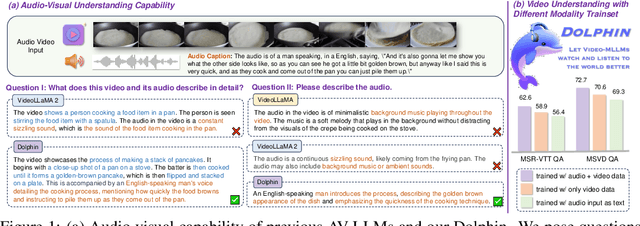
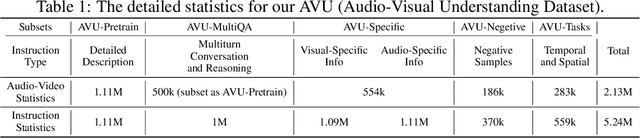
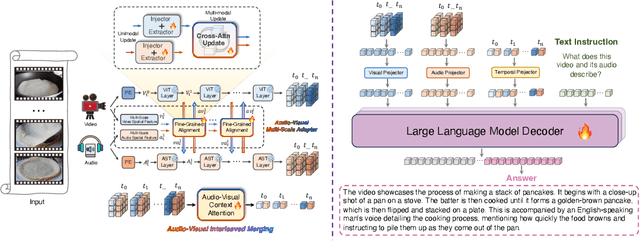
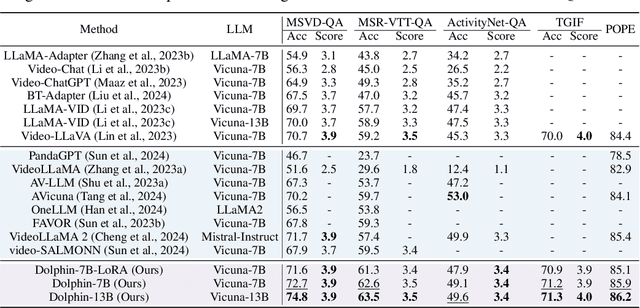
Audio is essential for multimodal video understanding. On the one hand, video inherently contains audio, which supplies complementary information to vision. Besides, video large language models (Video-LLMs) can encounter many audio-centric settings. However, existing Video-LLMs and Audio-Visual Large Language Models (AV-LLMs) exhibit deficiencies in exploiting audio information, leading to weak understanding and hallucinations. To solve the issues, we delve into the model architecture and dataset. (1) From the architectural perspective, we propose a fine-grained AV-LLM, namely Dolphin. The concurrent alignment of audio and visual modalities in both temporal and spatial dimensions ensures a comprehensive and accurate understanding of videos. Specifically, we devise an audio-visual multi-scale adapter for multi-scale information aggregation, which achieves spatial alignment. For temporal alignment, we propose audio-visual interleaved merging. (2) From the dataset perspective, we curate an audio-visual caption and instruction-tuning dataset, called AVU. It comprises 5.2 million diverse, open-ended data tuples (video, audio, question, answer) and introduces a novel data partitioning strategy. Extensive experiments show our model not only achieves remarkable performance in audio-visual understanding, but also mitigates potential hallucinations.
Wan: Open and Advanced Large-Scale Video Generative Models
Mar 26, 2025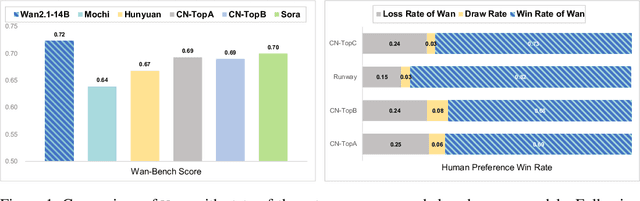
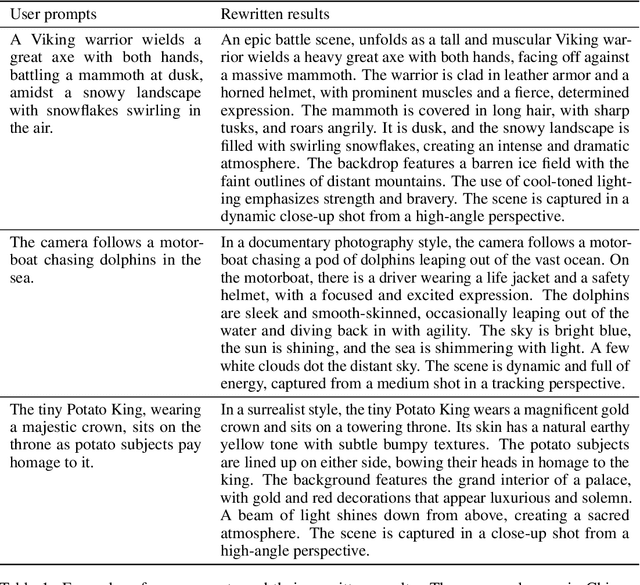
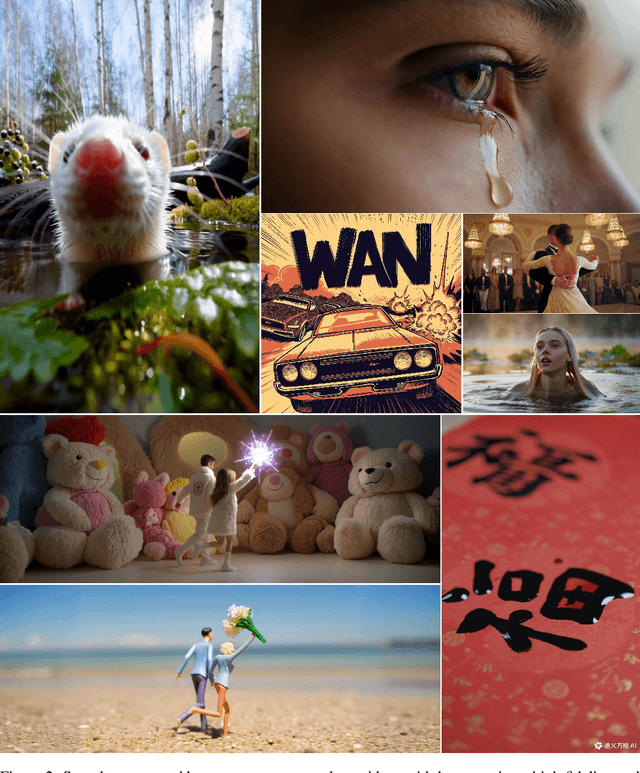
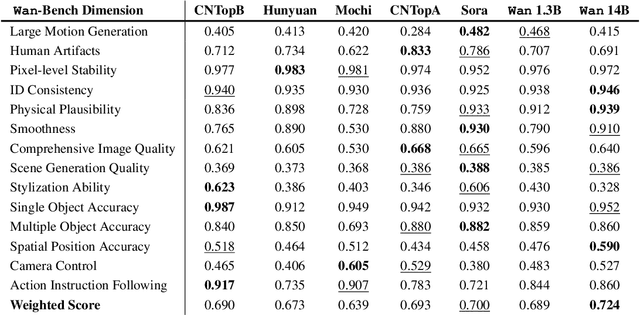
This report presents Wan, a comprehensive and open suite of video foundation models designed to push the boundaries of video generation. Built upon the mainstream diffusion transformer paradigm, Wan achieves significant advancements in generative capabilities through a series of innovations, including our novel VAE, scalable pre-training strategies, large-scale data curation, and automated evaluation metrics. These contributions collectively enhance the model's performance and versatility. Specifically, Wan is characterized by four key features: Leading Performance: The 14B model of Wan, trained on a vast dataset comprising billions of images and videos, demonstrates the scaling laws of video generation with respect to both data and model size. It consistently outperforms the existing open-source models as well as state-of-the-art commercial solutions across multiple internal and external benchmarks, demonstrating a clear and significant performance superiority. Comprehensiveness: Wan offers two capable models, i.e., 1.3B and 14B parameters, for efficiency and effectiveness respectively. It also covers multiple downstream applications, including image-to-video, instruction-guided video editing, and personal video generation, encompassing up to eight tasks. Consumer-Grade Efficiency: The 1.3B model demonstrates exceptional resource efficiency, requiring only 8.19 GB VRAM, making it compatible with a wide range of consumer-grade GPUs. Openness: We open-source the entire series of Wan, including source code and all models, with the goal of fostering the growth of the video generation community. This openness seeks to significantly expand the creative possibilities of video production in the industry and provide academia with high-quality video foundation models. All the code and models are available at https://github.com/Wan-Video/Wan2.1.
Hybrid-Level Instruction Injection for Video Token Compression in Multi-modal Large Language Models
Mar 20, 2025Recent Multi-modal Large Language Models (MLLMs) have been challenged by the computational overhead resulting from massive video frames, often alleviated through compression strategies. However, the visual content is not equally contributed to user instructions, existing strategies (\eg, average pool) inevitably lead to the loss of potentially useful information. To tackle this, we propose the Hybrid-level Instruction Injection Strategy for Conditional Token Compression in MLLMs (HICom), utilizing the instruction as a condition to guide the compression from both local and global levels. This encourages the compression to retain the maximum amount of user-focused information while reducing visual tokens to minimize computational burden. Specifically, the instruction condition is injected into the grouped visual tokens at the local level and the learnable tokens at the global level, and we conduct the attention mechanism to complete the conditional compression. From the hybrid-level compression, the instruction-relevant visual parts are highlighted while the temporal-spatial structure is also preserved for easier understanding of LLMs. To further unleash the potential of HICom, we introduce a new conditional pre-training stage with our proposed dataset HICom-248K. Experiments show that our HICom can obtain distinguished video understanding ability with fewer tokens, increasing the performance by 2.43\% average on three multiple-choice QA benchmarks and saving 78.8\% tokens compared with the SOTA method. The code is available at https://github.com/lntzm/HICom.