 Add to Chrome
 Add to Firefox
 Add to Edge
TreeProbe : A Tibetan Medicine Benchmark for Cultural Bias in LLMs
Aug 01, 2026
Large language models are increasingly viewed as a potential means of mitigating global health inequities, yet their outputs often reflect dominant high-resource medical traditions and provide limited coverage of traditional medical knowledge systems. Tibetan medicine, one of the world's four major traditional medical systems, has an independent and highly structured theoretical framework. When models lack grounded understanding of Tibetan medicine, they may fall back on dominant epistemic systems and distort the native knowledge structure during reasoning. However, quantitative tools for evaluating cultural bias in Tibetan medicine remain largely absent. To address this gap, we introduce TreeProbe, the first cultural-bias benchmark organized around the native Tree of Medicine framework in Tibetan medicine. It contains 4,719 expert-adjudicated items covering 467 diseases and 10 subtasks along the three roots. Experiments on representative LLMs show that current models remain limited in native Tibetan medical contexts and exhibit systematic external ontology drift. Further analysis reveals that models diverge in whether they drift toward biomedical or TCM reasoning, shaped by pretraining data composition and surface resemblance between TCM and Tibetan medicine. TreeProbe provides a diagnostic benchmark for developing medical AI systems that are both linguistically inclusive and epistemically fair. Code and data are available in an anonymous repository at https://anonymous.4open.science/r/TreeProbe/.

Tibetan-TTS:Low-Resource Tibetan Speech Synthesis with Large Model Adaptation
May 04, 2026Tibetan text-to-speech (TTS) has long been challenged by scarce speech resources, significant dialectal variation, and the complex mapping between written text and spoken pronunciation. To address these issues, this work presents, to the best of our knowledge, the first large-model-based Tibetan TTS system in the industry, built upon a large speech synthesis model developed by Xingchen AGI Lab. The proposed system integrates data quality enhancement, Tibetan-oriented text representation and tokenizer adaptation, and cross-lingual adaptive training for low-resource Tibetan speech synthesis. Experimental results show that the system can generate stable, natural, and intelligible Tibetan speech under low-resource conditions. In subjective evaluation, the MOS scores of the syllable-level and BPE-based systems reach 4.28 and 4.35, while their pronunciation accuracies reach 97.6% and 96.6%, respectively, outperforming an external commercial Tibetan TTS interface. These results demonstrate that combining a large-model backbone with Tibetan-oriented text representation adaptation and cross-lingual adaptive training enables highly usable low-resource Tibetan speech synthesis, and also provides a technical foundation for future unified multi-dialect Tibetan speech synthesis.
Early and Prediagnostic Detection of Pancreatic Cancer from Computed Tomography
Jan 29, 2026Pancreatic ductal adenocarcinoma (PDAC), one of the deadliest solid malignancies, is often detected at a late and inoperable stage. Retrospective reviews of prediagnostic CT scans, when conducted by expert radiologists aware that the patient later developed PDAC, frequently reveal lesions that were previously overlooked. To help detecting these lesions earlier, we developed an automated system named ePAI (early Pancreatic cancer detection with Artificial Intelligence). It was trained on data from 1,598 patients from a single medical center. In the internal test involving 1,009 patients, ePAI achieved an area under the receiver operating characteristic curve (AUC) of 0.939-0.999, a sensitivity of 95.3%, and a specificity of 98.7% for detecting small PDAC less than 2 cm in diameter, precisely localizing PDAC as small as 2 mm. In an external test involving 7,158 patients across 6 centers, ePAI achieved an AUC of 0.918-0.945, a sensitivity of 91.5%, and a specificity of 88.0%, precisely localizing PDAC as small as 5 mm. Importantly, ePAI detected PDACs on prediagnostic CT scans obtained 3 to 36 months before clinical diagnosis that had originally been overlooked by radiologists. It successfully detected and localized PDACs in 75 of 159 patients, with a median lead time of 347 days before clinical diagnosis. Our multi-reader study showed that ePAI significantly outperformed 30 board-certified radiologists by 50.3% (P < 0.05) in sensitivity while maintaining a comparable specificity of 95.4% in detecting PDACs early and prediagnostic. These findings suggest its potential of ePAI as an assistive tool to improve early detection of pancreatic cancer.
Context-Aware Dynamic Chunking for Streaming Tibetan Speech Recognition
Nov 12, 2025In this work, we propose a streaming speech recognition framework for Amdo Tibetan, built upon a hybrid CTC/Atten-tion architecture with a context-aware dynamic chunking mechanism. The proposed strategy adaptively adjusts chunk widths based on encoding states, enabling flexible receptive fields, cross-chunk information exchange, and robust adaptation to varying speaking rates, thereby alleviating the context truncation problem of fixed-chunk methods. To further capture the linguistic characteristics of Tibetan, we construct a lexicon grounded in its orthographic principles, providing linguistically motivated modeling units. During decoding, an external language model is integrated to enhance semantic consistency and improve recognition of long sentences. Experimental results show that the proposed framework achieves a word error rate (WER) of 6.23% on the test set, yielding a 48.15% relative improvement over the fixed-chunk baseline, while significantly reducing recognition latency and maintaining performance close to global decoding.
Listening, Imagining \& Refining: A Heuristic Optimized ASR Correction Framework with LLMs
Sep 18, 2025Automatic Speech Recognition (ASR) systems remain prone to errors that affect downstream applications. In this paper, we propose LIR-ASR, a heuristic optimized iterative correction framework using LLMs, inspired by human auditory perception. LIR-ASR applies a "Listening-Imagining-Refining" strategy, generating phonetic variants and refining them in context. A heuristic optimization with finite state machine (FSM) is introduced to prevent the correction process from being trapped in local optima and rule-based constraints help maintain semantic fidelity. Experiments on both English and Chinese ASR outputs show that LIR-ASR achieves average reductions in CER/WER of up to 1.5 percentage points compared to baselines, demonstrating substantial accuracy gains in transcription.
FMSD-TTS: Few-shot Multi-Speaker Multi-Dialect Text-to-Speech Synthesis for Ü-Tsang, Amdo and Kham Speech Dataset Generation
May 20, 2025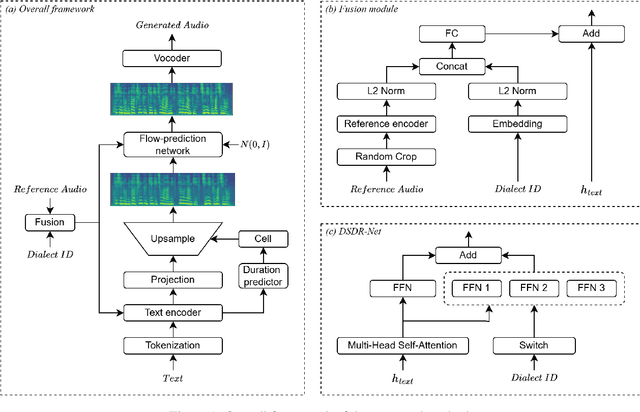

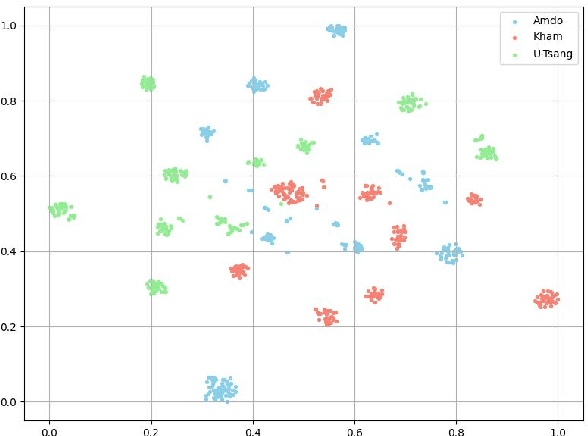
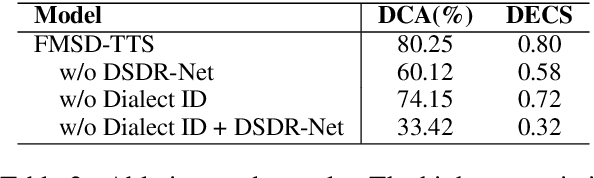
Tibetan is a low-resource language with minimal parallel speech corpora spanning its three major dialects-\"U-Tsang, Amdo, and Kham-limiting progress in speech modeling. To address this issue, we propose FMSD-TTS, a few-shot, multi-speaker, multi-dialect text-to-speech framework that synthesizes parallel dialectal speech from limited reference audio and explicit dialect labels. Our method features a novel speaker-dialect fusion module and a Dialect-Specialized Dynamic Routing Network (DSDR-Net) to capture fine-grained acoustic and linguistic variations across dialects while preserving speaker identity. Extensive objective and subjective evaluations demonstrate that FMSD-TTS significantly outperforms baselines in both dialectal expressiveness and speaker similarity. We further validate the quality and utility of the synthesized speech through a challenging speech-to-speech dialect conversion task. Our contributions include: (1) a novel few-shot TTS system tailored for Tibetan multi-dialect speech synthesis, (2) the public release of a large-scale synthetic Tibetan speech corpus generated by FMSD-TTS, and (3) an open-source evaluation toolkit for standardized assessment of speaker similarity, dialect consistency, and audio quality.