 Add to Chrome
 Add to Firefox
 Add to Edge
ParkingTwin: Training-Free Streaming 3D Reconstruction for Parking-Lot Digital Twins
Jan 20, 2026
High-fidelity parking-lot digital twins provide essential priors for path planning, collision checking, and perception validation in Automated Valet Parking (AVP). Yet robot-oriented reconstruction faces a trilemma: sparse forward-facing views cause weak parallax and ill-posed geometry; dynamic occlusions and extreme lighting hinder stable texture fusion; and neural rendering typically needs expensive offline optimization, violating edge-side streaming constraints. We propose ParkingTwin, a training-free, lightweight system for online streaming 3D reconstruction. First, OSM-prior-driven geometric construction uses OpenStreetMap semantic topology to directly generate a metric-consistent TSDF, replacing blind geometric search with deterministic mapping and avoiding costly optimization. Second, geometry-aware dynamic filtering employs a quad-modal constraint field (normal/height/depth consistency) to reject moving vehicles and transient occlusions in real time. Third, illumination-robust fusion in CIELAB decouples luminance and chromaticity via adaptive L-channel weighting and depth-gradient suppression, reducing seams under abrupt lighting changes. ParkingTwin runs at 30+ FPS on an entry-level GTX 1660. On a 68,000 m^2 real-world dataset, it achieves SSIM 0.87 (+16.0%), delivers about 15x end-to-end speedup, and reduces GPU memory by 83.3% compared with state-of-the-art 3D Gaussian Splatting (3DGS) that typically requires high-end GPUs (RTX 4090D). The system outputs explicit triangle meshes compatible with Unity/Unreal digital-twin pipelines. Project page: https://mihoutao-liu.github.io/ParkingTwin/

Joint DOA and Attitude Sensing Based on Tri-Polarized Continuous Aperture Array
Oct 02, 2025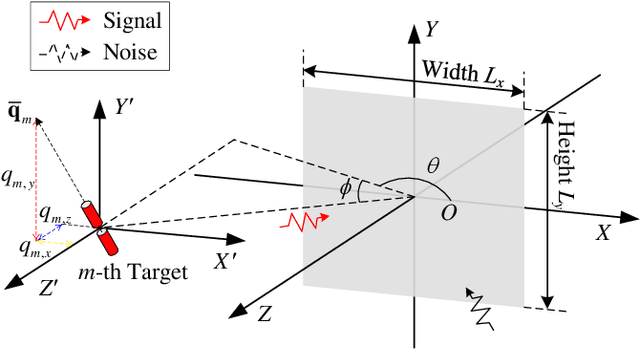
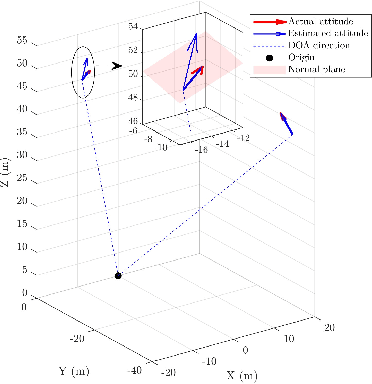
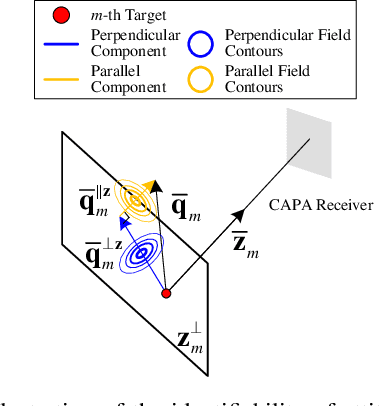
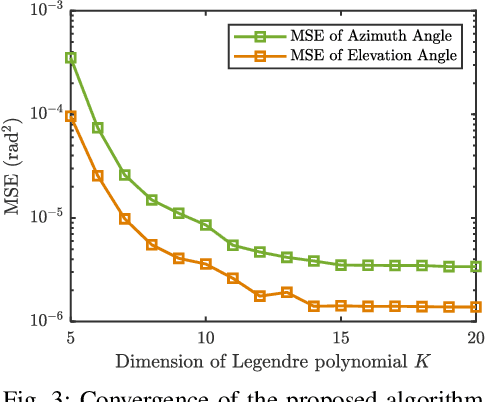
This paper investigates joint direction-of-arrival (DOA) and attitude sensing using tri-polarized continuous aperture arrays (CAPAs). By employing electromagnetic (EM) information theory, the spatially continuous received signals in tri-polarized CAPA are modeled, thereby enabling accurate DOA and attitude estimation. To facilitate subspace decomposition for continuous operators, an equivalent continuous-discrete transformation technique is developed. Moreover, both self- and cross-covariances of tri-polarized signals are exploited to construct a tri-polarized spectrum, significantly enhancing DOA estimation performance. Theoretical analyses reveal that the identifiability of attitude information fundamentally depends on the availability of prior target snapshots. Accordingly, two attitude estimation algorithms are proposed: one capable of estimating partial attitude information without prior knowledge, and the other achieving full attitude estimation when such knowledge is available. Numerical results demonstrate the feasibility and superiority of the proposed framework.