 Add to Chrome
 Add to Firefox
 Add to Edge
HOIGen-1M: A Large-scale Dataset for Human-Object Interaction Video Generation
Mar 31, 2025
Text-to-video (T2V) generation has made tremendous progress in generating complicated scenes based on texts. However, human-object interaction (HOI) often cannot be precisely generated by current T2V models due to the lack of large-scale videos with accurate captions for HOI. To address this issue, we introduce HOIGen-1M, the first largescale dataset for HOI Generation, consisting of over one million high-quality videos collected from diverse sources. In particular, to guarantee the high quality of videos, we first design an efficient framework to automatically curate HOI videos using the powerful multimodal large language models (MLLMs), and then the videos are further cleaned by human annotators. Moreover, to obtain accurate textual captions for HOI videos, we design a novel video description method based on a Mixture-of-Multimodal-Experts (MoME) strategy that not only generates expressive captions but also eliminates the hallucination by individual MLLM. Furthermore, due to the lack of an evaluation framework for generated HOI videos, we propose two new metrics to assess the quality of generated videos in a coarse-to-fine manner. Extensive experiments reveal that current T2V models struggle to generate high-quality HOI videos and confirm that our HOIGen-1M dataset is instrumental for improving HOI video generation. Project webpage is available at https://liuqi-creat.github.io/HOIGen.github.io.

JavisDiT: Joint Audio-Video Diffusion Transformer with Hierarchical Spatio-Temporal Prior Synchronization
Mar 30, 2025This paper introduces JavisDiT, a novel Joint Audio-Video Diffusion Transformer designed for synchronized audio-video generation (JAVG). Built upon the powerful Diffusion Transformer (DiT) architecture, JavisDiT is able to generate high-quality audio and video content simultaneously from open-ended user prompts. To ensure optimal synchronization, we introduce a fine-grained spatio-temporal alignment mechanism through a Hierarchical Spatial-Temporal Synchronized Prior (HiST-Sypo) Estimator. This module extracts both global and fine-grained spatio-temporal priors, guiding the synchronization between the visual and auditory components. Furthermore, we propose a new benchmark, JavisBench, consisting of 10,140 high-quality text-captioned sounding videos spanning diverse scenes and complex real-world scenarios. Further, we specifically devise a robust metric for evaluating the synchronization between generated audio-video pairs in real-world complex content. Experimental results demonstrate that JavisDiT significantly outperforms existing methods by ensuring both high-quality generation and precise synchronization, setting a new standard for JAVG tasks. Our code, model, and dataset will be made publicly available at https://javisdit.github.io/.
Multimodal Chain-of-Thought Reasoning: A Comprehensive Survey
Mar 16, 2025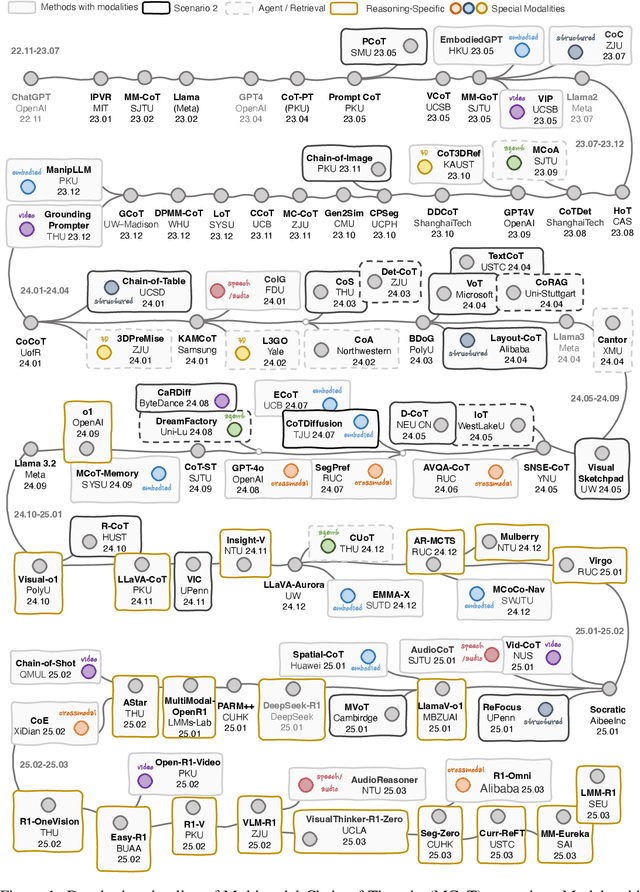
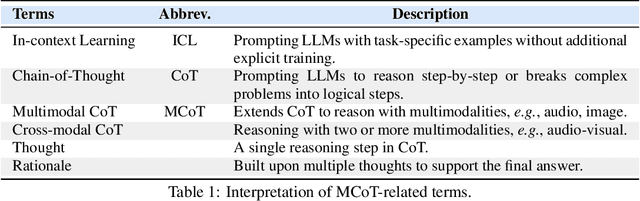
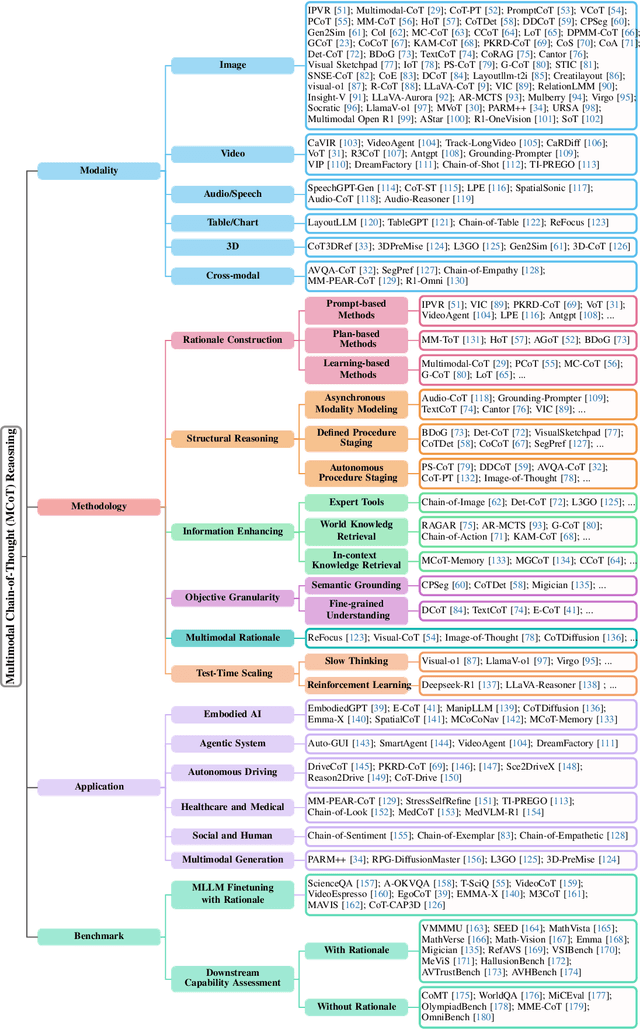
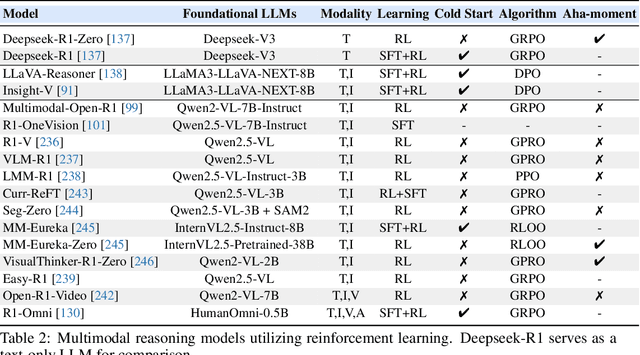
By extending the advantage of chain-of-thought (CoT) reasoning in human-like step-by-step processes to multimodal contexts, multimodal CoT (MCoT) reasoning has recently garnered significant research attention, especially in the integration with multimodal large language models (MLLMs). Existing MCoT studies design various methodologies and innovative reasoning paradigms to address the unique challenges of image, video, speech, audio, 3D, and structured data across different modalities, achieving extensive success in applications such as robotics, healthcare, autonomous driving, and multimodal generation. However, MCoT still presents distinct challenges and opportunities that require further focus to ensure consistent thriving in this field, where, unfortunately, an up-to-date review of this domain is lacking. To bridge this gap, we present the first systematic survey of MCoT reasoning, elucidating the relevant foundational concepts and definitions. We offer a comprehensive taxonomy and an in-depth analysis of current methodologies from diverse perspectives across various application scenarios. Furthermore, we provide insights into existing challenges and future research directions, aiming to foster innovation toward multimodal AGI.
OmniPaint: Mastering Object-Oriented Editing via Disentangled Insertion-Removal Inpainting
Mar 12, 2025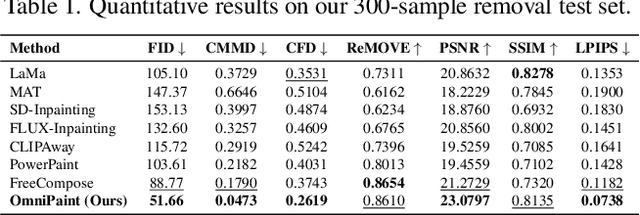
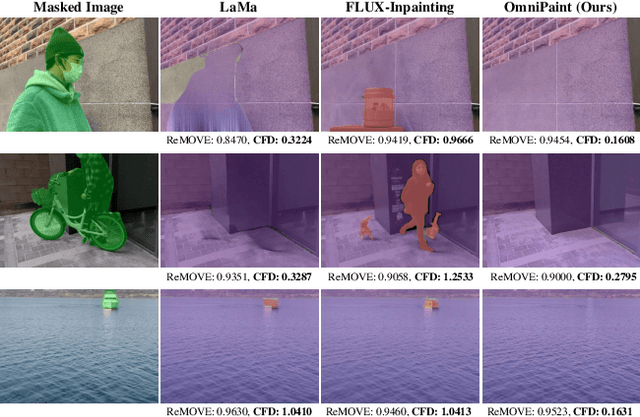
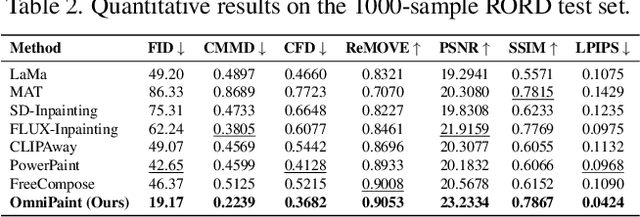
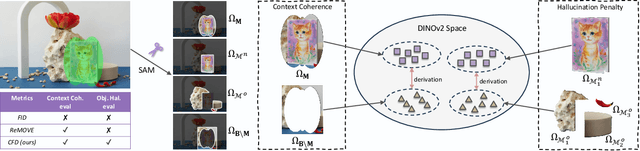
Diffusion-based generative models have revolutionized object-oriented image editing, yet their deployment in realistic object removal and insertion remains hampered by challenges such as the intricate interplay of physical effects and insufficient paired training data. In this work, we introduce OmniPaint, a unified framework that re-conceptualizes object removal and insertion as interdependent processes rather than isolated tasks. Leveraging a pre-trained diffusion prior along with a progressive training pipeline comprising initial paired sample optimization and subsequent large-scale unpaired refinement via CycleFlow, OmniPaint achieves precise foreground elimination and seamless object insertion while faithfully preserving scene geometry and intrinsic properties. Furthermore, our novel CFD metric offers a robust, reference-free evaluation of context consistency and object hallucination, establishing a new benchmark for high-fidelity image editing. Project page: https://yeates.github.io/OmniPaint-Page/
QuoTA: Query-oriented Token Assignment via CoT Query Decouple for Long Video Comprehension
Mar 11, 2025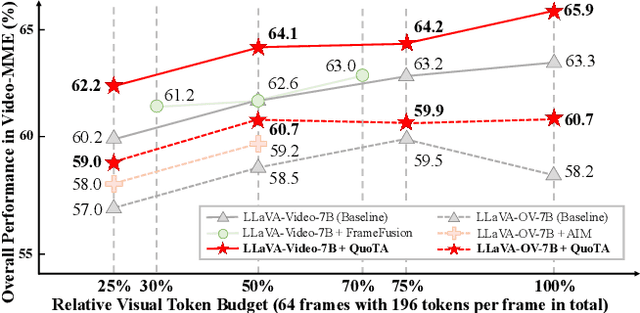
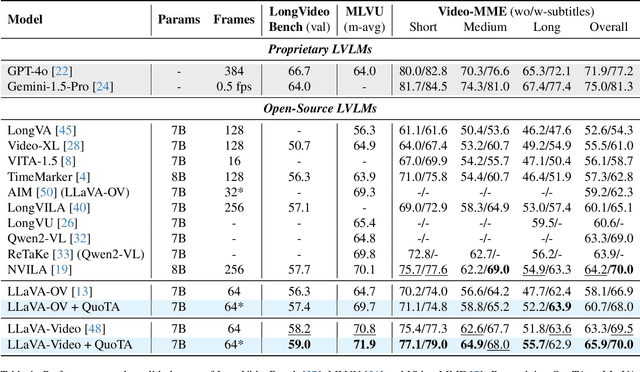
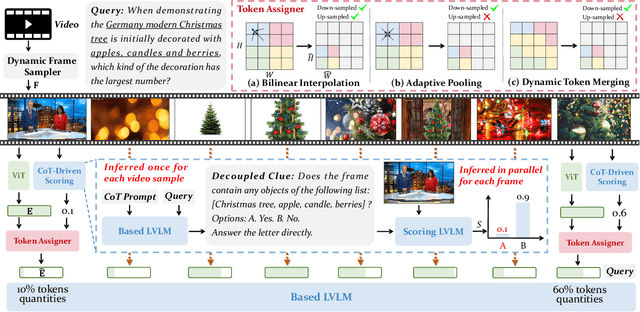
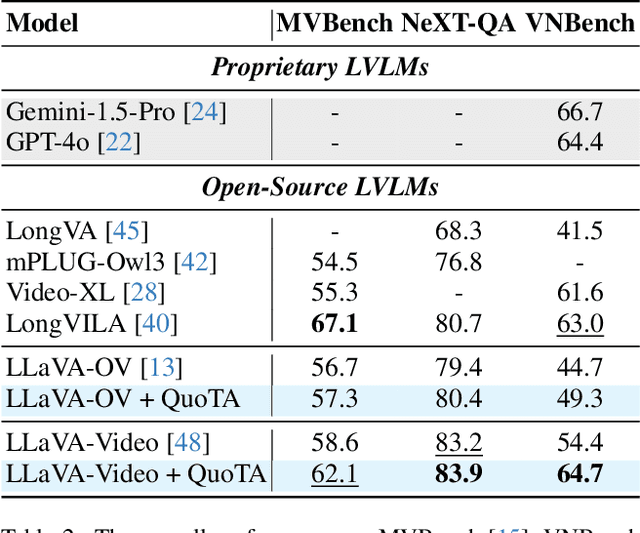
Recent advances in long video understanding typically mitigate visual redundancy through visual token pruning based on attention distribution. However, while existing methods employ post-hoc low-response token pruning in decoder layers, they overlook the input-level semantic correlation between visual tokens and instructions (query). In this paper, we propose QuoTA, an ante-hoc training-free modular that extends existing large video-language models (LVLMs) for visual token assignment based on query-oriented frame-level importance assessment. The query-oriented token selection is crucial as it aligns visual processing with task-specific requirements, optimizing token budget utilization while preserving semantically relevant content. Specifically, (i) QuoTA strategically allocates frame-level importance scores based on query relevance, enabling one-time visual token assignment before cross-modal interactions in decoder layers, (ii) we decouple the query through Chain-of-Thoughts reasoning to facilitate more precise LVLM-based frame importance scoring, and (iii) QuoTA offers a plug-and-play functionality that extends to existing LVLMs. Extensive experimental results demonstrate that implementing QuoTA with LLaVA-Video-7B yields an average performance improvement of 3.2% across six benchmarks (including Video-MME and MLVU) while operating within an identical visual token budget as the baseline. Codes are open-sourced at https://github.com/MAC-AutoML/QuoTA.
Code to Think, Think to Code: A Survey on Code-Enhanced Reasoning and Reasoning-Driven Code Intelligence in LLMs
Feb 26, 2025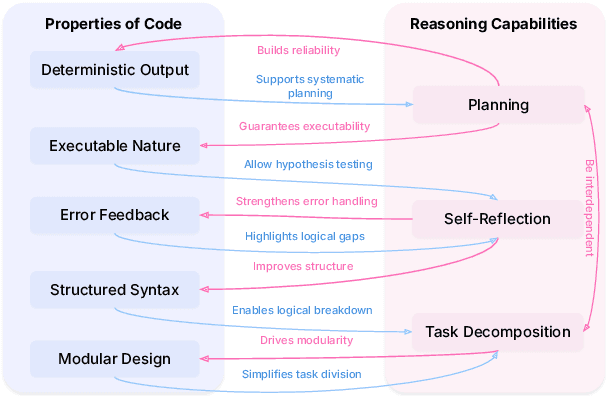
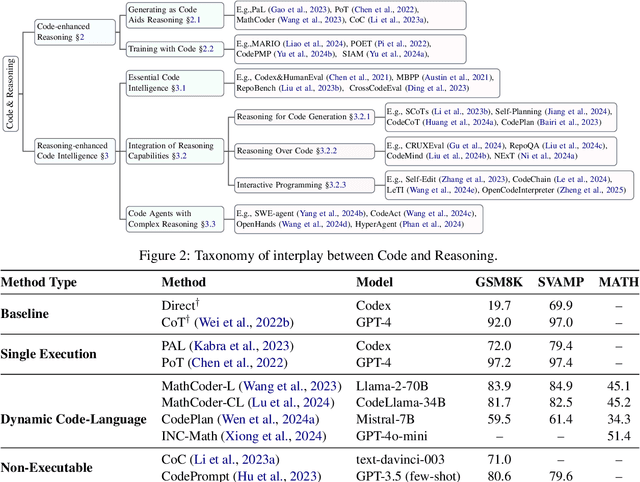
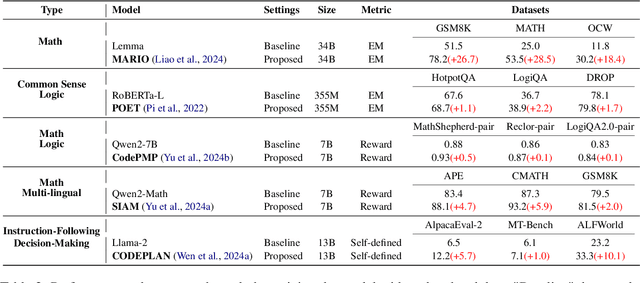
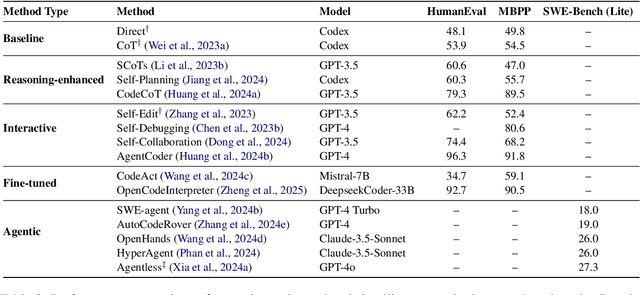
In large language models (LLMs), code and reasoning reinforce each other: code offers an abstract, modular, and logic-driven structure that supports reasoning, while reasoning translates high-level goals into smaller, executable steps that drive more advanced code intelligence. In this study, we examine how code serves as a structured medium for enhancing reasoning: it provides verifiable execution paths, enforces logical decomposition, and enables runtime validation. We also explore how improvements in reasoning have transformed code intelligence from basic completion to advanced capabilities, enabling models to address complex software engineering tasks through planning and debugging. Finally, we identify key challenges and propose future research directions to strengthen this synergy, ultimately improving LLM's performance in both areas.
Facilitating Long Context Understanding via Supervised Chain-of-Thought Reasoning
Feb 18, 2025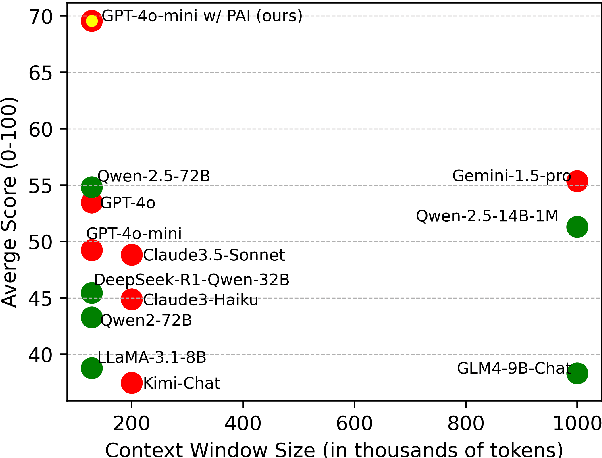
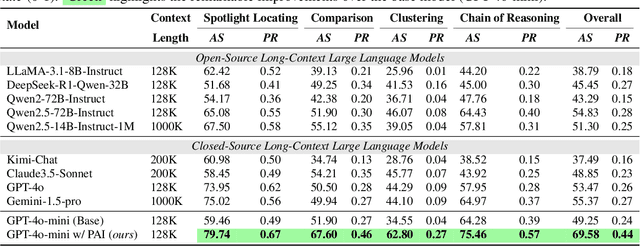
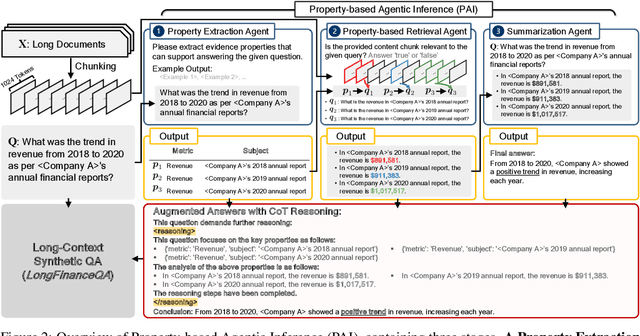
Recent advances in Large Language Models (LLMs) have enabled them to process increasingly longer sequences, ranging from 2K to 2M tokens and even beyond. However, simply extending the input sequence length does not necessarily lead to effective long-context understanding. In this study, we integrate Chain-of-Thought (CoT) reasoning into LLMs in a supervised manner to facilitate effective long-context understanding. To achieve this, we introduce LongFinanceQA, a synthetic dataset in the financial domain designed to improve long-context reasoning. Unlike existing long-context synthetic data, LongFinanceQA includes intermediate CoT reasoning before the final conclusion, which encourages LLMs to perform explicit reasoning, improving accuracy and interpretability in long-context understanding. To generate synthetic CoT reasoning, we propose Property-driven Agentic Inference (PAI), an agentic framework that simulates human-like reasoning steps, including property extraction, retrieval, and summarization. We evaluate PAI's reasoning capabilities by assessing GPT-4o-mini w/ PAI on the Loong benchmark, outperforming standard GPT-4o-mini by 20.0%. Furthermore, we fine-tune LLaMA-3.1-8B-Instruct on LongFinanceQA, achieving a 24.6% gain on Loong's financial subset.
From Selection to Generation: A Survey of LLM-based Active Learning
Feb 17, 2025Active Learning (AL) has been a powerful paradigm for improving model efficiency and performance by selecting the most informative data points for labeling and training. In recent active learning frameworks, Large Language Models (LLMs) have been employed not only for selection but also for generating entirely new data instances and providing more cost-effective annotations. Motivated by the increasing importance of high-quality data and efficient model training in the era of LLMs, we present a comprehensive survey on LLM-based Active Learning. We introduce an intuitive taxonomy that categorizes these techniques and discuss the transformative roles LLMs can play in the active learning loop. We further examine the impact of AL on LLM learning paradigms and its applications across various domains. Finally, we identify open challenges and propose future research directions. This survey aims to serve as an up-to-date resource for researchers and practitioners seeking to gain an intuitive understanding of LLM-based AL techniques and deploy them to new applications.
Can LLMs Simulate Social Media Engagement? A Study on Action-Guided Response Generation
Feb 17, 2025
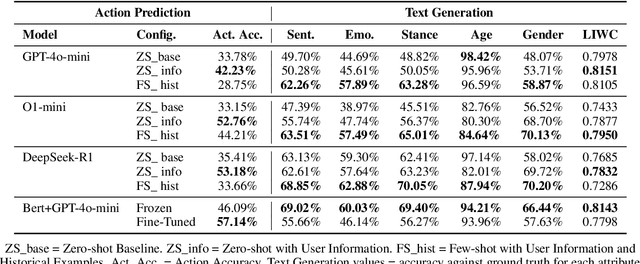
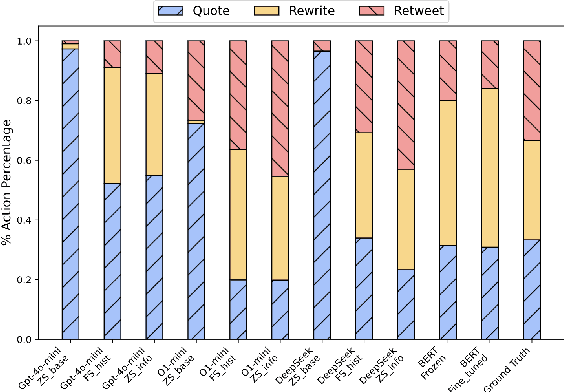
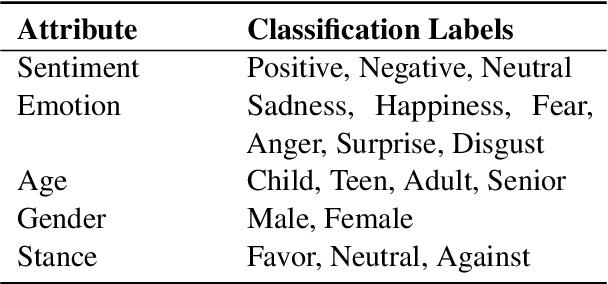
Social media enables dynamic user engagement with trending topics, and recent research has explored the potential of large language models (LLMs) for response generation. While some studies investigate LLMs as agents for simulating user behavior on social media, their focus remains on practical viability and scalability rather than a deeper understanding of how well LLM aligns with human behavior. This paper analyzes LLMs' ability to simulate social media engagement through action guided response generation, where a model first predicts a user's most likely engagement action-retweet, quote, or rewrite-towards a trending post before generating a personalized response conditioned on the predicted action. We benchmark GPT-4o-mini, O1-mini, and DeepSeek-R1 in social media engagement simulation regarding a major societal event discussed on X. Our findings reveal that zero-shot LLMs underperform BERT in action prediction, while few-shot prompting initially degrades the prediction accuracy of LLMs with limited examples. However, in response generation, few-shot LLMs achieve stronger semantic alignment with ground truth posts.
sDREAMER: Self-distilled Mixture-of-Modality-Experts Transformer for Automatic Sleep Staging
Jan 27, 2025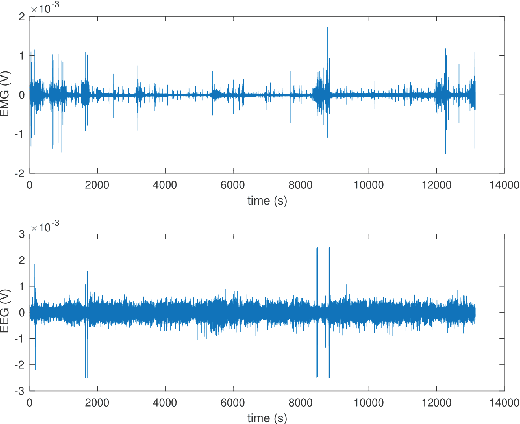
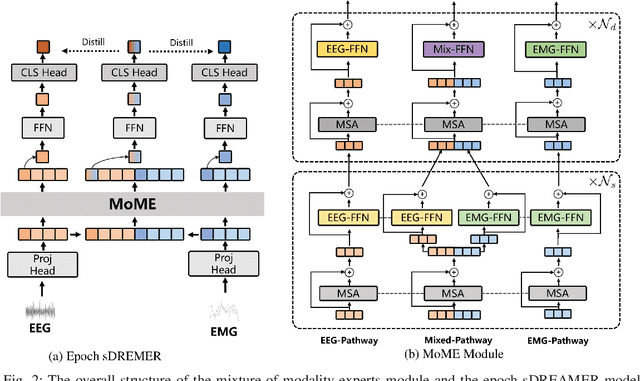
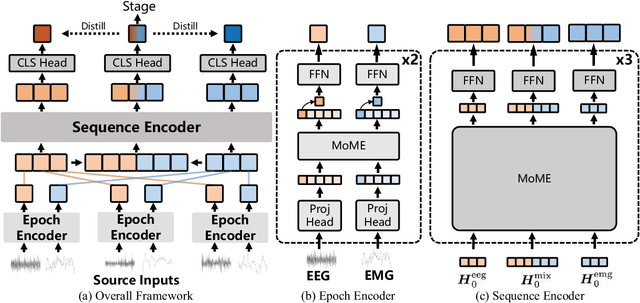
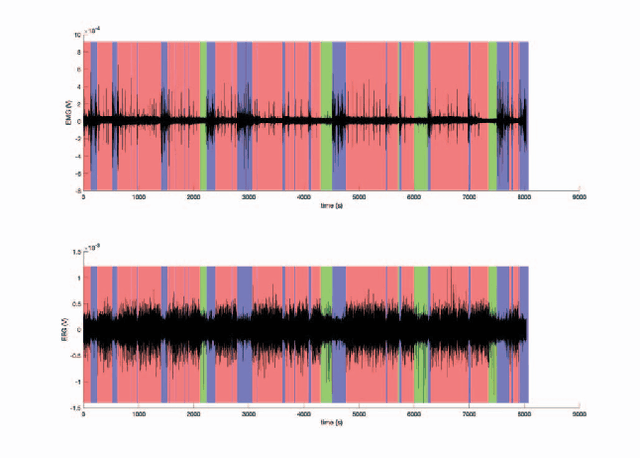
Automatic sleep staging based on electroencephalography (EEG) and electromyography (EMG) signals is an important aspect of sleep-related research. Current sleep staging methods suffer from two major drawbacks. First, there are limited information interactions between modalities in the existing methods. Second, current methods do not develop unified models that can handle different sources of input. To address these issues, we propose a novel sleep stage scoring model sDREAMER, which emphasizes cross-modality interaction and per-channel performance. Specifically, we develop a mixture-of-modality-expert (MoME) model with three pathways for EEG, EMG, and mixed signals with partially shared weights. We further propose a self-distillation training scheme for further information interaction across modalities. Our model is trained with multi-channel inputs and can make classifications on either single-channel or multi-channel inputs. Experiments demonstrate that our model outperforms the existing transformer-based sleep scoring methods for multi-channel inference. For single-channel inference, our model also outperforms the transformer-based models trained with single-channel signals.