 Add to Chrome
 Add to Firefox
 Add to Edge
Filesystem-Based Memory for LLM Agents: Organization, Evolution, and Sustainability
Jul 29, 2026
Deployed LLM agents increasingly keep their long-term memory as a filesystem: a directory tree of markdown files that the agent itself reads, writes, and reorganizes through generic file tools. Yet research has largely passed over this medium: prior systems design bespoke memory representations and study retrieval over them, leaving the default's two working assumptions untested: that an agent can keep a growing store organized as memories accumulate, conflict, and go stale, and that this organization pays. We present the first systematic exploration of filesystem-based memory for LLM agents. We formalize the setting as three roles around one memory filesystem: a management agent integrates and organizes incoming content, a search agent answers queries with cited sources, and an execution agent supplies task trajectories that are distilled into skills, unifying declarative memory and skills in a single store. Across long-conversation benchmarks and embodied tasks, we vary memory shape (agent-organized hierarchy, verbatim dump, chunk retrieval), stream scale, tool harness (sandboxed shell, memory-tool-style functions, varied search tooling), and the strengths of the management and search agents, tracking answer quality, cost, and store health as memory grows. What organization reliably buys is search economy: organized stores roughly halve retrieval cost where material is large. Today's agents, however, fall short of the default's promise: in our growth study, organization erodes for all but the strongest management agent, and no agent we measure converts organization itself into better answers. And the model is not the only lever over a store's shape: changing the tool set alone reshapes the store as strongly as swapping the model. The study turns the filesystem default from an assumption into a design space for agent memory.

Face De-Identification: A Domain-Centric Survey from Capture to Processing
Jul 28, 2026Face de-identification (De-ID) aims to remove or conceal personally identifiable facial features in images or videos to prevent identity recognition while preserving utility for downstream tasks. With the rising emphasis on data privacy and responsible AI, face De-ID has emerged as an active research area spanning computer vision and privacy-preserving communities. Early approaches, and many contemporary ones, operate in the digital domain by modifying pixel-level or appearance-level features through post-capture processing. Recent advances extend face De-ID beyond post-processing by integrating privacy mechanisms directly into sensors during image acquisition, bridging sensing systems and downstream vision algorithms. In parallel, physical-domain methods explore wearable accessories and materials that conceal identity information in real-world environments prior to capture. In this survey, we present the first unified overview that spans the full data acquisition pipeline, encompassing the physical, sensor, and digital domains. Through this domain-centric lens, we systematically analyze current methodologies, technical progress, and the distinct challenges inherent to each stage. We then review and organize existing evaluation protocols, examining current practices and highlighting the critical need for standardized, comprehensive benchmarks. Finally, we identify key open problems and outline emerging research directions to guide future work in this rapidly evolving field. To support ongoing research, we maintain a project page that organizes relevant literature with collected datasets and open source code: https://github.com/CV-AC/Awesome-FaceDe-ID.
How Hard Does It Think? Analyzing Step-Aware Reasoning Energy in LLM Chain-of-Thought Trajectories
Jul 28, 2026Understanding how computational effort is allocated across individual chain-of-thought (CoT) reasoning steps remains an open challenge: existing interpretability methods rely on output-level signals or collapse processing depth into a single trajectory-level scalar, leaving step-wise effort opaque. We propose Step-Aware Reasoning Energy (SARE), a geometric framework that quantifies effort at the granularity of individual CoT steps via Centered Kernel Alignment (CKA) between Gram matrices of token hidden states across adjacent transformer layers, capturing inter-token relational structure without requiring eigenvector alignment or cluster correspondence. SARE further contextualizes this energy within reasoning's semantic progression by modeling CoT trajectories as transitions among latent semantic states. Across six reasoning benchmarks and three open-weight LLMs, we find that reasoning energy is highly non-uniform across step types, exhibiting phase-like transitions invisible to trajectory-level metrics; incorrect trajectories show systematically lower energy at critical reasoning junctions; and SARE-based features match or outperform output-based confidence baselines in most settings, indicating that internal geometric dynamics encode predictive information beyond surface-level signals.
CanonicalPhys: Pose-Robust Remote Photoplethysmography via Canonical-Space Priors
Jul 17, 2026Deep remote photoplethysmography (rPPG) attains sub-bpm heart-rate error on frontal, stationary faces yet degrades sharply under head pose: on MMPD, the state-of-the-art FactorizePhys backbone's MAE grows $1.60\times$ from frontal ($|\text{yaw}|{<}15^\circ$) to large-yaw ($|\text{yaw}|{\geq}45^\circ$) frames. We argue that pose is a \emph{coordinate-structural} nuisance rather than a data-augmentation problem: in image coordinates the same pixel maps to different anatomy at different poses, blocking three priors otherwise natural for rPPG, namely the dichromatic reflection model, pulse-phase invariance across skin regions, and the POS/CHROM chromaticity projection, each of which presumes a stable anatomy-to-pixel mapping. We introduce \textbf{CanonicalPhys}, which prepends a differentiable four-point homography that fixes four facial anchors at canonical positions; in this canonical frame the three priors become expressible as a per-pixel Lambertian weight, a cross-ROI temporal consistency loss, and knowledge distillation from windowed POS, none of which adds trainable parameters over the backbone. At an identical parameter count, CanonicalPhys reduces MMPD's frontal-to-large-yaw MAE degradation from $1.60\times$ to $1.33\times$ and flattens the mild-yaw bin from $1.32\times$ to $1.07\times$ (across CanonicalPhys variants), with matched cross-dataset MAE reductions of up to $32\%$ on pose-rich targets. Code: https://github.com/infraface/CanonicalPhys
Reinforcement-Guided Synthetic Data Generation for Privacy-Sensitive Identity Recognition
Apr 09, 2026High-fidelity generative models are increasingly needed in privacy-sensitive scenarios, where access to data is severely restricted due to regulatory and copyright constraints. This scarcity hampers model development--ironically, in settings where generative models are most needed to compensate for the lack of data. This creates a self-reinforcing challenge: limited data leads to poor generative models, which in turn fail to mitigate data scarcity. To break this cycle, we propose a reinforcement-guided synthetic data generation framework that adapts general-domain generative priors to privacy-sensitive identity recognition tasks. We first perform a cold-start adaptation to align a pretrained generator with the target domain, establishing semantic relevance and initial fidelity. Building on this foundation, we introduce a multi-objective reward that jointly optimizes semantic consistency, coverage diversity, and expression richness, guiding the generator to produce both realistic and task-effective samples. During downstream training, a dynamic sample selection mechanism further prioritizes high-utility synthetic samples, enabling adaptive data scaling and improved domain alignment. Extensive experiments on benchmark datasets demonstrate that our framework significantly improves both generation fidelity and classification accuracy, while also exhibiting strong generalization to novel categories in small-data regimes.
FDeID-Toolbox: Face De-Identification Toolbox
Mar 13, 2026Face de-identification (FDeID) aims to remove personally identifiable information from facial images while preserving task-relevant utility attributes such as age, gender, and expression. It is critical for privacy-preserving computer vision, yet the field suffers from fragmented implementations, inconsistent evaluation protocols, and incomparable results across studies. These challenges stem from the inherent complexity of the task: FDeID spans multiple downstream applications (e.g., age estimation, gender recognition, expression analysis) and requires evaluation across three dimensions (e.g., privacy protection, utility preservation, and visual quality), making existing codebases difficult to use and extend. To address these issues, we present FDeID-Toolbox, a comprehensive toolbox designed for reproducible FDeID research. Our toolbox features a modular architecture comprising four core components: (1) standardized data loaders for mainstream benchmark datasets, (2) unified method implementations spanning classical approaches to SOTA generative models, (3) flexible inference pipelines, and (4) systematic evaluation protocols covering privacy, utility, and quality metrics. Through experiments, we demonstrate that FDeID-Toolbox enables fair and reproducible comparison of diverse FDeID methods under consistent conditions.
Home Health System Deployment Experience for Geriatric Care Remote Monitoring
Jan 24, 2026To support aging-in-place, adult children often provide care to their aging parents from a distance. These informal caregivers desire plug-and-play remote care solutions for privacy-preserving continuous monitoring that enabling real-time activity monitoring and intuitive, actionable information. This short paper presents insights from three iterations of deployment experience for remote monitoring system and the iterative improvement in hardware, modeling, and user interface guided by the Geriatric 4Ms framework (matters most, mentation, mobility, and medication). An LLM-assisted solution is developed to balance user experience (privacy-preserving, plug-and-play) and system performance.
RARR : Robust Real-World Activity Recognition with Vibration by Scavenging Near-Surface Audio Online
Aug 28, 2025
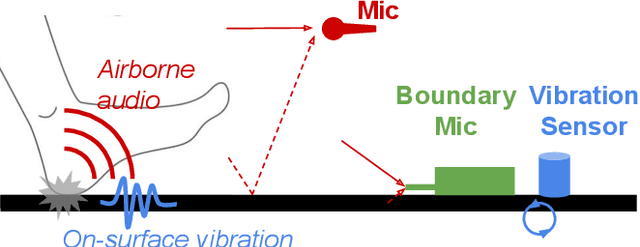

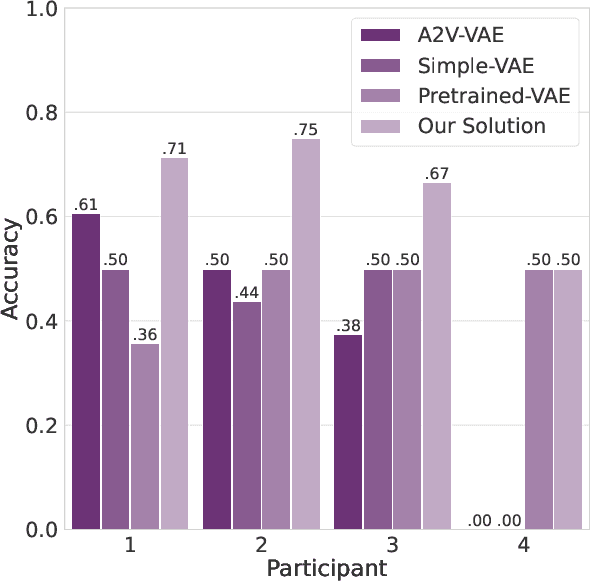
One in four people dementia live alone, leading family members to take on caregiving roles from a distance. Many researchers have developed remote monitoring solutions to lessen caregiving needs; however, limitations remain including privacy preserving solutions, activity recognition, and model generalizability to new users and environments. Structural vibration sensor systems are unobtrusive solutions that have been proven to accurately monitor human information, such as identification and activity recognition, in controlled settings by sensing surface vibrations generated by activities. However, when deploying in an end user's home, current solutions require a substantial amount of labeled data for accurate activity recognition. Our scalable solution adapts synthesized data from near-surface acoustic audio to pretrain a model and allows fine tuning with very limited data in order to create a robust framework for daily routine tracking.
A Survey of Foundation Models for IoT: Taxonomy and Criteria-Based Analysis
Jun 13, 2025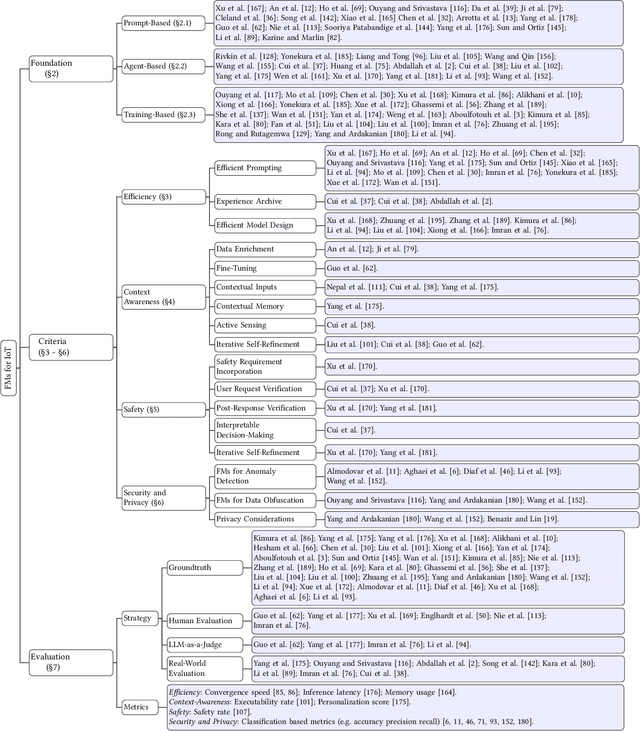

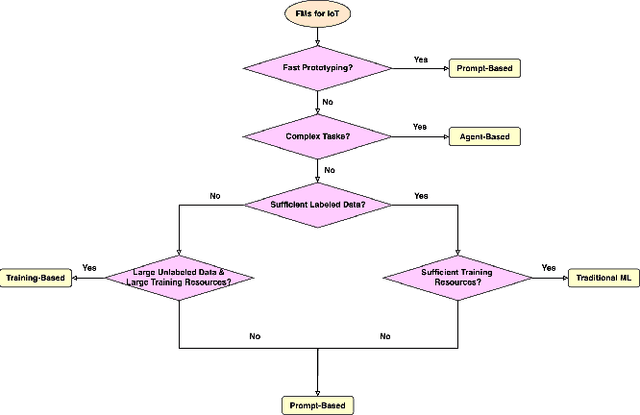
Foundation models have gained growing interest in the IoT domain due to their reduced reliance on labeled data and strong generalizability across tasks, which address key limitations of traditional machine learning approaches. However, most existing foundation model based methods are developed for specific IoT tasks, making it difficult to compare approaches across IoT domains and limiting guidance for applying them to new tasks. This survey aims to bridge this gap by providing a comprehensive overview of current methodologies and organizing them around four shared performance objectives by different domains: efficiency, context-awareness, safety, and security & privacy. For each objective, we review representative works, summarize commonly-used techniques and evaluation metrics. This objective-centric organization enables meaningful cross-domain comparisons and offers practical insights for selecting and designing foundation model based solutions for new IoT tasks. We conclude with key directions for future research to guide both practitioners and researchers in advancing the use of foundation models in IoT applications.
Graph-Based Physics-Guided Urban PM2.5 Air Quality Imputation with Constrained Monitoring Data
Jun 07, 2025This work introduces GraPhy, a graph-based, physics-guided learning framework for high-resolution and accurate air quality modeling in urban areas with limited monitoring data. Fine-grained air quality monitoring information is essential for reducing public exposure to pollutants. However, monitoring networks are often sparse in socioeconomically disadvantaged regions, limiting the accuracy and resolution of air quality modeling. To address this, we propose a physics-guided graph neural network architecture called GraPhy with layers and edge features designed specifically for low-resolution monitoring data. Experiments using data from California's socioeconomically disadvantaged San Joaquin Valley show that GraPhy achieves the overall best performance evaluated by mean squared error (MSE), mean absolute error (MAE), and R-square value (R2), improving the performance by 9%-56% compared to various baseline models. Moreover, GraPhy consistently outperforms baselines across different spatial heterogeneity levels, demonstrating the effectiveness of our model design.
* Accepted by ACM Transactions on Sensor Networks (TOSN) 2025