 Add to Chrome
 Add to Firefox
 Add to Edge
Rethinking Scientific Discovery in the Agentic Era
Jul 07, 2026
Artificial intelligence has advanced scientific discovery, but most AI4Science systems remain fragmented tools that rely on humans to coordinate problem formulation, literature grounding, model use, simulation, validation, and knowledge reuse. This paper presents \textbf{SCION (Scientific Collaborative Innovation with Agentic Organizational Nexus)}, an agentic scientific operating system that acts as an \textbf{organizational nexus}. Through a Science Agent serving as a \textbf{Meta-Harness}, SCION connects scientific tasks, tools, agents, artifacts, and memory, transforming research into an executable, auditable, and reusable operational process. At its core is the \textbf{Research Execution Plan (REP)}, which compiles high-level scientific intent into staged objectives, dependencies, verification checkpoints, tool requirements, expected artifacts, and fallback conditions. SCION further integrates hierarchical multi-agent execution, profile-driven specialization, selective context construction, governed delegation, and layered epistemic memory to support long-horizon scientific work. We formulate discovery under SCION as \textbf{Target-conditioned Inverse Search} and extend it to hidden-target settings through batch active search under finite experimental budgets. Applications in materials analysis, molecule design, and protein or antibody screening, together with experiments on scientific reading, idea generation, molecule generation, and antibody screening, show that SCION outperforms existing autonomous research-agent baselines, especially in decomposition, verification, refinement, and memory reuse. Overall, SCION shifts AI from isolated tools toward a coordinated operational layer for traceable and reusable scientific innovation.

Rethinking Scientific Discovery in an Agentic Era
Jul 04, 2026Artificial intelligence has advanced scientific discovery, but most AI4Science systems remain fragmented tools that rely on humans to coordinate problem formulation, literature grounding, model use, simulation, validation, and knowledge reuse. This paper presents \textbf{SCION (Scientific Collaborative Innovation with Agentic Organizational Nexus)}, an agentic scientific operating system that acts as an \textbf{organizational nexus}. Through a Science Agent serving as a \textbf{Meta-Harness}, SCION connects scientific tasks, tools, agents, artifacts, and memory, transforming research into an executable, auditable, and reusable operational process. At its core is the \textbf{Research Execution Plan (REP)}, which compiles high-level scientific intent into staged objectives, dependencies, verification checkpoints, tool requirements, expected artifacts, and fallback conditions. SCION further integrates hierarchical multi-agent execution, profile-driven specialization, selective context construction, governed delegation, and layered epistemic memory to support long-horizon scientific work. We formulate discovery under SCION as \textbf{Target-conditioned Inverse Search} and extend it to hidden-target settings through batch active search under finite experimental budgets. Applications in materials analysis, molecule design, and protein or antibody screening, together with experiments on scientific reading, idea generation, molecule generation, and antibody screening, show that SCION outperforms existing autonomous research-agent baselines, especially in decomposition, verification, refinement, and memory reuse. Overall, SCION shifts AI from isolated tools toward a coordinated operational layer for traceable and reusable scientific innovation.
A Rank-One Popularity Component in Dot-Product Recommender Scores:Population Theory and Prior-Separation Evidence
Jun 19, 2026Representation anisotropy in recommender systems is often attributed to Transformer architectures. We identify a more general source in the conditional training distribution. For any encoder using a dot-product softmax decoder, the population-optimal score decomposes into pointwise mutual information, an item-marginal term log p(i), and a context-dependent offset. After centering, the item marginal produces a context-shared rank-one score component, while time-varying marginals induce a low-rank popularity subspace. This score-level result does not imply universal embedding collapse because its transfer to embeddings depends on factorization geometry. Experiments on synthetic data and public Alibaba and Tianchi interaction logs support the proposed mechanism. Separating log p(i) from the learned dot product reduces the measured popularity-aligned score energy by 98.6 percent in a matched intervention. Permutation tests confirm that this reduction is specific to the empirical popularity direction. These results explain a class of apparent representation degeneration as a decoder-level consequence of long-tailed item marginals rather than a property unique to Transformer encoders.
V2I Work Zone Geometry Reconstruction with Pose-Conditioned UWB Range Denoising
May 28, 2026Reliable work zone mapping is important for connected and autonomous vehicles (CAVs) to navigate safely and smoothly through work zone areas. Cone-mounted ultra-wideband (UWB) roadside units (RSU) offer a cost-effective way for work zone layout inference, as roadside anchors and vehicle tags provide direct vehicle-to-infrastructure (V2I) range constraints for work zone geometry reconstruction. However, UWB range estimation is degraded by bursty outliers, non-line-of-sight (NLOS) errors, arbitrary anchor-ordering issues, and vehicle pose uncertainties in practical field deployments. To address these challenges, this study proposes a pose-conditioned, permutation-equivariant predictive denoiser for multi-anchor UWB ranging. The model employs shared anchor-wise temporal prediction to capture range dynamics, symmetric set aggregation to handle unordered and missing anchors, and pose-conditioned residual decoding to incorporate vehicle motion as a geometric prior. A two-stage training strategy first learns prediction from observed ranges, and then fine-tunes the denoiser with NLOS-weighted supervision. The method is evaluated on rare real-world V2I UWB field data collected with a CAV, as well as on controlled large-scale simulation benchmarks for ablative insights. Results show that the proposed method substantially improves range accuracy, cone localization, and work zone geometry reconstruction in challenging NLOS-dominated regimes, remains robust to anchor re-indexing and moderate anchor dropout, and reduces measurement-weighted field MSE by 66.9% relative to the raw input.
The Eleventh NTIRE 2026 Efficient Super-Resolution Challenge Report
Apr 03, 2026This paper reviews the NTIRE 2026 challenge on efficient single-image super-resolution with a focus on the proposed solutions and results. The aim of this challenge is to devise a network that reduces one or several aspects, such as runtime, parameters, and FLOPs, while maintaining PSNR of around 26.90 dB on the DIV2K_LSDIR_valid dataset, and 26.99 dB on the DIV2K_LSDIR_test dataset. The challenge had 95 registered participants, and 15 teams made valid submissions. They gauge the state-of-the-art results for efficient single-image super-resolution.
WaDi: Weight Direction-aware Distillation for One-step Image Synthesis
Mar 09, 2026Despite the impressive performance of diffusion models such as Stable Diffusion (SD) in image generation, their slow inference limits practical deployment. Recent works accelerate inference by distilling multi-step diffusion into one-step generators. To better understand the distillation mechanism, we analyze U-Net/DiT weight changes between one-step students and their multi-step teacher counterparts. Our analysis reveals that changes in weight direction significantly exceed those in weight norm, highlighting it as the key factor during distillation. Motivated by this insight, we propose the Low-rank Rotation of weight Direction (LoRaD), a parameter-efficient adapter tailored to one-step diffusion distillation. LoRaD is designed to model these structured directional changes using learnable low-rank rotation matrices. We further integrate LoRaD into Variational Score Distillation (VSD), resulting in Weight Direction-aware Distillation (WaDi)-a novel one-step distillation framework. WaDi achieves state-of-the-art FID scores on COCO 2014 and COCO 2017 while using only approximately 10% of the trainable parameters of the U-Net/DiT. Furthermore, the distilled one-step model demonstrates strong versatility and scalability, generalizing well to various downstream tasks such as controllable generation, relation inversion, and high-resolution synthesis.
Perception-Inspired Color Space Design for Photo White Balance Editing
Dec 11, 2025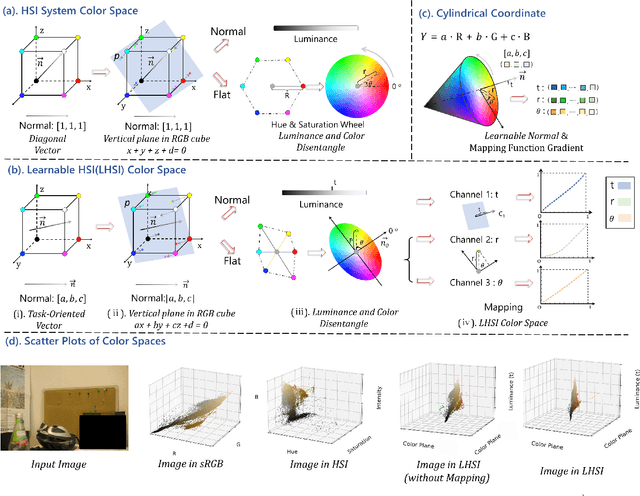
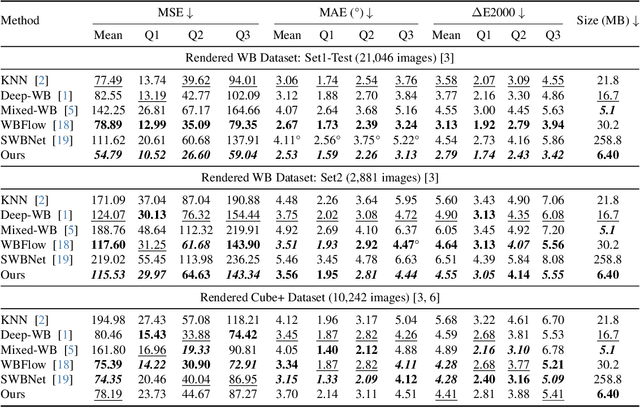
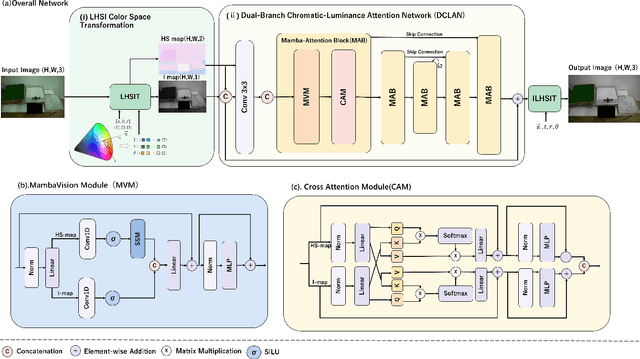
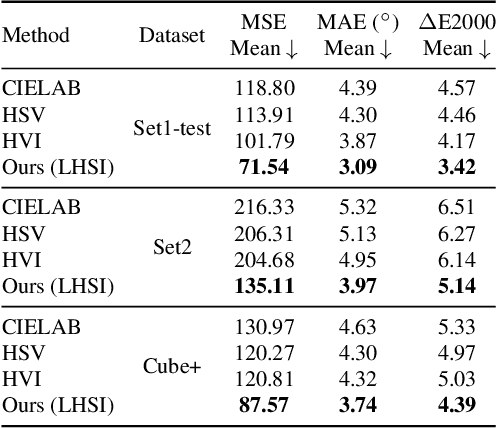
White balance (WB) is a key step in the image signal processor (ISP) pipeline that mitigates color casts caused by varying illumination and restores the scene's true colors. Currently, sRGB-based WB editing for post-ISP WB correction is widely used to address color constancy failures in the ISP pipeline when the original camera RAW is unavailable. However, additive color models (e.g., sRGB) are inherently limited by fixed nonlinear transformations and entangled color channels, which often impede their generalization to complex lighting conditions. To address these challenges, we propose a novel framework for WB correction that leverages a perception-inspired Learnable HSI (LHSI) color space. Built upon a cylindrical color model that naturally separates luminance from chromatic components, our framework further introduces dedicated parameters to enhance this disentanglement and learnable mapping to adaptively refine the flexibility. Moreover, a new Mamba-based network is introduced, which is tailored to the characteristics of the proposed LHSI color space. Experimental results on benchmark datasets demonstrate the superiority of our method, highlighting the potential of perception-inspired color space design in computational photography. The source code is available at https://github.com/YangCheng58/WB_Color_Space.
Spintronic Bayesian Hardware Driven by Stochastic Magnetic Domain Wall Dynamics
Jul 23, 2025As artificial intelligence (AI) advances into diverse applications, ensuring reliability of AI models is increasingly critical. Conventional neural networks offer strong predictive capabilities but produce deterministic outputs without inherent uncertainty estimation, limiting their reliability in safety-critical domains. Probabilistic neural networks (PNNs), which introduce randomness, have emerged as a powerful approach for enabling intrinsic uncertainty quantification. However, traditional CMOS architectures are inherently designed for deterministic operation and actively suppress intrinsic randomness. This poses a fundamental challenge for implementing PNNs, as probabilistic processing introduces significant computational overhead. To address this challenge, we introduce a Magnetic Probabilistic Computing (MPC) platform-an energy-efficient, scalable hardware accelerator that leverages intrinsic magnetic stochasticity for uncertainty-aware computing. This physics-driven strategy utilizes spintronic systems based on magnetic domain walls (DWs) and their dynamics to establish a new paradigm of physical probabilistic computing for AI. The MPC platform integrates three key mechanisms: thermally induced DW stochasticity, voltage controlled magnetic anisotropy (VCMA), and tunneling magnetoresistance (TMR), enabling fully electrical and tunable probabilistic functionality at the device level. As a representative demonstration, we implement a Bayesian Neural Network (BNN) inference structure and validate its functionality on CIFAR-10 classification tasks. Compared to standard 28nm CMOS implementations, our approach achieves a seven orders of magnitude improvement in the overall figure of merit, with substantial gains in area efficiency, energy consumption, and speed. These results underscore the MPC platform's potential to enable reliable and trustworthy physical AI systems.
The Tenth NTIRE 2025 Efficient Super-Resolution Challenge Report
Apr 14, 2025This paper presents a comprehensive review of the NTIRE 2025 Challenge on Single-Image Efficient Super-Resolution (ESR). The challenge aimed to advance the development of deep models that optimize key computational metrics, i.e., runtime, parameters, and FLOPs, while achieving a PSNR of at least 26.90 dB on the $\operatorname{DIV2K\_LSDIR\_valid}$ dataset and 26.99 dB on the $\operatorname{DIV2K\_LSDIR\_test}$ dataset. A robust participation saw \textbf{244} registered entrants, with \textbf{43} teams submitting valid entries. This report meticulously analyzes these methods and results, emphasizing groundbreaking advancements in state-of-the-art single-image ESR techniques. The analysis highlights innovative approaches and establishes benchmarks for future research in the field.
Stereophotoclinometry Revisited
Apr 11, 2025


Image-based surface reconstruction and characterization is crucial for missions to small celestial bodies, as it informs mission planning, navigation, and scientific analysis. However, current state-of-the-practice methods, such as stereophotoclinometry (SPC), rely heavily on human-in-the-loop verification and high-fidelity a priori information. This paper proposes Photoclinometry-from-Motion (PhoMo), a novel framework that incorporates photoclinometry techniques into a keypoint-based structure-from-motion (SfM) system to estimate the surface normal and albedo at detected landmarks to improve autonomous surface and shape characterization of small celestial bodies from in-situ imagery. In contrast to SPC, we forego the expensive maplet estimation step and instead use dense keypoint measurements and correspondences from an autonomous keypoint detection and matching method based on deep learning. Moreover, we develop a factor graph-based approach allowing for simultaneous optimization of the spacecraft's pose, landmark positions, Sun-relative direction, and surface normals and albedos via fusion of Sun vector measurements and image keypoint measurements. The proposed framework is validated on real imagery taken by the Dawn mission to the asteroid 4 Vesta and the minor planet 1 Ceres and compared against an SPC reconstruction, where we demonstrate superior rendering performance compared to an SPC solution and precise alignment to a stereophotogrammetry (SPG) solution without relying on any a priori camera pose and topography information or humans-in-the-loop.