 Add to Chrome
 Add to Firefox
 Add to Edge
Maturing Markov Decision Processes: Decision Making under Increasing Information and Shrinking Action Sets
Jun 17, 2026
Sequential decision problems often exhibit an asymmetric evolution of information and decision flexibility: as a decision cycle unfolds, the agent receives richer information while feasible actions expire due to operational cutoffs, commitments, or resource constraints. Standard MDP formulations typically flatten this structure into stage-dependent state descriptions and action masks, thereby obscuring the nested information--action asymmetry that determines which decisions are urgent and which can be deferred. We introduce Maturing Markov Decision Processes (MMDPs), a formulation built around this information--action asymmetry. We characterize one of its key consequences through an expiring-action priority principle, which identifies the actions that must be resolved before the next stage. Motivated by this structure, we develop a structure-aware reinforcement learning framework with stage-aware policy design, expiring-action abstraction, and search-augmented learning with distillation. Experiments on a controlled multi-supplier replenishment problem, simplified cash-management environments of increasing complexity, and a production-scale simulator show that explicitly modeling this asymmetry improves learning efficiency and becomes increasingly valuable as decision problems scale.

STDec: Spatio-Temporal Stability Guided Decoding for dLLMs
Apr 07, 2026Diffusion Large Language Models (dLLMs) have achieved rapid progress, viewed as a promising alternative to the autoregressive paradigm. However, most dLLM decoders still adopt a global confidence threshold, and do not explicitly model local context from neighboring decoded states or temporal consistency of predicted token IDs across steps. To address this issue, we propose a simple spatio-temporal stability guided decoding approach, named STDec. We observe strong spatio-temporal stability in dLLM decoding: newly decoded tokens tend to lie near decoded neighbors, and their predicted IDs often remain consistent across several denoising steps. Inspired by this stability, our STDec includes spatial-aware decoding and temporal-aware decoding. The spatial-aware decoding dynamically generates the token-adaptive threshold by aggregating the decoded states of nearby tokens. The temporal-aware decoding relaxes the decoding thresholds for tokens whose predicted token IDs remain consistent over denoising steps. Our STDec is training-free and remains compatible with cache-based acceleration methods. Across textual reasoning and multimodal understanding benchmarks, STDec substantially improves throughput while maintaining comparable task performance score. Notably, on MBPP with LLaDA, STDec achieves up to 14.17x speedup with a comparable score. Homepage: https://yzchen02.github.io/STDec.
Implicit and Explicit Language Guidance for Diffusion-based Visual Perception
Apr 11, 2024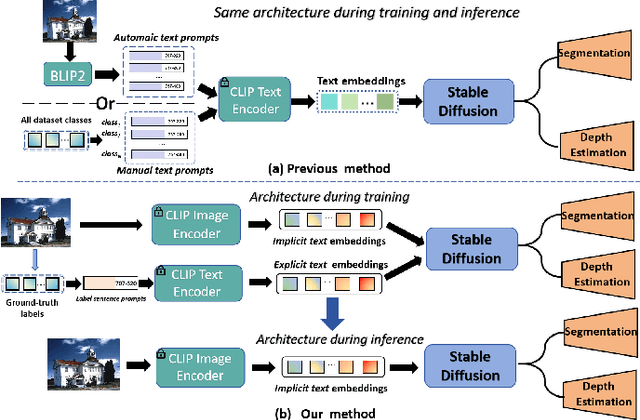
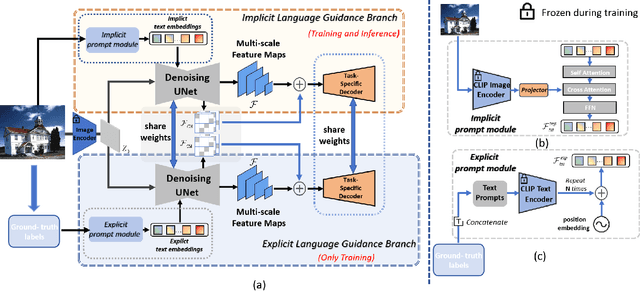
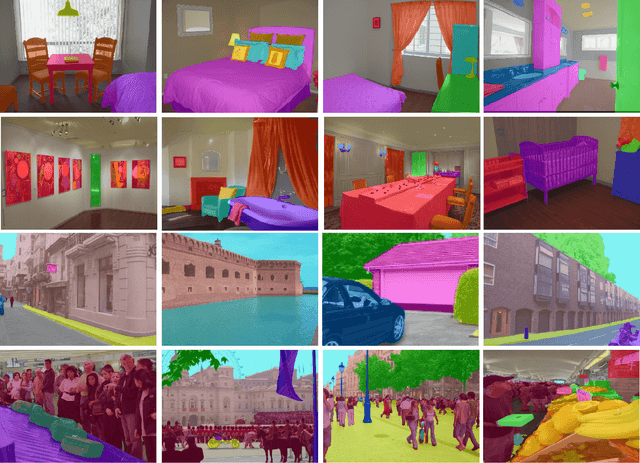
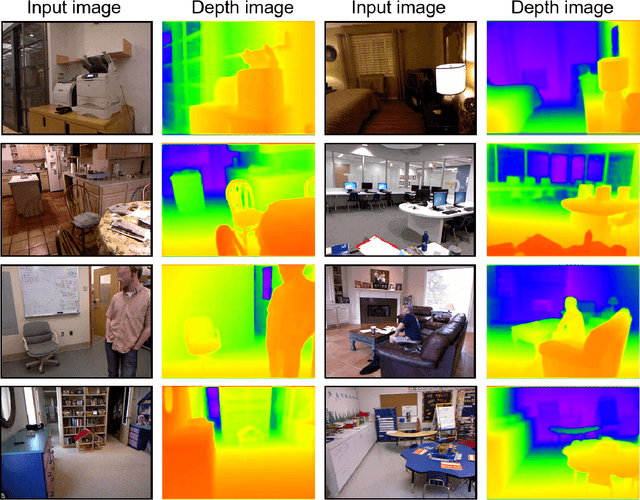
Text-to-image diffusion models have shown powerful ability on conditional image synthesis. With large-scale vision-language pre-training, diffusion models are able to generate high-quality images with rich texture and reasonable structure under different text prompts. However, it is an open problem to adapt the pre-trained diffusion model for visual perception. In this paper, we propose an implicit and explicit language guidance framework for diffusion-based perception, named IEDP. Our IEDP comprises of an implicit language guidance branch and an explicit language guidance branch. The implicit branch employs frozen CLIP image encoder to directly generate implicit text embeddings that are fed to diffusion model, without using explicit text prompts. The explicit branch utilizes the ground-truth labels of corresponding images as text prompts to condition feature extraction of diffusion model. During training, we jointly train diffusion model by sharing the model weights of these two branches. As a result, implicit and explicit branches can jointly guide feature learning. During inference, we only employ implicit branch for final prediction, which does not require any ground-truth labels. Experiments are performed on two typical perception tasks, including semantic segmentation and depth estimation. Our IEDP achieves promising performance on both tasks. For semantic segmentation, our IEDP has the mIoU score of 55.9% on AD20K validation set, which outperforms the baseline method VPD by 2.2%. For depth estimation, our IEDP outperforms the baseline method VPD with a relative gain of 10.2%.