 Add to Chrome
 Add to Firefox
 Add to Edge
Forecasting the Emergence and Evolution of Crash Hotspots: A Unified Deep Learning Framework for Proactive Traffic Safety
Jul 27, 2026
Road crashes remain among the gravest threats to public safety, and preventing them is a defining task of transportation systems worldwide. Much of that harm concentrates at hotspots, yet a hotspot is less a place than an episode; it emerges quietly at an intersection or along an arterial, intensifies for weeks, then subsides, only to reappear elsewhere. Enforcement guided by maps of past crashes inevitably trails this cycle, patrolling yesterday's hotspots while tomorrow's form unwatched. Breaking that lag requires three capabilities at once: detecting hotspots as they are born, forecasting where they will sit next week, and following each one through its life. We introduce HERALD (Hotspot Emergence, Risk Anticipation, and Life-cycle Dynamics), a unified deep learning framework that provides all three from a single statewide model. HERALD distills each county's recent crash history into weekly risk maps and forecasts the next with a CNN--Transformer, whose mixture-of-experts lets one model serve dense urban cores and sparse rural corridors alike. Each forecast is anchored in the county's long-run crash geography, sharpened by the self-exciting effect of recent crashes, and paired with explicit warnings of where new hotspots are about to appear. Followed over time, every hotspot acquires a legible life story, from birth through growth and stability to decline and death. Across six heterogeneous Wisconsin counties, HERALD forecasts more accurately than five identically trained baselines, locates hotspots most precisely, and flags emerging risks before they take hold. A single adjustable setting trades accuracy for extra sensitivity where deployment demands it. The result shifts hotspot management from mapping the past to anticipating the future.

Geometry-Aware Infrastructure-Anchored Denoiser for UWB Sensing and Work-Zone Reconstruction
Jul 05, 2026Accurate work-zone geometry perception is critical for intelligent transportation systems, and ultra-wideband sensing offers a low-cost approach for infrastructure-aided reconstruction. However, outdoor UWB ranging is often degraded by non-line-of-sight propagation, burst noise, and long-tail errors, which can distort downstream spatial reconstruction. We present GAIA, a geometry-aware, infrastructure-anchored learning framework that couples temporal range modeling with latent anchor-layout estimation and deterministic distance projection. GAIA preserves range denoising as the supervised task while orienting the learned distances toward boundary-consistent reconstruction. We evaluate GAIA on a real-world outdoor UWB dataset with synchronized UWB, GNSS, and IMU measurements, and further test robustness using a real-data-calibrated stress-test simulator. GAIA achieves the lowest overall range MSE and highest polygon IoU among evaluated filtering-based and learning-based baselines, reducing MSE by 18.4% and improving polygon IoU by 15.5% over PoseMLP. These results show that geometry-aware range denoising provides an effective path toward spatially coherent work-zone reconstruction.
V2I Work Zone Geometry Reconstruction with Pose-Conditioned UWB Range Denoising
May 28, 2026Reliable work zone mapping is important for connected and autonomous vehicles (CAVs) to navigate safely and smoothly through work zone areas. Cone-mounted ultra-wideband (UWB) roadside units (RSU) offer a cost-effective way for work zone layout inference, as roadside anchors and vehicle tags provide direct vehicle-to-infrastructure (V2I) range constraints for work zone geometry reconstruction. However, UWB range estimation is degraded by bursty outliers, non-line-of-sight (NLOS) errors, arbitrary anchor-ordering issues, and vehicle pose uncertainties in practical field deployments. To address these challenges, this study proposes a pose-conditioned, permutation-equivariant predictive denoiser for multi-anchor UWB ranging. The model employs shared anchor-wise temporal prediction to capture range dynamics, symmetric set aggregation to handle unordered and missing anchors, and pose-conditioned residual decoding to incorporate vehicle motion as a geometric prior. A two-stage training strategy first learns prediction from observed ranges, and then fine-tunes the denoiser with NLOS-weighted supervision. The method is evaluated on rare real-world V2I UWB field data collected with a CAV, as well as on controlled large-scale simulation benchmarks for ablative insights. Results show that the proposed method substantially improves range accuracy, cone localization, and work zone geometry reconstruction in challenging NLOS-dominated regimes, remains robust to anchor re-indexing and moderate anchor dropout, and reduces measurement-weighted field MSE by 66.9% relative to the raw input.
Behavior-Grounded Lane Representation Learning for Multi-Task Traffic Digital Twins
May 03, 2026Traffic digital twins are powerful tools for advanced traffic management, and most systems are built on static geometric representations. However, these representations fail to capture the dynamic functional semantics required for behavior-aware reasoning, such as how a lane operates under complex traffic conditions. To address this gap, we introduce GeoLaneRep, a behavior-grounded lane representation learning framework for traffic digital twins. GeoLaneRep jointly encodes static lane geometry, observed vehicle trajectories, and operational descriptors into a shared, cross-camera semantic embedding. The encoder is trained with a joint objective combining contrastive cross-camera alignment, auxiliary role supervision, and temporal anomaly detection. Across 16 roadside cameras and 132 lanes, the learned embeddings achieve a $0.004$ lateral-rank error and an edge-role F1 of $1.000$ in zero-shot cross-camera matching, and an AUROC of $0.991$ for window-level anomaly detection. We further show that the same behavioral embeddings can condition a diffusion-based generator to synthesize lane geometries that satisfy targeted operational specifications, with $87.9\%$ overall specification accuracy across 38 lane groups. GeoLaneRep thus provides a semantic interface between roadside observations and downstream digital twin tasks, supporting cross-camera transfer, behavior-aware monitoring, and goal-directed lane synthesis. The framework is openly available at https://github.com/raynbowy23/GeoLaneRep.
CrashSight: A Phase-Aware, Infrastructure-Centric Video Benchmark for Traffic Crash Scene Understanding and Reasoning
Apr 09, 2026Cooperative autonomous driving requires traffic scene understanding from both vehicle and infrastructure perspectives. While vision-language models (VLMs) show strong general reasoning capabilities, their performance in safety-critical traffic scenarios remains insufficiently evaluated due to the ego-vehicle focus of existing benchmarks. To bridge this gap, we present \textbf{CrashSight}, a large-scale vision-language benchmark for roadway crash understanding using real-world roadside camera data. The dataset comprises 250 crash videos, annotated with 13K multiple-choice question-answer pairs organized under a two-tier taxonomy. Tier 1 evaluates the visual grounding of scene context and involved parties, while Tier 2 probes higher-level reasoning, including crash mechanics, causal attribution, temporal progression, and post-crash outcomes. We benchmark 8 state-of-the-art VLMs and show that, despite strong scene description capabilities, current models struggle with temporal and causal reasoning in safety-critical scenarios. We provide a detailed analysis of failure scenarios and discuss directions for improving VLM crash understanding. The benchmark provides a standardized evaluation framework for infrastructure-assisted perception in cooperative autonomous driving. The CrashSight benchmark, including the full dataset and code, is accessible at https://mcgrche.github.io/crashsight.
V2X-QA: A Comprehensive Reasoning Dataset and Benchmark for Multimodal Large Language Models in Autonomous Driving Across Ego, Infrastructure, and Cooperative Views
Apr 03, 2026Multimodal large language models (MLLMs) have shown strong potential for autonomous driving, yet existing benchmarks remain largely ego-centric and therefore cannot systematically assess model performance in infrastructure-centric and cooperative driving conditions. In this work, we introduce V2X-QA, a real-world dataset and benchmark for evaluating MLLMs across vehicle-side, infrastructure-side, and cooperative viewpoints. V2X-QA is built around a view-decoupled evaluation protocol that enables controlled comparison under vehicle-only, infrastructure-only, and cooperative driving conditions within a unified multiple-choice question answering (MCQA) framework. The benchmark is organized into a twelve-task taxonomy spanning perception, prediction, and reasoning and planning, and is constructed through expert-verified MCQA annotation to enable fine-grained diagnosis of viewpoint-dependent capabilities. Benchmark results across ten representative state-of-the-art proprietary and open-source models show that viewpoint accessibility substantially affects performance, and infrastructure-side reasoning supports meaningful macroscopic traffic understanding. Results also indicate that cooperative reasoning remains challenging since it requires cross-view alignment and evidence integration rather than simply additional visual input. To address these challenges, we introduce V2X-MoE, a benchmark-aligned baseline with explicit view routing and viewpoint-specific LoRA experts. The strong performance of V2X-MoE further suggests that explicit viewpoint specialization is a promising direction for multi-view reasoning in autonomous driving. Overall, V2X-QA provides a foundation for studying multi-perspective reasoning, reliability, and cooperative physical intelligence in connected autonomous driving. The dataset and V2X-MoE resources are publicly available at: https://github.com/junwei0001/V2X-QA.
HERMES: A Holistic End-to-End Risk-Aware Multimodal Embodied System with Vision-Language Models for Long-Tail Autonomous Driving
Feb 01, 2026End-to-end autonomous driving models increasingly benefit from large vision--language models for semantic understanding, yet ensuring safe and accurate operation under long-tail conditions remains challenging. These challenges are particularly prominent in long-tail mixed-traffic scenarios, where autonomous vehicles must interact with heterogeneous road users, including human-driven vehicles and vulnerable road users, under complex and uncertain conditions. This paper proposes HERMES, a holistic risk-aware end-to-end multimodal driving framework designed to inject explicit long-tail risk cues into trajectory planning. HERMES employs a foundation-model-assisted annotation pipeline to produce structured Long-Tail Scene Context and Long-Tail Planning Context, capturing hazard-centric cues together with maneuver intent and safety preference, and uses these signals to guide end-to-end planning. HERMES further introduces a Tri-Modal Driving Module that fuses multi-view perception, historical motion cues, and semantic guidance, ensuring risk-aware accurate trajectory planning under long-tail scenarios. Experiments on the real-world long-tail dataset demonstrate that HERMES consistently outperforms representative end-to-end and VLM-driven baselines under long-tail mixed-traffic scenarios. Ablation studies verify the complementary contributions of key components.
V2X-REALM: Vision-Language Model-Based Robust End-to-End Cooperative Autonomous Driving with Adaptive Long-Tail Modeling
Jun 26, 2025Ensuring robust planning and decision-making under rare, diverse, and visually degraded long-tail scenarios remains a fundamental challenge for autonomous driving in urban environments. This issue becomes more critical in cooperative settings, where vehicles and infrastructure jointly perceive and reason across complex environments. To address this challenge, we propose V2X-REALM, a vision-language model (VLM)-based framework with adaptive multimodal learning for robust cooperative autonomous driving under long-tail scenarios. V2X-REALM introduces three core innovations: (i) a prompt-driven long-tail scenario generation and evaluation pipeline that leverages foundation models to synthesize realistic long-tail conditions such as snow and fog across vehicle- and infrastructure-side views, enriching training diversity efficiently; (ii) a gated multi-scenario adaptive attention module that modulates the visual stream using scenario priors to recalibrate ambiguous or corrupted features; and (iii) a multi-task scenario-aware contrastive learning objective that improves multimodal alignment and promotes cross-scenario feature separability. Extensive experiments demonstrate that V2X-REALM significantly outperforms existing baselines in robustness, semantic reasoning, safety, and planning accuracy under complex, challenging driving conditions, advancing the scalability of end-to-end cooperative autonomous driving.
Planning Safety Trajectories with Dual-Phase, Physics-Informed, and Transportation Knowledge-Driven Large Language Models
Apr 06, 2025Foundation models have demonstrated strong reasoning and generalization capabilities in driving-related tasks, including scene understanding, planning, and control. However, they still face challenges in hallucinations, uncertainty, and long inference latency. While existing foundation models have general knowledge of avoiding collisions, they often lack transportation-specific safety knowledge. To overcome these limitations, we introduce LetsPi, a physics-informed, dual-phase, knowledge-driven framework for safe, human-like trajectory planning. To prevent hallucinations and minimize uncertainty, this hybrid framework integrates Large Language Model (LLM) reasoning with physics-informed social force dynamics. LetsPi leverages the LLM to analyze driving scenes and historical information, providing appropriate parameters and target destinations (goals) for the social force model, which then generates the future trajectory. Moreover, the dual-phase architecture balances reasoning and computational efficiency through its Memory Collection phase and Fast Inference phase. The Memory Collection phase leverages the physics-informed LLM to process and refine planning results through reasoning, reflection, and memory modules, storing safe, high-quality driving experiences in a memory bank. Surrogate safety measures and physics-informed prompt techniques are introduced to enhance the LLM's knowledge of transportation safety and physical force, respectively. The Fast Inference phase extracts similar driving experiences as few-shot examples for new scenarios, while simplifying input-output requirements to enable rapid trajectory planning without compromising safety. Extensive experiments using the HighD dataset demonstrate that LetsPi outperforms baseline models across five safety metrics.See PDF for project Github link.
V2X-LLM: Enhancing V2X Integration and Understanding in Connected Vehicle Corridors
Mar 04, 2025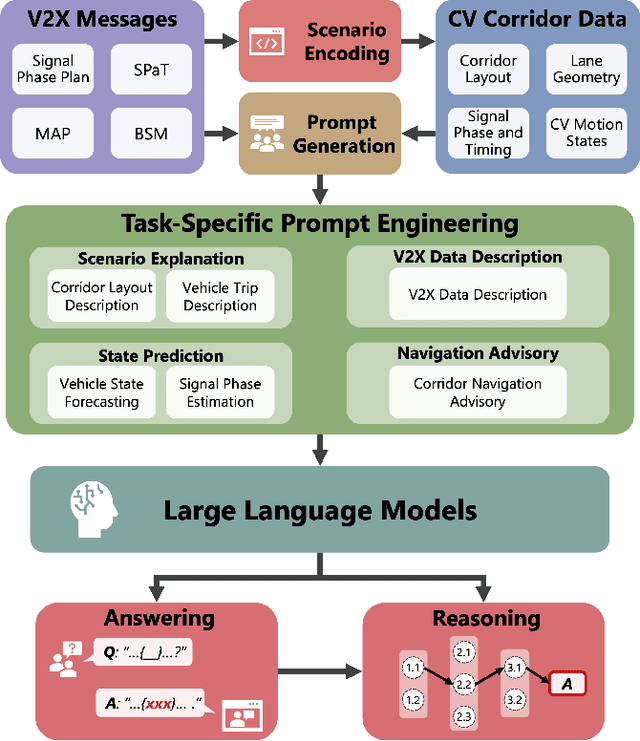
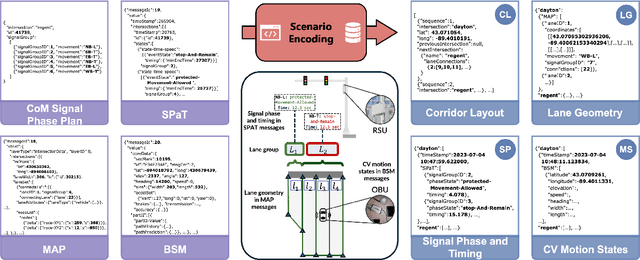

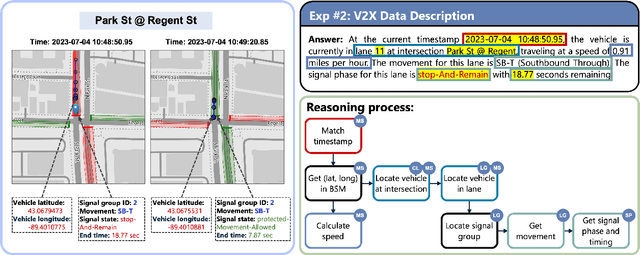
The advancement of Connected and Automated Vehicles (CAVs) and Vehicle-to-Everything (V2X) offers significant potential for enhancing transportation safety, mobility, and sustainability. However, the integration and analysis of the diverse and voluminous V2X data, including Basic Safety Messages (BSMs) and Signal Phase and Timing (SPaT) data, present substantial challenges, especially on Connected Vehicle Corridors. These challenges include managing large data volumes, ensuring real-time data integration, and understanding complex traffic scenarios. Although these projects have developed an advanced CAV data pipeline that enables real-time communication between vehicles, infrastructure, and other road users for managing connected vehicle and roadside unit (RSU) data, significant hurdles in data comprehension and real-time scenario analysis and reasoning persist. To address these issues, we introduce the V2X-LLM framework, a novel enhancement to the existing CV data pipeline. V2X-LLM leverages Large Language Models (LLMs) to improve the understanding and real-time analysis of V2X data. The framework includes four key tasks: Scenario Explanation, offering detailed narratives of traffic conditions; V2X Data Description, detailing vehicle and infrastructure statuses; State Prediction, forecasting future traffic states; and Navigation Advisory, providing optimized routing instructions. By integrating LLM-driven reasoning with V2X data within the data pipeline, the V2X-LLM framework offers real-time feedback and decision support for traffic management. This integration enhances the accuracy of traffic analysis, safety, and traffic optimization. Demonstrations in a real-world urban corridor highlight the framework's potential to advance intelligent transportation systems.