 Add to Chrome
 Add to Firefox
 Add to Edge
SpecTran: Spectral-Aware Transformer-based Adapter for LLM-Enhanced Sequential Recommendation
Jan 29, 2026
Traditional sequential recommendation (SR) models learn low-dimensional item ID embeddings from user-item interactions, often overlooking textual information such as item titles or descriptions. Recent advances in Large Language Models (LLMs) have inspired a surge of research that encodes item textual information with high-dimensional semantic embeddings, and designs transformation methods to inject such embeddings into SR models. These embedding transformation strategies can be categorized into two types, both of which exhibits notable drawbacks: 1) adapter-based methods suffer from pronounced dimension collapse, concentrating information into a few dominant dimensions; 2) SVD-based methods are rigid and manual, considering only a few principal spectral components while discarding rich information in the remaining spectrum. To address these limitations, we propose SpecTran, a spectral-aware transformer-based adapter that operates in the spectral domain, attending to the full spectrum to select and aggregates informative components. A learnable spectral-position encoding injects singular-value cues as an inductive bias, guiding attention toward salient spectral components and promoting diversity across embedding dimensions. Across four real-world datasets and three SR backbones, it consistently outperforms strong baselines, achieving an average improvement of 9.17%.

Talos: Optimizing Top-$K$ Accuracy in Recommender Systems
Jan 27, 2026Recommender systems (RS) aim to retrieve a small set of items that best match individual user preferences. Naturally, RS place primary emphasis on the quality of the Top-$K$ results rather than performance across the entire item set. However, estimating Top-$K$ accuracy (e.g., Precision@$K$, Recall@$K$) requires determining the ranking positions of items, which imposes substantial computational overhead and poses significant challenges for optimization. In addition, RS often suffer from distribution shifts due to evolving user preferences or data biases, further complicating the task. To address these issues, we propose Talos, a loss function that is specifically designed to optimize the Talos recommendation accuracy. Talos leverages a quantile technique that replaces the complex ranking-dependent operations into simpler comparisons between predicted scores and learned score thresholds. We further develop a sampling-based regression algorithm for efficient and accurate threshold estimation, and introduce a constraint term to maintain optimization stability by preventing score inflation. Additionally, we incorporate a tailored surrogate function to address discontinuity and enhance robustness against distribution shifts. Comprehensive theoretical analyzes and empirical experiments are conducted to demonstrate the effectiveness, efficiency, convergence, and distributional robustness of Talos. The code is available at https://github.com/cynthia-shengjia/WWW-2026-Talos.
TopKGAT: A Top-K Objective-Driven Architecture for Recommendation
Jan 26, 2026Recommendation systems (RS) aim to retrieve the top-K items most relevant to users, with metrics such as Precision@K and Recall@K commonly used to assess effectiveness. The architecture of an RS model acts as an inductive bias, shaping the patterns the model is inclined to learn. In recent years, numerous recommendation architectures have emerged, spanning traditional matrix factorization, deep neural networks, and graph neural networks. However, their designs are often not explicitly aligned with the top-K objective, thereby limiting their effectiveness. To address this limitation, we propose TopKGAT, a novel recommendation architecture directly derived from a differentiable approximation of top-K metrics. The forward computation of a single TopKGAT layer is intrinsically aligned with the gradient ascent dynamics of the Precision@K metric, enabling the model to naturally improve top-K recommendation accuracy. Structurally, TopKGAT resembles a graph attention network and can be implemented efficiently. Extensive experiments on four benchmark datasets demonstrate that TopKGAT consistently outperforms state-of-the-art baselines. The code is available at https://github.com/StupidThree/TopKGAT.
ReCreate: Reasoning and Creating Domain Agents Driven by Experience
Jan 16, 2026Large Language Model agents are reshaping the industrial landscape. However, most practical agents remain human-designed because tasks differ widely, making them labor-intensive to build. This situation poses a central question: can we automatically create and adapt domain agents in the wild? While several recent approaches have sought to automate agent creation, they typically treat agent generation as a black-box procedure and rely solely on final performance metrics to guide the process. Such strategies overlook critical evidence explaining why an agent succeeds or fails, and often require high computational costs. To address these limitations, we propose ReCreate, an experience-driven framework for the automatic creation of domain agents. ReCreate systematically leverages agent interaction histories, which provide rich concrete signals on both the causes of success or failure and the avenues for improvement. Specifically, we introduce an agent-as-optimizer paradigm that effectively learns from experience via three key components: (i) an experience storage and retrieval mechanism for on-demand inspection; (ii) a reasoning-creating synergy pipeline that maps execution experience into scaffold edits; and (iii) hierarchical updates that abstract instance-level details into reusable domain patterns. In experiments across diverse domains, ReCreate consistently outperforms human-designed agents and existing automated agent generation methods, even when starting from minimal seed scaffolds.
Milestones over Outcome: Unlocking Geometric Reasoning with Sub-Goal Verifiable Reward
Jan 08, 2026Multimodal Large Language Models (MLLMs) struggle with complex geometric reasoning, largely because "black box" outcome-based supervision fails to distinguish between lucky guesses and rigorous deduction. To address this, we introduce a paradigm shift towards subgoal-level evaluation and learning. We first construct GeoGoal, a benchmark synthesized via a rigorous formal verification data engine, which converts abstract proofs into verifiable numeric subgoals. This structure reveals a critical divergence between reasoning quality and outcome accuracy. Leveraging this, we propose the Sub-Goal Verifiable Reward (SGVR) framework, which replaces sparse signals with dense rewards based on the Skeleton Rate. Experiments demonstrate that SGVR not only enhances geometric performance (+9.7%) but also exhibits strong generalization, transferring gains to general math (+8.0%) and other general reasoning tasks (+2.8%), demonstrating broad applicability across diverse domains.
MindWatcher: Toward Smarter Multimodal Tool-Integrated Reasoning
Dec 29, 2025Traditional workflow-based agents exhibit limited intelligence when addressing real-world problems requiring tool invocation. Tool-integrated reasoning (TIR) agents capable of autonomous reasoning and tool invocation are rapidly emerging as a powerful approach for complex decision-making tasks involving multi-step interactions with external environments. In this work, we introduce MindWatcher, a TIR agent integrating interleaved thinking and multimodal chain-of-thought (CoT) reasoning. MindWatcher can autonomously decide whether and how to invoke diverse tools and coordinate their use, without relying on human prompts or workflows. The interleaved thinking paradigm enables the model to switch between thinking and tool calling at any intermediate stage, while its multimodal CoT capability allows manipulation of images during reasoning to yield more precise search results. We implement automated data auditing and evaluation pipelines, complemented by manually curated high-quality datasets for training, and we construct a benchmark, called MindWatcher-Evaluate Bench (MWE-Bench), to evaluate its performance. MindWatcher is equipped with a comprehensive suite of auxiliary reasoning tools, enabling it to address broad-domain multimodal problems. A large-scale, high-quality local image retrieval database, covering eight categories including cars, animals, and plants, endows model with robust object recognition despite its small size. Finally, we design a more efficient training infrastructure for MindWatcher, enhancing training speed and hardware utilization. Experiments not only demonstrate that MindWatcher matches or exceeds the performance of larger or more recent models through superior tool invocation, but also uncover critical insights for agent training, such as the genetic inheritance phenomenon in agentic RL.
SWE-RM: Execution-free Feedback For Software Engineering Agents
Dec 26, 2025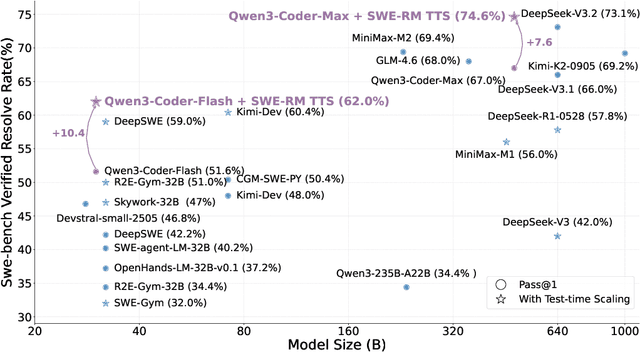
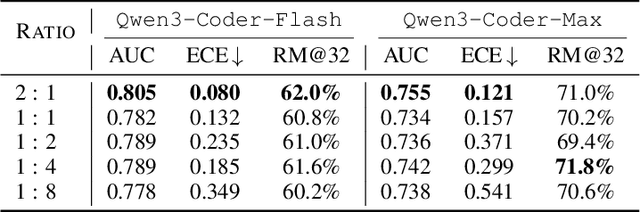
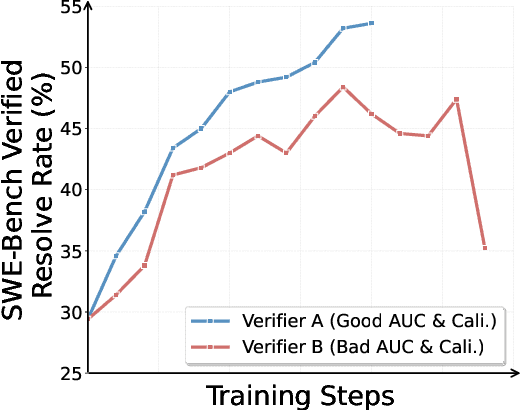
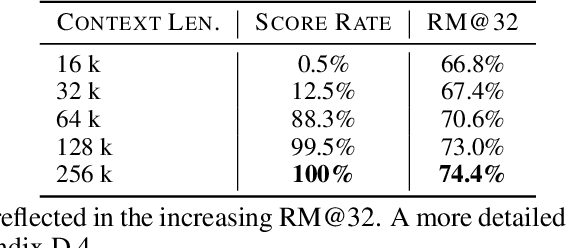
Execution-based feedback like unit testing is widely used in the development of coding agents through test-time scaling (TTS) and reinforcement learning (RL). This paradigm requires scalable and reliable collection of unit test cases to provide accurate feedback, and the resulting feedback is often sparse and cannot effectively distinguish between trajectories that are both successful or both unsuccessful. In contrast, execution-free feedback from reward models can provide more fine-grained signals without depending on unit test cases. Despite this potential, execution-free feedback for realistic software engineering (SWE) agents remains underexplored. Aiming to develop versatile reward models that are effective across TTS and RL, however, we observe that two verifiers with nearly identical TTS performance can nevertheless yield very different results in RL. Intuitively, TTS primarily reflects the model's ability to select the best trajectory, but this ability does not necessarily generalize to RL. To address this limitation, we identify two additional aspects that are crucial for RL training: classification accuracy and calibration. We then conduct comprehensive controlled experiments to investigate how to train a robust reward model that performs well across these metrics. In particular, we analyze the impact of various factors such as training data scale, policy mixtures, and data source composition. Guided by these investigations, we introduce SWE-RM, an accurate and robust reward model adopting a mixture-of-experts architecture with 30B total parameters and 3B activated during inference. SWE-RM substantially improves SWE agents on both TTS and RL performance. For example, it increases the accuracy of Qwen3-Coder-Flash from 51.6% to 62.0%, and Qwen3-Coder-Max from 67.0% to 74.6% on SWE-Bench Verified using TTS, achieving new state-of-the-art performance among open-source models.
Tree of Preferences for Diversified Recommendation
Dec 24, 2025Diversified recommendation has attracted increasing attention from both researchers and practitioners, which can effectively address the homogeneity of recommended items. Existing approaches predominantly aim to infer the diversity of user preferences from observed user feedback. Nonetheless, due to inherent data biases, the observed data may not fully reflect user interests, where underexplored preferences can be overwhelmed or remain unmanifested. Failing to capture these preferences can lead to suboptimal diversity in recommendations. To fill this gap, this work aims to study diversified recommendation from a data-bias perspective. Inspired by the outstanding performance of large language models (LLMs) in zero-shot inference leveraging world knowledge, we propose a novel approach that utilizes LLMs' expertise to uncover underexplored user preferences from observed behavior, ultimately providing diverse and relevant recommendations. To achieve this, we first introduce Tree of Preferences (ToP), an innovative structure constructed to model user preferences from coarse to fine. ToP enables LLMs to systematically reason over the user's rationale behind their behavior, thereby uncovering their underexplored preferences. To guide diversified recommendations using uncovered preferences, we adopt a data-centric approach, identifying candidate items that match user preferences and generating synthetic interactions that reflect underexplored preferences. These interactions are integrated to train a general recommender for diversification. Moreover, we scale up overall efficiency by dynamically selecting influential users during optimization. Extensive evaluations of both diversity and relevance show that our approach outperforms existing methods in most cases and achieves near-optimal performance in others, with reasonable inference latency.
Who Can See Through You? Adversarial Shielding Against VLM-Based Attribute Inference Attacks
Dec 20, 2025As vision-language models (VLMs) become widely adopted, VLM-based attribute inference attacks have emerged as a serious privacy concern, enabling adversaries to infer private attributes from images shared on social media. This escalating threat calls for dedicated protection methods to safeguard user privacy. However, existing methods often degrade the visual quality of images or interfere with vision-based functions on social media, thereby failing to achieve a desirable balance between privacy protection and user experience. To address this challenge, we propose a novel protection method that jointly optimizes privacy suppression and utility preservation under a visual consistency constraint. While our method is conceptually effective, fair comparisons between methods remain challenging due to the lack of publicly available evaluation datasets. To fill this gap, we introduce VPI-COCO, a publicly available benchmark comprising 522 images with hierarchically structured privacy questions and corresponding non-private counterparts, enabling fine-grained and joint evaluation of protection methods in terms of privacy preservation and user experience. Building upon this benchmark, experiments on multiple VLMs demonstrate that our method effectively reduces PAR below 25%, keeps NPAR above 88%, maintains high visual consistency, and generalizes well to unseen and paraphrased privacy questions, demonstrating its strong practical applicability for real-world VLM deployments.
Task-Specific Sparse Feature Masks for Molecular Toxicity Prediction with Chemical Language Models
Dec 12, 2025Reliable in silico molecular toxicity prediction is a cornerstone of modern drug discovery, offering a scalable alternative to experimental screening. However, the black-box nature of state-of-the-art models remains a significant barrier to adoption, as high-stakes safety decisions demand verifiable structural insights alongside predictive performance. To address this, we propose a novel multi-task learning (MTL) framework designed to jointly enhance accuracy and interpretability. Our architecture integrates a shared chemical language model with task-specific attention modules. By imposing an L1 sparsity penalty on these modules, the framework is constrained to focus on a minimal set of salient molecular fragments for each distinct toxicity endpoint. The resulting framework is trained end-to-end and is readily adaptable to various transformer-based backbones. Evaluated on the ClinTox, SIDER, and Tox21 benchmark datasets, our approach consistently outperforms both single-task and standard MTL baselines. Crucially, the sparse attention weights provide chemically intuitive visualizations that reveal the specific fragments influencing predictions, thereby enhancing insight into the model's decision-making process.