 Add to Chrome
 Add to Firefox
 Add to Edge
ChainSpace: A Chained-Reasoning Paradigm for Spatial Intelligence
Aug 16, 2026
Spatial intelligence requires foundation models to maintain coherent spatial state across interactions with the physical world. However, existing data-centric approaches typically treat spatial reasoning as independent question-answer instances, enabling shortcut-based answering and providing limited supervision for persistent spatial understanding. To address this, we introduce ChainSpace, a chained-reasoning paradigm that structures spatial reasoning as a state-preserving multi-round process. In this paradigm, spatial questions are organized into logically constrained and jointly consistent chains, where later questions depend on spatial constraints established in earlier rounds. Following this principle, we instantiate ChainSpace-Bench, a manually annotated real-world multi-round benchmark with a Chain-Aware Metric, and ChainSpace-Pipeline, a simulator-based chain-structured supervision generation framework for spatial intelligence training. Experiments show that ChainSpace-Bench exposes chain-level failures that are not captured by isolated question accuracy. Additionally, with a relatively small amount of simulator-generated chained data, models trained by ChainSpace-Pipeline achieve the best performance among open-source models on ChainSpace-Bench and transfer competitively to multiple external spatial intelligence benchmarks. These results establish ChainSpace as an effective paradigm for more faithful evaluation and more data-efficient learning of spatial intelligence.

StreamingClaw Technical Report
Mar 23, 2026Applications such as embodied intelligence rely on a real-time perception-decision-action closed loop, posing stringent challenges for streaming video understanding. However, current agents suffer from fragmented capabilities, such as supporting only offline video understanding, lacking long-term multimodal memory mechanisms, or struggling to achieve real-time reasoning and proactive interaction under streaming inputs. These shortcomings have become a key bottleneck for preventing them from sustaining perception, making real-time decisions, and executing actions in real-world environments. To alleviate these issues, we propose StreamingClaw, a unified agent framework for streaming video understanding and embodied intelligence. It is also an OpenClaw-compatible framework that supports real-time, multimodal streaming interaction. StreamingClaw integrates five core capabilities: (1) It supports real-time streaming reasoning. (2) It supports reasoning about future events and proactive interaction under the online evolution of interaction objectives. (3) It supports multimodal long-term storage, hierarchical evolution, and efficient retrieval of shared memory across multiple agents. (4) It supports a closed-loop of perception-decision-action. In addition to conventional tools and skills, it also provides streaming tools and action-centric skills tailored for real-world physical environments. (5) It is compatible with the OpenClaw framework, allowing it to fully leverage the resources and support of the open-source community. With these designs, StreamingClaw integrates online real-time reasoning, multimodal long-term memory, and proactive interaction within a unified framework. Moreover, by translating decisions into executable actions, it enables direct control of the physical world, supporting practical deployment of embodied interaction.
MindWatcher: Toward Smarter Multimodal Tool-Integrated Reasoning
Dec 29, 2025Traditional workflow-based agents exhibit limited intelligence when addressing real-world problems requiring tool invocation. Tool-integrated reasoning (TIR) agents capable of autonomous reasoning and tool invocation are rapidly emerging as a powerful approach for complex decision-making tasks involving multi-step interactions with external environments. In this work, we introduce MindWatcher, a TIR agent integrating interleaved thinking and multimodal chain-of-thought (CoT) reasoning. MindWatcher can autonomously decide whether and how to invoke diverse tools and coordinate their use, without relying on human prompts or workflows. The interleaved thinking paradigm enables the model to switch between thinking and tool calling at any intermediate stage, while its multimodal CoT capability allows manipulation of images during reasoning to yield more precise search results. We implement automated data auditing and evaluation pipelines, complemented by manually curated high-quality datasets for training, and we construct a benchmark, called MindWatcher-Evaluate Bench (MWE-Bench), to evaluate its performance. MindWatcher is equipped with a comprehensive suite of auxiliary reasoning tools, enabling it to address broad-domain multimodal problems. A large-scale, high-quality local image retrieval database, covering eight categories including cars, animals, and plants, endows model with robust object recognition despite its small size. Finally, we design a more efficient training infrastructure for MindWatcher, enhancing training speed and hardware utilization. Experiments not only demonstrate that MindWatcher matches or exceeds the performance of larger or more recent models through superior tool invocation, but also uncover critical insights for agent training, such as the genetic inheritance phenomenon in agentic RL.
LDGen: Enhancing Text-to-Image Synthesis via Large Language Model-Driven Language Representation
Feb 25, 2025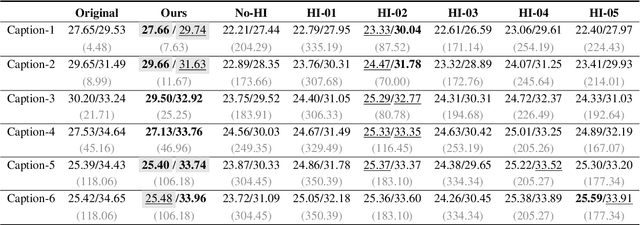
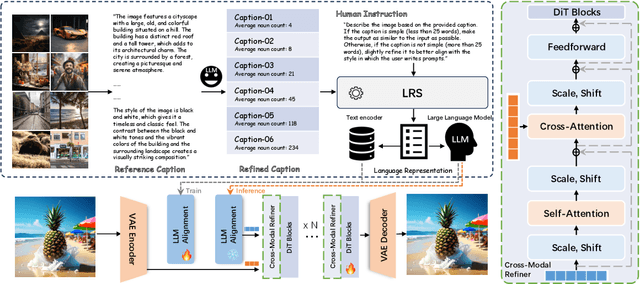
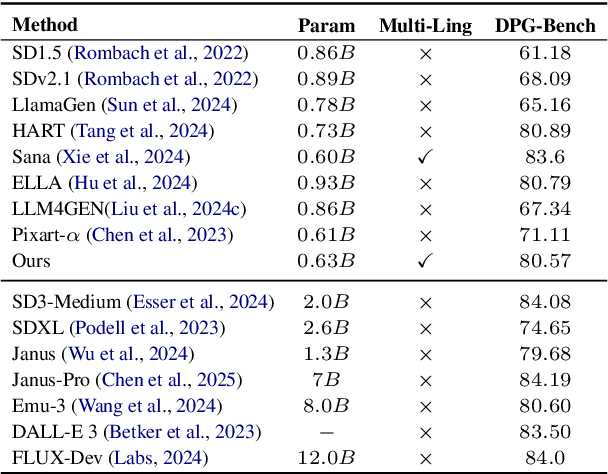
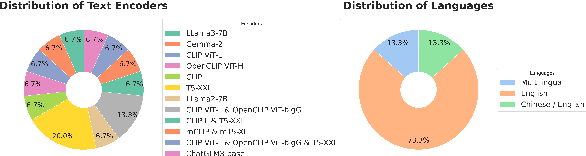
In this paper, we introduce LDGen, a novel method for integrating large language models (LLMs) into existing text-to-image diffusion models while minimizing computational demands. Traditional text encoders, such as CLIP and T5, exhibit limitations in multilingual processing, hindering image generation across diverse languages. We address these challenges by leveraging the advanced capabilities of LLMs. Our approach employs a language representation strategy that applies hierarchical caption optimization and human instruction techniques to derive precise semantic information,. Subsequently, we incorporate a lightweight adapter and a cross-modal refiner to facilitate efficient feature alignment and interaction between LLMs and image features. LDGen reduces training time and enables zero-shot multilingual image generation. Experimental results indicate that our method surpasses baseline models in both prompt adherence and image aesthetic quality, while seamlessly supporting multiple languages. Project page: https://zrealli.github.io/LDGen.