 Add to Chrome
 Add to Firefox
 Add to Edge
Evolve as a Team: Collaborative Self-Evolution for LLM-based Multi-Agent Systems
May 28, 2026
LLM-based multi-agent systems (MAS) have emerged as an effective paradigm for complex and long-horizon tasks. However, in real-world tasks, MAS often exhibit various failures during execution and such failures are difficult to eliminate during design. This motivates experience-driven MAS evolution, where a system improves based on its own execution experience. Yet such evolution is challenging because MAS experience is prolonged and intricate, interleaving multiple agents' execution chains and communication messages, which makes it difficult to identify what should be improved. To address this challenge, we propose Meta-Team, an experience-driven MAS evolution framework based on collaborative self-evolution. Meta-Team preserves the execution context of each agent and coordinates post-task communication, enabling agents to exchange distributed evidence for evolution. Building on this design, Meta-Team conducts multi-scale self-evolution, transforming execution experience into reusable improvements to agent behaviors, inter-agent coordination, and team-level organization. Across six long-horizon agent benchmarks, Meta-Team consistently outperforms single-agent systems, hand-crafted MAS, and prior MAS evolution methods; further analyses demonstrate that Meta-Team enables more reliable and scalable MAS self-evolution.

Meta-Cognitive Memory Policy Optimization for Long-Horizon LLM Agents
May 28, 2026Memory-augmented LLM agents tackle complex long-horizon tasks by recursively summarizing interaction trajectories into compact memory. However, existing approaches typically train these memory policies using outcome-based reinforcement learning, failing to localize where intermediate memory quality degrades. As interactions unfold, ambiguous recursive summaries progressively discard task-relevant information and introduce semantic noise. This exacerbates belief deviation, obscuring the agent's estimate of the latent task state and ultimately derailing long-horizon reasoning. We therefore argue that memory optimization should focus not merely on trajectory-level success, but on the clarity of the belief induced by intermediate summaries. To this end, we introduce Belief Entropy, a self-supervised proxy that probes how uncertain the model remains about the latent task state given its current memory. Based on this proxy, we propose Metacognitive Memory Policy Optimization (MMPO). Instead of relying only on sparse outcome-based signals, MMPO provides fine-grained, memory-specific supervision via explicitly penalizing summaries that induce high epistemic uncertainty. Experiments show that MMPO consistently outperforms existing methods on diverse long-horizon tasks, maintaining 97.1% performance even when scaled to 1.75M-token contexts.
PDEAgent-Bench: A Multi-Metric, Multi-Library Benchmark for PDE Solver Generation
May 10, 2026PDE-to-solver code generation aims to automatically synthesize executable numerical solvers from partial differential equation (PDE) specifications. This task requires not only understanding the mathematical structure of PDEs, but also selecting appropriate discretization schemes and solver configurations, and correctly implementing the resulting formulations in finite-element method (FEM) libraries. Existing code generation benchmarks mainly evaluate syntactic correctness, or success on predefined test cases. To our knowledge, there is currently no publicly available benchmark specifically for PDE-to-solver code generation, and general-purpose code benchmarks do not fully capture the unique challenges of numerical PDE solution, such as ensuring solver accuracy, efficiency, and compatibility with professional FEM libraries. We introduce PDEAgent-Bench, to the best of our knowledge, the first multi-metric, multi-library benchmark for PDE-to-solver code generation. PDEAgent-Bench contains 645 instances across 6 mathematical categories and 11 PDE families, with common FEM libraries for DOLFINx, Firedrake, and deal.II. Each instance provides an agent-facing problem specification, a reference solution on a prescribed evaluation grid, and case-specific accuracy and runtime targets. PDEAgent-Bench adopts a staged evaluation framework in which generated solvers must sequentially pass executability, numerical accuracy, and computational efficiency checks. Experiments with representative LLMs and code agents show that models can often produce runnable code, but their pass rate drops substantially once accuracy and efficiency requirements are enforced. These results indicate that current agents remain limited in producing numerically reliable and efficient PDE solvers, and that PDEAgent-Bench provides a reproducible testbed grounded in the practical requirements of numerical PDE solving.
LEPO: Latent Reasoning Policy Optimization for Large Language Models
Apr 21, 2026Recently, latent reasoning has been introduced into large language models (LLMs) to leverage rich information within a continuous space. However, without stochastic sampling, these methods inevitably collapse to deterministic inference, failing to discover diverse reasoning paths. To bridge the gap, we inject controllable stochasticity into latent reasoning via Gumbel-Softmax, restoring LLMs' exploratory capacity and enhancing their compatibility with Reinforcement Learning (RL). Building on this, we propose \textbf{\underline{L}}atent R\textbf{\underline{e}}asoning \textbf{\underline{P}}olicy \textbf{\underline{O}}ptimization~(\textbf{LEPO}), a novel framework that applies RL directly to continuous latent representations. Specifically, in rollout stage, LEPO maintains stochasticity to enable diverse trajectory sampling, while in optimization stage, LEPO constructs a unified gradient estimation for both latent representations and discrete tokens. Extensive experiments show that LEPO significantly outperforms existing RL methods for discrete and latent reasoning.
Scaling Human-AI Coding Collaboration Requires a Governable Consensus Layer
Apr 20, 2026Vibe coding produces correct, executable code at speed, but leaves no record of the structural commitments, dependencies, or evidence behind it. Reviewers cannot determine what invariants were assumed, what changed, or why a regression occurred. This is not a generation failure but a control failure: the dominant artifact of AI-assisted development (code plus chat history) performs dimension collapse, flattening complex system topology into low-dimensional text and making systems opaque and fragile under change. We propose Agentic Consensus: a paradigm in which the consensus layer C, an operable world model represented as a typed property graph, replaces code as the primary artifact of engineering. Executable artifacts are derived from C and kept in correspondence via synchronization operators Phi (realize) and Psi (rehydrate). Evidence links directly to structural claims in C, making every commitment auditable and under-specification explicit as measurable consensus entropy rather than a silent guess. Evaluation must move beyond code correctness toward alignment fidelity, consensus entropy, and intervention distance. We propose benchmark task families designed to measure whether consensus-based workflows reduce human intervention compared to chat-driven baselines.
DSO: Dual-Scale Neural Operators for Stable Long-term Fluid Dynamics Forecasting
Mar 26, 2026Long-term fluid dynamics forecasting is a critically important problem in science and engineering. While neural operators have emerged as a promising paradigm for modeling systems governed by partial differential equations (PDEs), they often struggle with long-term stability and precision. We identify two fundamental failure modes in existing architectures: (1) local detail blurring, where fine-scale structures such as vortex cores and sharp gradients are progressively smoothed, and (2) global trend deviation, where the overall motion trajectory drifts from the ground truth during extended rollouts. We argue that these failures arise because existing neural operators treat local and global information processing uniformly, despite their inherently different evolution characteristics in physical systems. To bridge this gap, we propose the Dual-Scale Neural Operator (DSO), which explicitly decouples information processing into two complementary modules: depthwise separable convolutions for fine-grained local feature extraction and an MLP-Mixer for long-range global aggregation. Through numerical experiments on vortex dynamics, we demonstrate that nearby perturbations primarily affect local vortex structure while distant perturbations influence global motion trends, providing empirical validation for our design choice. Extensive experiments on turbulent flow benchmarks show that DSO achieves state-of-the-art accuracy while maintaining robust long-term stability, reducing prediction error by over 88% compared to existing neural operators.
ReCreate: Reasoning and Creating Domain Agents Driven by Experience
Jan 16, 2026Large Language Model agents are reshaping the industrial landscape. However, most practical agents remain human-designed because tasks differ widely, making them labor-intensive to build. This situation poses a central question: can we automatically create and adapt domain agents in the wild? While several recent approaches have sought to automate agent creation, they typically treat agent generation as a black-box procedure and rely solely on final performance metrics to guide the process. Such strategies overlook critical evidence explaining why an agent succeeds or fails, and often require high computational costs. To address these limitations, we propose ReCreate, an experience-driven framework for the automatic creation of domain agents. ReCreate systematically leverages agent interaction histories, which provide rich concrete signals on both the causes of success or failure and the avenues for improvement. Specifically, we introduce an agent-as-optimizer paradigm that effectively learns from experience via three key components: (i) an experience storage and retrieval mechanism for on-demand inspection; (ii) a reasoning-creating synergy pipeline that maps execution experience into scaffold edits; and (iii) hierarchical updates that abstract instance-level details into reusable domain patterns. In experiments across diverse domains, ReCreate consistently outperforms human-designed agents and existing automated agent generation methods, even when starting from minimal seed scaffolds.
Uncertainty-Aware Graph Structure Learning
Feb 19, 2025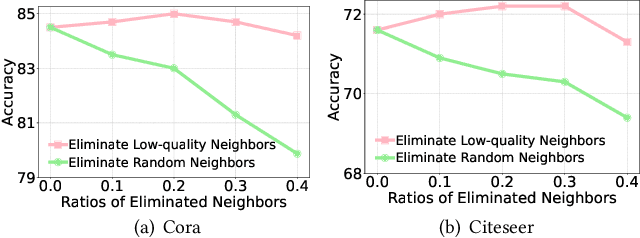

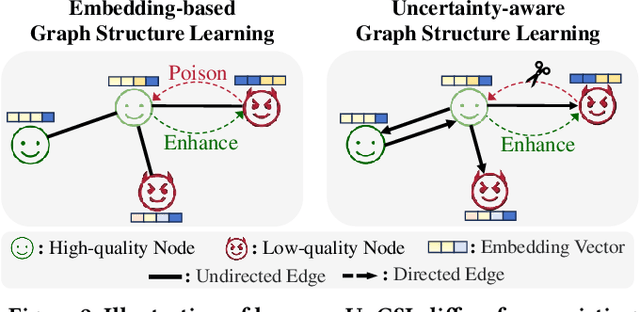
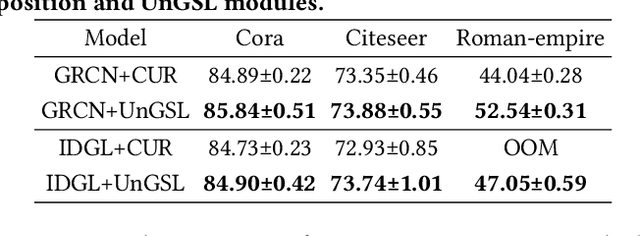
Graph Neural Networks (GNNs) have become a prominent approach for learning from graph-structured data. However, their effectiveness can be significantly compromised when the graph structure is suboptimal. To address this issue, Graph Structure Learning (GSL) has emerged as a promising technique that refines node connections adaptively. Nevertheless, we identify two key limitations in existing GSL methods: 1) Most methods primarily focus on node similarity to construct relationships, while overlooking the quality of node information. Blindly connecting low-quality nodes and aggregating their ambiguous information can degrade the performance of other nodes. 2) The constructed graph structures are often constrained to be symmetric, which may limit the model's flexibility and effectiveness. To overcome these limitations, we propose an Uncertainty-aware Graph Structure Learning (UnGSL) strategy. UnGSL estimates the uncertainty of node information and utilizes it to adjust the strength of directional connections, where the influence of nodes with high uncertainty is adaptively reduced. Importantly, UnGSL serves as a plug-in module that can be seamlessly integrated into existing GSL methods with minimal additional computational cost. In our experiments, we implement UnGSL into six representative GSL methods, demonstrating consistent performance improvements.
Acceleration Algorithms in GNNs: A Survey
May 07, 2024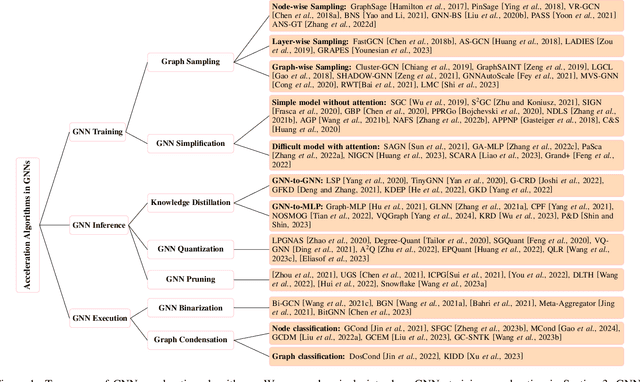
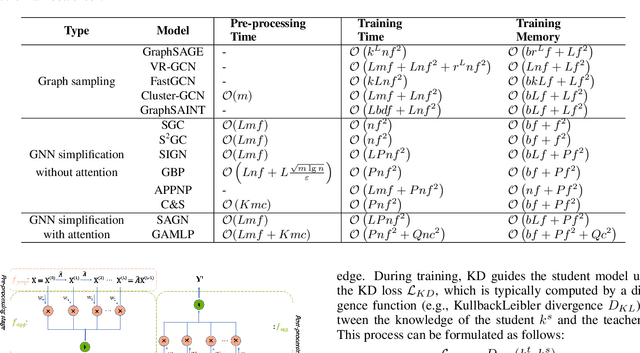
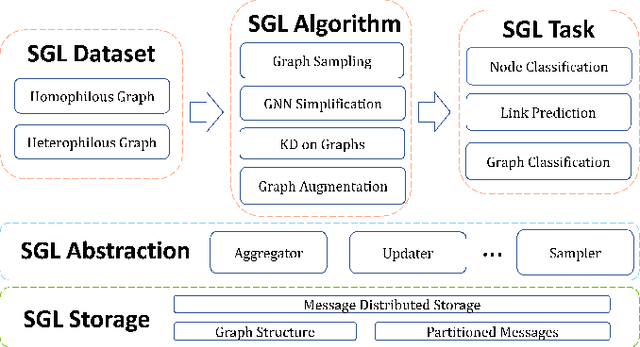
Graph Neural Networks (GNNs) have demonstrated effectiveness in various graph-based tasks. However, their inefficiency in training and inference presents challenges for scaling up to real-world and large-scale graph applications. To address the critical challenges, a range of algorithms have been proposed to accelerate training and inference of GNNs, attracting increasing attention from the research community. In this paper, we present a systematic review of acceleration algorithms in GNNs, which can be categorized into three main topics based on their purpose: training acceleration, inference acceleration, and execution acceleration. Specifically, we summarize and categorize the existing approaches for each main topic, and provide detailed characterizations of the approaches within each category. Additionally, we review several libraries related to acceleration algorithms in GNNs and discuss our Scalable Graph Learning (SGL) library. Finally, we propose promising directions for future research. A complete summary is presented in our GitHub repository: https://github.com/PKU-DAIR/SGL/blob/main/Awsome-GNN-Acceleration.md.
Multi-class Support Vector Machine with Maximizing Minimum Margin
Dec 15, 2023
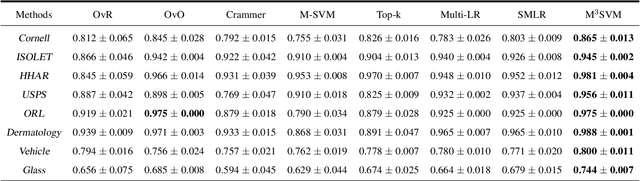
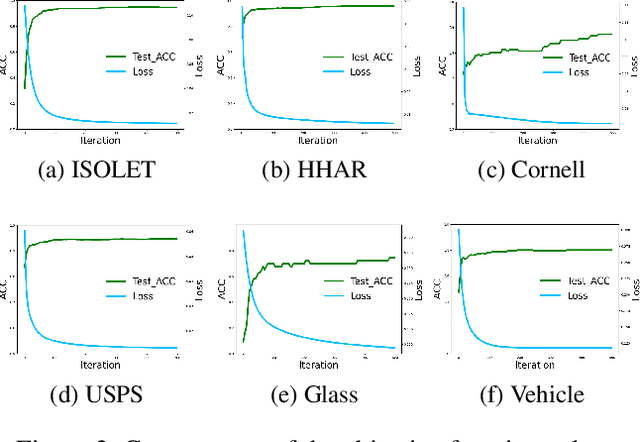
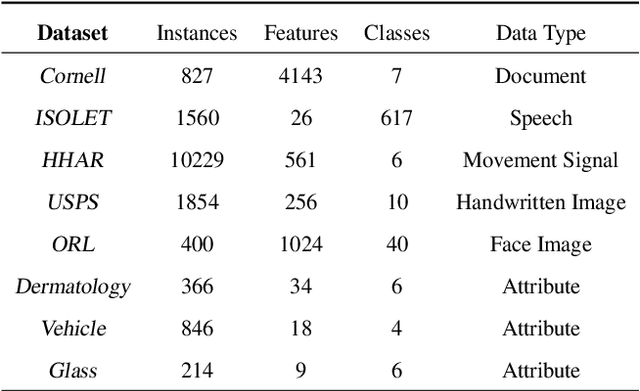
Support Vector Machine (SVM) stands out as a prominent machine learning technique widely applied in practical pattern recognition tasks. It achieves binary classification by maximizing the "margin", which represents the minimum distance between instances and the decision boundary. Although many efforts have been dedicated to expanding SVM for multi-class case through strategies such as one versus one and one versus the rest, satisfactory solutions remain to be developed. In this paper, we propose a novel method for multi-class SVM that incorporates pairwise class loss considerations and maximizes the minimum margin. Adhering to this concept, we embrace a new formulation that imparts heightened flexibility to multi-class SVM. Furthermore, the correlations between the proposed method and multiple forms of multi-class SVM are analyzed. The proposed regularizer, akin to the concept of "margin", can serve as a seamless enhancement over the softmax in deep learning, providing guidance for network parameter learning. Empirical evaluations demonstrate the effectiveness and superiority of our proposed method over existing multi-classification methods.Code is available at https://github.com/zz-haooo/M3SVM.