 Add to Chrome
 Add to Firefox
 Add to Edge
Explaining black box text modules in natural language with language models
May 17, 2023
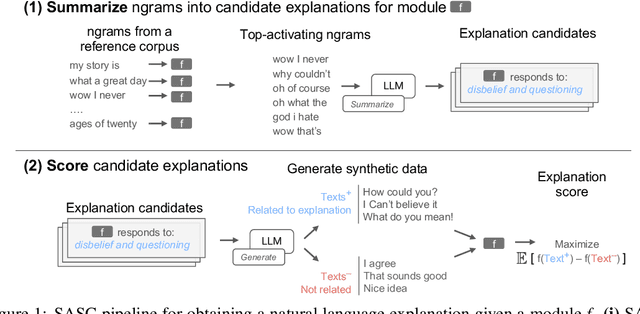
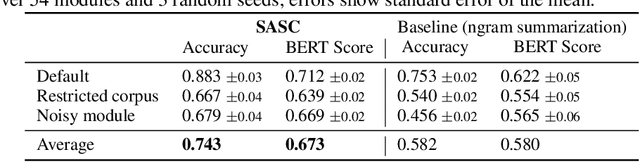

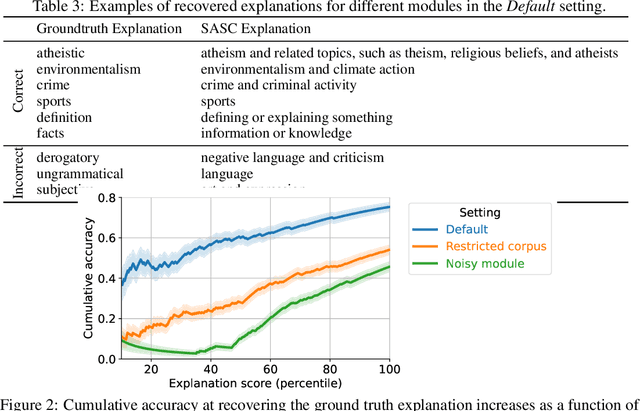
Large language models (LLMs) have demonstrated remarkable prediction performance for a growing array of tasks. However, their rapid proliferation and increasing opaqueness have created a growing need for interpretability. Here, we ask whether we can automatically obtain natural language explanations for black box text modules. A "text module" is any function that maps text to a scalar continuous value, such as a submodule within an LLM or a fitted model of a brain region. "Black box" indicates that we only have access to the module's inputs/outputs. We introduce Summarize and Score (SASC), a method that takes in a text module and returns a natural language explanation of the module's selectivity along with a score for how reliable the explanation is. We study SASC in 3 contexts. First, we evaluate SASC on synthetic modules and find that it often recovers ground truth explanations. Second, we use SASC to explain modules found within a pre-trained BERT model, enabling inspection of the model's internals. Finally, we show that SASC can generate explanations for the response of individual fMRI voxels to language stimuli, with potential applications to fine-grained brain mapping. All code for using SASC and reproducing results is made available on Github.

Chain-of-Skills: A Configurable Model for Open-domain Question Answering
May 04, 2023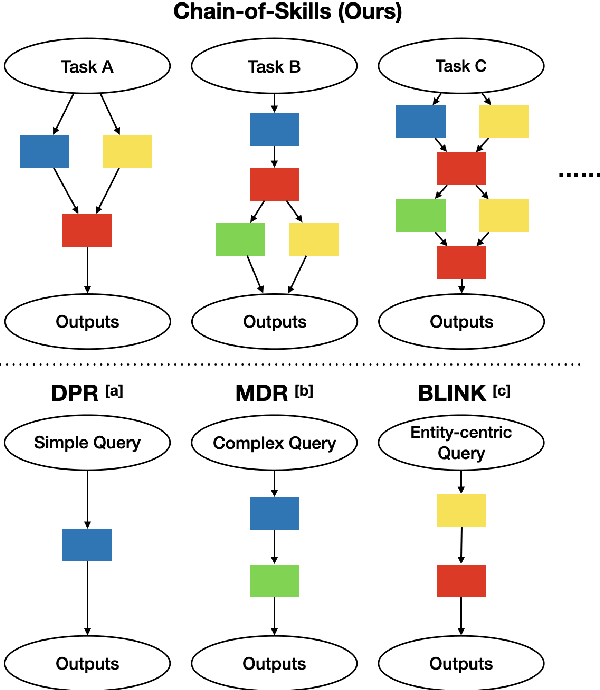


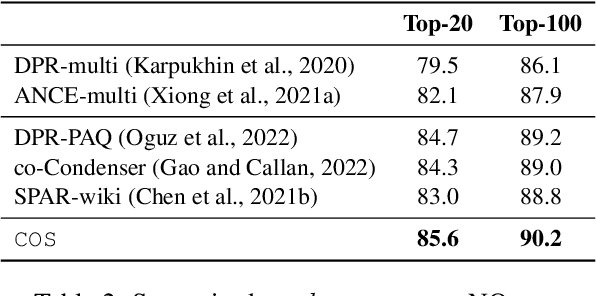
The retrieval model is an indispensable component for real-world knowledge-intensive tasks, e.g., open-domain question answering (ODQA). As separate retrieval skills are annotated for different datasets, recent work focuses on customized methods, limiting the model transferability and scalability. In this work, we propose a modular retriever where individual modules correspond to key skills that can be reused across datasets. Our approach supports flexible skill configurations based on the target domain to boost performance. To mitigate task interference, we design a novel modularization parameterization inspired by sparse Transformer. We demonstrate that our model can benefit from self-supervised pretraining on Wikipedia and fine-tuning using multiple ODQA datasets, both in a multi-task fashion. Our approach outperforms recent self-supervised retrievers in zero-shot evaluations and achieves state-of-the-art fine-tuned retrieval performance on NQ, HotpotQA and OTT-QA.
Segment Everything Everywhere All at Once
May 01, 2023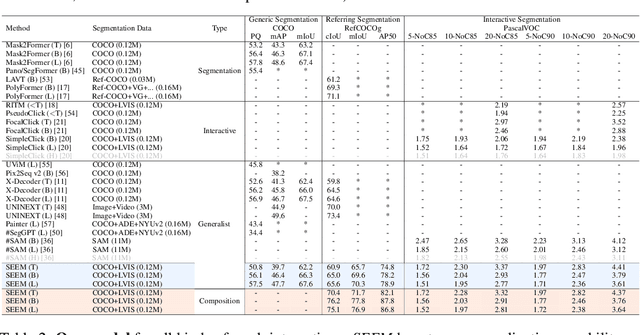
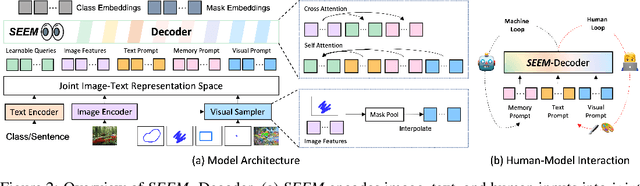
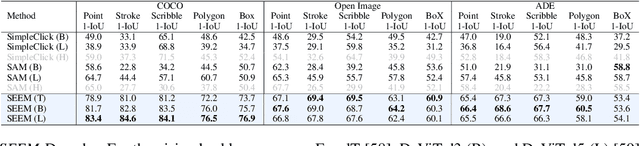
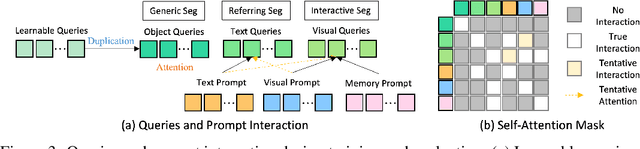
Despite the growing demand for interactive AI systems, there have been few comprehensive studies on human-AI interaction in visual understanding e.g. segmentation. Inspired by the development of prompt-based universal interfaces for LLMs, this paper presents SEEM, a promptable, interactive model for Segmenting Everything Everywhere all at once in an image. SEEM has four desiderata: i) Versatility: by introducing a versatile prompting engine for different types of prompts, including points, boxes, scribbles, masks, texts, and referred regions of another image; ii) Compositionality: by learning a joint visual-semantic space for visual and textual prompts to compose queries on the fly for inference as shown in Fig 1; iii)Interactivity: by incorporating learnable memory prompts to retain dialog history information via mask-guided cross-attention; and iv) Semantic-awareness: by using a text encoder to encode text queries and mask labels for open-vocabulary segmentation.
ArK: Augmented Reality with Knowledge Interactive Emergent Ability
May 01, 2023
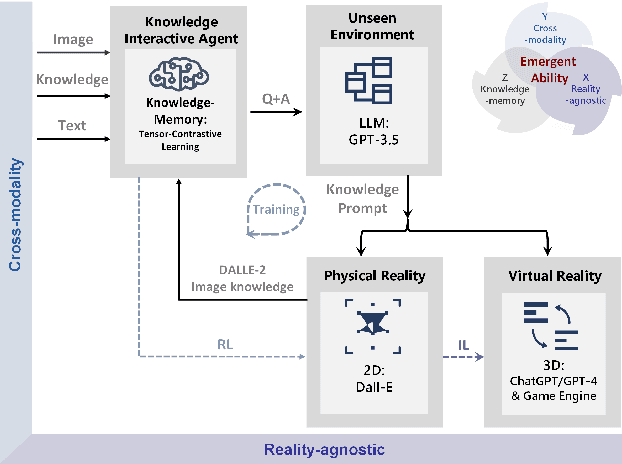

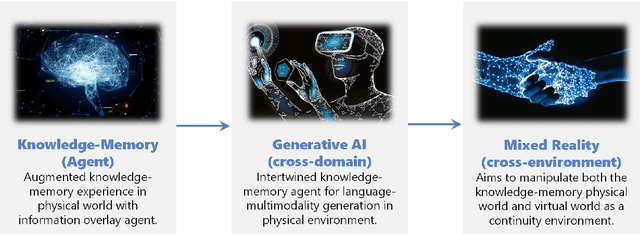
Despite the growing adoption of mixed reality and interactive AI agents, it remains challenging for these systems to generate high quality 2D/3D scenes in unseen environments. The common practice requires deploying an AI agent to collect large amounts of data for model training for every new task. This process is costly, or even impossible, for many domains. In this study, we develop an infinite agent that learns to transfer knowledge memory from general foundation models (e.g. GPT4, DALLE) to novel domains or scenarios for scene understanding and generation in the physical or virtual world. The heart of our approach is an emerging mechanism, dubbed Augmented Reality with Knowledge Inference Interaction (ArK), which leverages knowledge-memory to generate scenes in unseen physical world and virtual reality environments. The knowledge interactive emergent ability (Figure 1) is demonstrated as the observation learns i) micro-action of cross-modality: in multi-modality models to collect a large amount of relevant knowledge memory data for each interaction task (e.g., unseen scene understanding) from the physical reality; and ii) macro-behavior of reality-agnostic: in mix-reality environments to improve interactions that tailor to different characterized roles, target variables, collaborative information, and so on. We validate the effectiveness of ArK on the scene generation and editing tasks. We show that our ArK approach, combined with large foundation models, significantly improves the quality of generated 2D/3D scenes, compared to baselines, demonstrating the potential benefit of incorporating ArK in generative AI for applications such as metaverse and gaming simulation.
Chameleon: Plug-and-Play Compositional Reasoning with Large Language Models
Apr 19, 2023Large language models (LLMs) have achieved remarkable progress in various natural language processing tasks with emergent abilities. However, they face inherent limitations, such as an inability to access up-to-date information, utilize external tools, or perform precise mathematical reasoning. In this paper, we introduce Chameleon, a plug-and-play compositional reasoning framework that augments LLMs to help address these challenges. Chameleon synthesizes programs to compose various tools, including LLM models, off-the-shelf vision models, web search engines, Python functions, and rule-based modules tailored to user interests. Built on top of an LLM as a natural language planner, Chameleon infers the appropriate sequence of tools to compose and execute in order to generate a final response. We showcase the adaptability and effectiveness of Chameleon on two tasks: ScienceQA and TabMWP. Notably, Chameleon with GPT-4 achieves an 86.54% accuracy on ScienceQA, significantly improving upon the best published few-shot model by 11.37%; using GPT-4 as the underlying LLM, Chameleon achieves a 17.8% increase over the state-of-the-art model, leading to a 98.78% overall accuracy on TabMWP. Further studies suggest that using GPT-4 as a planner exhibits more consistent and rational tool selection and is able to infer potential constraints given the instructions, compared to other LLMs like ChatGPT.
Bridging Discrete and Backpropagation: Straight-Through and Beyond
Apr 17, 2023Backpropagation, the cornerstone of deep learning, is limited to computing gradients solely for continuous variables. This limitation hinders various research on problems involving discrete latent variables. To address this issue, we propose a novel approach for approximating the gradient of parameters involved in generating discrete latent variables. First, we examine the widely used Straight-Through (ST) heuristic and demonstrate that it works as a first-order approximation of the gradient. Guided by our findings, we propose a novel method called ReinMax, which integrates Heun's Method, a second-order numerical method for solving ODEs, to approximate the gradient. Our method achieves second-order accuracy without requiring Hessian or other second-order derivatives. We conduct experiments on structured output prediction and unsupervised generative modeling tasks. Our results show that \ours brings consistent improvements over the state of the art, including ST and Straight-Through Gumbel-Softmax. Implementations are released at https://github.com/microsoft/ReinMax.
Instruction Tuning with GPT-4
Apr 06, 2023Prior work has shown that finetuning large language models (LLMs) using machine-generated instruction-following data enables such models to achieve remarkable zero-shot capabilities on new tasks, and no human-written instructions are needed. In this paper, we present the first attempt to use GPT-4 to generate instruction-following data for LLM finetuning. Our early experiments on instruction-tuned LLaMA models show that the 52K English and Chinese instruction-following data generated by GPT-4 leads to superior zero-shot performance on new tasks to the instruction-following data generated by previous state-of-the-art models. We also collect feedback and comparison data from GPT-4 to enable a comprehensive evaluation and reward model training. We make our data generated using GPT-4 as well as our codebase publicly available.
Pre-training Transformers for Knowledge Graph Completion
Mar 28, 2023Learning transferable representation of knowledge graphs (KGs) is challenging due to the heterogeneous, multi-relational nature of graph structures. Inspired by Transformer-based pretrained language models' success on learning transferable representation for texts, we introduce a novel inductive KG representation model (iHT) for KG completion by large-scale pre-training. iHT consists of a entity encoder (e.g., BERT) and a neighbor-aware relational scoring function both parameterized by Transformers. We first pre-train iHT on a large KG dataset, Wikidata5M. Our approach achieves new state-of-the-art results on matched evaluations, with a relative improvement of more than 25% in mean reciprocal rank over previous SOTA models. When further fine-tuned on smaller KGs with either entity and relational shifts, pre-trained iHT representations are shown to be transferable, significantly improving the performance on FB15K-237 and WN18RR.
A Simple Framework for Open-Vocabulary Segmentation and Detection
Mar 20, 2023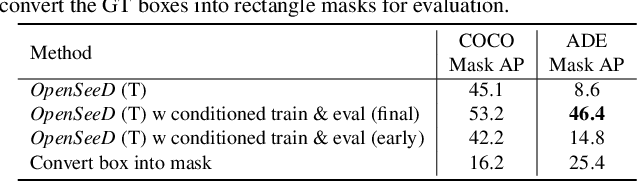
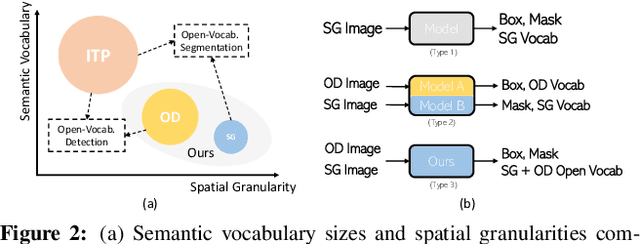
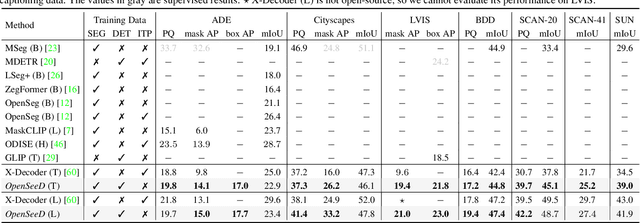
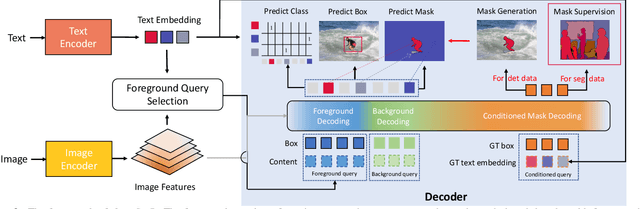
We present OpenSeeD, a simple Open-vocabulary Segmentation and Detection framework that jointly learns from different segmentation and detection datasets. To bridge the gap of vocabulary and annotation granularity, we first introduce a pre-trained text encoder to encode all the visual concepts in two tasks and learn a common semantic space for them. This gives us reasonably good results compared with the counterparts trained on segmentation task only. To further reconcile them, we locate two discrepancies: $i$) task discrepancy -- segmentation requires extracting masks for both foreground objects and background stuff, while detection merely cares about the former; $ii$) data discrepancy -- box and mask annotations are with different spatial granularity, and thus not directly interchangeable. To address these issues, we propose a decoupled decoding to reduce the interference between foreground/background and a conditioned mask decoding to assist in generating masks for given boxes. To this end, we develop a simple encoder-decoder model encompassing all three techniques and train it jointly on COCO and Objects365. After pre-training, our model exhibits competitive or stronger zero-shot transferability for both segmentation and detection. Specifically, OpenSeeD beats the state-of-the-art method for open-vocabulary instance and panoptic segmentation across 5 datasets, and outperforms previous work for open-vocabulary detection on LVIS and ODinW under similar settings. When transferred to specific tasks, our model achieves new SoTA for panoptic segmentation on COCO and ADE20K, and instance segmentation on ADE20K and Cityscapes. Finally, we note that OpenSeeD is the first to explore the potential of joint training on segmentation and detection, and hope it can be received as a strong baseline for developing a single model for both tasks in open world.
Interactive Text Generation
Mar 17, 2023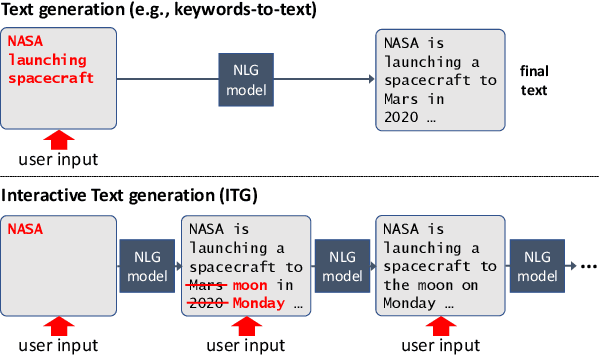
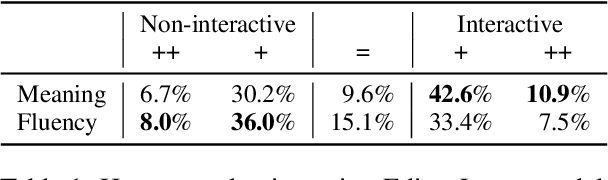
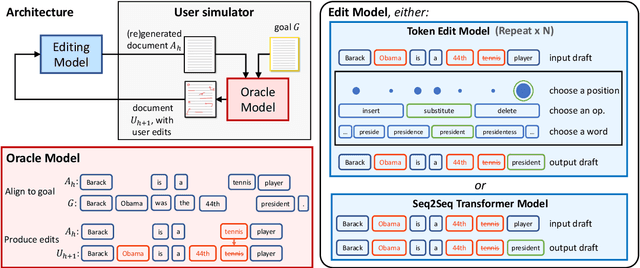
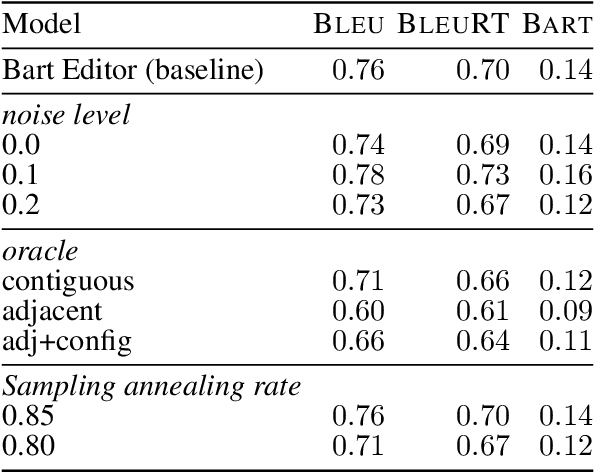
Users interact with text, image, code, or other editors on a daily basis. However, machine learning models are rarely trained in the settings that reflect the interactivity between users and their editor. This is understandable as training AI models with real users is not only slow and costly, but what these models learn may be specific to user interface design choices. Unfortunately, this means most of the research on text, code, and image generation has focused on non-interactive settings, whereby the model is expected to get everything right without accounting for any input from a user who may be willing to help. We introduce a new Interactive Text Generation task that allows training generation models interactively without the costs of involving real users, by using user simulators that provide edits that guide the model towards a given target text. We train our interactive models using Imitation Learning, and our experiments against competitive non-interactive generation models show that models trained interactively are superior to their non-interactive counterparts, even when all models are given the same budget of user inputs or edits.