 Add to Chrome
 Add to Firefox
 Add to Edge
VideoNet: A Large-Scale Dataset for Domain-Specific Action Recognition
May 05, 2026
Videos are unique in their ability to capture actions which transcend multiple frames. Accordingly, for many years action recognition was the quintessential task for video understanding. Unfortunately, due to a lack of sufficiently diverse and challenging data, modern vision-language models (VLMs) are no longer evaluated on their action recognition capabilities. To revitalize action recognition in the era of VLMs, we advocate for a returned focus on domain-specific actions. To this end, we introduce VideoNet, a domain-specific action recognition benchmark covering 1,000 distinct actions from 37 domains. We begin with a multiple-choice evaluation setting, where the difference between closed and open models is stark: Gemini 3.1 Pro attains 69.9% accuracy while Qwen3-VL-8B gets a mere 45.0%. To understand why VLMs struggle on VideoNet, we relax the questions into a binary setting, where random chance is 50%. Still, Qwen achieves only 59.2% accuracy. Further relaxing the evaluation setup, we provide $k\in\{1,2,3\}$ in-context examples of the action. Some models excel in the few-shot setting, while others falter; Qwen improves $+7.0\%$, while Gemini declines $-4.8\%$. Notably, these gains fall short of the $+13.6\%$ improvement in non-expert humans when given few-shot examples. Finding that VLMs struggle to fully exploit in-context examples, we shift from test-time improvements to the training side. We collect the first large-scale training dataset for domain-specific actions, totaling nearly 500k video question-answer pairs. Fine-tuning a Molmo2-4B model on our data, we surpass all open-weight 8B models on the VideoNet benchmark.

MolmoAct2: Action Reasoning Models for Real-world Deployment
May 04, 2026Vision-Language-Action (VLA) models aim to provide a single generalist controller for robots, but today's systems fall short on the criteria that matter for real-world deployment. Frontier models are closed, open-weight alternatives are tied to expensive hardware, reasoning-augmented policies pay prohibitive latency for their grounding, and fine-tuned success rates remain below the threshold for dependable use. We present MolmoAct2, a fully open action reasoning model built for practical deployment, advancing its predecessor along five axes. We introduce MolmoER, a VLM backbone specialized for spatial and embodied reasoning, trained on a 3.3M-sample corpus with a specialize-then-rehearse recipe. We release three new datasets spanning low-to-medium cost platforms, including MolmoAct2-BimanualYAM, 720 hours of teleoperated bimanual trajectories that constitute the largest open bimanual dataset to date, together with quality-filtered Franka (DROID) and SO100/101 subsets. We provide OpenFAST, an open-weight, open-data action tokenizer trained on millions of trajectories across five embodiments. We redesign the architecture to graft a flow-matching continuous-action expert onto a discrete-token VLM via per-layer KV-cache conditioning. Finally, we propose MolmoThink, an adaptive-depth reasoning variant that re-predicts depth tokens only for scene regions that change between timesteps, retaining geometric grounding at a fraction of prior latency. In the most extensive empirical study of any open VLA to date, spanning 7 simulation and real-world benchmarks, MolmoAct2 outperforms strong baselines including Pi-05, while MolmoER surpasses GPT-5 and Gemini Robotics ER-1.5 across 13 embodied-reasoning benchmarks. We release model weights, training code, and complete training data. Project page: https://allenai.org/blog/molmoact2
MolmoPoint: Better Pointing for VLMs with Grounding Tokens
Mar 30, 2026Grounding has become a fundamental capability of vision-language models (VLMs). Most existing VLMs point by generating coordinates as part of their text output, which requires learning a complicated coordinate system and results in a high token count. Instead, we propose a more intuitive pointing mechanism that directly selects the visual tokens that contain the target concept. Our model generates a special pointing token that cross-attends to the input image or video tokens and selects the appropriate one. To make this model more fine-grained, we follow these pointing tokens with an additional special token that selects a fine-grained subpatch within the initially selected region, and then a third token that specifies a location within that subpatch. We further show that performance improves by generating points sequentially in a consistent order, encoding the relative position of the previously selected point, and including a special no-more-points class when selecting visual tokens. Using this method, we set a new state-of-the-art on image pointing (70.7% on PointBench), set a new state-of-the-art among fully open models on GUI pointing (61.1% on ScreenSpotPro), and improve video pointing (59.1% human preference win rate vs. a text coordinate baseline) and tracking (+6.3% gain on Molmo2Track). We additionally show that our method achieves much higher sample efficiency and discuss the qualitative differences that emerge from this design change.
Molmo2: Open Weights and Data for Vision-Language Models with Video Understanding and Grounding
Jan 15, 2026Today's strongest video-language models (VLMs) remain proprietary. The strongest open-weight models either rely on synthetic data from proprietary VLMs, effectively distilling from them, or do not disclose their training data or recipe. As a result, the open-source community lacks the foundations needed to improve on the state-of-the-art video (and image) language models. Crucially, many downstream applications require more than just high-level video understanding; they require grounding -- either by pointing or by tracking in pixels. Even proprietary models lack this capability. We present Molmo2, a new family of VLMs that are state-of-the-art among open-source models and demonstrate exceptional new capabilities in point-driven grounding in single image, multi-image, and video tasks. Our key contribution is a collection of 7 new video datasets and 2 multi-image datasets, including a dataset of highly detailed video captions for pre-training, a free-form video Q&A dataset for fine-tuning, a new object tracking dataset with complex queries, and an innovative new video pointing dataset, all collected without the use of closed VLMs. We also present a training recipe for this data utilizing an efficient packing and message-tree encoding scheme, and show bi-directional attention on vision tokens and a novel token-weight strategy improves performance. Our best-in-class 8B model outperforms others in the class of open weight and data models on short videos, counting, and captioning, and is competitive on long-videos. On video-grounding Molmo2 significantly outperforms existing open-weight models like Qwen3-VL (35.5 vs 29.6 accuracy on video counting) and surpasses proprietary models like Gemini 3 Pro on some tasks (38.4 vs 20.0 F1 on video pointing and 56.2 vs 41.1 J&F on video tracking).
Synthetic Visual Genome
Jun 09, 2025Reasoning over visual relationships-spatial, functional, interactional, social, etc.-is considered to be a fundamental component of human cognition. Yet, despite the major advances in visual comprehension in multimodal language models (MLMs), precise reasoning over relationships and their generations remains a challenge. We introduce ROBIN: an MLM instruction-tuned with densely annotated relationships capable of constructing high-quality dense scene graphs at scale. To train ROBIN, we curate SVG, a synthetic scene graph dataset by completing the missing relations of selected objects in existing scene graphs using a teacher MLM and a carefully designed filtering process to ensure high-quality. To generate more accurate and rich scene graphs at scale for any image, we introduce SG-EDIT: a self-distillation framework where GPT-4o further refines ROBIN's predicted scene graphs by removing unlikely relations and/or suggesting relevant ones. In total, our dataset contains 146K images and 5.6M relationships for 2.6M objects. Results show that our ROBIN-3B model, despite being trained on less than 3 million instances, outperforms similar-size models trained on over 300 million instances on relationship understanding benchmarks, and even surpasses larger models up to 13B parameters. Notably, it achieves state-of-the-art performance in referring expression comprehension with a score of 88.9, surpassing the previous best of 87.4. Our results suggest that training on the refined scene graph data is crucial to maintaining high performance across diverse visual reasoning task.
BLIP3-KALE: Knowledge Augmented Large-Scale Dense Captions
Nov 12, 2024
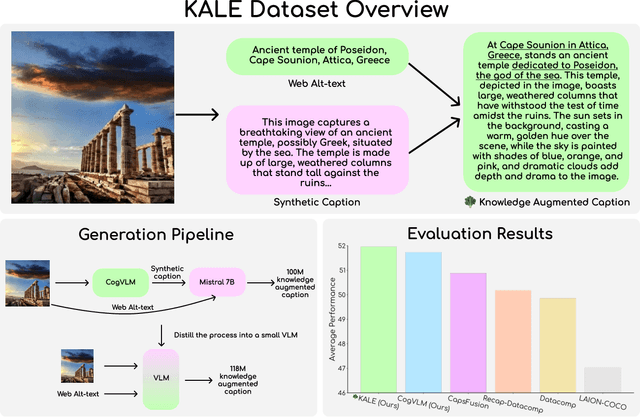
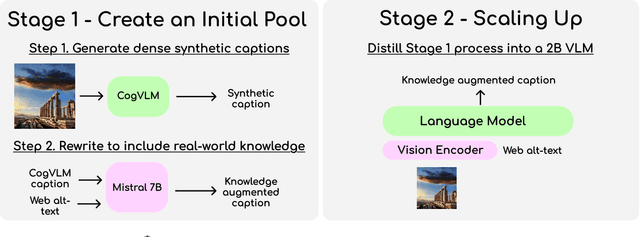

We introduce BLIP3-KALE, a dataset of 218 million image-text pairs that bridges the gap between descriptive synthetic captions and factual web-scale alt-text. KALE augments synthetic dense image captions with web-scale alt-text to generate factually grounded image captions. Our two-stage approach leverages large vision-language models and language models to create knowledge-augmented captions, which are then used to train a specialized VLM for scaling up the dataset. We train vision-language models on KALE and demonstrate improvements on vision-language tasks. Our experiments show the utility of KALE for training more capable and knowledgeable multimodal models. We release the KALE dataset at https://huggingface.co/datasets/Salesforce/blip3-kale
ActionAtlas: A VideoQA Benchmark for Domain-specialized Action Recognition
Oct 08, 2024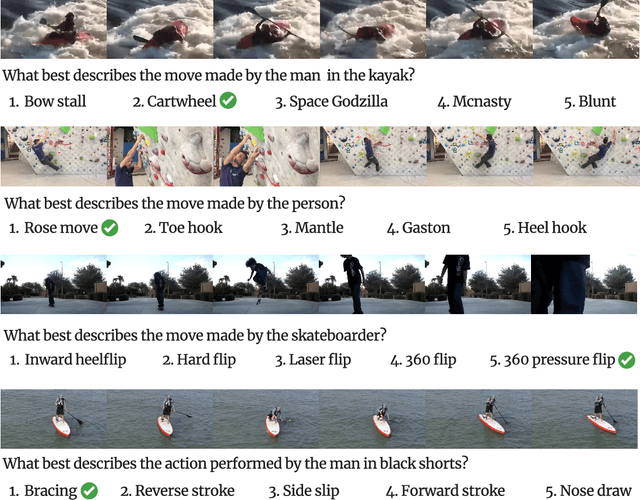
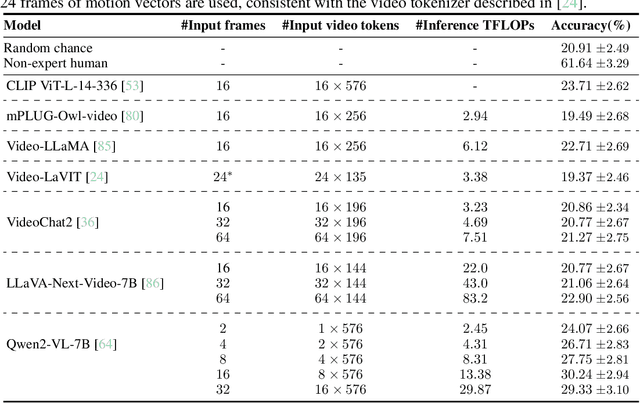
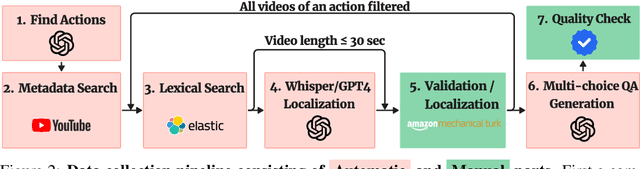
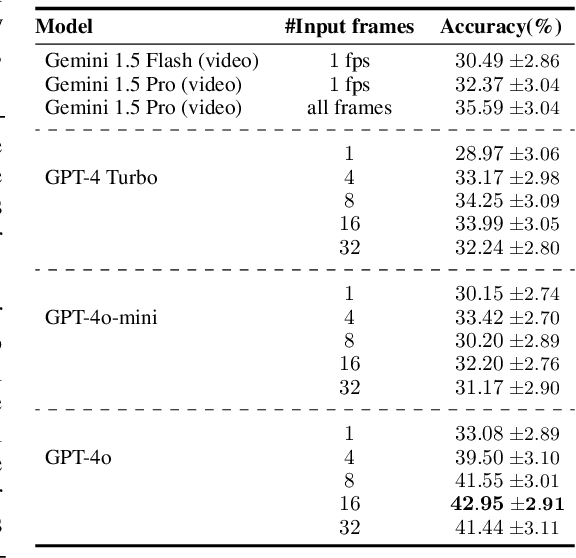
Our world is full of varied actions and moves across specialized domains that we, as humans, strive to identify and understand. Within any single domain, actions can often appear quite similar, making it challenging for deep models to distinguish them accurately. To evaluate the effectiveness of multimodal foundation models in helping us recognize such actions, we present ActionAtlas v1.0, a multiple-choice video question answering benchmark featuring short videos across various sports. Each video in the dataset is paired with a question and four or five choices. The question pinpoints specific individuals, asking which choice "best" describes their action within a certain temporal context. Overall, the dataset includes 934 videos showcasing 580 unique actions across 56 sports, with a total of 1896 actions within choices. Unlike most existing video question answering benchmarks that only cover simplistic actions, often identifiable from a single frame, ActionAtlas focuses on intricate movements and rigorously tests the model's capability to discern subtle differences between moves that look similar within each domain. We evaluate open and proprietary foundation models on this benchmark, finding that the best model, GPT-4o, achieves a maximum accuracy of 45.52%. Meanwhile, Non-expert crowd workers, provided with action description for each choice, achieve 61.64% accuracy, where random chance is approximately 21%. Our findings with state-of-the-art models indicate that having a high frame sampling rate is important for accurately recognizing actions in ActionAtlas, a feature that some leading proprietary video models, such as Gemini, do not include in their default configuration.
Molmo and PixMo: Open Weights and Open Data for State-of-the-Art Multimodal Models
Sep 25, 2024


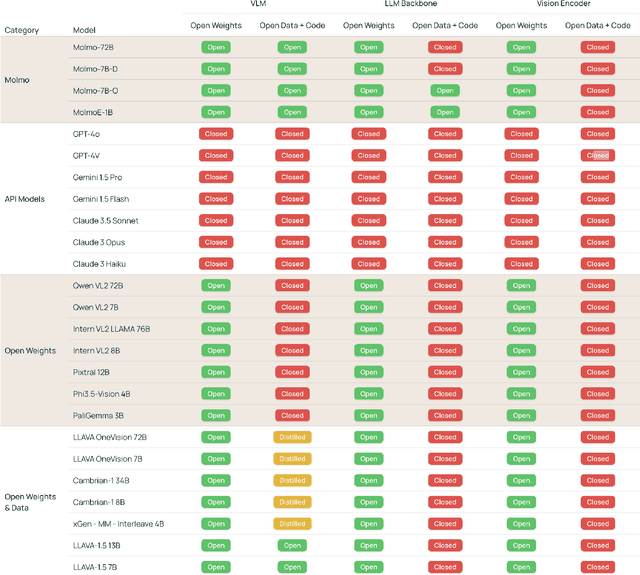
Today's most advanced multimodal models remain proprietary. The strongest open-weight models rely heavily on synthetic data from proprietary VLMs to achieve good performance, effectively distilling these closed models into open ones. As a result, the community is still missing foundational knowledge about how to build performant VLMs from scratch. We present Molmo, a new family of VLMs that are state-of-the-art in their class of openness. Our key innovation is a novel, highly detailed image caption dataset collected entirely from human annotators using speech-based descriptions. To enable a wide array of user interactions, we also introduce a diverse dataset mixture for fine-tuning that includes in-the-wild Q&A and innovative 2D pointing data. The success of our approach relies on careful choices for the model architecture details, a well-tuned training pipeline, and, most critically, the quality of our newly collected datasets, all of which will be released. The best-in-class 72B model within the Molmo family not only outperforms others in the class of open weight and data models but also compares favorably against proprietary systems like GPT-4o, Claude 3.5, and Gemini 1.5 on both academic benchmarks and human evaluation. We will be releasing all of our model weights, captioning and fine-tuning data, and source code in the near future. Select model weights, inference code, and demo are available at https://molmo.allenai.org.
Certainly Uncertain: A Benchmark and Metric for Multimodal Epistemic and Aleatoric Awareness
Jul 02, 2024

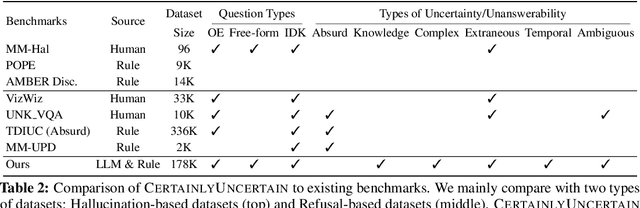

The ability to acknowledge the inevitable uncertainty in their knowledge and reasoning is a prerequisite for AI systems to be truly truthful and reliable. In this paper, we present a taxonomy of uncertainty specific to vision-language AI systems, distinguishing between epistemic uncertainty (arising from a lack of information) and aleatoric uncertainty (due to inherent unpredictability), and further explore finer categories within. Based on this taxonomy, we synthesize a benchmark dataset, CertainlyUncertain, featuring 178K visual question answering (VQA) samples as contrastive pairs. This is achieved by 1) inpainting images to make previously answerable questions into unanswerable ones; and 2) using image captions to prompt large language models for both answerable and unanswerable questions. Additionally, we introduce a new metric confidence-weighted accuracy, that is well correlated with both accuracy and calibration error, to address the shortcomings of existing metrics.
Superposed Decoding: Multiple Generations from a Single Autoregressive Inference Pass
May 29, 2024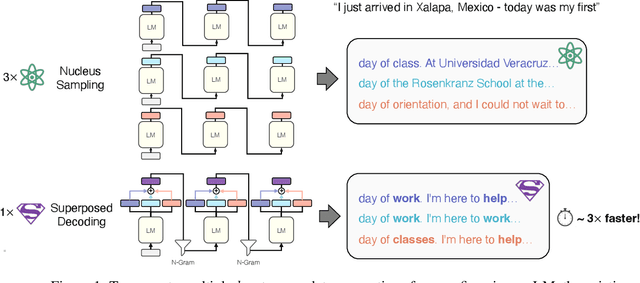

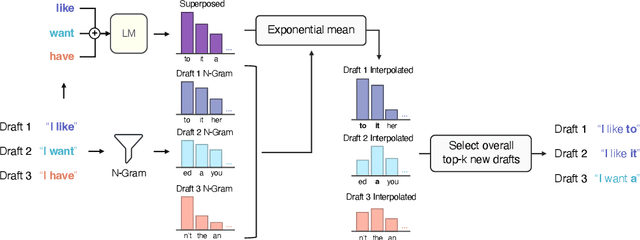
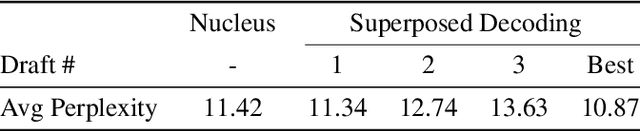
Many applications today provide users with multiple auto-complete drafts as they type, including GitHub's code completion, Gmail's smart compose, and Apple's messaging auto-suggestions. Under the hood, language models support this by running an autoregressive inference pass to provide a draft. Consequently, providing $k$ drafts to the user requires running an expensive language model $k$ times. To alleviate the computation cost of running $k$ inference passes, we propose Superposed Decoding, a new decoding algorithm that generates $k$ drafts at the computation cost of one autoregressive inference pass. We achieve this by feeding a superposition of the most recent token embeddings from the $k$ drafts as input to the next decoding step of the language model. At every inference step we combine the $k$ drafts with the top-$k$ tokens to get $k^2$ new drafts and cache the $k$ most likely options, using an n-gram interpolation with minimal compute overhead to filter out incoherent generations. Our experiments show that $k$ drafts from Superposed Decoding are at least as coherent and factual as Nucleus Sampling and Greedy Decoding respectively, while being at least $2.44\times$ faster for $k\ge3$. In a compute-normalized setting, user evaluations demonstrably favor text generated by Superposed Decoding over Nucleus Sampling. Code and more examples open-sourced at https://github.com/RAIVNLab/SuperposedDecoding.