 Add to Chrome
 Add to Firefox
 Add to Edge
Re-Visible Dual-Domain Self-Supervised Deep Unfolding Network for MRI Reconstruction
Jan 07, 2025
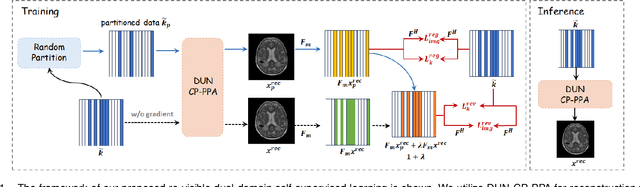
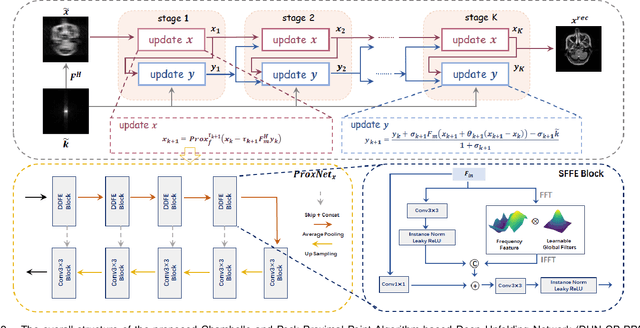
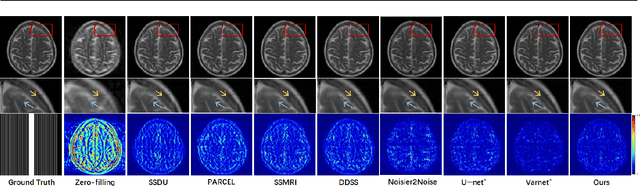
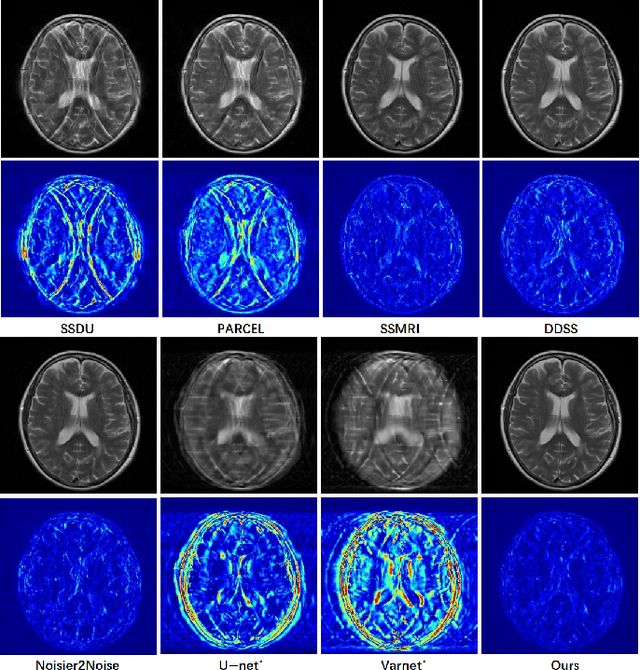
Magnetic Resonance Imaging (MRI) is widely used in clinical practice, but suffered from prolonged acquisition time. Although deep learning methods have been proposed to accelerate acquisition and demonstrate promising performance, they rely on high-quality fully-sampled datasets for training in a supervised manner. However, such datasets are time-consuming and expensive-to-collect, which constrains their broader applications. On the other hand, self-supervised methods offer an alternative by enabling learning from under-sampled data alone, but most existing methods rely on further partitioned under-sampled k-space data as model's input for training, resulting in a loss of valuable information. Additionally, their models have not fully incorporated image priors, leading to degraded reconstruction performance. In this paper, we propose a novel re-visible dual-domain self-supervised deep unfolding network to address these issues when only under-sampled datasets are available. Specifically, by incorporating re-visible dual-domain loss, all under-sampled k-space data are utilized during training to mitigate information loss caused by further partitioning. This design enables the model to implicitly adapt to all under-sampled k-space data as input. Additionally, we design a deep unfolding network based on Chambolle and Pock Proximal Point Algorithm (DUN-CP-PPA) to achieve end-to-end reconstruction, incorporating imaging physics and image priors to guide the reconstruction process. By employing a Spatial-Frequency Feature Extraction (SFFE) block to capture global and local feature representation, we enhance the model's efficiency to learn comprehensive image priors. Experiments conducted on the fastMRI and IXI datasets demonstrate that our method significantly outperforms state-of-the-art approaches in terms of reconstruction performance.

DepthMaster: Taming Diffusion Models for Monocular Depth Estimation
Jan 05, 2025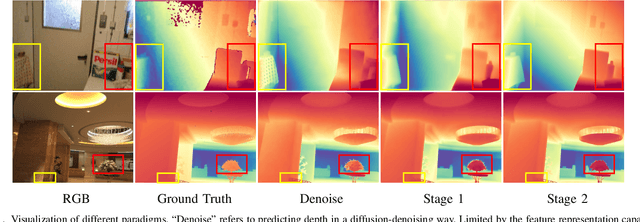
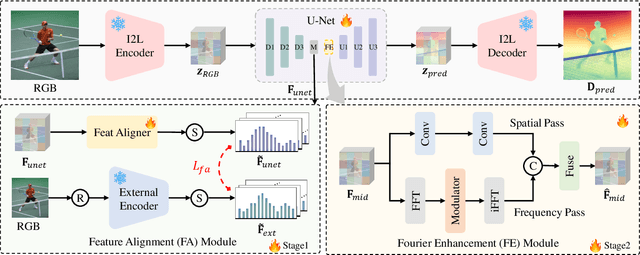
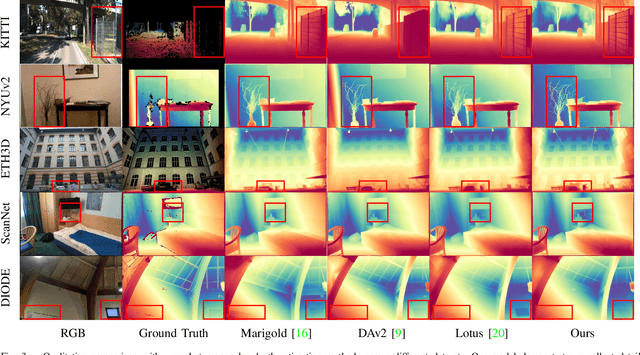
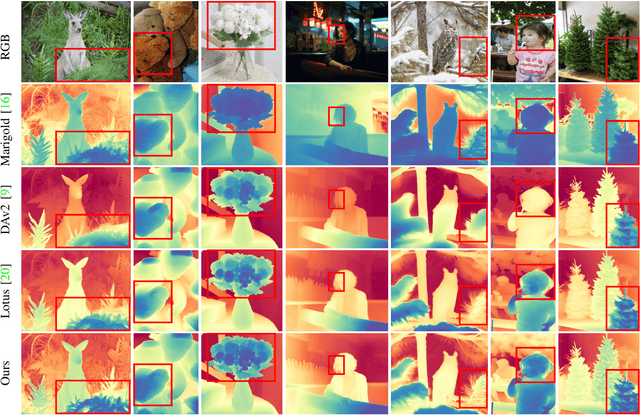
Monocular depth estimation within the diffusion-denoising paradigm demonstrates impressive generalization ability but suffers from low inference speed. Recent methods adopt a single-step deterministic paradigm to improve inference efficiency while maintaining comparable performance. However, they overlook the gap between generative and discriminative features, leading to suboptimal results. In this work, we propose DepthMaster, a single-step diffusion model designed to adapt generative features for the discriminative depth estimation task. First, to mitigate overfitting to texture details introduced by generative features, we propose a Feature Alignment module, which incorporates high-quality semantic features to enhance the denoising network's representation capability. Second, to address the lack of fine-grained details in the single-step deterministic framework, we propose a Fourier Enhancement module to adaptively balance low-frequency structure and high-frequency details. We adopt a two-stage training strategy to fully leverage the potential of the two modules. In the first stage, we focus on learning the global scene structure with the Feature Alignment module, while in the second stage, we exploit the Fourier Enhancement module to improve the visual quality. Through these efforts, our model achieves state-of-the-art performance in terms of generalization and detail preservation, outperforming other diffusion-based methods across various datasets. Our project page can be found at https://indu1ge.github.io/DepthMaster_page.
Loss-Aware Curriculum Learning for Chinese Grammatical Error Correction
Dec 31, 2024Chinese grammatical error correction (CGEC) aims to detect and correct errors in the input Chinese sentences. Recently, Pre-trained Language Models (PLMS) have been employed to improve the performance. However, current approaches ignore that correction difficulty varies across different instances and treat these samples equally, enhancing the challenge of model learning. To address this problem, we propose a multi-granularity Curriculum Learning (CL) framework. Specifically, we first calculate the correction difficulty of these samples and feed them into the model from easy to hard batch by batch. Then Instance-Level CL is employed to help the model optimize in the appropriate direction automatically by regulating the loss function. Extensive experimental results and comprehensive analyses of various datasets prove the effectiveness of our method.
Efficiently Serving LLM Reasoning Programs with Certaindex
Dec 30, 2024


The rapid evolution of large language models (LLMs) has unlocked their capabilities in advanced reasoning tasks like mathematical problem-solving, code generation, and legal analysis. Central to this progress are inference-time reasoning algorithms, which refine outputs by exploring multiple solution paths, at the cost of increasing compute demands and response latencies. Existing serving systems fail to adapt to the scaling behaviors of these algorithms or the varying difficulty of queries, leading to inefficient resource use and unmet latency targets. We present Dynasor, a system that optimizes inference-time compute for LLM reasoning queries. Unlike traditional engines, Dynasor tracks and schedules requests within reasoning queries and uses Certaindex, a proxy that measures statistical reasoning progress based on model certainty, to guide compute allocation dynamically. Dynasor co-adapts scheduling with reasoning progress: it allocates more compute to hard queries, reduces compute for simpler ones, and terminates unpromising queries early, balancing accuracy, latency, and cost. On diverse datasets and algorithms, Dynasor reduces compute by up to 50% in batch processing and sustaining 3.3x higher query rates or 4.7x tighter latency SLOs in online serving.
Exploiting Hybrid Policy in Reinforcement Learning for Interpretable Temporal Logic Manipulation
Dec 29, 2024Reinforcement Learning (RL) based methods have been increasingly explored for robot learning. However, RL based methods often suffer from low sampling efficiency in the exploration phase, especially for long-horizon manipulation tasks, and generally neglect the semantic information from the task level, resulted in a delayed convergence or even tasks failure. To tackle these challenges, we propose a Temporal-Logic-guided Hybrid policy framework (HyTL) which leverages three-level decision layers to improve the agent's performance. Specifically, the task specifications are encoded via linear temporal logic (LTL) to improve performance and offer interpretability. And a waypoints planning module is designed with the feedback from the LTL-encoded task level as a high-level policy to improve the exploration efficiency. The middle-level policy selects which behavior primitives to execute, and the low-level policy specifies the corresponding parameters to interact with the environment. We evaluate HyTL on four challenging manipulation tasks, which demonstrate its effectiveness and interpretability. Our project is available at: https://sites.google.com/view/hytl-0257/.
Molar: Multimodal LLMs with Collaborative Filtering Alignment for Enhanced Sequential Recommendation
Dec 24, 2024Sequential recommendation (SR) systems have evolved significantly over the past decade, transitioning from traditional collaborative filtering to deep learning approaches and, more recently, to large language models (LLMs). While the adoption of LLMs has driven substantial advancements, these models inherently lack collaborative filtering information, relying primarily on textual content data neglecting other modalities and thus failing to achieve optimal recommendation performance. To address this limitation, we propose Molar, a Multimodal large language sequential recommendation framework that integrates multiple content modalities with ID information to capture collaborative signals effectively. Molar employs an MLLM to generate unified item representations from both textual and non-textual data, facilitating comprehensive multimodal modeling and enriching item embeddings. Additionally, it incorporates collaborative filtering signals through a post-alignment mechanism, which aligns user representations from content-based and ID-based models, ensuring precise personalization and robust performance. By seamlessly combining multimodal content with collaborative filtering insights, Molar captures both user interests and contextual semantics, leading to superior recommendation accuracy. Extensive experiments validate that Molar significantly outperforms traditional and LLM-based baselines, highlighting its strength in utilizing multimodal data and collaborative signals for sequential recommendation tasks. The source code is available at https://anonymous.4open.science/r/Molar-8B06/.
SyNeg: LLM-Driven Synthetic Hard-Negatives for Dense Retrieval
Dec 23, 2024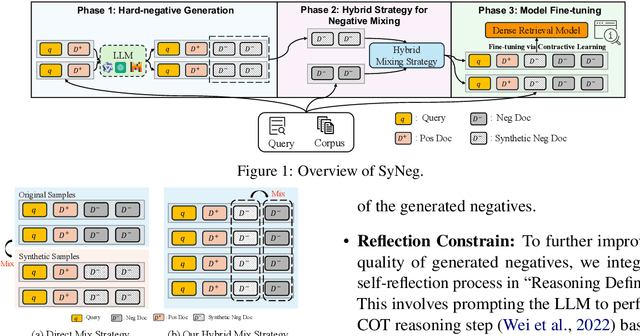
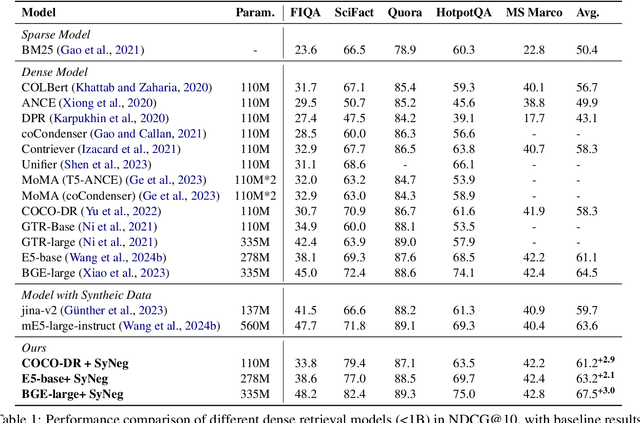
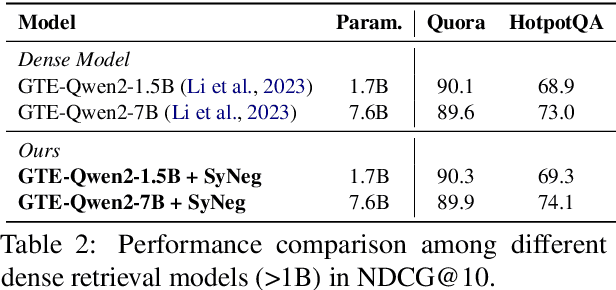
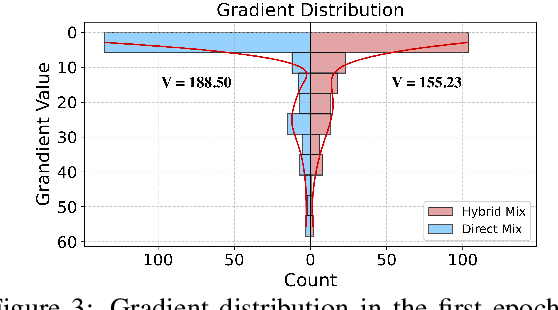
The performance of Dense retrieval (DR) is significantly influenced by the quality of negative sampling. Traditional DR methods primarily depend on naive negative sampling techniques or on mining hard negatives through external retriever and meticulously crafted strategies. However, naive negative sampling often fails to adequately capture the accurate boundaries between positive and negative samples, whereas existing hard negative sampling methods are prone to false negatives, resulting in performance degradation and training instability. Recent advancements in large language models (LLMs) offer an innovative solution to these challenges by generating contextually rich and diverse negative samples. In this work, we present a framework that harnesses LLMs to synthesize high-quality hard negative samples. We first devise a \textit{multi-attribute self-reflection prompting strategy} to direct LLMs in hard negative sample generation. Then, we implement a \textit{hybrid sampling strategy} that integrates these synthetic negatives with traditionally retrieved negatives, thereby stabilizing the training process and improving retrieval performance. Extensive experiments on five benchmark datasets demonstrate the efficacy of our approach, and code is also publicly available.
Fast Causal Discovery by Approximate Kernel-based Generalized Score Functions with Linear Computational Complexity
Dec 23, 2024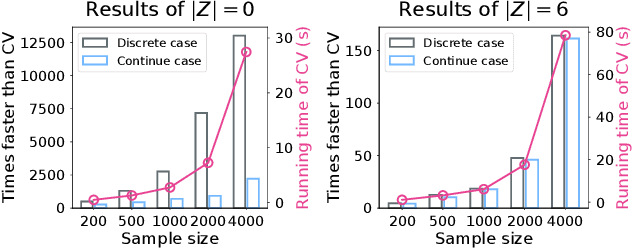
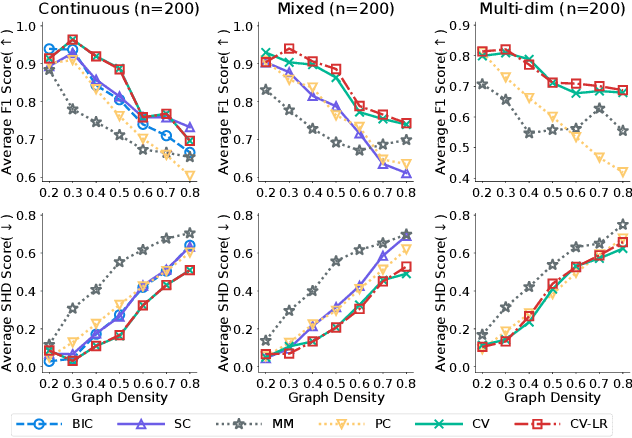
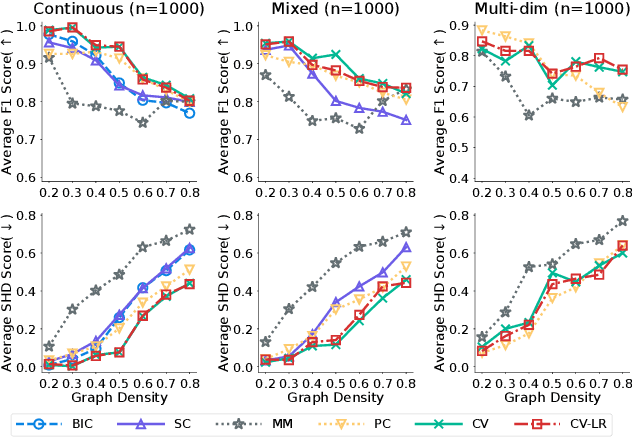
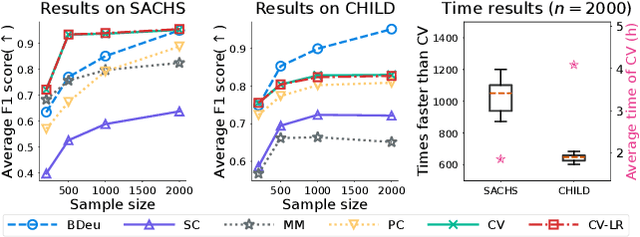
Score-based causal discovery methods can effectively identify causal relationships by evaluating candidate graphs and selecting the one with the highest score. One popular class of scores is kernel-based generalized score functions, which can adapt to a wide range of scenarios and work well in practice because they circumvent assumptions about causal mechanisms and data distributions. Despite these advantages, kernel-based generalized score functions pose serious computational challenges in time and space, with a time complexity of $\mathcal{O}(n^3)$ and a memory complexity of $\mathcal{O}(n^2)$, where $n$ is the sample size. In this paper, we propose an approximate kernel-based generalized score function with $\mathcal{O}(n)$ time and space complexities by using low-rank technique and designing a set of rules to handle the complex composite matrix operations required to calculate the score, as well as developing sampling algorithms for different data types to benefit the handling of diverse data types efficiently. Our extensive causal discovery experiments on both synthetic and real-world data demonstrate that compared to the state-of-the-art method, our method can not only significantly reduce computational costs, but also achieve comparable accuracy, especially for large datasets.
MotionBridge: Dynamic Video Inbetweening with Flexible Controls
Dec 17, 2024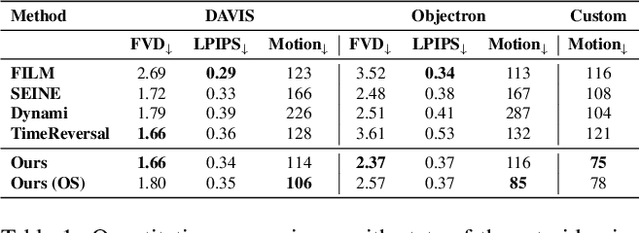


By generating plausible and smooth transitions between two image frames, video inbetweening is an essential tool for video editing and long video synthesis. Traditional works lack the capability to generate complex large motions. While recent video generation techniques are powerful in creating high-quality results, they often lack fine control over the details of intermediate frames, which can lead to results that do not align with the creative mind. We introduce MotionBridge, a unified video inbetweening framework that allows flexible controls, including trajectory strokes, keyframes, masks, guide pixels, and text. However, learning such multi-modal controls in a unified framework is a challenging task. We thus design two generators to extract the control signal faithfully and encode feature through dual-branch embedders to resolve ambiguities. We further introduce a curriculum training strategy to smoothly learn various controls. Extensive qualitative and quantitative experiments have demonstrated that such multi-modal controls enable a more dynamic, customizable, and contextually accurate visual narrative.
Advancing Comprehensive Aesthetic Insight with Multi-Scale Text-Guided Self-Supervised Learning
Dec 16, 2024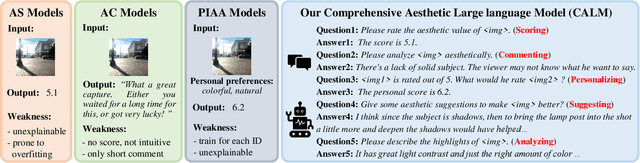

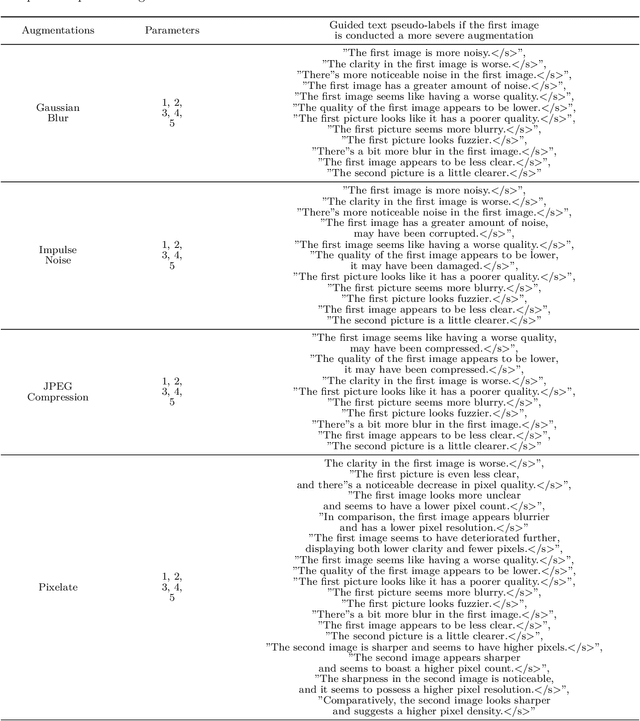
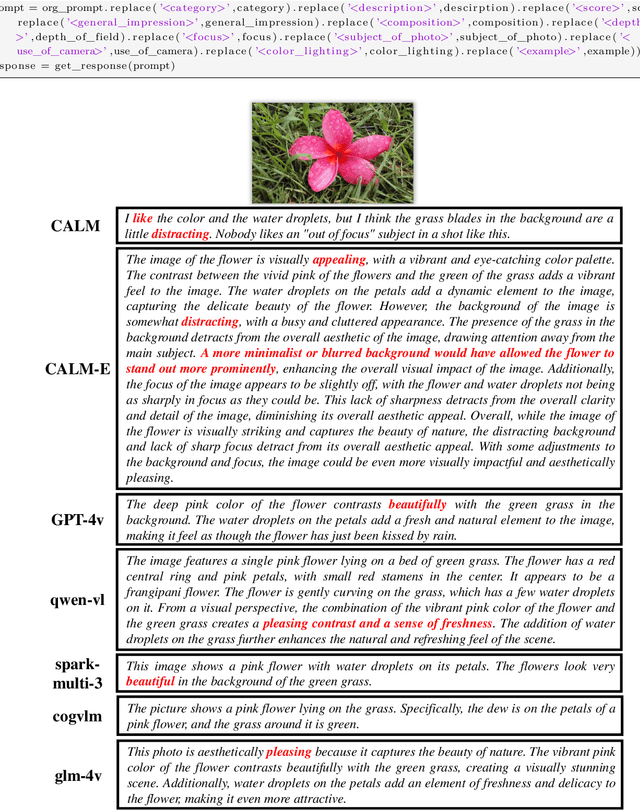
Image Aesthetic Assessment (IAA) is a vital and intricate task that entails analyzing and assessing an image's aesthetic values, and identifying its highlights and areas for improvement. Traditional methods of IAA often concentrate on a single aesthetic task and suffer from inadequate labeled datasets, thus impairing in-depth aesthetic comprehension. Despite efforts to overcome this challenge through the application of Multi-modal Large Language Models (MLLMs), such models remain underdeveloped for IAA purposes. To address this, we propose a comprehensive aesthetic MLLM capable of nuanced aesthetic insight. Central to our approach is an innovative multi-scale text-guided self-supervised learning technique. This technique features a multi-scale feature alignment module and capitalizes on a wealth of unlabeled data in a self-supervised manner to structurally and functionally enhance aesthetic ability. The empirical evidence indicates that accompanied with extensive instruct-tuning, our model sets new state-of-the-art benchmarks across multiple tasks, including aesthetic scoring, aesthetic commenting, and personalized image aesthetic assessment. Remarkably, it also demonstrates zero-shot learning capabilities in the emerging task of aesthetic suggesting. Furthermore, for personalized image aesthetic assessment, we harness the potential of in-context learning and showcase its inherent advantages.