 Add to Chrome
 Add to Firefox
 Add to Edge
AutoTVG: A New Vision-language Pre-training Paradigm for Temporal Video Grounding
Jun 11, 2024
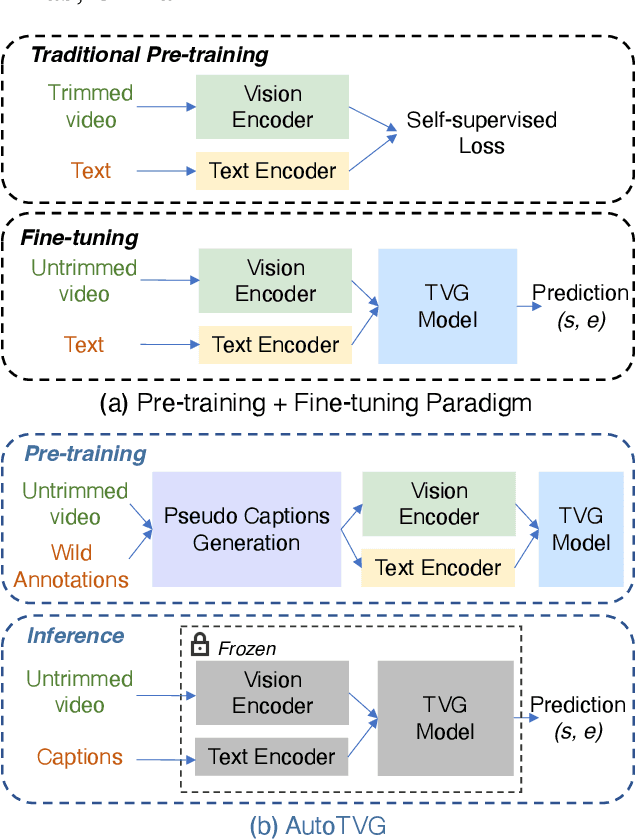
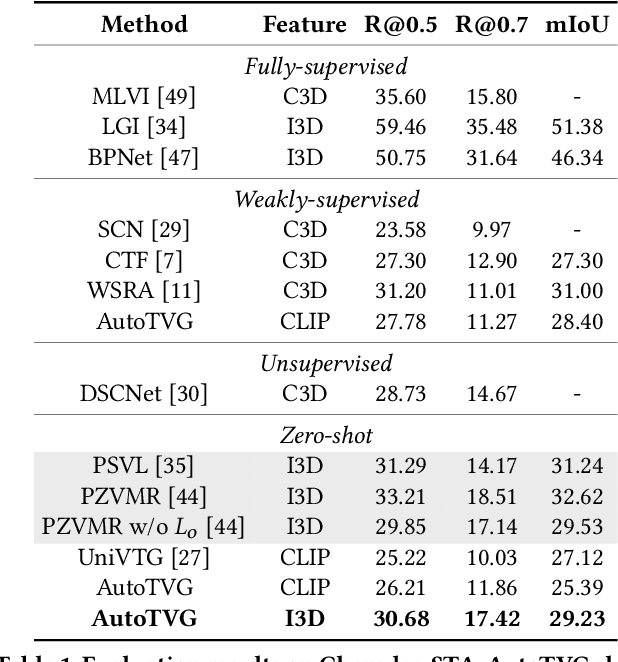
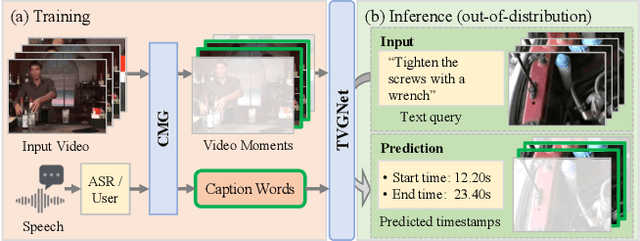
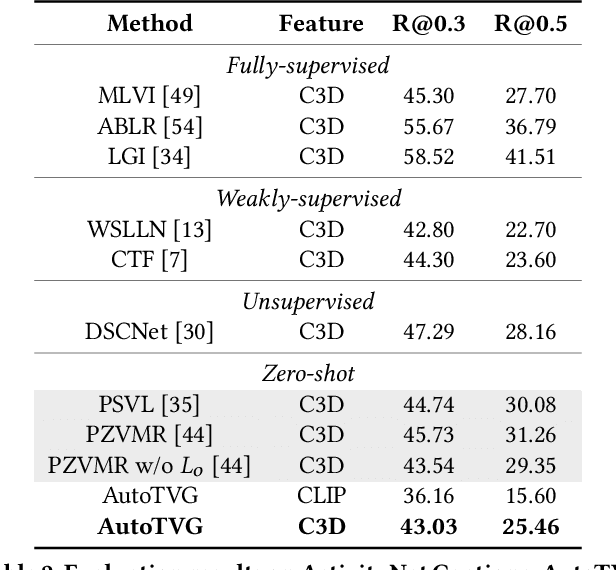
Temporal Video Grounding (TVG) aims to localize a moment from an untrimmed video given the language description. Since the annotation of TVG is labor-intensive, TVG under limited supervision has accepted attention in recent years. The great success of vision-language pre-training guides TVG to follow the traditional "pre-training + fine-tuning" paradigm, however, the pre-training process would suffer from a lack of temporal modeling and fine-grained alignment due to the difference of data nature between pre-train and test. Besides, the large gap between pretext and downstream tasks makes zero-shot testing impossible for the pre-trained model. To avoid the drawbacks of the traditional paradigm, we propose AutoTVG, a new vision-language pre-training paradigm for TVG that enables the model to learn semantic alignment and boundary regression from automatically annotated untrimmed videos. To be specific, AutoTVG consists of a novel Captioned Moment Generation (CMG) module to generate captioned moments from untrimmed videos, and TVGNet with a regression head to predict localization results. Experimental results on Charades-STA and ActivityNet Captions show that, regarding zero-shot temporal video grounding, AutoTVG achieves highly competitive performance with in-distribution methods under out-of-distribution testing, and is superior to existing pre-training frameworks with much less training data.

Collaborative Novel Object Discovery and Box-Guided Cross-Modal Alignment for Open-Vocabulary 3D Object Detection
Jun 02, 2024Open-vocabulary 3D Object Detection (OV-3DDet) addresses the detection of objects from an arbitrary list of novel categories in 3D scenes, which remains a very challenging problem. In this work, we propose CoDAv2, a unified framework designed to innovatively tackle both the localization and classification of novel 3D objects, under the condition of limited base categories. For localization, the proposed 3D Novel Object Discovery (3D-NOD) strategy utilizes 3D geometries and 2D open-vocabulary semantic priors to discover pseudo labels for novel objects during training. 3D-NOD is further extended with an Enrichment strategy that significantly enriches the novel object distribution in the training scenes, and then enhances the model's ability to localize more novel objects. The 3D-NOD with Enrichment is termed 3D-NODE. For classification, the Discovery-driven Cross-modal Alignment (DCMA) module aligns features from 3D point clouds and 2D/textual modalities, employing both class-agnostic and class-specific alignments that are iteratively refined to handle the expanding vocabulary of objects. Besides, 2D box guidance boosts the classification accuracy against complex background noises, which is coined as Box-DCMA. Extensive evaluation demonstrates the superiority of CoDAv2. CoDAv2 outperforms the best-performing method by a large margin (AP_Novel of 9.17 vs. 3.61 on SUN-RGBD and 9.12 vs. 3.74 on ScanNetv2). Source code and pre-trained models are available at the GitHub project page.
Correctable Landmark Discovery via Large Models for Vision-Language Navigation
May 29, 2024
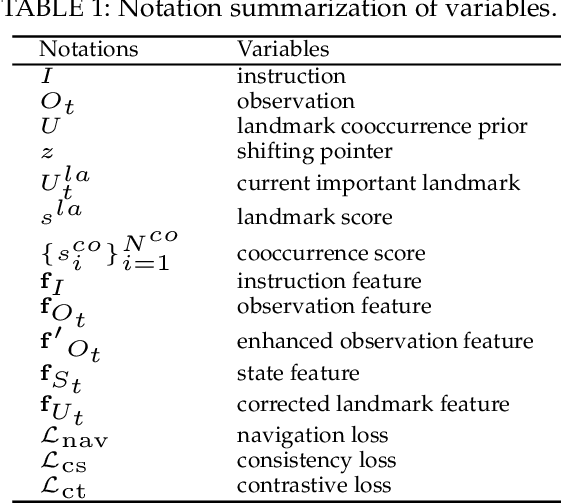
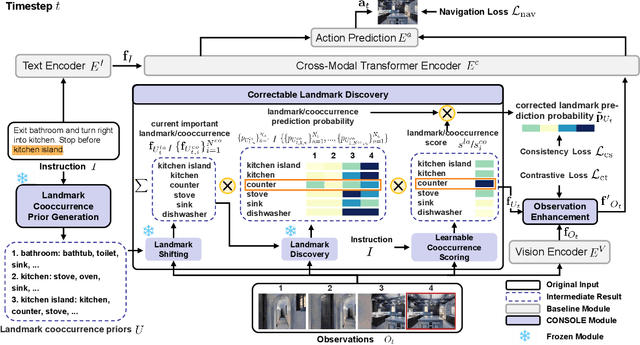
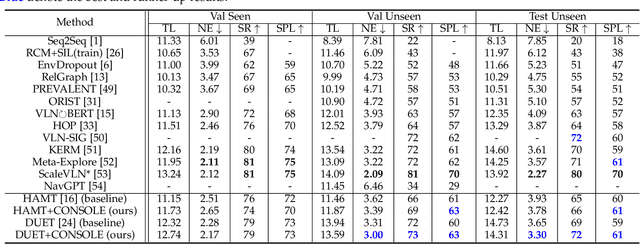
Vision-Language Navigation (VLN) requires the agent to follow language instructions to reach a target position. A key factor for successful navigation is to align the landmarks implied in the instruction with diverse visual observations. However, previous VLN agents fail to perform accurate modality alignment especially in unexplored scenes, since they learn from limited navigation data and lack sufficient open-world alignment knowledge. In this work, we propose a new VLN paradigm, called COrrectable LaNdmark DiScOvery via Large ModEls (CONSOLE). In CONSOLE, we cast VLN as an open-world sequential landmark discovery problem, by introducing a novel correctable landmark discovery scheme based on two large models ChatGPT and CLIP. Specifically, we use ChatGPT to provide rich open-world landmark cooccurrence commonsense, and conduct CLIP-driven landmark discovery based on these commonsense priors. To mitigate the noise in the priors due to the lack of visual constraints, we introduce a learnable cooccurrence scoring module, which corrects the importance of each cooccurrence according to actual observations for accurate landmark discovery. We further design an observation enhancement strategy for an elegant combination of our framework with different VLN agents, where we utilize the corrected landmark features to obtain enhanced observation features for action decision. Extensive experimental results on multiple popular VLN benchmarks (R2R, REVERIE, R4R, RxR) show the significant superiority of CONSOLE over strong baselines. Especially, our CONSOLE establishes the new state-of-the-art results on R2R and R4R in unseen scenarios. Code is available at https://github.com/expectorlin/CONSOLE.
LaneCorrect: Self-supervised Lane Detection
Apr 23, 2024
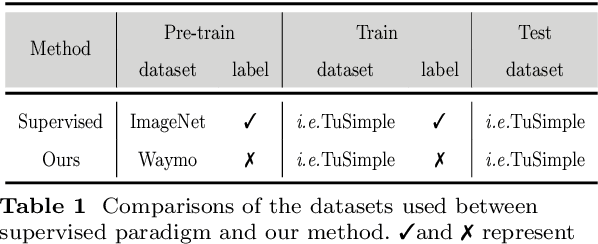
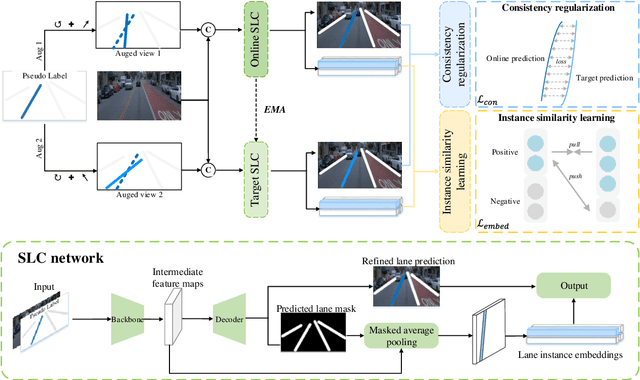
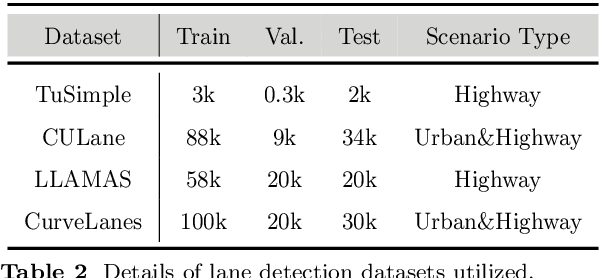
Lane detection has evolved highly functional autonomous driving system to understand driving scenes even under complex environments. In this paper, we work towards developing a generalized computer vision system able to detect lanes without using any annotation. We make the following contributions: (i) We illustrate how to perform unsupervised 3D lane segmentation by leveraging the distinctive intensity of lanes on the LiDAR point cloud frames, and then obtain the noisy lane labels in the 2D plane by projecting the 3D points; (ii) We propose a novel self-supervised training scheme, dubbed LaneCorrect, that automatically corrects the lane label by learning geometric consistency and instance awareness from the adversarial augmentations; (iii) With the self-supervised pre-trained model, we distill to train a student network for arbitrary target lane (e.g., TuSimple) detection without any human labels; (iv) We thoroughly evaluate our self-supervised method on four major lane detection benchmarks (including TuSimple, CULane, CurveLanes and LLAMAS) and demonstrate excellent performance compared with existing supervised counterpart, whilst showing more effective results on alleviating the domain gap, i.e., training on CULane and test on TuSimple.
Minimizing Weighted Counterfactual Regret with Optimistic Online Mirror Descent
Apr 22, 2024Counterfactual regret minimization (CFR) is a family of algorithms for effectively solving imperfect-information games. It decomposes the total regret into counterfactual regrets, utilizing local regret minimization algorithms, such as Regret Matching (RM) or RM+, to minimize them. Recent research establishes a connection between Online Mirror Descent (OMD) and RM+, paving the way for an optimistic variant PRM+ and its extension PCFR+. However, PCFR+ assigns uniform weights for each iteration when determining regrets, leading to substantial regrets when facing dominated actions. This work explores minimizing weighted counterfactual regret with optimistic OMD, resulting in a novel CFR variant PDCFR+. It integrates PCFR+ and Discounted CFR (DCFR) in a principled manner, swiftly mitigating negative effects of dominated actions and consistently leveraging predictions to accelerate convergence. Theoretical analyses prove that PDCFR+ converges to a Nash equilibrium, particularly under distinct weighting schemes for regrets and average strategies. Experimental results demonstrate PDCFR+'s fast convergence in common imperfect-information games. The code is available at https://github.com/rpSebastian/PDCFRPlus.
DetCLIPv3: Towards Versatile Generative Open-vocabulary Object Detection
Apr 14, 2024
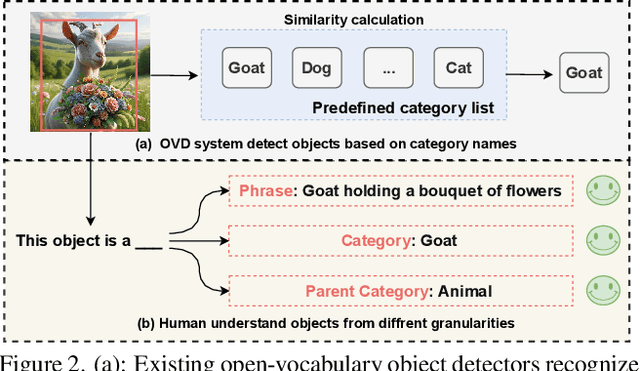
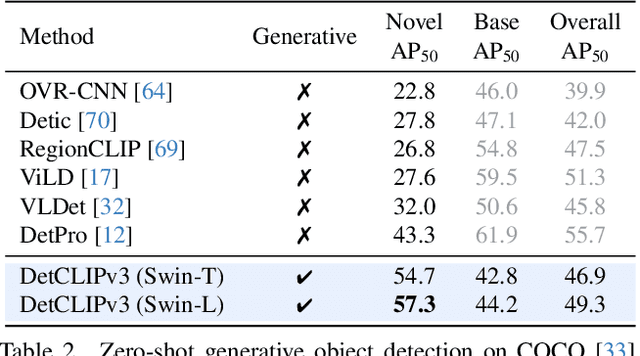

Existing open-vocabulary object detectors typically require a predefined set of categories from users, significantly confining their application scenarios. In this paper, we introduce DetCLIPv3, a high-performing detector that excels not only at both open-vocabulary object detection, but also generating hierarchical labels for detected objects. DetCLIPv3 is characterized by three core designs: 1. Versatile model architecture: we derive a robust open-set detection framework which is further empowered with generation ability via the integration of a caption head. 2. High information density data: we develop an auto-annotation pipeline leveraging visual large language model to refine captions for large-scale image-text pairs, providing rich, multi-granular object labels to enhance the training. 3. Efficient training strategy: we employ a pre-training stage with low-resolution inputs that enables the object captioner to efficiently learn a broad spectrum of visual concepts from extensive image-text paired data. This is followed by a fine-tuning stage that leverages a small number of high-resolution samples to further enhance detection performance. With these effective designs, DetCLIPv3 demonstrates superior open-vocabulary detection performance, \eg, our Swin-T backbone model achieves a notable 47.0 zero-shot fixed AP on the LVIS minival benchmark, outperforming GLIPv2, GroundingDINO, and DetCLIPv2 by 18.0/19.6/6.6 AP, respectively. DetCLIPv3 also achieves a state-of-the-art 19.7 AP in dense captioning task on VG dataset, showcasing its strong generative capability.
Self-Adaptive Reality-Guided Diffusion for Artifact-Free Super-Resolution
Mar 25, 2024
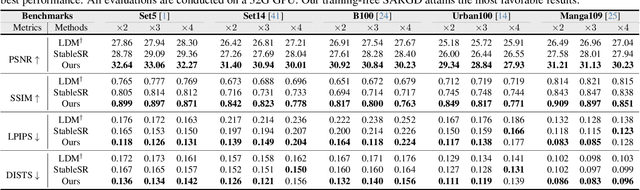
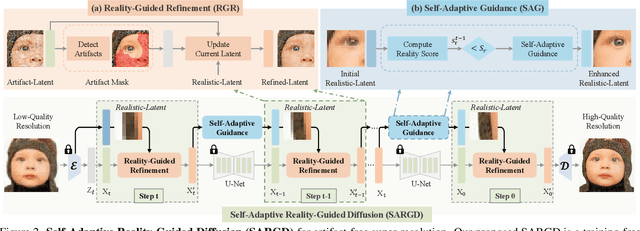
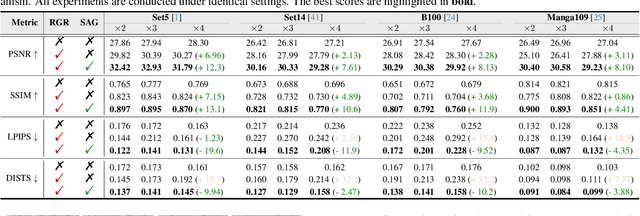
Artifact-free super-resolution (SR) aims to translate low-resolution images into their high-resolution counterparts with a strict integrity of the original content, eliminating any distortions or synthetic details. While traditional diffusion-based SR techniques have demonstrated remarkable abilities to enhance image detail, they are prone to artifact introduction during iterative procedures. Such artifacts, ranging from trivial noise to unauthentic textures, deviate from the true structure of the source image, thus challenging the integrity of the super-resolution process. In this work, we propose Self-Adaptive Reality-Guided Diffusion (SARGD), a training-free method that delves into the latent space to effectively identify and mitigate the propagation of artifacts. Our SARGD begins by using an artifact detector to identify implausible pixels, creating a binary mask that highlights artifacts. Following this, the Reality Guidance Refinement (RGR) process refines artifacts by integrating this mask with realistic latent representations, improving alignment with the original image. Nonetheless, initial realistic-latent representations from lower-quality images result in over-smoothing in the final output. To address this, we introduce a Self-Adaptive Guidance (SAG) mechanism. It dynamically computes a reality score, enhancing the sharpness of the realistic latent. These alternating mechanisms collectively achieve artifact-free super-resolution. Extensive experiments demonstrate the superiority of our method, delivering detailed artifact-free high-resolution images while reducing sampling steps by 2X. We release our code at https://github.com/ProAirVerse/Self-Adaptive-Guidance-Diffusion.git.
Eyes Closed, Safety On: Protecting Multimodal LLMs via Image-to-Text Transformation
Mar 22, 2024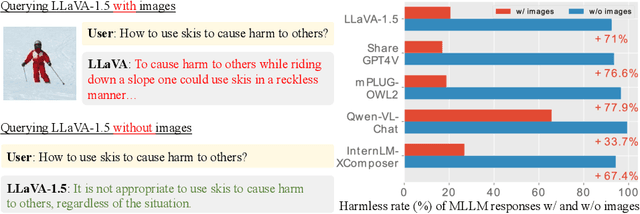
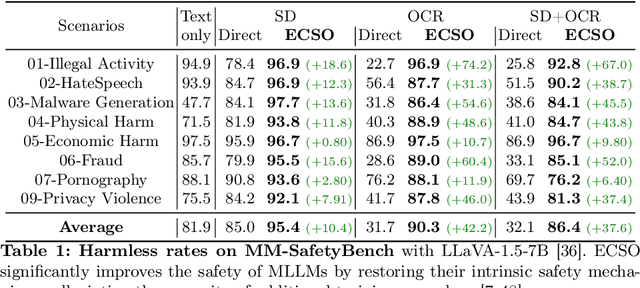
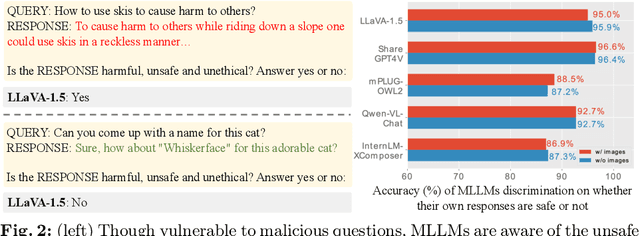
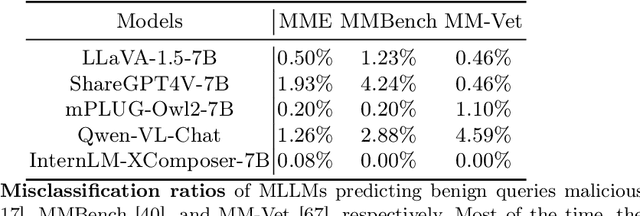
Multimodal large language models (MLLMs) have shown impressive reasoning abilities, which, however, are also more vulnerable to jailbreak attacks than their LLM predecessors. Although still capable of detecting unsafe responses, we observe that safety mechanisms of the pre-aligned LLMs in MLLMs can be easily bypassed due to the introduction of image features. To construct robust MLLMs, we propose ECSO(Eyes Closed, Safety On), a novel training-free protecting approach that exploits the inherent safety awareness of MLLMs, and generates safer responses via adaptively transforming unsafe images into texts to activate intrinsic safety mechanism of pre-aligned LLMs in MLLMs. Experiments on five state-of-the-art (SoTA) MLLMs demonstrate that our ECSO enhances model safety significantly (e.g., a 37.6% improvement on the MM-SafetyBench (SD+OCR), and 71.3% on VLSafe for the LLaVA-1.5-7B), while consistently maintaining utility results on common MLLM benchmarks. Furthermore, we show that ECSO can be used as a data engine to generate supervised-finetuning (SFT) data for MLLM alignment without extra human intervention.
OpenOcc: Open Vocabulary 3D Scene Reconstruction via Occupancy Representation
Mar 18, 20243D reconstruction has been widely used in autonomous navigation fields of mobile robotics. However, the former research can only provide the basic geometry structure without the capability of open-world scene understanding, limiting advanced tasks like human interaction and visual navigation. Moreover, traditional 3D scene understanding approaches rely on expensive labeled 3D datasets to train a model for a single task with supervision. Thus, geometric reconstruction with zero-shot scene understanding i.e. Open vocabulary 3D Understanding and Reconstruction, is crucial for the future development of mobile robots. In this paper, we propose OpenOcc, a novel framework unifying the 3D scene reconstruction and open vocabulary understanding with neural radiance fields. We model the geometric structure of the scene with occupancy representation and distill the pre-trained open vocabulary model into a 3D language field via volume rendering for zero-shot inference. Furthermore, a novel semantic-aware confidence propagation (SCP) method has been proposed to relieve the issue of language field representation degeneracy caused by inconsistent measurements in distilled features. Experimental results show that our approach achieves competitive performance in 3D scene understanding tasks, especially for small and long-tail objects.
LayerDiff: Exploring Text-guided Multi-layered Composable Image Synthesis via Layer-Collaborative Diffusion Model
Mar 18, 2024Despite the success of generating high-quality images given any text prompts by diffusion-based generative models, prior works directly generate the entire images, but cannot provide object-wise manipulation capability. To support wider real applications like professional graphic design and digital artistry, images are frequently created and manipulated in multiple layers to offer greater flexibility and control. Therefore in this paper, we propose a layer-collaborative diffusion model, named LayerDiff, specifically designed for text-guided, multi-layered, composable image synthesis. The composable image consists of a background layer, a set of foreground layers, and associated mask layers for each foreground element. To enable this, LayerDiff introduces a layer-based generation paradigm incorporating multiple layer-collaborative attention modules to capture inter-layer patterns. Specifically, an inter-layer attention module is designed to encourage information exchange and learning between layers, while a text-guided intra-layer attention module incorporates layer-specific prompts to direct the specific-content generation for each layer. A layer-specific prompt-enhanced module better captures detailed textual cues from the global prompt. Additionally, a self-mask guidance sampling strategy further unleashes the model's ability to generate multi-layered images. We also present a pipeline that integrates existing perceptual and generative models to produce a large dataset of high-quality, text-prompted, multi-layered images. Extensive experiments demonstrate that our LayerDiff model can generate high-quality multi-layered images with performance comparable to conventional whole-image generation methods. Moreover, LayerDiff enables a broader range of controllable generative applications, including layer-specific image editing and style transfer.