 Add to Chrome
 Add to Firefox
 Add to Edge
MagicSeg: Open-World Segmentation Pretraining via Counterfactural Diffusion-Based Auto-Generation
Mar 20, 2026
Open-world semantic segmentation presently relies significantly on extensive image-text pair datasets, which often suffer from a lack of fine-grained pixel annotations on sufficient categories. The acquisition of such data is rendered economically prohibitive due to the substantial investments of both human labor and time. In light of the formidable image generation capabilities of diffusion models, we introduce a novel diffusion model-driven pipeline for automatically generating datasets tailored to the needs of open-world semantic segmentation, named "MagicSeg". Our MagicSeg initiates from class labels and proceeds to generate high-fidelity textual descriptions, which in turn serve as guidance for the diffusion model to generate images. Rather than only generating positive samples for each label, our process encompasses the simultaneous generation of corresponding negative images, designed to serve as paired counterfactual samples for contrastive training. Then, to provide a self-supervised signal for open-world segmentation pretraining, our MagicSeg integrates an open-vocabulary detection model and an interactive segmentation model to extract object masks as precise segmentation labels from images based on the provided category labels. By applying our dataset to the contrastive language-image pretraining model with the pseudo mask supervision and the auxiliary counterfactual contrastive training, the downstream model obtains strong performance on open-world semantic segmentation. We evaluate our model on PASCAL VOC, PASCAL Context, and COCO, achieving SOTA with performance of 62.9%, 26.7%, and 40.2%, respectively, demonstrating our dataset's effectiveness in enhancing open-world semantic segmentation capabilities. Project website: https://github.com/ckxhp/magicseg.

Can Atomic Step Decomposition Enhance the Self-structured Reasoning of Multimodal Large Models?
Mar 08, 2025In this paper, we address the challenging task of multimodal mathematical reasoning by incorporating the ability of "slow thinking" into multimodal large language models (MLLMs). Our core idea is that different levels of reasoning abilities can be combined dynamically to tackle questions with different complexity. To this end, we propose a paradigm of Self-structured Chain of Thought (SCoT), which is composed of minimal semantic atomic steps. Different from existing methods that rely on structured templates or free-form paradigms, our method can not only generate cognitive CoT structures for various complex tasks but also mitigates the phenomenon of overthinking. To introduce structured reasoning capabilities into visual understanding models, we further design a novel AtomThink framework with four key modules, including (i) a data engine to generate high-quality multimodal reasoning paths; (ii) a supervised fine-tuning process with serialized inference data; (iii) a policy-guided multi-turn inference method; and (iv) an atomic capability metric to evaluate the single step utilization rate. We conduct extensive experiments to show that the proposed AtomThink significantly improves the performance of baseline MLLMs, achieving more than 10\% average accuracy gains on MathVista and MathVerse. Compared to state-of-the-art structured CoT approaches, our method not only achieves higher accuracy but also improves data utilization by 5 times and boosts inference efficiency by 85.3\%. Our code is now public available in https://github.com/Quinn777/AtomThink.
TheaterGen: Character Management with LLM for Consistent Multi-turn Image Generation
Apr 29, 2024


Recent advances in diffusion models can generate high-quality and stunning images from text. However, multi-turn image generation, which is of high demand in real-world scenarios, still faces challenges in maintaining semantic consistency between images and texts, as well as contextual consistency of the same subject across multiple interactive turns. To address this issue, we introduce TheaterGen, a training-free framework that integrates large language models (LLMs) and text-to-image (T2I) models to provide the capability of multi-turn image generation. Within this framework, LLMs, acting as a "Screenwriter", engage in multi-turn interaction, generating and managing a standardized prompt book that encompasses prompts and layout designs for each character in the target image. Based on these, Theatergen generate a list of character images and extract guidance information, akin to the "Rehearsal". Subsequently, through incorporating the prompt book and guidance information into the reverse denoising process of T2I diffusion models, Theatergen generate the final image, as conducting the "Final Performance". With the effective management of prompt books and character images, TheaterGen significantly improves semantic and contextual consistency in synthesized images. Furthermore, we introduce a dedicated benchmark, CMIGBench (Consistent Multi-turn Image Generation Benchmark) with 8000 multi-turn instructions. Different from previous multi-turn benchmarks, CMIGBench does not define characters in advance. Both the tasks of story generation and multi-turn editing are included on CMIGBench for comprehensive evaluation. Extensive experimental results show that TheaterGen outperforms state-of-the-art methods significantly. It raises the performance bar of the cutting-edge Mini DALLE 3 model by 21% in average character-character similarity and 19% in average text-image similarity.
LayerDiff: Exploring Text-guided Multi-layered Composable Image Synthesis via Layer-Collaborative Diffusion Model
Mar 18, 2024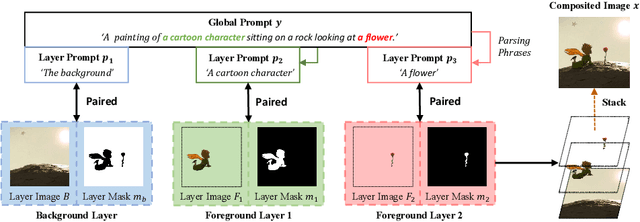
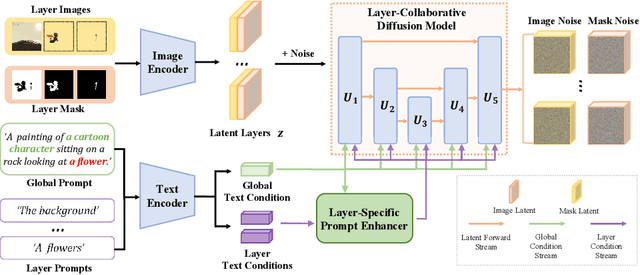
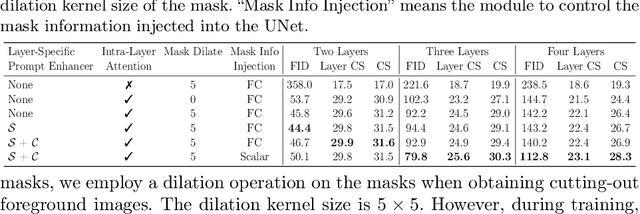

Despite the success of generating high-quality images given any text prompts by diffusion-based generative models, prior works directly generate the entire images, but cannot provide object-wise manipulation capability. To support wider real applications like professional graphic design and digital artistry, images are frequently created and manipulated in multiple layers to offer greater flexibility and control. Therefore in this paper, we propose a layer-collaborative diffusion model, named LayerDiff, specifically designed for text-guided, multi-layered, composable image synthesis. The composable image consists of a background layer, a set of foreground layers, and associated mask layers for each foreground element. To enable this, LayerDiff introduces a layer-based generation paradigm incorporating multiple layer-collaborative attention modules to capture inter-layer patterns. Specifically, an inter-layer attention module is designed to encourage information exchange and learning between layers, while a text-guided intra-layer attention module incorporates layer-specific prompts to direct the specific-content generation for each layer. A layer-specific prompt-enhanced module better captures detailed textual cues from the global prompt. Additionally, a self-mask guidance sampling strategy further unleashes the model's ability to generate multi-layered images. We also present a pipeline that integrates existing perceptual and generative models to produce a large dataset of high-quality, text-prompted, multi-layered images. Extensive experiments demonstrate that our LayerDiff model can generate high-quality multi-layered images with performance comparable to conventional whole-image generation methods. Moreover, LayerDiff enables a broader range of controllable generative applications, including layer-specific image editing and style transfer.
MixReorg: Cross-Modal Mixed Patch Reorganization is a Good Mask Learner for Open-World Semantic Segmentation
Aug 09, 2023
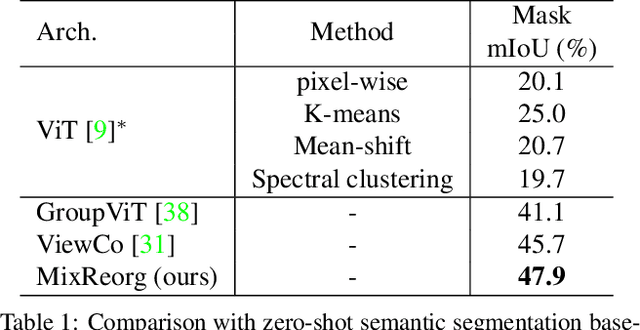


Recently, semantic segmentation models trained with image-level text supervision have shown promising results in challenging open-world scenarios. However, these models still face difficulties in learning fine-grained semantic alignment at the pixel level and predicting accurate object masks. To address this issue, we propose MixReorg, a novel and straightforward pre-training paradigm for semantic segmentation that enhances a model's ability to reorganize patches mixed across images, exploring both local visual relevance and global semantic coherence. Our approach involves generating fine-grained patch-text pairs data by mixing image patches while preserving the correspondence between patches and text. The model is then trained to minimize the segmentation loss of the mixed images and the two contrastive losses of the original and restored features. With MixReorg as a mask learner, conventional text-supervised semantic segmentation models can achieve highly generalizable pixel-semantic alignment ability, which is crucial for open-world segmentation. After training with large-scale image-text data, MixReorg models can be applied directly to segment visual objects of arbitrary categories, without the need for further fine-tuning. Our proposed framework demonstrates strong performance on popular zero-shot semantic segmentation benchmarks, outperforming GroupViT by significant margins of 5.0%, 6.2%, 2.5%, and 3.4% mIoU on PASCAL VOC2012, PASCAL Context, MS COCO, and ADE20K, respectively.