 Add to Chrome
 Add to Firefox
 Add to Edge
SpecTran: Spectral-Aware Transformer-based Adapter for LLM-Enhanced Sequential Recommendation
Jan 29, 2026
Traditional sequential recommendation (SR) models learn low-dimensional item ID embeddings from user-item interactions, often overlooking textual information such as item titles or descriptions. Recent advances in Large Language Models (LLMs) have inspired a surge of research that encodes item textual information with high-dimensional semantic embeddings, and designs transformation methods to inject such embeddings into SR models. These embedding transformation strategies can be categorized into two types, both of which exhibits notable drawbacks: 1) adapter-based methods suffer from pronounced dimension collapse, concentrating information into a few dominant dimensions; 2) SVD-based methods are rigid and manual, considering only a few principal spectral components while discarding rich information in the remaining spectrum. To address these limitations, we propose SpecTran, a spectral-aware transformer-based adapter that operates in the spectral domain, attending to the full spectrum to select and aggregates informative components. A learnable spectral-position encoding injects singular-value cues as an inductive bias, guiding attention toward salient spectral components and promoting diversity across embedding dimensions. Across four real-world datasets and three SR backbones, it consistently outperforms strong baselines, achieving an average improvement of 9.17%.

Visual-Guided Key-Token Regularization for Multimodal Large Language Model Unlearning
Jan 29, 2026Unlearning in Multimodal Large Language Models (MLLMs) prevents the model from revealing private information when queried about target images. Existing MLLM unlearning methods largely adopt approaches developed for LLMs. They treat all answer tokens uniformly, disregarding their varying importance in the unlearning process. Moreover, these methods focus exclusively on the language modality, disregarding visual cues that indicate key tokens in answers. In this paper, after formulating the problem of unlearning in multimodal question answering for MLLMs, we propose Visual-Guided Key-Token Regularization (ViKeR). We leverage irrelevant visual inputs to predict ideal post-unlearning token-level distributions and use these distributions to regularize the unlearning process, thereby prioritizing key tokens. Further, we define key tokens in unlearning via information entropy and discuss ViKeR's effectiveness through token-level gradient reweighting, which amplifies updates on key tokens. Experiments on MLLMU and CLEAR benchmarks demonstrate that our method effectively performs unlearning while mitigating forgetting and maintaining response coherence.
Let's Roll a BiFTA: Bi-refinement for Fine-grained Text-visual Alignment in Vision-Language Models
Jan 28, 2026Recent research has shown that aligning fine-grained text descriptions with localized image patches can significantly improve the zero-shot performance of pre-trained vision-language models (e.g., CLIP). However, we find that both fine-grained text descriptions and localized image patches often contain redundant information, making text-visual alignment less effective. In this paper, we tackle this issue from two perspectives: \emph{View Refinement} and \emph{Description refinement}, termed as \textit{\textbf{Bi}-refinement for \textbf{F}ine-grained \textbf{T}ext-visual \textbf{A}lignment} (BiFTA). \emph{View refinement} removes redundant image patches with high \emph{Intersection over Union} (IoU) ratios, resulting in more distinctive visual samples. \emph{Description refinement} removes redundant text descriptions with high pairwise cosine similarity, ensuring greater diversity in the remaining descriptions. BiFTA achieves superior zero-shot performance on 6 benchmark datasets for both ViT-based and ResNet-based CLIP, justifying the necessity to remove redundant information in visual-text alignment.
Advances in LLM Reasoning Enable Flexibility in Clinical Problem-Solving
Jan 17, 2026Large Language Models (LLMs) have achieved high accuracy on medical question-answer (QA) benchmarks, yet their capacity for flexible clinical reasoning has been debated. Here, we asked whether advances in reasoning LLMs improve their cognitive flexibility in clinical reasoning. We assessed reasoning models from the OpenAI, Grok, Gemini, Claude, and DeepSeek families on the medicine abstraction and reasoning corpus (mARC), an adversarial medical QA benchmark which utilizes the Einstellung effect to induce inflexible overreliance on learned heuristic patterns in contexts where they become suboptimal. We found that strong reasoning models avoided Einstellung-based traps more often than weaker reasoning models, achieving human-level performance on mARC. On questions most commonly missed by physicians, the top 5 performing models answered 55% to 70% correctly with high confidence, indicating that these models may be less susceptible than humans to Einstellung effects. Our results indicate that strong reasoning models demonstrate improved flexibility in medical reasoning, achieving performance on par with humans on mARC.
DreamLoop: Controllable Cinemagraph Generation from a Single Photograph
Jan 06, 2026Cinemagraphs, which combine static photographs with selective, looping motion, offer unique artistic appeal. Generating them from a single photograph in a controllable manner is particularly challenging. Existing image-animation techniques are restricted to simple, low-frequency motions and operate only in narrow domains with repetitive textures like water and smoke. In contrast, large-scale video diffusion models are not tailored for cinemagraph constraints and lack the specialized data required to generate seamless, controlled loops. We present DreamLoop, a controllable video synthesis framework dedicated to generating cinemagraphs from a single photo without requiring any cinemagraph training data. Our key idea is to adapt a general video diffusion model by training it on two objectives: temporal bridging and motion conditioning. This strategy enables flexible cinemagraph generation. During inference, by using the input image as both the first- and last- frame condition, we enforce a seamless loop. By conditioning on static tracks, we maintain a static background. Finally, by providing a user-specified motion path for a target object, our method provides intuitive control over the animation's trajectory and timing. To our knowledge, DreamLoop is the first method to enable cinemagraph generation for general scenes with flexible and intuitive controls. We demonstrate that our method produces high-quality, complex cinemagraphs that align with user intent, outperforming existing approaches.
SCP: Accelerating Discovery with a Global Web of Autonomous Scientific Agents
Dec 30, 2025We introduce SCP: the Science Context Protocol, an open-source standard designed to accelerate discovery by enabling a global network of autonomous scientific agents. SCP is built on two foundational pillars: (1) Unified Resource Integration: At its core, SCP provides a universal specification for describing and invoking scientific resources, spanning software tools, models, datasets, and physical instruments. This protocol-level standardization enables AI agents and applications to discover, call, and compose capabilities seamlessly across disparate platforms and institutional boundaries. (2) Orchestrated Experiment Lifecycle Management: SCP complements the protocol with a secure service architecture, which comprises a centralized SCP Hub and federated SCP Servers. This architecture manages the complete experiment lifecycle (registration, planning, execution, monitoring, and archival), enforces fine-grained authentication and authorization, and orchestrates traceable, end-to-end workflows that bridge computational and physical laboratories. Based on SCP, we have constructed a scientific discovery platform that offers researchers and agents a large-scale ecosystem of more than 1,600 tool resources. Across diverse use cases, SCP facilitates secure, large-scale collaboration between heterogeneous AI systems and human researchers while significantly reducing integration overhead and enhancing reproducibility. By standardizing scientific context and tool orchestration at the protocol level, SCP establishes essential infrastructure for scalable, multi-institution, agent-driven science.
CTTA-T: Continual Test-Time Adaptation for Text Understanding via Teacher-Student with a Domain-aware and Generalized Teacher
Dec 20, 2025Text understanding often suffers from domain shifts. To handle testing domains, domain adaptation (DA) is trained to adapt to a fixed and observed testing domain; a more challenging paradigm, test-time adaptation (TTA), cannot access the testing domain during training and online adapts to the testing samples during testing, where the samples are from a fixed domain. We aim to explore a more practical and underexplored scenario, continual test-time adaptation (CTTA) for text understanding, which involves a sequence of testing (unobserved) domains in testing. Current CTTA methods struggle in reducing error accumulation over domains and enhancing generalization to handle unobserved domains: 1) Noise-filtering reduces accumulated errors but discards useful information, and 2) accumulating historical domains enhances generalization, but it is hard to achieve adaptive accumulation. In this paper, we propose a CTTA-T (continual test-time adaptation for text understanding) framework adaptable to evolving target domains: it adopts a teacher-student framework, where the teacher is domain-aware and generalized for evolving domains. To improve teacher predictions, we propose a refine-then-filter based on dropout-driven consistency, which calibrates predictions and removes unreliable guidance. For the adaptation-generalization trade-off, we construct a domain-aware teacher by dynamically accumulating cross-domain semantics via incremental PCA, which continuously tracks domain shifts. Experiments show CTTA-T excels baselines.
Probing Scientific General Intelligence of LLMs with Scientist-Aligned Workflows
Dec 18, 2025Despite advances in scientific AI, a coherent framework for Scientific General Intelligence (SGI)-the ability to autonomously conceive, investigate, and reason across scientific domains-remains lacking. We present an operational SGI definition grounded in the Practical Inquiry Model (PIM: Deliberation, Conception, Action, Perception) and operationalize it via four scientist-aligned tasks: deep research, idea generation, dry/wet experiments, and experimental reasoning. SGI-Bench comprises over 1,000 expert-curated, cross-disciplinary samples inspired by Science's 125 Big Questions, enabling systematic evaluation of state-of-the-art LLMs. Results reveal gaps: low exact match (10--20%) in deep research despite step-level alignment; ideas lacking feasibility and detail; high code executability but low execution result accuracy in dry experiments; low sequence fidelity in wet protocols; and persistent multimodal comparative-reasoning challenges. We further introduce Test-Time Reinforcement Learning (TTRL), which optimizes retrieval-augmented novelty rewards at inference, enhancing hypothesis novelty without reference answer. Together, our PIM-grounded definition, workflow-centric benchmark, and empirical insights establish a foundation for AI systems that genuinely participate in scientific discovery.
AG-MPBS: a Mobility-Aware Prediction and Behavior-Based Scheduling Framework for Air-Ground Unmanned Systems
Dec 18, 2025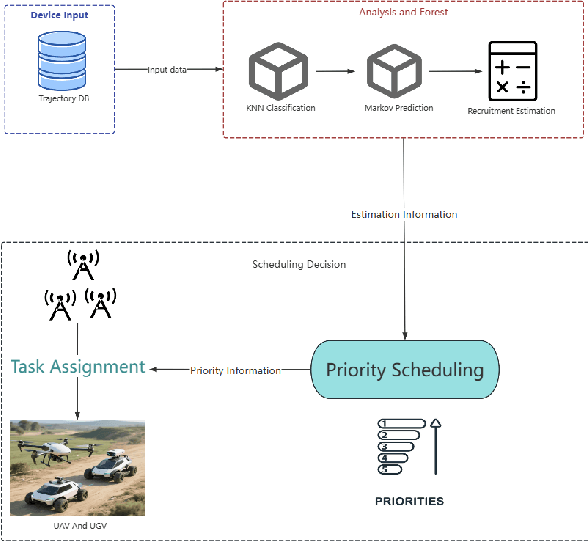
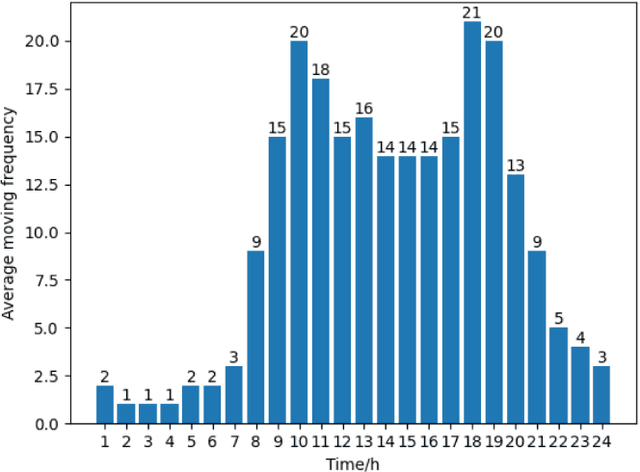
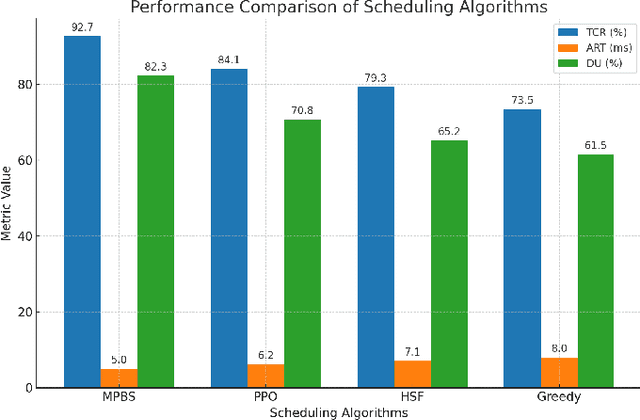
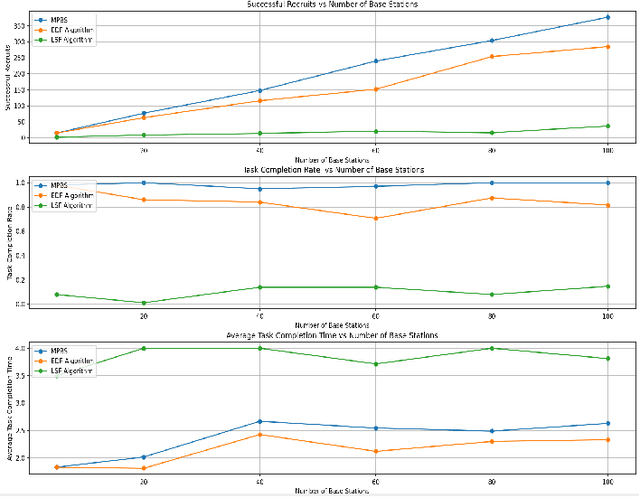
As unmanned systems such as Unmanned Aerial Vehicles (UAVs) and Unmanned Ground Vehicles (UGVs) become increasingly important to applications like urban sensing and emergency response, efficiently recruiting these autonomous devices to perform time-sensitive tasks has become a critical challenge. This paper presents MPBS (Mobility-aware Prediction and Behavior-based Scheduling), a scalable task recruitment framework that treats each device as a recruitable "user". MPBS integrates three key modules: a behavior-aware KNN classifier, a time-varying Markov prediction model for forecasting device mobility, and a dynamic priority scheduling mechanism that considers task urgency and base station performance. By combining behavioral classification with spatiotemporal prediction, MPBS adaptively assigns tasks to the most suitable devices in real time. Experimental evaluations on the real-world GeoLife dataset show that MPBS significantly improves task completion efficiency and resource utilization. The proposed framework offers a predictive, behavior-aware solution for intelligent and collaborative scheduling in unmanned systems.
Structure-Aware Decoding Mechanisms for Complex Entity Extraction with Large-Scale Language Models
Dec 16, 2025This paper proposes a structure-aware decoding method based on large language models to address the difficulty of traditional approaches in maintaining both semantic integrity and structural consistency in nested and overlapping entity extraction tasks. The method introduces a candidate span generation mechanism and structured attention modeling to achieve unified modeling of entity boundaries, hierarchical relationships, and cross-dependencies. The model first uses a pretrained language model to obtain context-aware semantic representations, then captures multi-granular entity span features through candidate representation combinations, and introduces hierarchical structural constraints during decoding to ensure consistency between semantics and structure. To enhance stability in complex scenarios, the model jointly optimizes classification loss and structural consistency loss, maintaining high recognition accuracy under multi-entity co-occurrence and long-sentence dependency conditions. Experiments conducted on the ACE 2005 dataset demonstrate significant improvements in Accuracy, Precision, Recall, and F1-Score, particularly in nested and overlapping entity recognition, where the model shows stronger boundary localization and structural modeling capability. This study verifies the effectiveness of structure-aware decoding in complex semantic extraction tasks, provides a new perspective for developing language models with hierarchical understanding, and establishes a methodological foundation for high-precision information extraction.