 Add to Chrome
 Add to Firefox
 Add to Edge
TSA: Temporal Slot Activation for Persistent Object-Centric Video Representation
Jun 10, 2026
Unsupervised video object-centric learning aims to decompose dynamic scenes into temporally persistent entity representations. Existing recurrent video slot-attention methods propagate a fixed set of slots across frames, but typically assume unconditional slot propagation: every slot is updated and decoded at every frame, regardless of whether its corresponding object is visible. We show that this design violates a basic lifecycle requirement for persistent slots: when an object is absent or fully occluded, its slot should preserve its previous state and avoid explaining unrelated visible content. Instead, unconditional propagation creates two failure pathways: update-induced state drift, where current-frame evidence overwrites the absent object's representation, and decoder-induced reconstruction interference, where the inactive slot remains coupled to reconstruction through decoder attention. We propose Temporal Slot Activation (TSA), a mechanism that learns a per-slot, per-frame activation score $α_{k,t} \in (0, 1)$ without visibility supervision. TSA uses this activation as a shared latent control variable for slot lifecycle modeling. When a slot is inactive, TSA anchors its state to the previous slot via activation-gated updating and suppresses its decoder participation through an activation-dependent additive bias on attention logits before softmax normalization. This jointly reduces state drift and reconstruction-driven interference. To improve decisions under partial occlusion and gradual reappearance, TSA further conditions activation prediction on a per-slot temporal memory produced by a Temporal Context Encoder. We evaluate TSA on MOVi-C/E, YT-VIS, and OVIS benchmarks using both standard and tracking-based metrics (FG-ARI, mBO, IDF1, HOTA). TSA consistently improves object decomposition and temporal identity preservation, with large gains on long, heavily occluded videos.

TokenDial: Continuous Attribute Control in Text-to-Video via Spatiotemporal Token Offsets
Mar 29, 2026We present TokenDial, a framework for continuous, slider-style attribute control in pretrained text-to-video generation models. While modern generators produce strong holistic videos, they offer limited control over how much an attribute changes (e.g., effect intensity or motion magnitude) without drifting identity, background, or temporal coherence. TokenDial is built on the observation: additive offsets in the intermediate spatiotemporal visual patch-token space form a semantic control direction, where adjusting the offset magnitude yields coherent, predictable edits for both appearance and motion dynamics. We learn attribute-specific token offsets without retraining the backbone, using pretrained understanding signals: semantic direction matching for appearance and motion-magnitude scaling for motion. We demonstrate TokenDial's effectiveness on diverse attributes and prompts, achieving stronger controllability and higher-quality edits than state-of-the-art baselines, supported by extensive quantitative evaluation and human studies.
TRACE: Object Motion Editing in Videos with First-Frame Trajectory Guidance
Mar 26, 2026We study object motion path editing in videos, where the goal is to alter a target object's trajectory while preserving the original scene content. Unlike prior video editing methods that primarily manipulate appearance or rely on point-track-based trajectory control, which is often challenging for users to provide during inference, especially in videos with camera motion, we offer a practical, easy-to-use approach to controllable object-centric motion editing. We present Trace, a framework that enables users to design the desired trajectory in a single anchor frame and then synthesizes a temporally consistent edited video. Our approach addresses this task with a two-stage pipeline: a cross-view motion transformation module that maps first-frame path design to frame-aligned box trajectories under camera motion, and a motion-conditioned video re-synthesis module that follows these trajectories to regenerate the object while preserving the remaining content of the input video. Experiments on diverse real-world videos show that our method produces more coherent, realistic, and controllable motion edits than recent image-to-video and video-to-video methods.
RelayS2S: A Dual-Path Speculative Generation for Real-Time Dialogue
Mar 24, 2026Real-time spoken dialogue systems face a fundamental tension between latency and response quality. End-to-end speech-to-speech (S2S) models respond immediately and naturally handle turn-taking, backchanneling, and interruption, but produce semantically weaker outputs. Cascaded pipelines (ASR -> LLM) deliver stronger responses at the cost of latency that grows with model size. We present RelayS2S, a hybrid architecture that runs two paths in parallel upon turn detection. The fast path -- a duplex S2S model -- speculatively drafts a short response prefix that is streamed immediately to TTS for low-latency audio onset, while continuing to monitor live audio events. The slow path -- a cascaded ASR -> LLM pipeline -- generates a higher-quality continuation conditioned on the committed prefix, producing a seamless utterance. A lightweight learned verifier gates the handoff, committing the prefix when appropriate or falling back gracefully to the slow path alone. Experiments show that RelayS2S achieves P90 onset latency comparable to the S2S model while retaining 99% cascaded response quality in average score, with benefits growing as the slow-path model scales. Because the prefix handoff requires no architectural modification to either component, RelayS2S serves as a lightweight, drop-in addition to existing cascaded pipelines. Our code and data are publicly available at: https://github.com/mailong25/relays2s
V2M-Zero: Zero-Pair Time-Aligned Video-to-Music Generation
Mar 11, 2026Generating music that temporally aligns with video events is challenging for existing text-to-music models, which lack fine-grained temporal control. We introduce V2M-Zero, a zero-pair video-to-music generation approach that outputs time-aligned music for video. Our method is motivated by a key observation: temporal synchronization requires matching when and how much change occurs, not what changes. While musical and visual events differ semantically, they exhibit shared temporal structure that can be captured independently within each modality. We capture this structure through event curves computed from intra-modal similarity using pretrained music and video encoders. By measuring temporal change within each modality independently, these curves provide comparable representations across modalities. This enables a simple training strategy: fine-tune a text-to-music model on music-event curves, then substitute video-event curves at inference without cross-modal training or paired data. Across OES-Pub, MovieGenBench-Music, and AIST++, V2M-Zero achieves substantial gains over paired-data baselines: 5-21% higher audio quality, 13-15% better semantic alignment, 21-52% improved temporal synchronization, and 28% higher beat alignment on dance videos. We find similar results via a large crowd-source subjective listening test. Overall, our results validate that temporal alignment through within-modality features, rather than paired cross-modal supervision, is effective for video-to-music generation. Results are available at https://genjib.github.io/v2m_zero/
DreamLoop: Controllable Cinemagraph Generation from a Single Photograph
Jan 06, 2026Cinemagraphs, which combine static photographs with selective, looping motion, offer unique artistic appeal. Generating them from a single photograph in a controllable manner is particularly challenging. Existing image-animation techniques are restricted to simple, low-frequency motions and operate only in narrow domains with repetitive textures like water and smoke. In contrast, large-scale video diffusion models are not tailored for cinemagraph constraints and lack the specialized data required to generate seamless, controlled loops. We present DreamLoop, a controllable video synthesis framework dedicated to generating cinemagraphs from a single photo without requiring any cinemagraph training data. Our key idea is to adapt a general video diffusion model by training it on two objectives: temporal bridging and motion conditioning. This strategy enables flexible cinemagraph generation. During inference, by using the input image as both the first- and last- frame condition, we enforce a seamless loop. By conditioning on static tracks, we maintain a static background. Finally, by providing a user-specified motion path for a target object, our method provides intuitive control over the animation's trajectory and timing. To our knowledge, DreamLoop is the first method to enable cinemagraph generation for general scenes with flexible and intuitive controls. We demonstrate that our method produces high-quality, complex cinemagraphs that align with user intent, outperforming existing approaches.
Diffusion Transformer-to-Mamba Distillation for High-Resolution Image Generation
Jun 23, 2025
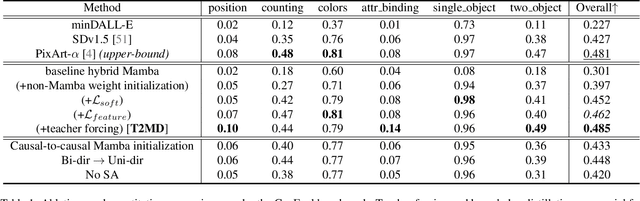
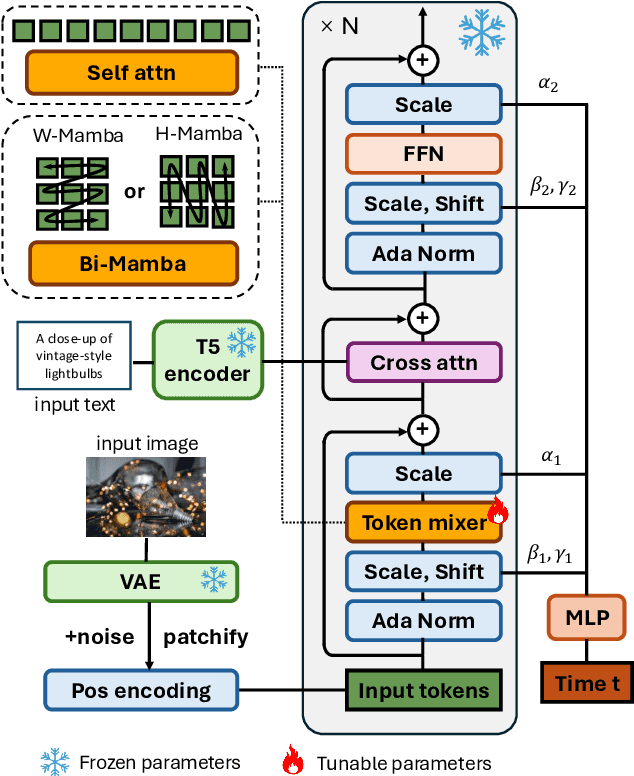
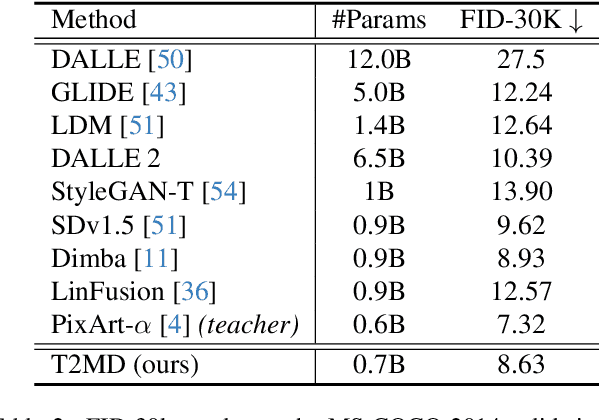
The quadratic computational complexity of self-attention in diffusion transformers (DiT) introduces substantial computational costs in high-resolution image generation. While the linear-complexity Mamba model emerges as a potential alternative, direct Mamba training remains empirically challenging. To address this issue, this paper introduces diffusion transformer-to-mamba distillation (T2MD), forming an efficient training pipeline that facilitates the transition from the self-attention-based transformer to the linear complexity state-space model Mamba. We establish a diffusion self-attention and Mamba hybrid model that simultaneously achieves efficiency and global dependencies. With the proposed layer-level teacher forcing and feature-based knowledge distillation, T2MD alleviates the training difficulty and high cost of a state space model from scratch. Starting from the distilled 512$\times$512 resolution base model, we push the generation towards 2048$\times$2048 images via lightweight adaptation and high-resolution fine-tuning. Experiments demonstrate that our training path leads to low overhead but high-quality text-to-image generation. Importantly, our results also justify the feasibility of using sequential and causal Mamba models for generating non-causal visual output, suggesting the potential for future exploration.
CineVerse: Consistent Keyframe Synthesis for Cinematic Scene Composition
Apr 28, 2025We present CineVerse, a novel framework for the task of cinematic scene composition. Similar to traditional multi-shot generation, our task emphasizes the need for consistency and continuity across frames. However, our task also focuses on addressing challenges inherent to filmmaking, such as multiple characters, complex interactions, and visual cinematic effects. In order to learn to generate such content, we first create the CineVerse dataset. We use this dataset to train our proposed two-stage approach. First, we prompt a large language model (LLM) with task-specific instructions to take in a high-level scene description and generate a detailed plan for the overall setting and characters, as well as the individual shots. Then, we fine-tune a text-to-image generation model to synthesize high-quality visual keyframes. Experimental results demonstrate that CineVerse yields promising improvements in generating visually coherent and contextually rich movie scenes, paving the way for further exploration in cinematic video synthesis.
REGEN: Learning Compact Video Embedding with (Re-)Generative Decoder
Mar 11, 2025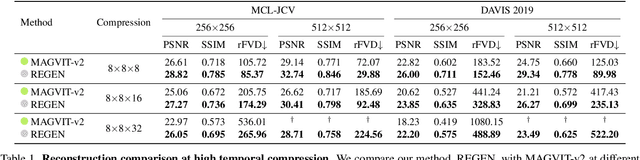
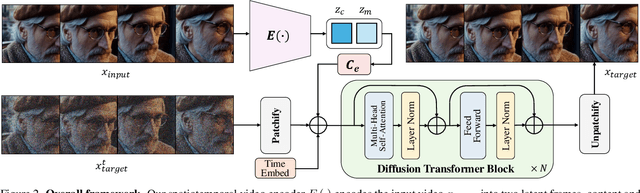
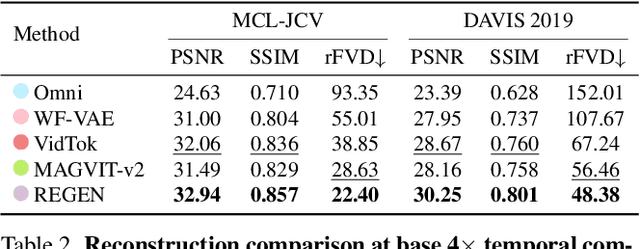
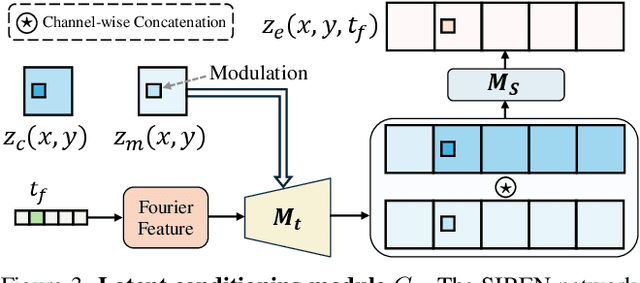
We present a novel perspective on learning video embedders for generative modeling: rather than requiring an exact reproduction of an input video, an effective embedder should focus on synthesizing visually plausible reconstructions. This relaxed criterion enables substantial improvements in compression ratios without compromising the quality of downstream generative models. Specifically, we propose replacing the conventional encoder-decoder video embedder with an encoder-generator framework that employs a diffusion transformer (DiT) to synthesize missing details from a compact latent space. Therein, we develop a dedicated latent conditioning module to condition the DiT decoder on the encoded video latent embedding. Our experiments demonstrate that our approach enables superior encoding-decoding performance compared to state-of-the-art methods, particularly as the compression ratio increases. To demonstrate the efficacy of our approach, we report results from our video embedders achieving a temporal compression ratio of up to 32x (8x higher than leading video embedders) and validate the robustness of this ultra-compact latent space for text-to-video generation, providing a significant efficiency boost in latent diffusion model training and inference.
MotionCanvas: Cinematic Shot Design with Controllable Image-to-Video Generation
Feb 06, 2025
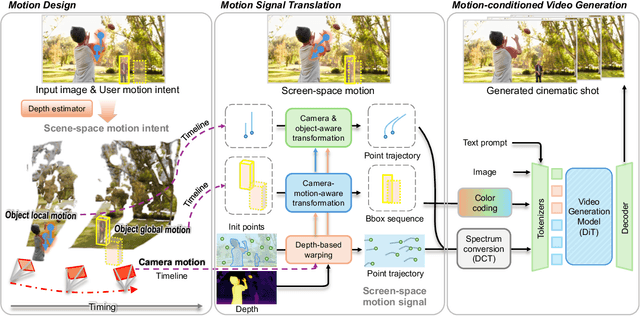


This paper presents a method that allows users to design cinematic video shots in the context of image-to-video generation. Shot design, a critical aspect of filmmaking, involves meticulously planning both camera movements and object motions in a scene. However, enabling intuitive shot design in modern image-to-video generation systems presents two main challenges: first, effectively capturing user intentions on the motion design, where both camera movements and scene-space object motions must be specified jointly; and second, representing motion information that can be effectively utilized by a video diffusion model to synthesize the image animations. To address these challenges, we introduce MotionCanvas, a method that integrates user-driven controls into image-to-video (I2V) generation models, allowing users to control both object and camera motions in a scene-aware manner. By connecting insights from classical computer graphics and contemporary video generation techniques, we demonstrate the ability to achieve 3D-aware motion control in I2V synthesis without requiring costly 3D-related training data. MotionCanvas enables users to intuitively depict scene-space motion intentions, and translates them into spatiotemporal motion-conditioning signals for video diffusion models. We demonstrate the effectiveness of our method on a wide range of real-world image content and shot-design scenarios, highlighting its potential to enhance the creative workflows in digital content creation and adapt to various image and video editing applications.