 Add to Chrome
 Add to Firefox
 Add to Edge
Accurate Ensembles, Fragile Narratives: Multi-Scale Stacking and a Fidelity Audit of LLM-Generated Explanations for Credit Risk
Aug 08, 2026
Credit scoring increasingly relies on models whose decision logic cannot be read off their parameters, in tension with supervisory expectations that adverse decisions be explainable. A common proposal closes that gap with a language model: compute feature attributions, hand them to an LLM, and let it write the rationale. We build such a system end to end and test whether the second half of the promise holds. The predictive component is a multi-scale stacking ensemble fusing four differently regularised gradient-boosting learners with a residual network through a neural meta-learner trained on out-of-fold predictions. On a public 32,581-application credit dataset it reaches test ROC-AUC 0.9539 (95% CI [0.9462, 0.9616]) and PR-AUC 0.9137, beating the best single model by Delta-AUC = 0.0143 (p = 0.016 under a conservative independence assumption). Our central finding is asymmetric. The ranking gain is real but operationally small: at the F1-optimal threshold the ensemble avoids only six additional missed defaults out of 1,422 against a tuned random forest, cutting cost-weighted loss by under 2%. The narrative layer fails in a way prompt engineering alone does not fix. In an audited case the model named three factors as risk-increasing that the supplied attributions scored as risk-reducing, omitted the dominant driver, and introduced a feature never given to it. We trace this to properties we measure rather than assume: SHAP and LIME agree on which features matter (overlap@10 = 0.80) but not on their order (tau = 0.43, p = 0.18), and the attribution sign for the model's most sensitive input is near a coin flip across applicants (modal-sign share 0.53). Calibration (ECS = 0.117) and perturbation stability (DPD = 0.078) both fall short of our own thresholds. Constrained prompting is necessary but not sufficient: grounding must be verified after generation, not assumed.

Reward-Driven LLM Agent Workflows: Synthesizing POMDP Routing and Self-Correction for Autonomous Decision-Making
Jul 19, 2026This paper addresses key technical challenges in current large language model (LLM) agent applications, including long-horizon planning, sparse reward attribution, and dynamic environmental interaction, by designing and optimizing an intelligent agent workflow. The proposed architecture is based on the synthesis of core AI paradigms: Visual, Language, Generative, Graph, Multimodal, Reinforcement, and Agent Intelligence. Unlike conventional baseline models that rely on static prompting and lack robust perception-action loops, our approach introduces a Partially Observable Markov Decision Process (POMDP) routing mechanism. This mechanism is augmented with an internal, self-correcting reward model that evaluates decision trajectories before execution. By integrating multimodal inputs and advanced reinforcement learning principles (such as proximal policy optimization and value function approximation), the agent maintains long-term structural memory and dynamically adapts its reasoning pathways to mitigate error accumulation. Empirical experiments on the ALFWorld embodied simulation environment and the WebShop online navigation benchmark demonstrate a 24.5% absolute improvement in task success rate and trajectory efficiency over mainstream baselines like the standard ReAct framework. Comprehensive ablation studies confirm the significant contribution of the reward-driven critique module in suppressing hallucination rates. This research bridges theoretical foundations of reinforcement learning and graph-based memory with autonomous agent workflows. Ultimately, the resulting architecture offers a practical, scalable reference framework for developing artificial intelligence technologies in complex, multi-step autonomous systems. Code is available at https://github.com/01Amez/RLAW_Implementation.
Fusion Matters: Length-Aware Analysis of Positional-Encoding Fusion in Transformers
Jan 09, 2026Transformers require positional encodings to represent sequence order, yet most prior work focuses on designing new positional encodings rather than examining how positional information is fused with token embeddings. In this paper, we study whether the fusion mechanism itself affects performance, particularly in long-sequence settings. We conduct a controlled empirical study comparing three canonical fusion strategies--element-wise addition, concatenation with projection, and scalar gated fusion--under identical Transformer architectures, data splits, and random seeds. Experiments on three text classification datasets spanning short (AG News), medium (IMDB), and long (ArXiv) sequences show that fusion choice has negligible impact on short texts but produces consistent gains on long documents. To verify that these gains are structural rather than stochastic, we perform paired-seed analysis and cross-dataset comparison across sequence-length regimes. Additional experiments on the ArXiv dataset indicate that the benefit of learnable fusion generalizes across multiple positional encoding families. Finally, we explore a lightweight convolutional gating mechanism that introduces local inductive bias at the fusion level, evaluated on long documents only. Our results indicate that positional-encoding fusion is a non-trivial design choice for long-sequence Transformers and should be treated as an explicit modeling decision rather than a fixed default.
RoboGSim: A Real2Sim2Real Robotic Gaussian Splatting Simulator
Nov 18, 2024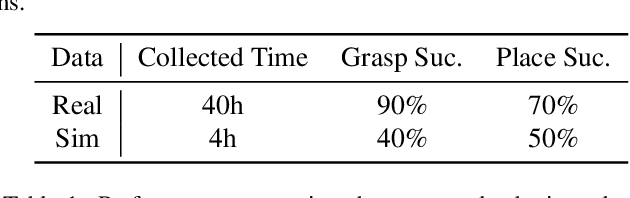
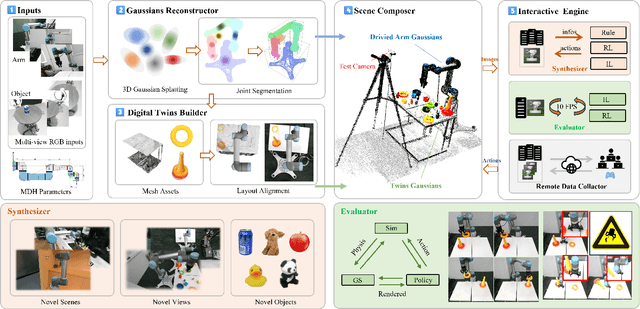
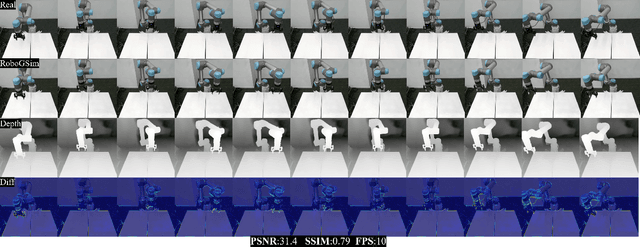
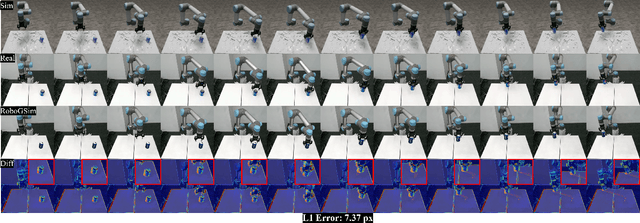
Efficient acquisition of real-world embodied data has been increasingly critical. However, large-scale demonstrations captured by remote operation tend to take extremely high costs and fail to scale up the data size in an efficient manner. Sampling the episodes under a simulated environment is a promising way for large-scale collection while existing simulators fail to high-fidelity modeling on texture and physics. To address these limitations, we introduce the RoboGSim, a real2sim2real robotic simulator, powered by 3D Gaussian Splatting and the physics engine. RoboGSim mainly includes four parts: Gaussian Reconstructor, Digital Twins Builder, Scene Composer, and Interactive Engine. It can synthesize the simulated data with novel views, objects, trajectories, and scenes. RoboGSim also provides an online, reproducible, and safe evaluation for different manipulation policies. The real2sim and sim2real transfer experiments show a high consistency in the texture and physics. Moreover, the effectiveness of synthetic data is validated under the real-world manipulated tasks. We hope RoboGSim serves as a closed-loop simulator for fair comparison on policy learning. More information can be found on our project page https://robogsim.github.io/ .
GaussianDiffusion: 3D Gaussian Splatting for Denoising Diffusion Probabilistic Models with Structured Noise
Nov 19, 2023Text-to-3D, known for its efficient generation methods and expansive creative potential, has garnered significant attention in the AIGC domain. However, the amalgamation of Nerf and 2D diffusion models frequently yields oversaturated images, posing severe limitations on downstream industrial applications due to the constraints of pixelwise rendering method. Gaussian splatting has recently superseded the traditional pointwise sampling technique prevalent in NeRF-based methodologies, revolutionizing various aspects of 3D reconstruction. This paper introduces a novel text to 3D content generation framework based on Gaussian splatting, enabling fine control over image saturation through individual Gaussian sphere transparencies, thereby producing more realistic images. The challenge of achieving multi-view consistency in 3D generation significantly impedes modeling complexity and accuracy. Taking inspiration from SJC, we explore employing multi-view noise distributions to perturb images generated by 3D Gaussian splatting, aiming to rectify inconsistencies in multi-view geometry. We ingeniously devise an efficient method to generate noise that produces Gaussian noise from diverse viewpoints, all originating from a shared noise source. Furthermore, vanilla 3D Gaussian-based generation tends to trap models in local minima, causing artifacts like floaters, burrs, or proliferative elements. To mitigate these issues, we propose the variational Gaussian splatting technique to enhance the quality and stability of 3D appearance. To our knowledge, our approach represents the first comprehensive utilization of Gaussian splatting across the entire spectrum of 3D content generation processes.