 Add to Chrome
 Add to Firefox
 Add to Edge
ARM: Advantage Reward Modeling for Long-Horizon Manipulation
Apr 03, 2026
Long-horizon robotic manipulation remains challenging for reinforcement learning (RL) because sparse rewards provide limited guidance for credit assignment. Practical policy improvement thus relies on richer intermediate supervision, such as dense progress rewards, which are costly to obtain and ill-suited to non-monotonic behaviors such as backtracking and recovery. To address this, we propose Advantage Reward Modeling (ARM), a framework that shifts from hard-to-quantify absolute progress to estimating relative advantage. We introduce a cost-effective tri-state labeling strategy -- Progressive, Regressive, and Stagnant -- that reduces human cognitive overhead while ensuring high cross-annotator consistency. By training on these intuitive signals, ARM enables automated progress annotation for both complete demonstrations and fragmented DAgger-style data. Integrating ARM into an offline RL pipeline allows for adaptive action-reward reweighting, effectively filtering suboptimal samples. Our approach achieves a 99.4% success rate on a challenging long-horizon towel-folding task, demonstrating improved stability and data efficiency over current VLA baselines with near-zero human intervention during policy training.

BFA++: Hierarchical Best-Feature-Aware Token Prune for Multi-View Vision Language Action Model
Feb 24, 2026Vision-Language-Action (VLA) models have achieved significant breakthroughs by leveraging Large Vision Language Models (VLMs) to jointly interpret instructions and visual inputs. However, the substantial increase in visual tokens, particularly from multi-view inputs, poses serious challenges to real-time robotic manipulation. Existing acceleration techniques for VLMs, such as token pruning, often result in degraded performance when directly applied to VLA models, as they overlook the relationships between different views and fail to account for the dynamic and task-specific characteristics of robotic operation. To address this, we propose BFA++, a dynamic token pruning framework designed specifically for VLA models. BFA++ introduces a hierarchical pruning strategy guided by two-level importance predictors: an intra-view predictor highlights task-relevant regions within each image to suppress spatial noise, while an inter-view predictor identifies critical camera views throughout different manipulation phases to reduce cross-view redundancy. This design enables efficient token selection while preserving essential visual cues, resulting in improved computational efficiency and higher manipulation success rates. Evaluations on the RoboTwin benchmark and real-world robotic tasks demonstrate that BFA++ consistently outperforms existing methods. BFA++ improves the success rate by about 10% on both the π0 and RDT models, achieving speedup of 1.8X and 1.5X, respectively. Our results highlight that context-sensitive and task-aware token pruning serves as a more effective strategy than full visual processing, enabling faster inference and improved manipulation accuracy in real-world robotic systems.
RoboMatrix: A Skill-centric Hierarchical Framework for Scalable Robot Task Planning and Execution in Open-World
Nov 29, 2024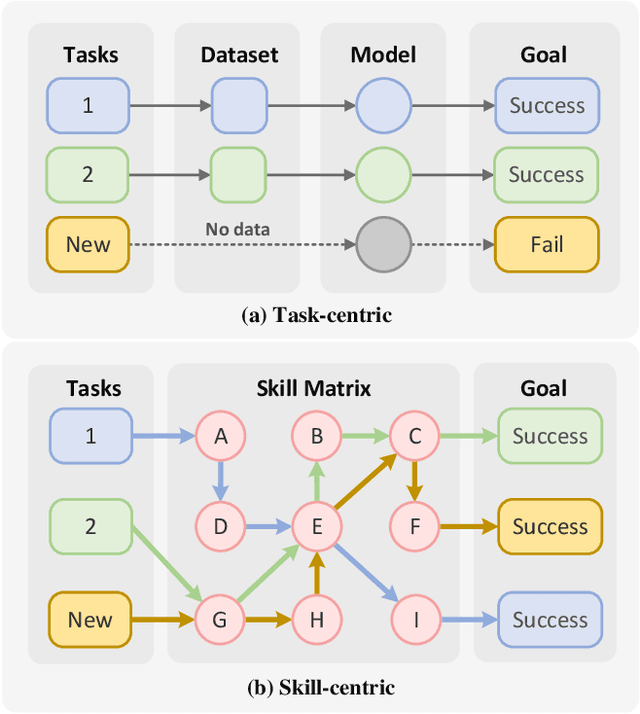
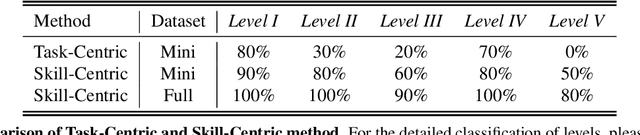
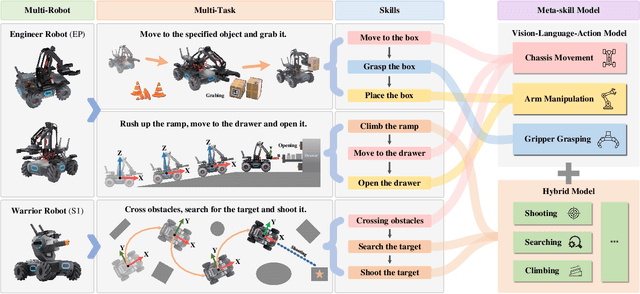

Existing policy learning methods predominantly adopt the task-centric paradigm, necessitating the collection of task data in an end-to-end manner. Consequently, the learned policy tends to fail to tackle novel tasks. Moreover, it is hard to localize the errors for a complex task with multiple stages due to end-to-end learning. To address these challenges, we propose RoboMatrix, a skill-centric and hierarchical framework for scalable task planning and execution. We first introduce a novel skill-centric paradigm that extracts the common meta-skills from different complex tasks. This allows for the capture of embodied demonstrations through a kill-centric approach, enabling the completion of open-world tasks by combining learned meta-skills. To fully leverage meta-skills, we further develop a hierarchical framework that decouples complex robot tasks into three interconnected layers: (1) a high-level modular scheduling layer; (2) a middle-level skill layer; and (3) a low-level hardware layer. Experimental results illustrate that our skill-centric and hierarchical framework achieves remarkable generalization performance across novel objects, scenes, tasks, and embodiments. This framework offers a novel solution for robot task planning and execution in open-world scenarios. Our software and hardware are available at https://github.com/WayneMao/RoboMatrix.
An Adaptive Spatial-Temporal Local Feature Difference Method for Infrared Small-moving Target Detection
Sep 05, 2023Detecting small moving targets accurately in infrared (IR) image sequences is a significant challenge. To address this problem, we propose a novel method called spatial-temporal local feature difference (STLFD) with adaptive background suppression (ABS). Our approach utilizes filters in the spatial and temporal domains and performs pixel-level ABS on the output to enhance the contrast between the target and the background. The proposed method comprises three steps. First, we obtain three temporal frame images based on the current frame image and extract two feature maps using the designed spatial domain and temporal domain filters. Next, we fuse the information of the spatial domain and temporal domain to produce the spatial-temporal feature maps and suppress noise using our pixel-level ABS module. Finally, we obtain the segmented binary map by applying a threshold. Our experimental results demonstrate that the proposed method outperforms existing state-of-the-art methods for infrared small-moving target detection.