 Add to Chrome
 Add to Firefox
 Add to Edge
The First Few Tokens Are All You Need: An Efficient and Effective Unsupervised Prefix Fine-Tuning Method for Reasoning Models
Mar 04, 2025
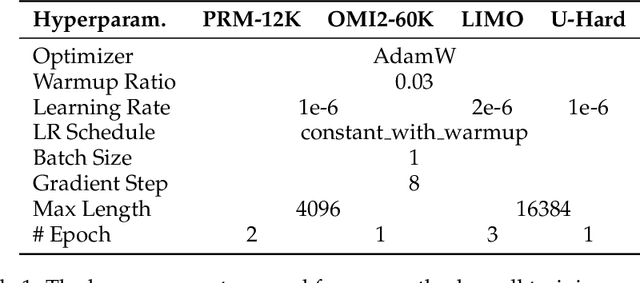
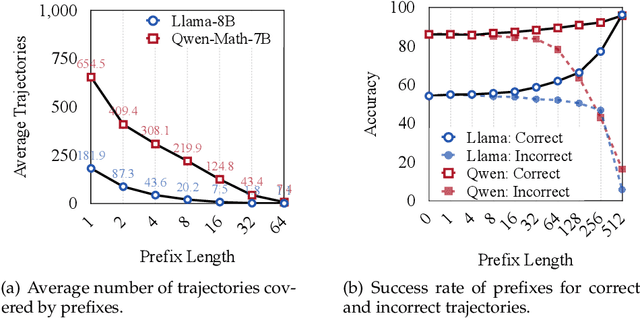
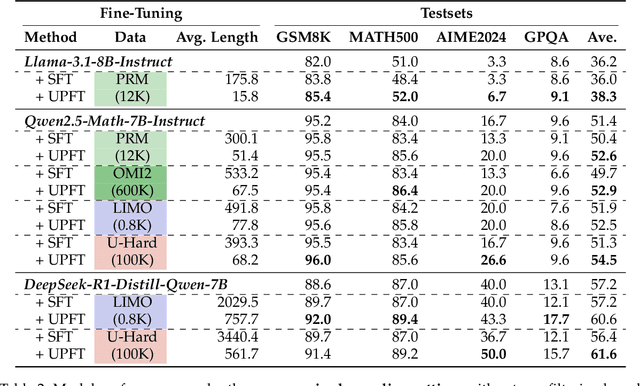

Improving the reasoning capabilities of large language models (LLMs) typically requires supervised fine-tuning with labeled data or computationally expensive sampling. We introduce Unsupervised Prefix Fine-Tuning (UPFT), which leverages the observation of Prefix Self-Consistency -- the shared initial reasoning steps across diverse solution trajectories -- to enhance LLM reasoning efficiency. By training exclusively on the initial prefix substrings (as few as 8 tokens), UPFT removes the need for labeled data or exhaustive sampling. Experiments on reasoning benchmarks show that UPFT matches the performance of supervised methods such as Rejection Sampling Fine-Tuning, while reducing training time by 75% and sampling cost by 99%. Further analysis reveals that errors tend to appear in later stages of the reasoning process and that prefix-based training preserves the model's structural knowledge. This work demonstrates how minimal unsupervised fine-tuning can unlock substantial reasoning gains in LLMs, offering a scalable and resource-efficient alternative to conventional approaches.

Improving LLM General Preference Alignment via Optimistic Online Mirror Descent
Feb 24, 2025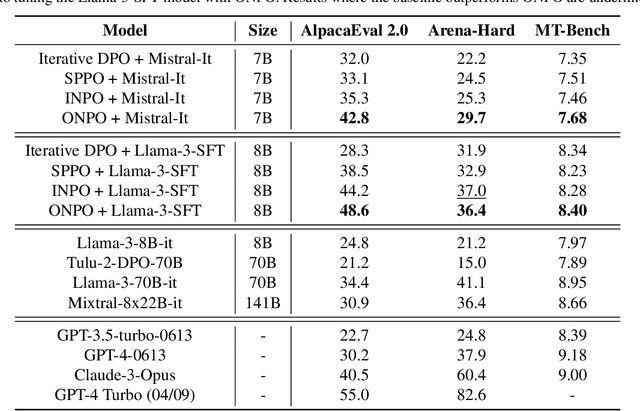
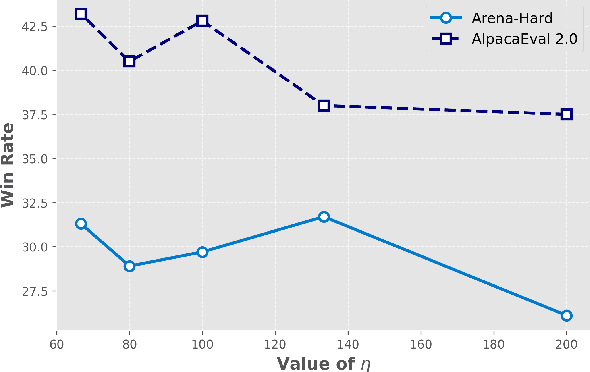

Reinforcement learning from human feedback (RLHF) has demonstrated remarkable effectiveness in aligning large language models (LLMs) with human preferences. Many existing alignment approaches rely on the Bradley-Terry (BT) model assumption, which assumes the existence of a ground-truth reward for each prompt-response pair. However, this assumption can be overly restrictive when modeling complex human preferences. In this paper, we drop the BT model assumption and study LLM alignment under general preferences, formulated as a two-player game. Drawing on theoretical insights from learning in games, we integrate optimistic online mirror descent into our alignment framework to approximate the Nash policy. Theoretically, we demonstrate that our approach achieves an $O(T^{-1})$ bound on the duality gap, improving upon the previous $O(T^{-1/2})$ result. More importantly, we implement our method and show through experiments that it outperforms state-of-the-art RLHF algorithms across multiple representative benchmarks.
Balancing Speech Understanding and Generation Using Continual Pre-training for Codec-based Speech LLM
Feb 24, 2025Recent efforts have extended textual LLMs to the speech domain. Yet, a key challenge remains, which is balancing speech understanding and generation while avoiding catastrophic forgetting when integrating acoustically rich codec-based representations into models originally trained on text. In this work, we propose a novel approach that leverages continual pre-training (CPT) on a pre-trained textual LLM to create a codec-based speech language model. This strategy mitigates the modality gap between text and speech, preserving the linguistic reasoning of the original model while enabling high-fidelity speech synthesis. We validate our approach with extensive experiments across multiple tasks, including automatic speech recognition, text-to-speech, speech-to-text translation, and speech-to-speech translation (S2ST), demonstrating that our model achieves superior TTS performance and, notably, the first end-to-end S2ST system based on neural codecs.
LLM-Enhanced Dialogue Management for Full-Duplex Spoken Dialogue Systems
Feb 19, 2025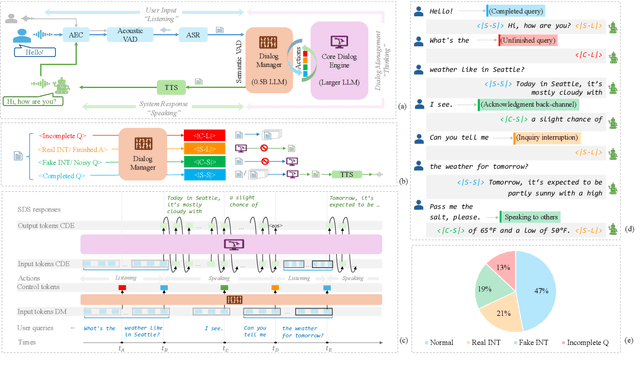
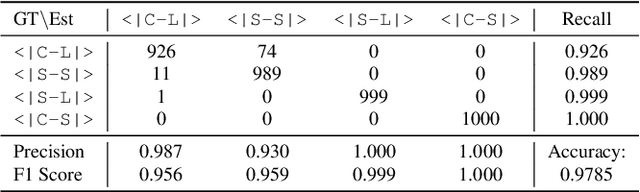
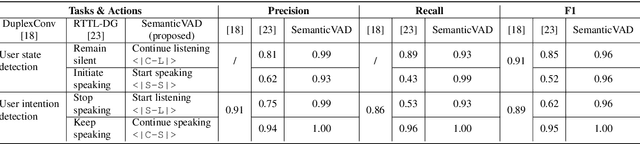
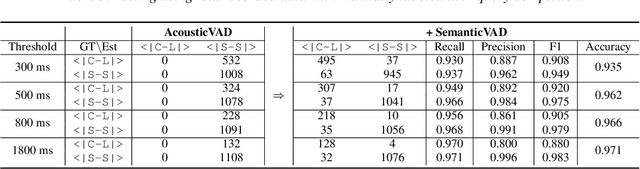
Achieving full-duplex communication in spoken dialogue systems (SDS) requires real-time coordination between listening, speaking, and thinking. This paper proposes a semantic voice activity detection (VAD) module as a dialogue manager (DM) to efficiently manage turn-taking in full-duplex SDS. Implemented as a lightweight (0.5B) LLM fine-tuned on full-duplex conversation data, the semantic VAD predicts four control tokens to regulate turn-switching and turn-keeping, distinguishing between intentional and unintentional barge-ins while detecting query completion for handling user pauses and hesitations. By processing input speech in short intervals, the semantic VAD enables real-time decision-making, while the core dialogue engine (CDE) is only activated for response generation, reducing computational overhead. This design allows independent DM optimization without retraining the CDE, balancing interaction accuracy and inference efficiency for scalable, next-generation full-duplex SDS.
Thoughts Are All Over the Place: On the Underthinking of o1-Like LLMs
Jan 30, 2025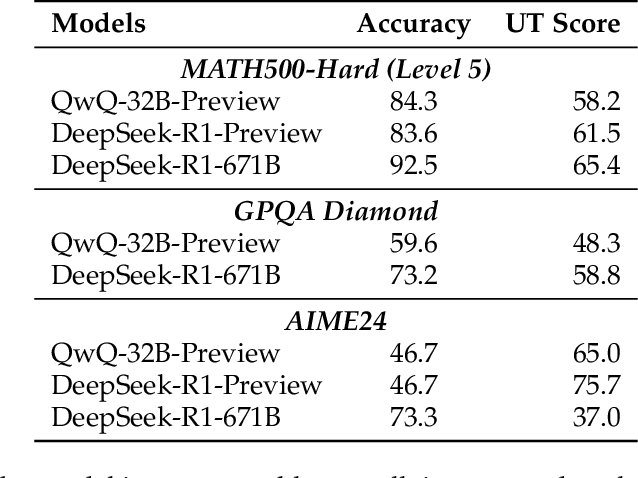
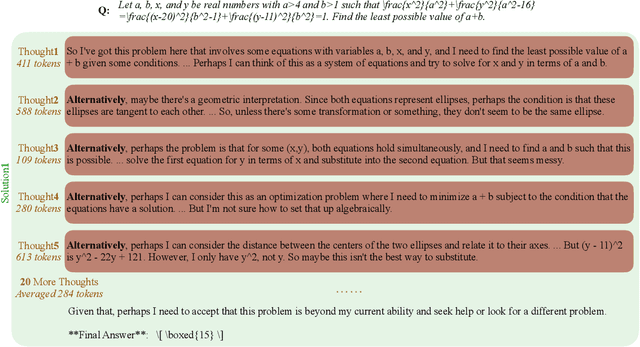
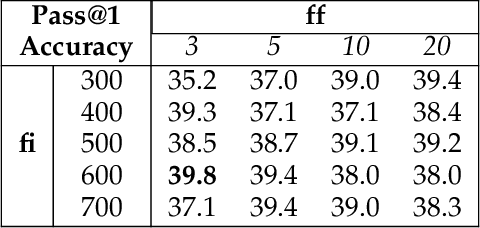
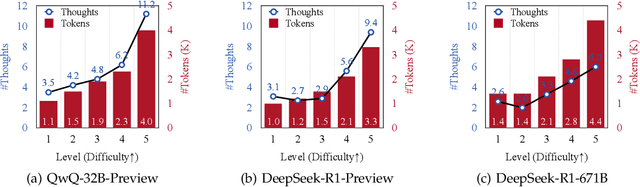
Large language models (LLMs) such as OpenAI's o1 have demonstrated remarkable abilities in complex reasoning tasks by scaling test-time compute and exhibiting human-like deep thinking. However, we identify a phenomenon we term underthinking, where o1-like LLMs frequently switch between different reasoning thoughts without sufficiently exploring promising paths to reach a correct solution. This behavior leads to inadequate depth of reasoning and decreased performance, particularly on challenging mathematical problems. To systematically analyze this issue, we conduct experiments on three challenging test sets and two representative open-source o1-like models, revealing that frequent thought switching correlates with incorrect responses. We introduce a novel metric to quantify underthinking by measuring token efficiency in incorrect answers. To address underthinking, we propose a decoding strategy with thought switching penalty TIP that discourages premature transitions between thoughts, encouraging deeper exploration of each reasoning path. Experimental results demonstrate that our approach improves accuracy across challenging datasets without requiring model fine-tuning. Our findings contribute to understanding reasoning inefficiencies in o1-like LLMs and offer a practical solution to enhance their problem-solving capabilities.
OpenCharacter: Training Customizable Role-Playing LLMs with Large-Scale Synthetic Personas
Jan 26, 2025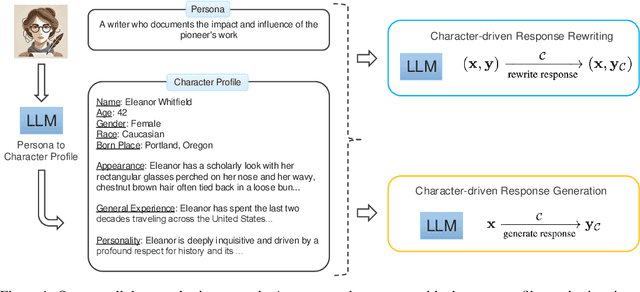
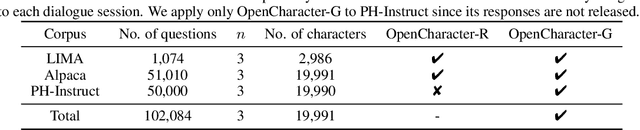


Customizable role-playing in large language models (LLMs), also known as character generalization, is gaining increasing attention for its versatility and cost-efficiency in developing and deploying role-playing dialogue agents. This study explores a large-scale data synthesis approach to equip LLMs with character generalization capabilities. We begin by synthesizing large-scale character profiles using personas from Persona Hub and then explore two strategies: response rewriting and response generation, to create character-aligned instructional responses. To validate the effectiveness of our synthetic instruction tuning data for character generalization, we perform supervised fine-tuning (SFT) using the LLaMA-3 8B model. Our best-performing model strengthens the original LLaMA-3 8B Instruct model and achieves performance comparable to GPT-4o models on role-playing dialogue. We release our synthetic characters and instruction-tuning dialogues to support public research.
Lifelong Learning of Large Language Model based Agents: A Roadmap
Jan 13, 2025Lifelong learning, also known as continual or incremental learning, is a crucial component for advancing Artificial General Intelligence (AGI) by enabling systems to continuously adapt in dynamic environments. While large language models (LLMs) have demonstrated impressive capabilities in natural language processing, existing LLM agents are typically designed for static systems and lack the ability to adapt over time in response to new challenges. This survey is the first to systematically summarize the potential techniques for incorporating lifelong learning into LLM-based agents. We categorize the core components of these agents into three modules: the perception module for multimodal input integration, the memory module for storing and retrieving evolving knowledge, and the action module for grounded interactions with the dynamic environment. We highlight how these pillars collectively enable continuous adaptation, mitigate catastrophic forgetting, and improve long-term performance. This survey provides a roadmap for researchers and practitioners working to develop lifelong learning capabilities in LLM agents, offering insights into emerging trends, evaluation metrics, and application scenarios. Relevant literature and resources are available at \href{this url}{https://github.com/qianlima-lab/awesome-lifelong-llm-agent}.
Disambiguation of Chinese Polyphones in an End-to-End Framework with Semantic Features Extracted by Pre-trained BERT
Jan 02, 2025


Grapheme-to-phoneme (G2P) conversion serves as an essential component in Chinese Mandarin text-to-speech (TTS) system, where polyphone disambiguation is the core issue. In this paper, we propose an end-to-end framework to predict the pronunciation of a polyphonic character, which accepts sentence containing polyphonic character as input in the form of Chinese character sequence without the necessity of any preprocessing. The proposed method consists of a pre-trained bidirectional encoder representations from Transformers (BERT) model and a neural network (NN) based classifier. The pre-trained BERT model extracts semantic features from a raw Chinese character sequence and the NN based classifier predicts the polyphonic character's pronunciation according to BERT output. In out experiments, we implemented three classifiers, a fully-connected network based classifier, a long short-term memory (LSTM) network based classifier and a Transformer block based classifier. The experimental results compared with the baseline approach based on LSTM demonstrate that, the pre-trained model extracts effective semantic features, which greatly enhances the performance of polyphone disambiguation. In addition, we also explored the impact of contextual information on polyphone disambiguation.
* Accepted at INTERSPEECH 2019
Do NOT Think That Much for 2+3=? On the Overthinking of o1-Like LLMs
Dec 30, 2024The remarkable performance of models like the OpenAI o1 can be attributed to their ability to emulate human-like long-time thinking during inference. These models employ extended chain-of-thought (CoT) processes, exploring multiple strategies to enhance problem-solving capabilities. However, a critical question remains: How to intelligently and efficiently scale computational resources during testing. This paper presents the first comprehensive study on the prevalent issue of overthinking in these models, where excessive computational resources are allocated for simple problems with minimal benefit. We introduce novel efficiency metrics from both outcome and process perspectives to evaluate the rational use of computational resources by o1-like models. Using a self-training paradigm, we propose strategies to mitigate overthinking, streamlining reasoning processes without compromising accuracy. Experimental results show that our approach successfully reduces computational overhead while preserving model performance across a range of testsets with varying difficulty levels, such as GSM8K, MATH500, GPQA, and AIME.
A Silver Bullet or a Compromise for Full Attention? A Comprehensive Study of Gist Token-based Context Compression
Dec 23, 2024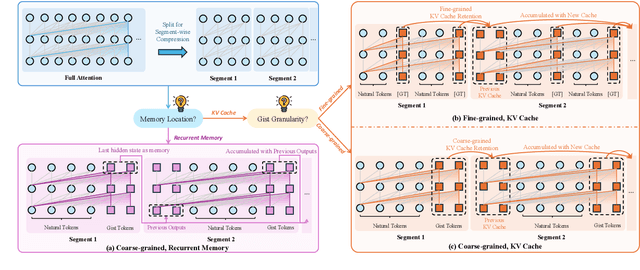
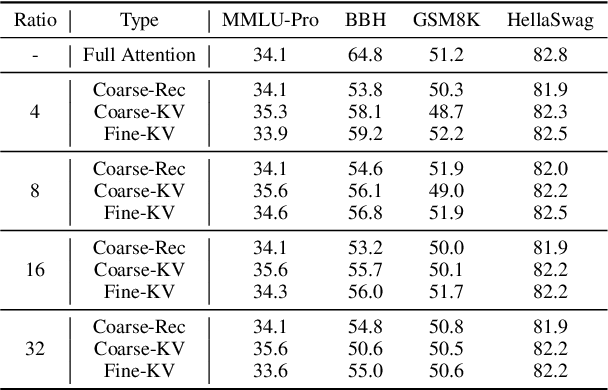
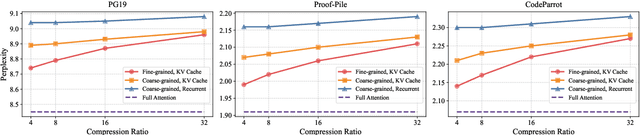
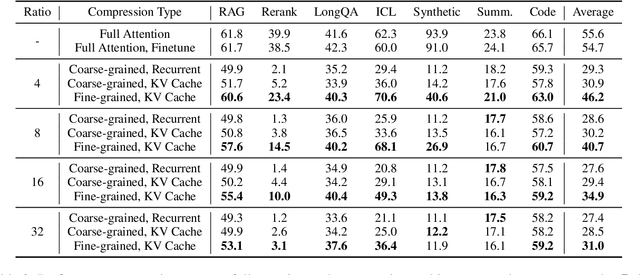
In this work, we provide a thorough investigation of gist-based context compression methods to improve long-context processing in large language models. We focus on two key questions: (1) How well can these methods replace full attention models? and (2) What potential failure patterns arise due to compression? Through extensive experiments, we show that while gist-based compression can achieve near-lossless performance on tasks like retrieval-augmented generation and long-document QA, it faces challenges in tasks like synthetic recall. Furthermore, we identify three key failure patterns: lost by the boundary, lost if surprise, and lost along the way. To mitigate these issues, we propose two effective strategies: fine-grained autoencoding, which enhances the reconstruction of original token information, and segment-wise token importance estimation, which adjusts optimization based on token dependencies. Our work provides valuable insights into the understanding of gist token-based context compression and offers practical strategies for improving compression capabilities.