 Add to Chrome
 Add to Firefox
 Add to Edge
Large Reasoning Models in Agent Scenarios: Exploring the Necessity of Reasoning Capabilities
Mar 14, 2025
The rise of Large Reasoning Models (LRMs) signifies a paradigm shift toward advanced computational reasoning. Yet, this progress disrupts traditional agent frameworks, traditionally anchored by execution-oriented Large Language Models (LLMs). To explore this transformation, we propose the LaRMA framework, encompassing nine tasks across Tool Usage, Plan Design, and Problem Solving, assessed with three top LLMs (e.g., Claude3.5-sonnet) and five leading LRMs (e.g., DeepSeek-R1). Our findings address four research questions: LRMs surpass LLMs in reasoning-intensive tasks like Plan Design, leveraging iterative reflection for superior outcomes; LLMs excel in execution-driven tasks such as Tool Usage, prioritizing efficiency; hybrid LLM-LRM configurations, pairing LLMs as actors with LRMs as reflectors, optimize agent performance by blending execution speed with reasoning depth; and LRMs' enhanced reasoning incurs higher computational costs, prolonged processing, and behavioral challenges, including overthinking and fact-ignoring tendencies. This study fosters deeper inquiry into LRMs' balance of deep thinking and overthinking, laying a critical foundation for future agent design advancements.

Cost-Aware Optimal Pairwise Pure Exploration
Mar 10, 2025Pure exploration is one of the fundamental problems in multi-armed bandits (MAB). However, existing works mostly focus on specific pure exploration tasks, without a holistic view of the general pure exploration problem. This work fills this gap by introducing a versatile framework to study pure exploration, with a focus on identifying the pairwise relationships between targeted arm pairs. Moreover, unlike existing works that only optimize the stopping time (i.e., sample complexity), this work considers that arms are associated with potentially different costs and targets at optimizing the cumulative cost that occurred during learning. Under the general framework of pairwise pure exploration with arm-specific costs, a performance lower bound is derived. Then, a novel algorithm, termed CAET (Cost-Aware Pairwise Exploration Task), is proposed. CAET builds on the track-and-stop principle with a novel design to handle the arm-specific costs, which can potentially be zero and thus represent a very challenging case. Theoretical analyses prove that the performance of CAET approaches the lower bound asymptotically. Special cases are further discussed, including an extension to regret minimization, which is another major focus of MAB. The effectiveness and efficiency of CAET are also verified through experimental results under various settings.
REArtGS: Reconstructing and Generating Articulated Objects via 3D Gaussian Splatting with Geometric and Motion Constraints
Mar 09, 2025Articulated objects, as prevalent entities in human life, their 3D representations play crucial roles across various applications. However, achieving both high-fidelity textured surface reconstruction and dynamic generation for articulated objects remains challenging for existing methods. In this paper, we present REArtGS, a novel framework that introduces additional geometric and motion constraints to 3D Gaussian primitives, enabling high-quality textured surface reconstruction and generation for articulated objects. Specifically, given multi-view RGB images of arbitrary two states of articulated objects, we first introduce an unbiased Signed Distance Field (SDF) guidance to regularize Gaussian opacity fields, enhancing geometry constraints and improving surface reconstruction quality. Then we establish deformable fields for 3D Gaussians constrained by the kinematic structures of articulated objects, achieving unsupervised generation of surface meshes in unseen states. Extensive experiments on both synthetic and real datasets demonstrate our approach achieves high-quality textured surface reconstruction for given states, and enables high-fidelity surface generation for unseen states. Codes will be released within the next four months.
Generative Multi-Agent Collaboration in Embodied AI: A Systematic Review
Feb 17, 2025Embodied multi-agent systems (EMAS) have attracted growing attention for their potential to address complex, real-world challenges in areas such as logistics and robotics. Recent advances in foundation models pave the way for generative agents capable of richer communication and adaptive problem-solving. This survey provides a systematic examination of how EMAS can benefit from these generative capabilities. We propose a taxonomy that categorizes EMAS by system architectures and embodiment modalities, emphasizing how collaboration spans both physical and virtual contexts. Central building blocks, perception, planning, communication, and feedback, are then analyzed to illustrate how generative techniques bolster system robustness and flexibility. Through concrete examples, we demonstrate the transformative effects of integrating foundation models into embodied, multi-agent frameworks. Finally, we discuss challenges and future directions, underlining the significant promise of EMAS to reshape the landscape of AI-driven collaboration.
IU4Rec: Interest Unit-Based Product Organization and Recommendation for E-Commerce Platform
Feb 11, 2025Most recommendation systems typically follow a product-based paradigm utilizing user-product interactions to identify the most engaging items for users. However, this product-based paradigm has notable drawbacks for Xianyu~\footnote{Xianyu is China's largest online C2C e-commerce platform where a large portion of the product are post by individual sellers}. Most of the product on Xianyu posted from individual sellers often have limited stock available for distribution, and once the product is sold, it's no longer available for distribution. This result in most items distributed product on Xianyu having relatively few interactions, affecting the effectiveness of traditional recommendation depending on accumulating user-item interactions. To address these issues, we introduce \textbf{IU4Rec}, an \textbf{I}nterest \textbf{U}nit-based two-stage \textbf{Rec}ommendation system framework. We first group products into clusters based on attributes such as category, image, and semantics. These IUs are then integrated into the Recommendation system, delivering both product and technological innovations. IU4Rec begins by grouping products into clusters based on attributes such as category, image, and semantics, forming Interest Units (IUs). Then we redesign the recommendation process into two stages. In the first stage, the focus is on recommend these Interest Units, capturing broad-level interests. In the second stage, it guides users to find the best option among similar products within the selected Interest Unit. User-IU interactions are incorporated into our ranking models, offering the advantage of more persistent IU behaviors compared to item-specific interactions. Experimental results on the production dataset and online A/B testing demonstrate the effectiveness and superiority of our proposed IU-centric recommendation approach.
MXMap: A Multivariate Cross Mapping Framework for Causal Discovery in Dynamical Systems
Feb 06, 2025Convergent Cross Mapping (CCM) is a powerful method for detecting causality in coupled nonlinear dynamical systems, providing a model-free approach to capture dynamic causal interactions. Partial Cross Mapping (PCM) was introduced as an extension of CCM to address indirect causality in three-variable systems by comparing cross-mapping quality between direct cause-effect mapping and indirect mapping through an intermediate conditioning variable. However, PCM remains limited to univariate delay embeddings in its cross-mapping processes. In this work, we extend PCM to the multivariate setting, introducing multiPCM, which leverages multivariate embeddings to more effectively distinguish indirect causal relationships. We further propose a multivariate cross-mapping framework (MXMap) for causal discovery in dynamical systems. This two-phase framework combines (1) pairwise CCM tests to establish an initial causal graph and (2) multiPCM to refine the graph by pruning indirect causal connections. Through experiments on simulated data and the ERA5 Reanalysis weather dataset, we demonstrate the effectiveness of MXMap. Additionally, MXMap is compared against several baseline methods, showing advantages in accuracy and causal graph refinement.
PINS: Proximal Iterations with Sparse Newton and Sinkhorn for Optimal Transport
Feb 06, 2025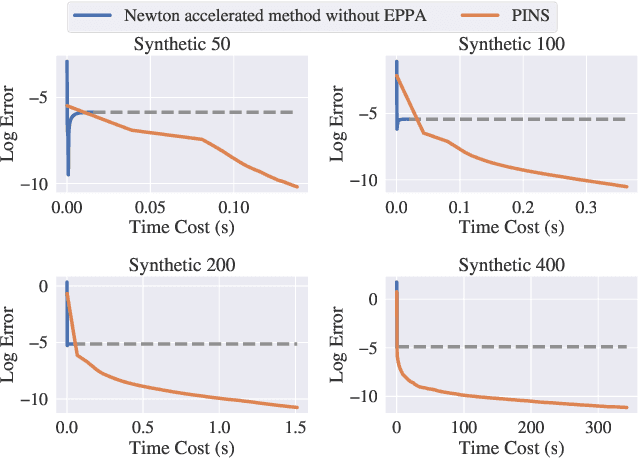
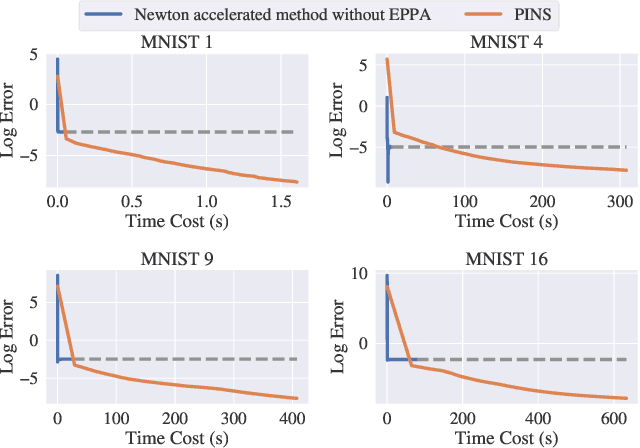
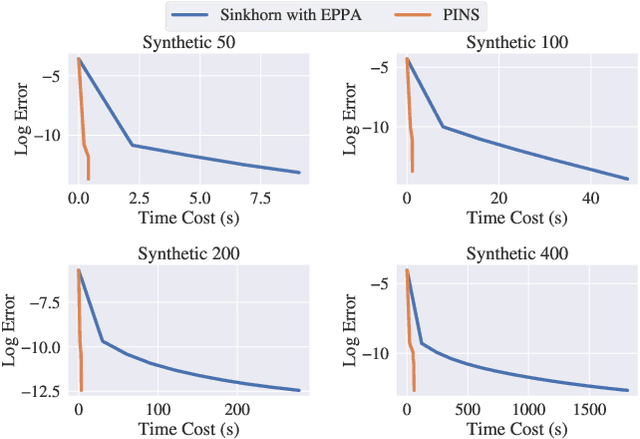
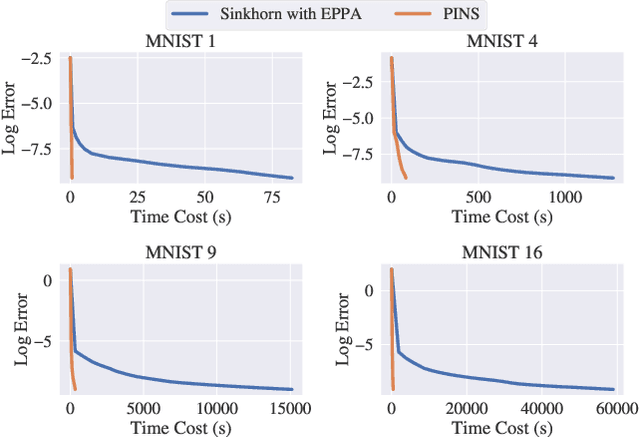
Optimal transport (OT) is a critical problem in optimization and machine learning, where accuracy and efficiency are paramount. Although entropic regularization and the Sinkhorn algorithm improve scalability, they frequently encounter numerical instability and slow convergence, especially when the regularization parameter is small. In this work, we introduce Proximal Iterations with Sparse Newton and Sinkhorn methods (PINS) to efficiently compute highly accurate solutions for large-scale OT problems. A reduced computational complexity through overall sparsity and global convergence are guaranteed by rigorous theoretical analysis. Our approach offers three key advantages: it achieves accuracy comparable to exact solutions, progressively accelerates each iteration for greater efficiency, and enhances robustness by reducing sensitivity to regularization parameters. Extensive experiments confirm these advantages, demonstrating superior performance compared to related methods.
Fine-Tuned Language Models as Space Systems Controllers
Jan 28, 2025Large language models (LLMs), or foundation models (FMs), are pretrained transformers that coherently complete sentences auto-regressively. In this paper, we show that LLMs can control simplified space systems after some additional training, called fine-tuning. We look at relatively small language models, ranging between 7 and 13 billion parameters. We focus on four problems: a three-dimensional spring toy problem, low-thrust orbit transfer, low-thrust cislunar control, and powered descent guidance. The fine-tuned LLMs are capable of controlling systems by generating sufficiently accurate outputs that are multi-dimensional vectors with up to 10 significant digits. We show that for several problems the amount of data required to perform fine-tuning is smaller than what is generally required of traditional deep neural networks (DNNs), and that fine-tuned LLMs are good at generalizing outside of the training dataset. Further, the same LLM can be fine-tuned with data from different problems, with only minor performance degradation with respect to LLMs trained for a single application. This work is intended as a first step towards the development of a general space systems controller.
An Aspect Performance-aware Hypergraph Neural Network for Review-based Recommendation
Jan 26, 2025Online reviews allow consumers to provide detailed feedback on various aspects of items. Existing methods utilize these aspects to model users' fine-grained preferences for specific item features through graph neural networks. We argue that the performance of items on different aspects is important for making precise recommendations, which has not been taken into account by existing approaches, due to lack of data. In this paper, we propose an aspect performance-aware hypergraph neural network (APH) for the review-based recommendation, which learns the performance of items from the conflicting sentiment polarity of user reviews. Specifically, APH comprehensively models the relationships among users, items, aspects, and sentiment polarity by systematically constructing an aspect hypergraph based on user reviews. In addition, APH aggregates aspects representing users and items by employing an aspect performance-aware hypergraph aggregation method. It aggregates the sentiment polarities from multiple users by jointly considering user preferences and the semantics of their sentiments, determining the weights of sentiment polarities to infer the performance of items on various aspects. Such performances are then used as weights to aggregate neighboring aspects. Experiments on six real-world datasets demonstrate that APH improves MSE, Precision@5, and Recall@5 by an average of 2.30%, 4.89%, and 1.60% over the best baseline. The source code and data are available at https://github.com/dianziliu/APH.
DRDT3: Diffusion-Refined Decision Test-Time Training Model
Jan 12, 2025Decision Transformer (DT), a trajectory modeling method, has shown competitive performance compared to traditional offline reinforcement learning (RL) approaches on various classic control tasks. However, it struggles to learn optimal policies from suboptimal, reward-labeled trajectories. In this study, we explore the use of conditional generative modeling to facilitate trajectory stitching given its high-quality data generation ability. Additionally, recent advancements in Recurrent Neural Networks (RNNs) have shown their linear complexity and competitive sequence modeling performance over Transformers. We leverage the Test-Time Training (TTT) layer, an RNN that updates hidden states during testing, to model trajectories in the form of DT. We introduce a unified framework, called Diffusion-Refined Decision TTT (DRDT3), to achieve performance beyond DT models. Specifically, we propose the Decision TTT (DT3) module, which harnesses the sequence modeling strengths of both self-attention and the TTT layer to capture recent contextual information and make coarse action predictions. We further integrate DT3 with the diffusion model using a unified optimization objective. With experiments on multiple tasks of Gym and AntMaze in the D4RL benchmark, our DT3 model without diffusion refinement demonstrates improved performance over standard DT, while DRDT3 further achieves superior results compared to state-of-the-art conventional offline RL and DT-based methods.