 Add to Chrome
 Add to Firefox
 Add to Edge
LeAct: Learning to Reason from Expert Actions
Jul 23, 2026
Modern reasoning models depend on reasoning data, today sourced from human annotations or distilled from stronger LLMs. However, a rich and largely untapped source of supervision lies in expert systems (e.g., game engines, classical planners, theorem provers), which routinely produce near-optimal actions across diverse domains. But these experts are silent: they commit to an action without writing down the chain of thought (CoT) behind it. Recovering that CoT as natural-language reasoning would distill expert knowledge into a student that generalizes beyond the demonstrated actions. We treat it as a latent variable and study how to recover it from the action alone. Our approach, LeAct (Learning to reason from Actions), optimizes this latent variable: the student samples candidate CoTs for each expert action, and we retain those that measurably improve its own probability of recovering the action. Across imperfect-information games at multiple scales and a simulated robotics benchmark, LeAct reaches the solver's numerical floor on small enumerable games. At larger scale, it is $5\times$ closer to the solver than the strongest expert-iteration baseline. At Flop Hold'em ($\sim 10^9$ infosets), LeAct wins head-to-head by $+60$ mbb/g, and on the robotics probe it is the only training recipe that improves on direct imitation. We present a principled framework and the result: expert systems become a categorically new source of reasoning teachers for foundation models.

The Past Is Prologue: A Plug-in Controller for Selective Updates in Sequentially Evolving LLM Memory
Jun 30, 2026Sequentially evolving LLM memory enables agents to reuse past experience, but existing systems usually deploy each locally generated memory update without checking whether it improves future behavior. As a result, updates that help the current task may overwrite useful knowledge, introduce over-specific rules, or bias the final memory toward recent examples. We propose Janus, a plug-in memory controller that decides whether to accept a candidate memory update or retain the previous memory. To make this decision efficient, Janus uses a Memory Momentum Trigger to identify suspicious deviations in the memory-update trajectory, and compares old and new memories on a compact hybrid evaluation set of coverage, boundary, and fresh tasks instead of replaying the full history. Janus is method-agnostic and wraps existing updaters without changing their update rules. Across six datasets, two backbone LLMs, and two memory updaters, Janus improves average accuracy by +2.7 to +4.6 points over the corresponding base updaters.
Efficient Multi-objective Prompt Optimization via Pure-exploration Bandits
May 14, 2026Prompt engineering has become central to eliciting the capabilities of large language models (LLMs). At its core lies prompt selection -- efficiently identifying the most effective prompts. However, most prior investigations overlook a key challenge: the inherently multi-faceted nature of prompt performance, which cannot be captured by a single metric. To fill this gap, we study the multi-objective prompt selection problem under two practical settings: Pareto prompt set recovery and best feasible prompt identification. Casting the problem into the pure-exploration bandits framework, we adapt provably efficient algorithms from multi-objective bandits and further introduce a novel design for best feasible arm identification in structured bandits, with theoretical guarantees on the identification error in the linear case. Extensive experiments across multiple LLMs show that the bandit-based approaches yield significant improvements over baselines, establishing a principled and efficient framework for multi-objective prompt optimization.
Continual Harness: Online Adaptation for Self-Improving Foundation Agents
May 11, 2026Coding harnesses such as Claude Code and OpenHands wrap foundation models with tools, memory, and planning, but no equivalent exists for embodied agents' long-horizon partial-observability decision-making. We first report our Gemini Plays Pokemon (GPP) experiments. With iterative human-in-the-loop harness refinement, GPP became the first AI system to complete Pokemon Blue, Yellow Legacy on hard mode, and Crystal without a lost battle. In the hardest stages, the agent itself began iterating on its strategy through long-context memory, surfacing emergent self-improvement signals alongside human-in-the-loop refinement. Continual Harness removes the human fully from this loop: a reset-free self-improving harness for embodied agents that formalizes and automates what we observed. Starting from only a minimal environment interface, the agent alternates between acting and refining its own prompt, sub-agents, skills, and memory, drawing on any past trajectory data. Prompt-optimization methods require episode resets; Continual Harness adapts online within a single run. On Pokemon Red and Emerald across frontier models, Continual Harness starting from scratch substantially reduces button-press cost relative to the minimalist baseline and recovers a majority of the gap to a hand-engineered expert harness, with capability-dependent gains, despite starting from the same raw interface with no curated knowledge, no hand-crafted tools, and no domain scaffolding. We then close the loop with the model itself: an online process-reward co-learning loop, in which an open-source agent's rollouts through the refining harness are relabeled by a frontier teacher and used to update the model, drives sustained in-game milestone progress on Pokemon Red without resetting the environment between training iterations.
Augmenting Online RL with Offline Data is All You Need: A Unified Hybrid RL Algorithm Design and Analysis
May 19, 2025This paper investigates a hybrid learning framework for reinforcement learning (RL) in which the agent can leverage both an offline dataset and online interactions to learn the optimal policy. We present a unified algorithm and analysis and show that augmenting confidence-based online RL algorithms with the offline dataset outperforms any pure online or offline algorithm alone and achieves state-of-the-art results under two learning metrics, i.e., sub-optimality gap and online learning regret. Specifically, we show that our algorithm achieves a sub-optimality gap $\tilde{O}(\sqrt{1/(N_0/\mathtt{C}(\pi^*|\rho)+N_1}) )$, where $\mathtt{C}(\pi^*|\rho)$ is a new concentrability coefficient, $N_0$ and $N_1$ are the numbers of offline and online samples, respectively. For regret minimization, we show that it achieves a constant $\tilde{O}( \sqrt{N_1/(N_0/\mathtt{C}(\pi^{-}|\rho)+N_1)} )$ speed-up compared to pure online learning, where $\mathtt{C}(\pi^-|\rho)$ is the concentrability coefficient over all sub-optimal policies. Our results also reveal an interesting separation on the desired coverage properties of the offline dataset for sub-optimality gap minimization and regret minimization. We further validate our theoretical findings in several experiments in special RL models such as linear contextual bandits and Markov decision processes (MDPs).
Cost-Aware Optimal Pairwise Pure Exploration
Mar 10, 2025Pure exploration is one of the fundamental problems in multi-armed bandits (MAB). However, existing works mostly focus on specific pure exploration tasks, without a holistic view of the general pure exploration problem. This work fills this gap by introducing a versatile framework to study pure exploration, with a focus on identifying the pairwise relationships between targeted arm pairs. Moreover, unlike existing works that only optimize the stopping time (i.e., sample complexity), this work considers that arms are associated with potentially different costs and targets at optimizing the cumulative cost that occurred during learning. Under the general framework of pairwise pure exploration with arm-specific costs, a performance lower bound is derived. Then, a novel algorithm, termed CAET (Cost-Aware Pairwise Exploration Task), is proposed. CAET builds on the track-and-stop principle with a novel design to handle the arm-specific costs, which can potentially be zero and thus represent a very challenging case. Theoretical analyses prove that the performance of CAET approaches the lower bound asymptotically. Special cases are further discussed, including an extension to regret minimization, which is another major focus of MAB. The effectiveness and efficiency of CAET are also verified through experimental results under various settings.
Transformers as Game Players: Provable In-context Game-playing Capabilities of Pre-trained Models
Oct 13, 2024The in-context learning (ICL) capability of pre-trained models based on the transformer architecture has received growing interest in recent years. While theoretical understanding has been obtained for ICL in reinforcement learning (RL), the previous results are largely confined to the single-agent setting. This work proposes to further explore the in-context learning capabilities of pre-trained transformer models in competitive multi-agent games, i.e., in-context game-playing (ICGP). Focusing on the classical two-player zero-sum games, theoretical guarantees are provided to demonstrate that pre-trained transformers can provably learn to approximate Nash equilibrium in an in-context manner for both decentralized and centralized learning settings. As a key part of the proof, constructional results are established to demonstrate that the transformer architecture is sufficiently rich to realize celebrated multi-agent game-playing algorithms, in particular, decentralized V-learning and centralized VI-ULCB.
Building Math Agents with Multi-Turn Iterative Preference Learning
Sep 04, 2024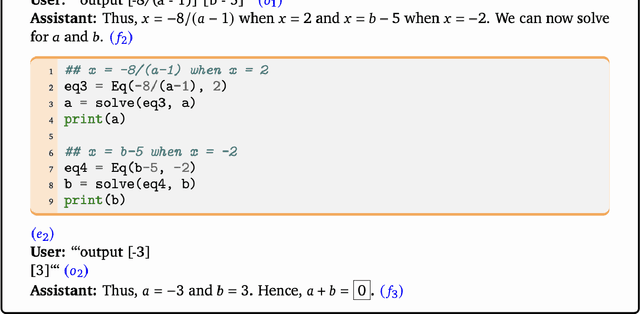


Recent studies have shown that large language models' (LLMs) mathematical problem-solving capabilities can be enhanced by integrating external tools, such as code interpreters, and employing multi-turn Chain-of-Thought (CoT) reasoning. While current methods focus on synthetic data generation and Supervised Fine-Tuning (SFT), this paper studies the complementary direct preference learning approach to further improve model performance. However, existing direct preference learning algorithms are originally designed for the single-turn chat task, and do not fully address the complexities of multi-turn reasoning and external tool integration required for tool-integrated mathematical reasoning tasks. To fill in this gap, we introduce a multi-turn direct preference learning framework, tailored for this context, that leverages feedback from code interpreters and optimizes trajectory-level preferences. This framework includes multi-turn DPO and multi-turn KTO as specific implementations. The effectiveness of our framework is validated through training of various language models using an augmented prompt set from the GSM8K and MATH datasets. Our results demonstrate substantial improvements: a supervised fine-tuned Gemma-1.1-it-7B model's performance increased from 77.5% to 83.9% on GSM8K and from 46.1% to 51.2% on MATH. Similarly, a Gemma-2-it-9B model improved from 84.1% to 86.3% on GSM8K and from 51.0% to 54.5% on MATH.
Best Arm Identification for Prompt Learning under a Limited Budget
Feb 20, 2024The remarkable instruction-following capability of large language models (LLMs) has sparked a growing interest in automatically learning suitable prompts. However, while many effective methods have been proposed, the cost incurred during the learning process (e.g., accessing LLM and evaluating the responses) has not been considered. To overcome this limitation, this work explicitly incorporates a finite budget constraint into prompt learning. Towards developing principled solutions, a novel connection is established between prompt learning and fixed-budget best arm identification (BAI-FB) in multi-armed bandits (MAB). Based on this connection, a general framework TRIPLE (besT aRm Identification for Prompt LEarning) is proposed to harness the power of BAI-FB in prompt learning systematically. Unique characteristics of prompt learning further lead to two embedding-based enhancements of TRIPLE by exploiting the ideas of clustering and function approximation. Extensive experiments on multiple well-adopted tasks using both GPT 3.5 and Llama2 demonstrate the significant performance improvement of TRIPLE over the previous baselines while satisfying the limited budget constraints.
Harnessing the Power of Federated Learning in Federated Contextual Bandits
Dec 26, 2023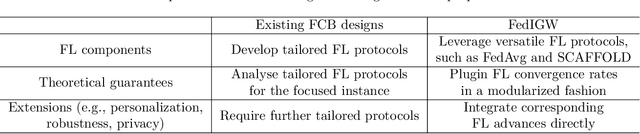
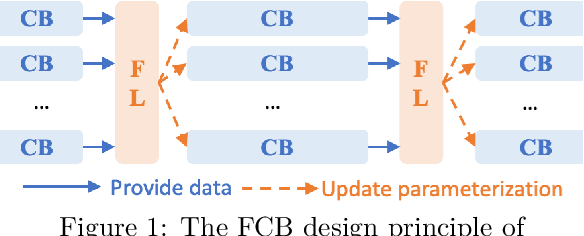
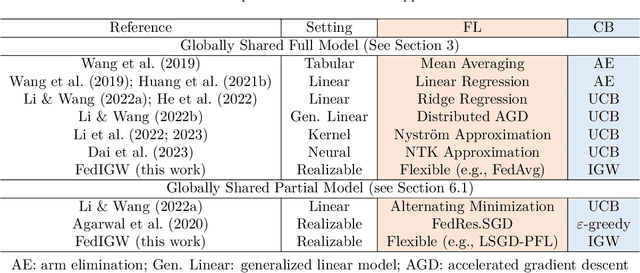
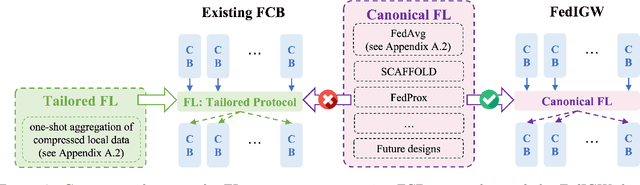
Federated learning (FL) has demonstrated great potential in revolutionizing distributed machine learning, and tremendous efforts have been made to extend it beyond the original focus on supervised learning. Among many directions, federated contextual bandits (FCB), a pivotal integration of FL and sequential decision-making, has garnered significant attention in recent years. Despite substantial progress, existing FCB approaches have largely employed their tailored FL components, often deviating from the canonical FL framework. Consequently, even renowned algorithms like FedAvg remain under-utilized in FCB, let alone other FL advancements. Motivated by this disconnection, this work takes one step towards building a tighter relationship between the canonical FL study and the investigations on FCB. In particular, a novel FCB design, termed FedIGW, is proposed to leverage a regression-based CB algorithm, i.e., inverse gap weighting. Compared with existing FCB approaches, the proposed FedIGW design can better harness the entire spectrum of FL innovations, which is concretely reflected as (1) flexible incorporation of (both existing and forthcoming) FL protocols; (2) modularized plug-in of FL analyses in performance guarantees; (3) seamless integration of FL appendages (such as personalization, robustness, and privacy). We substantiate these claims through rigorous theoretical analyses and empirical evaluations.