 Add to Chrome
 Add to Firefox
 Add to Edge
Beyond Expected Information Gain: Stable Bayesian Optimal Experimental Design with Integral Probability Metrics and Plug-and-Play Extensions
Apr 23, 2026
Bayesian Optimal Experimental Design (BOED) provides a rigorous framework for decision-making tasks in which data acquisition is often the critical bottleneck, especially in resource-constrained settings. Traditionally, BOED typically selects designs by maximizing expected information gain (EIG), commonly defined through the Kullback-Leibler (KL) divergence. However, classical evaluation of EIG often involves challenging nested expectations, and even advanced variational methods leave the underlying log-density-ratio objective unchanged. As a result, support mismatch, tail underestimation, and rare-event sensitivity remain intrinsic concerns for KL-based BOED. To address these fundamental bottlenecks, we introduce an IPM-based BOED framework that replaces density-based divergences with integral probability metrics (IPMs), including the Wasserstein distance, Maximum Mean Discrepancy, and Energy Distance, resulting in a highly flexible plug-and-play BOED framework. We establish theoretical guarantees showing that IPM-based utilities provide stronger geometry-aware stability under surrogate-model error and prior misspecification than classical EIG-based utilities. We also validate the proposed framework empirically, demonstrating that IPM-based designs yield highly concentrated credible sets. Furthermore, by extending the same sample-based BOED template in a plug-and-play manner to geometry-aware discrepancies beyond the IPM class, illustrated by a neural optimal transport estimator, we achieve accurate optimal designs in high-dimensional settings where conventional nested Monte Carlo estimators and advanced variational methods fail.

Principal Prototype Analysis on Manifold for Interpretable Reinforcement Learning
Mar 31, 2026Recent years have witnessed the widespread adoption of reinforcement learning (RL), from solving real-time games to fine-tuning large language models using human preference data significantly improving alignment with user expectations. However, as model complexity grows exponentially, the interpretability of these systems becomes increasingly challenging. While numerous explainability methods have been developed for computer vision and natural language processing to elucidate both local and global reasoning patterns, their application to RL remains limited. Direct extensions of these methods often struggle to maintain the delicate balance between interpretability and performance within RL settings. Prototype-Wrapper Networks (PW-Nets) have recently shown promise in bridging this gap by enhancing explainability in RL domains without sacrificing the efficiency of the original black-box models. However, these methods typically require manually defined reference prototypes, which often necessitate expert domain knowledge. In this work, we propose a method that removes this dependency by automatically selecting optimal prototypes from the available data. Preliminary experiments on standard Gym environments demonstrate that our approach matches the performance of existing PW-Nets, while remaining competitive with the original black-box models.
AutoNumerics: An Autonomous, PDE-Agnostic Multi-Agent Pipeline for Scientific Computing
Feb 19, 2026PDEs are central to scientific and engineering modeling, yet designing accurate numerical solvers typically requires substantial mathematical expertise and manual tuning. Recent neural network-based approaches improve flexibility but often demand high computational cost and suffer from limited interpretability. We introduce \texttt{AutoNumerics}, a multi-agent framework that autonomously designs, implements, debugs, and verifies numerical solvers for general PDEs directly from natural language descriptions. Unlike black-box neural solvers, our framework generates transparent solvers grounded in classical numerical analysis. We introduce a coarse-to-fine execution strategy and a residual-based self-verification mechanism. Experiments on 24 canonical and real-world PDE problems demonstrate that \texttt{AutoNumerics} achieves competitive or superior accuracy compared to existing neural and LLM-based baselines, and correctly selects numerical schemes based on PDE structural properties, suggesting its viability as an accessible paradigm for automated PDE solving.
DRIFT: Detecting Representational Inconsistencies for Factual Truthfulness
Jan 29, 2026LLMs often produce fluent but incorrect answers, yet detecting such hallucinations typically requires multiple sampling passes or post-hoc verification, adding significant latency and cost. We hypothesize that intermediate layers encode confidence signals that are lost in the final output layer, and propose a lightweight probe to read these signals directly from hidden states. The probe adds less than 0.1\% computational overhead and can run fully in parallel with generation, enabling hallucination detection before the answer is produced. Building on this, we develop an LLM router that answers confident queries immediately while delegating uncertain ones to stronger models. Despite its simplicity, our method achieves SOTA AUROC on 10 out of 12 settings across four QA benchmarks and three LLM families, with gains of up to 13 points over prior methods, and generalizes across dataset shifts without retraining.
HALT: Hallucination Assessment via Latent Testing
Jan 20, 2026Hallucination in large language models (LLMs) can be understood as a failure of faithful readout: although internal representations may encode uncertainty about a query, decoding pressures still yield a fluent answer. We propose lightweight residual probes that read hallucination risk directly from intermediate hidden states of question tokens, motivated by the hypothesis that these layers retain epistemic signals that are attenuated in the final decoding stage. The probe is a small auxiliary network whose computation is orders of magnitude cheaper than token generation and can be evaluated fully in parallel with inference, enabling near-instantaneous hallucination risk estimation with effectively zero added latency in low-risk cases. We deploy the probe as an agentic critic for fast selective generation and routing, allowing LLMs to immediately answer confident queries while delegating uncertain ones to stronger verification pipelines. Across four QA benchmarks and multiple LLM families, the method achieves strong AUROC and AURAC, generalizes under dataset shift, and reveals interpretable structure in intermediate representations, positioning fast internal uncertainty readout as a principled foundation for reliable agentic AI.
ReSearch: A Multi-Stage Machine Learning Framework for Earth Science Data Discovery
Jan 20, 2026The rapid expansion of Earth Science data from satellite observations, reanalysis products, and numerical simulations has created a critical bottleneck in scientific discovery, namely identifying relevant datasets for a given research objective. Existing discovery systems are primarily retrieval-centric and struggle to bridge the gap between high-level scientific intent and heterogeneous metadata at scale. We introduce \textbf{ReSearch}, a multi-stage, reasoning-enhanced search framework that formulates Earth Science data discovery as an iterative process of intent interpretation, high-recall retrieval, and context-aware ranking. ReSearch integrates lexical search, semantic embeddings, abbreviation expansion, and large language model reranking within a unified architecture that explicitly separates recall and precision objectives. To enable realistic evaluation, we construct a literature-grounded benchmark by aligning natural language intent with datasets cited in peer-reviewed Earth Science studies. Experiments demonstrate that ReSearch consistently improves recall and ranking performance over baseline methods, particularly for task-based queries expressing abstract scientific goals. These results underscore the importance of intent-aware, multi-stage search as a foundational capability for reproducible and scalable Earth Science research.
FMint-SDE: A Multimodal Foundation Model for Accelerating Numerical Simulation of SDEs via Error Correction
Oct 31, 2025Fast and accurate simulation of dynamical systems is a fundamental challenge across scientific and engineering domains. Traditional numerical integrators often face a trade-off between accuracy and computational efficiency, while existing neural network-based approaches typically require training a separate model for each case. To overcome these limitations, we introduce a novel multi-modal foundation model for large-scale simulations of differential equations: FMint-SDE (Foundation Model based on Initialization for stochastic differential equations). Based on a decoder-only transformer with in-context learning, FMint-SDE leverages numerical and textual modalities to learn a universal error-correction scheme. It is trained using prompted sequences of coarse solutions generated by conventional solvers, enabling broad generalization across diverse systems. We evaluate our models on a suite of challenging SDE benchmarks spanning applications in molecular dynamics, mechanical systems, finance, and biology. Experimental results show that our approach achieves a superior accuracy-efficiency tradeoff compared to classical solvers, underscoring the potential of FMint-SDE as a general-purpose simulation tool for dynamical systems.
Multi-Scale Finite Expression Method for PDEs with Oscillatory Solutions on Complex Domains
Oct 26, 2025Solving partial differential equations (PDEs) with highly oscillatory solutions on complex domains remains a challenging and important problem. High-frequency oscillations and intricate geometries often result in prohibitively expensive representations for traditional numerical methods and lead to difficult optimization landscapes for machine learning-based approaches. In this work, we introduce an enhanced Finite Expression Method (FEX) designed to address these challenges with improved accuracy, interpretability, and computational efficiency. The proposed framework incorporates three key innovations: a symbolic spectral composition module that enables FEX to learn and represent multiscale oscillatory behavior; a redesigned linear input layer that significantly expands the expressivity of the model; and an eigenvalue formulation that extends FEX to a new class of problems involving eigenvalue PDEs. Through extensive numerical experiments, we demonstrate that FEX accurately resolves oscillatory PDEs on domains containing multiple holes of varying shapes and sizes. Compared with existing neural network-based solvers, FEX achieves substantially higher accuracy while yielding interpretable, closed-form solutions that expose the underlying structure of the problem. These advantages, often absent in conventional finite element, finite difference, and black-box neural approaches, highlight FEX as a powerful and transparent framework for solving complex PDEs.
Efficient Kilometer-Scale Precipitation Downscaling with Conditional Wavelet Diffusion
Jul 02, 2025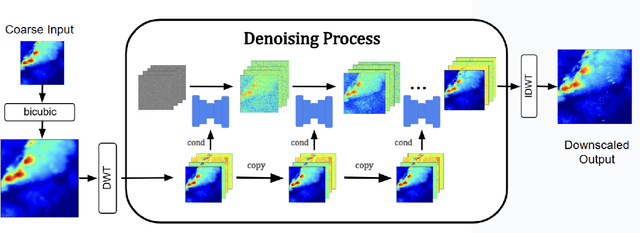
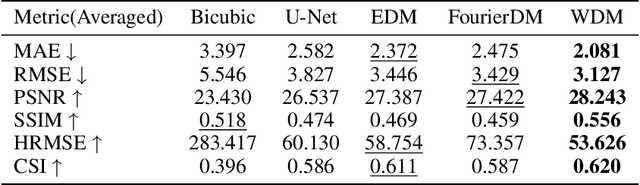
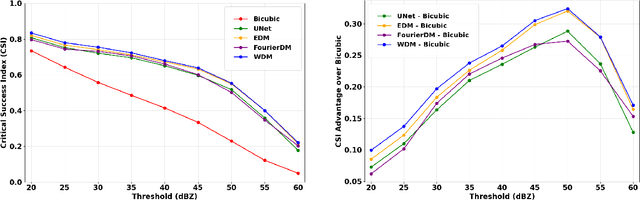
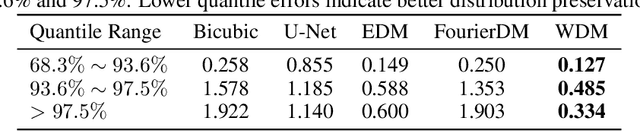
Effective hydrological modeling and extreme weather analysis demand precipitation data at a kilometer-scale resolution, which is significantly finer than the 10 km scale offered by standard global products like IMERG. To address this, we propose the Wavelet Diffusion Model (WDM), a generative framework that achieves 10x spatial super-resolution (downscaling to 1 km) and delivers a 9x inference speedup over pixel-based diffusion models. WDM is a conditional diffusion model that learns the learns the complex structure of precipitation from MRMS radar data directly in the wavelet domain. By focusing on high-frequency wavelet coefficients, it generates exceptionally realistic and detailed 1-km precipitation fields. This wavelet-based approach produces visually superior results with fewer artifacts than pixel-space models, and delivers a significant gains in sampling efficiency. Our results demonstrate that WDM provides a robust solution to the dual challenges of accuracy and speed in geoscience super-resolution, paving the way for more reliable hydrological forecasts.
OptimAI: Optimization from Natural Language Using LLM-Powered AI Agents
Apr 23, 2025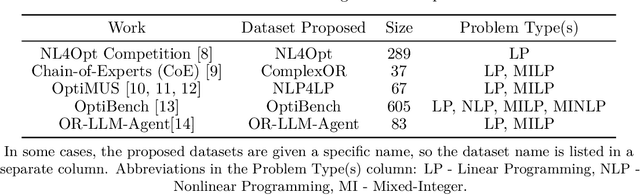
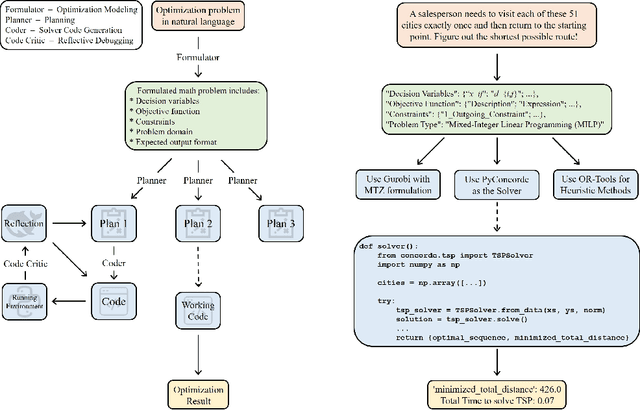
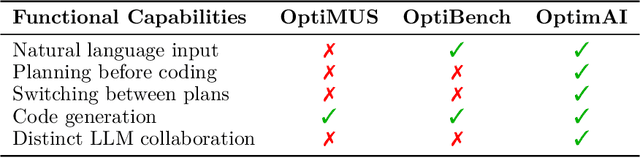
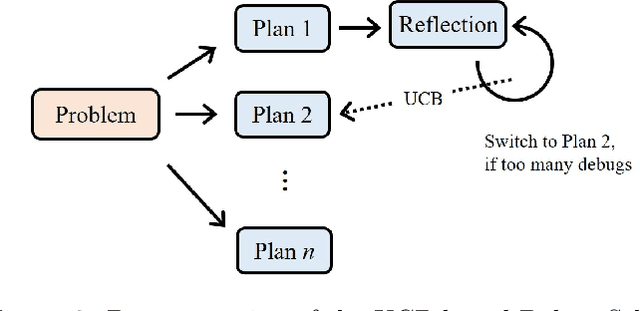
Optimization plays a vital role in scientific research and practical applications, but formulating a concrete optimization problem described in natural language into a mathematical form and selecting a suitable solver to solve the problem requires substantial domain expertise. We introduce \textbf{OptimAI}, a framework for solving \underline{Optim}ization problems described in natural language by leveraging LLM-powered \underline{AI} agents, achieving superior performance over current state-of-the-art methods. Our framework is built upon four key roles: (1) a \emph{formulator} that translates natural language problem descriptions into precise mathematical formulations; (2) a \emph{planner} that constructs a high-level solution strategy prior to execution; and (3) a \emph{coder} and a \emph{code critic} capable of interacting with the environment and reflecting on outcomes to refine future actions. Ablation studies confirm that all roles are essential; removing the planner or code critic results in $5.8\times$ and $3.1\times$ drops in productivity, respectively. Furthermore, we introduce UCB-based debug scheduling to dynamically switch between alternative plans, yielding an additional $3.3\times$ productivity gain. Our design emphasizes multi-agent collaboration, allowing us to conveniently explore the synergistic effect of combining diverse models within a unified system. Our approach attains 88.1\% accuracy on the NLP4LP dataset and 71.2\% on the Optibench (non-linear w/o table) subset, reducing error rates by 58\% and 50\% respectively over prior best results.