 Add to Chrome
 Add to Firefox
 Add to Edge
DynaGraph: Lightweight Multi-Model Interaction Framework via Dynamic Topological Reconfiguration
May 28, 2026
Tackling complex reasoning tasks typically relies on massive monolithic LLMs, which suffer from severe computational redundancy. While task decomposition through structured pipelines or multi-agent collaborations offers an alternative, these approaches inevitably fall into a critical dilemma: predefined static topologies are highly vulnerable to cascading errors, whereas unconstrained dynamic agents suffer from trajectory divergence and unpredictable memory bloat. To address this, we present DynaGraph, a lightweight multi-model framework driven by dynamic topological reconfiguration. At the execution level, DynaGraph multiplexes time-division PEFT adapters over a shared base model, enabling both full system training and inference deployment on a single consumer-grade GPU. At the routing level, the Evaluator continuously monitors execution confidence to trigger hierarchical self-healing: Fine-grained Patching for localized data gaps and Subgraph Reconstruction for severe logical ruptures. Experiments on StrategyQA, MATH, and FinQA demonstrate our 8B model closely approximates the reasoning capabilities of a 72B monolithic model (e.g., 87.6% on StrategyQA, 82.7% on MATH). Furthermore, it reduces latency by up to 68.1% and token consumption by 68.6% compared to unconstrained dynamic architectures.

A Clinically Validated Foundation Model for Comprehensive Lung Pathology Interpretation
May 25, 2026Pathological assessment guides lung cancer diagnosis, treatment selection, and prognostic evaluation, yet current CPath approaches rely on task-specific models for isolated objectives. Although pan-cancer foundation models offer versatility, they lack subspecialty-level depth and have not been evaluated across clinical workflows or prospectively validated in real-world settings. We introduce PulmoFoundation, a multi-center, prospectively validated, randomized controlled trial (RCT)-evaluated foundation model for comprehensive lung pathology assessment across pre-operative, intra-operative, and post-operative care. Built upon Virchow2 via subspecialty-specific pretraining using ~40,000 diagnostic H&E-stained whole-slide images (WSIs), PulmoFoundation was systematically evaluated on ~26,000 WSIs across 32 clinically relevant tasks. In addition to accurately predicting molecular markers and patient survival, our model achieves clinical-grade performance in core diagnostic tasks across biopsy, frozen section, and surgical resection slides. In a registered prospective study of 1,357 patients across 11 diagnostic tasks, our model achieved an average AUC of 92.3%. Using pre-specified triage thresholds, PulmoFoundation could reduce additional second-review burden for 68.8% of biopsies and 83.0% of frozen sections, and defer 44.5% of IHC stain orders, with PPVs of 1.0, 0.991, and 0.966. Beyond prospective validation, we conducted a crossover RCT with eight pathologists, in which AI assistance improved diagnostic accuracy across 4,928 case-reader pairs (91.7% w/ AI vs. 83.8% w/o AI). AI assistance also reduced median diagnostic time by 19.6%, increased diagnostic confidence by 8.7%, and improved inter-rater agreement from moderate (kappa = 0.56) to substantial (kappa = 0.76). Together, these evaluations support PulmoFoundation as a clinically validated decision-support system for lung pathology.
Beyond Expected Information Gain: Stable Bayesian Optimal Experimental Design with Integral Probability Metrics and Plug-and-Play Extensions
Apr 23, 2026Bayesian Optimal Experimental Design (BOED) provides a rigorous framework for decision-making tasks in which data acquisition is often the critical bottleneck, especially in resource-constrained settings. Traditionally, BOED typically selects designs by maximizing expected information gain (EIG), commonly defined through the Kullback-Leibler (KL) divergence. However, classical evaluation of EIG often involves challenging nested expectations, and even advanced variational methods leave the underlying log-density-ratio objective unchanged. As a result, support mismatch, tail underestimation, and rare-event sensitivity remain intrinsic concerns for KL-based BOED. To address these fundamental bottlenecks, we introduce an IPM-based BOED framework that replaces density-based divergences with integral probability metrics (IPMs), including the Wasserstein distance, Maximum Mean Discrepancy, and Energy Distance, resulting in a highly flexible plug-and-play BOED framework. We establish theoretical guarantees showing that IPM-based utilities provide stronger geometry-aware stability under surrogate-model error and prior misspecification than classical EIG-based utilities. We also validate the proposed framework empirically, demonstrating that IPM-based designs yield highly concentrated credible sets. Furthermore, by extending the same sample-based BOED template in a plug-and-play manner to geometry-aware discrepancies beyond the IPM class, illustrated by a neural optimal transport estimator, we achieve accurate optimal designs in high-dimensional settings where conventional nested Monte Carlo estimators and advanced variational methods fail.
Fast and Effective Computation of Generalized Symmetric Matrix Factorization
Mar 19, 2026In this paper, we study a nonconvex, nonsmooth, and non-Lipschitz generalized symmetric matrix factorization model that unifies a broad class of matrix factorization formulations arising in machine learning, image science, engineering, and related areas. We first establish two exactness properties. On the modeling side, we prove an exact penalty property showing that, under suitable conditions, the symmetry-inducing quadratic penalty enforces symmetry whenever the penalty parameter is sufficiently large but finite, thereby exactly recovering the associated symmetric formulation. On the algorithmic side, we introduce an auxiliary-variable splitting formulation and establish an exact relaxation relationship that rigorously links stationary points of the original objective function to those of a relaxed potential function. Building on these exactness properties, we propose an average-type nonmonotone alternating updating method (A-NAUM) based on the relaxed potential function. At each iteration, A-NAUM alternately updates the two factor blocks by (approximately) minimizing the potential function, while the auxiliary block is updated in closed form. To ensure the convergence and enhance practical performance, we further incorporate an average-type nonmonotone line search and show that it is well-defined under mild conditions. Moreover, based on the Kurdyka-Łojasiewicz property and its associated exponent, we establish global convergence of the entire sequence to a stationary point and derive convergence rate results. Finally, numerical experiments on real datasets demonstrate the efficiency of A-NAUM.
A Deployment-Friendly Foundational Framework for Efficient Computational Pathology
Feb 15, 2026Pathology foundation models (PFMs) have enabled robust generalization in computational pathology through large-scale datasets and expansive architectures, but their substantial computational cost, particularly for gigapixel whole slide images, limits clinical accessibility and scalability. Here, we present LitePath, a deployment-friendly foundational framework designed to mitigate model over-parameterization and patch level redundancy. LitePath integrates LiteFM, a compact model distilled from three large PFMs (Virchow2, H-Optimus-1 and UNI2) using 190 million patches, and the Adaptive Patch Selector (APS), a lightweight component for task-specific patch selection. The framework reduces model parameters by 28x and lowers FLOPs by 403.5x relative to Virchow2, enabling deployment on low-power edge hardware such as the NVIDIA Jetson Orin Nano Super. On this device, LitePath processes 208 slides per hour, 104.5x faster than Virchow2, and consumes 0.36 kWh per 3,000 slides, 171x lower than Virchow2 on an RTX3090 GPU. We validated accuracy using 37 cohorts across four organs and 26 tasks (26 internal, 9 external, and 2 prospective), comprising 15,672 slides from 9,808 patients disjoint from the pretraining data. LitePath ranks second among 19 evaluated models and outperforms larger models including H-Optimus-1, mSTAR, UNI2 and GPFM, while retaining 99.71% of the AUC of Virchow2 on average. To quantify the balance between accuracy and efficiency, we propose the Deployability Score (D-Score), defined as the weighted geometric mean of normalized AUC and normalized FLOP, where LitePath achieves the highest value, surpassing Virchow2 by 10.64%. These results demonstrate that LitePath enables rapid, cost-effective and energy-efficient pathology image analysis on accessible hardware while maintaining accuracy comparable to state-of-the-art PFMs and reducing the carbon footprint of AI deployment.
OptimAI: Optimization from Natural Language Using LLM-Powered AI Agents
Apr 23, 2025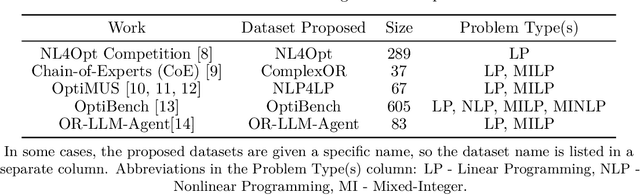
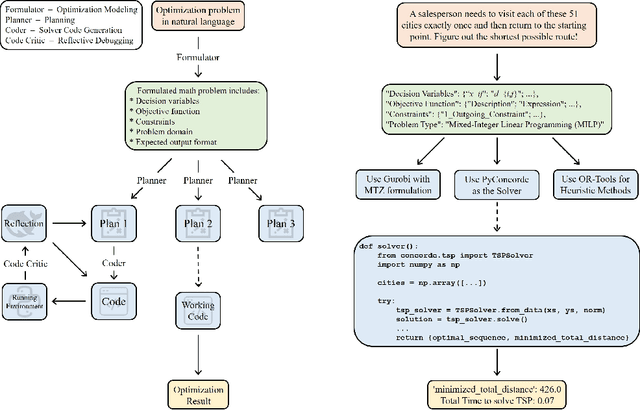
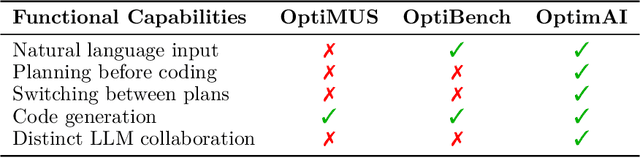
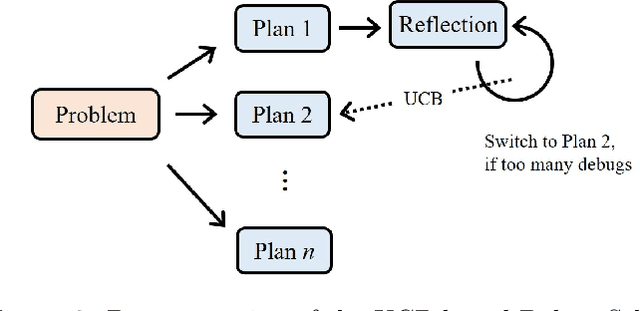
Optimization plays a vital role in scientific research and practical applications, but formulating a concrete optimization problem described in natural language into a mathematical form and selecting a suitable solver to solve the problem requires substantial domain expertise. We introduce \textbf{OptimAI}, a framework for solving \underline{Optim}ization problems described in natural language by leveraging LLM-powered \underline{AI} agents, achieving superior performance over current state-of-the-art methods. Our framework is built upon four key roles: (1) a \emph{formulator} that translates natural language problem descriptions into precise mathematical formulations; (2) a \emph{planner} that constructs a high-level solution strategy prior to execution; and (3) a \emph{coder} and a \emph{code critic} capable of interacting with the environment and reflecting on outcomes to refine future actions. Ablation studies confirm that all roles are essential; removing the planner or code critic results in $5.8\times$ and $3.1\times$ drops in productivity, respectively. Furthermore, we introduce UCB-based debug scheduling to dynamically switch between alternative plans, yielding an additional $3.3\times$ productivity gain. Our design emphasizes multi-agent collaboration, allowing us to conveniently explore the synergistic effect of combining diverse models within a unified system. Our approach attains 88.1\% accuracy on the NLP4LP dataset and 71.2\% on the Optibench (non-linear w/o table) subset, reducing error rates by 58\% and 50\% respectively over prior best results.
HybriMoE: Hybrid CPU-GPU Scheduling and Cache Management for Efficient MoE Inference
Apr 08, 2025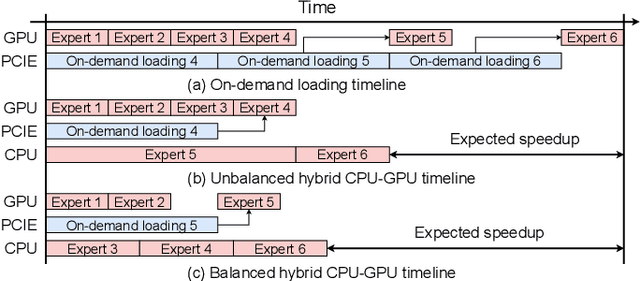
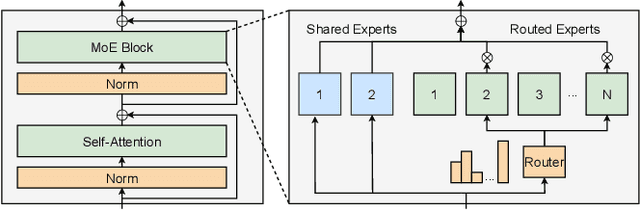
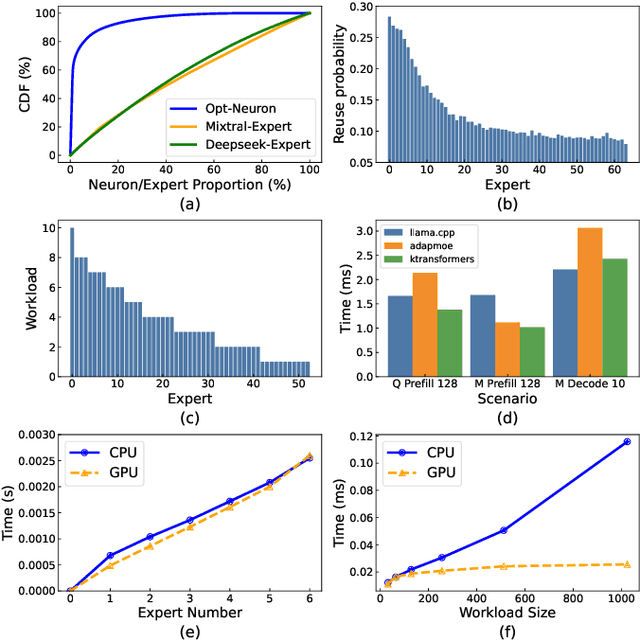
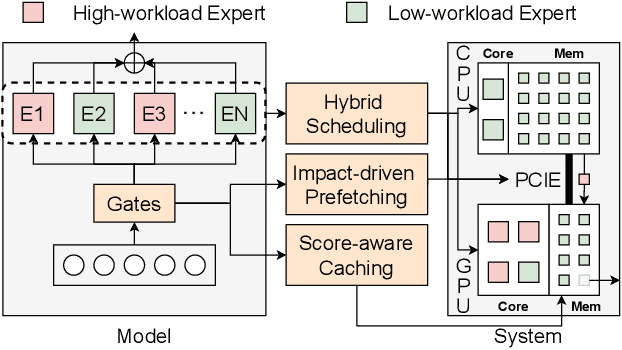
The Mixture of Experts (MoE) architecture has demonstrated significant advantages as it enables to increase the model capacity without a proportional increase in computation. However, the large MoE model size still introduces substantial memory demands, which usually requires expert offloading on resource-constrained platforms and incurs significant overhead. Hybrid CPU-GPU inference has been proposed to leverage CPU computation to reduce expert loading overhead but faces major challenges: on one hand, the expert activation patterns of MoE models are highly unstable, rendering the fixed mapping strategies in existing works inefficient; on the other hand, the hybrid CPU-GPU schedule for MoE is inherently complex due to the diverse expert sizes, structures, uneven workload distribution, etc. To address these challenges, in this paper, we propose HybriMoE, a hybrid CPU-GPU inference framework that improves resource utilization through a novel CPU-GPU scheduling and cache management system. HybriMoE introduces (i) a dynamic intra-layer scheduling strategy to balance workloads across CPU and GPU, (ii) an impact-driven inter-layer prefetching algorithm, and (iii) a score-based caching algorithm to mitigate expert activation instability. We implement HybriMoE on top of the kTransformers framework and evaluate it on three widely used MoE-based LLMs. Experimental results demonstrate that HybriMoE achieves an average speedup of 1.33$\times$ in the prefill stage and 1.70$\times$ in the decode stage compared to state-of-the-art hybrid MoE inference framework. Our code is available at: https://github.com/PKU-SEC-Lab/HybriMoE.
From Equations to Insights: Unraveling Symbolic Structures in PDEs with LLMs
Mar 13, 2025Motivated by the remarkable success of artificial intelligence (AI) across diverse fields, the application of AI to solve scientific problems-often formulated as partial differential equations (PDEs)-has garnered increasing attention. While most existing research concentrates on theoretical properties (such as well-posedness, regularity, and continuity) of the solutions, alongside direct AI-driven methods for solving PDEs, the challenge of uncovering symbolic relationships within these equations remains largely unexplored. In this paper, we propose leveraging large language models (LLMs) to learn such symbolic relationships. Our results demonstrate that LLMs can effectively predict the operators involved in PDE solutions by utilizing the symbolic information in the PDEs. Furthermore, we show that discovering these symbolic relationships can substantially improve both the efficiency and accuracy of the finite expression method for finding analytical approximation of PDE solutions, delivering a fully interpretable solution pipeline. This work opens new avenues for understanding the symbolic structure of scientific problems and advancing their solution processes.
Towards Effective and Sparse Adversarial Attack on Spiking Neural Networks via Breaking Invisible Surrogate Gradients
Mar 05, 2025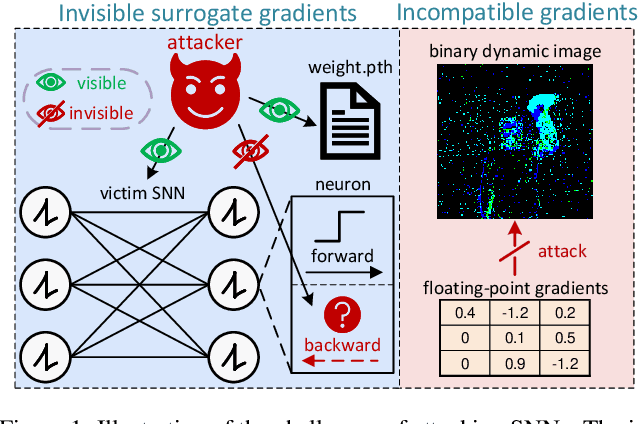
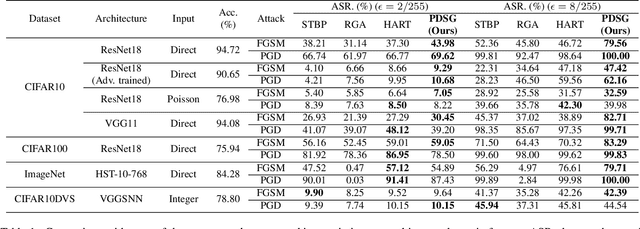
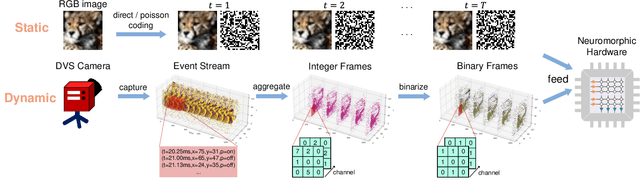
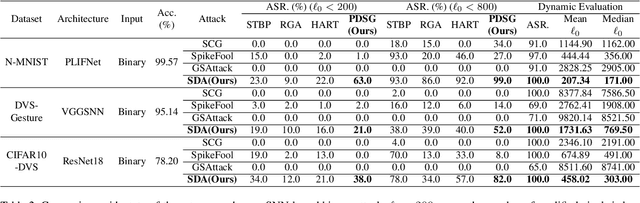
Spiking neural networks (SNNs) have shown their competence in handling spatial-temporal event-based data with low energy consumption. Similar to conventional artificial neural networks (ANNs), SNNs are also vulnerable to gradient-based adversarial attacks, wherein gradients are calculated by spatial-temporal back-propagation (STBP) and surrogate gradients (SGs). However, the SGs may be invisible for an inference-only model as they do not influence the inference results, and current gradient-based attacks are ineffective for binary dynamic images captured by the dynamic vision sensor (DVS). While some approaches addressed the issue of invisible SGs through universal SGs, their SGs lack a correlation with the victim model, resulting in sub-optimal performance. Moreover, the imperceptibility of existing SNN-based binary attacks is still insufficient. In this paper, we introduce an innovative potential-dependent surrogate gradient (PDSG) method to establish a robust connection between the SG and the model, thereby enhancing the adaptability of adversarial attacks across various models with invisible SGs. Additionally, we propose the sparse dynamic attack (SDA) to effectively attack binary dynamic images. Utilizing a generation-reduction paradigm, SDA can fully optimize the sparsity of adversarial perturbations. Experimental results demonstrate that our PDSG and SDA outperform state-of-the-art SNN-based attacks across various models and datasets. Specifically, our PDSG achieves 100% attack success rate on ImageNet, and our SDA obtains 82% attack success rate by modifying only 0.24% of the pixels on CIFAR10DVS. The code is available at https://github.com/ryime/PDSG-SDA .
PINS: Proximal Iterations with Sparse Newton and Sinkhorn for Optimal Transport
Feb 06, 2025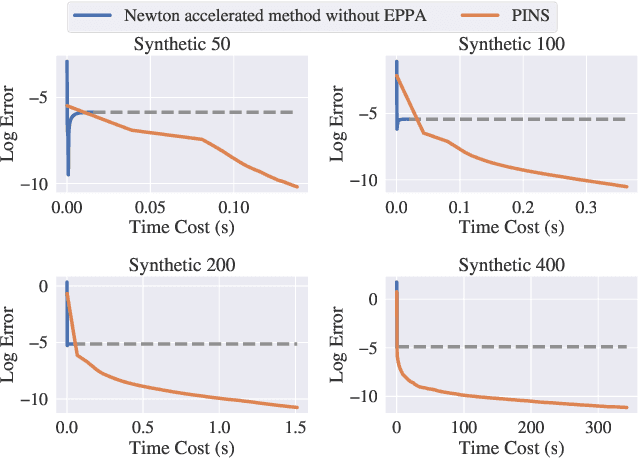
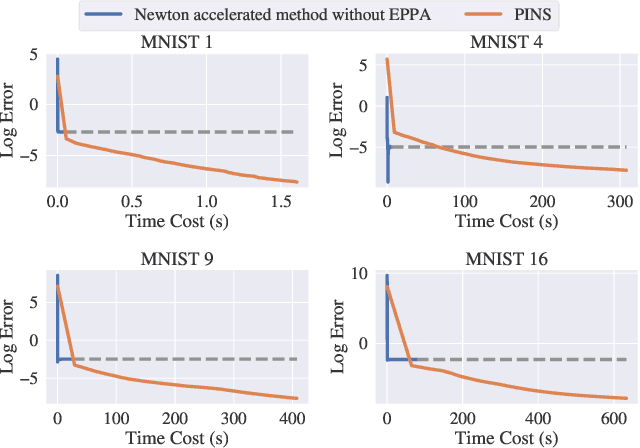
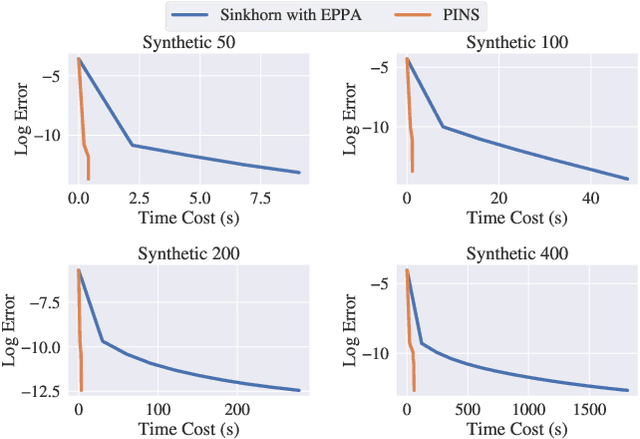
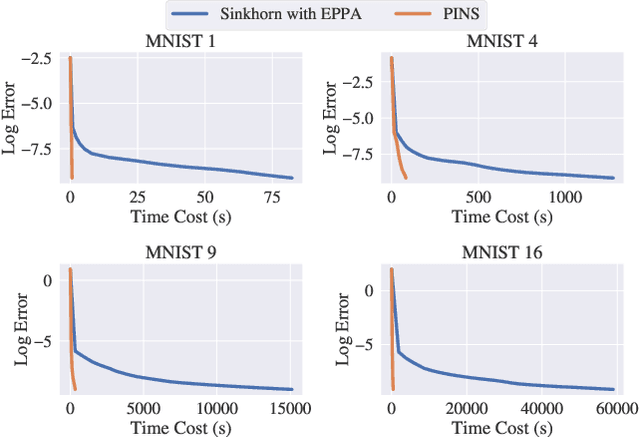
Optimal transport (OT) is a critical problem in optimization and machine learning, where accuracy and efficiency are paramount. Although entropic regularization and the Sinkhorn algorithm improve scalability, they frequently encounter numerical instability and slow convergence, especially when the regularization parameter is small. In this work, we introduce Proximal Iterations with Sparse Newton and Sinkhorn methods (PINS) to efficiently compute highly accurate solutions for large-scale OT problems. A reduced computational complexity through overall sparsity and global convergence are guaranteed by rigorous theoretical analysis. Our approach offers three key advantages: it achieves accuracy comparable to exact solutions, progressively accelerates each iteration for greater efficiency, and enhances robustness by reducing sensitivity to regularization parameters. Extensive experiments confirm these advantages, demonstrating superior performance compared to related methods.