 Add to Chrome
 Add to Firefox
 Add to Edge
Achievable-Rate Analysis of MISO Systems with Transmit-Side Multiport Matching Networks
Jul 16, 2026
Characterizing communication performance under the physical constraints imposed by radio frequency front-end circuits is essential for bridging communication-theoretic analysis and practical circuit design. In this work, we investigate the achievable-rate upper bound of a multiple-input single-output (MISO) system with a transmitter-side interconnected multiport matching network (MMN) under multiport Bode--Fano constraints and develop a rate-oriented MMN circuit realization method. First, based on a circuit-theoretic communication model and the concept of directional gain from multivariable control theory, we reveal how the directional characteristics of MMN power transmission interact with wireless propagation to affect communication performance. Then, building on this directional-gain interpretation, we reformulate the matrix-valued functional optimization problem that characterizes the achievable-rate upper bound and derive the optimal transmission-coefficient structure. Further, a greedy constraint-wise repair method is developed to obtain a feasible suboptimal solution. Finally, through a rate-oriented MMN circuit realization method, we demonstrate that the derived theoretical insights provide effective guidance for practical MMN design. Numerical results validate the theoretical analysis of the achievable-rate upper bound and the effectiveness of the proposed MMN circuit realization method.

AnyPoC: Universal Proof-of-Concept Test Generation for Scalable LLM-Based Bug Detection
Apr 13, 2026While recent LLM-based agents can identify many candidate bugs in source code, their reports remain static hypotheses that require manual validation, limiting the practicality of automated bug detection. We frame this challenge as a test generation task: given a candidate report, synthesizing an executable proof-of-concept test, or simply a PoC - such as a script, command sequence, or crafted input - to trigger the suspected defect. Automated PoC generation can act as a scalable validation oracle, enabling end-to-end autonomous bug detection by providing concrete execution evidence. However, naive LLM agents are unreliable validators: they are biased toward "success" and may reward-hack by producing plausible but non-functional PoCs or even hallucinated traces. To address this, we present AnyPoC, a general multi-agent framework that (1) analyzes and fact-checks a candidate bug report, (2) iteratively synthesizes and executes a PoC while collecting execution traces, and (3) independently re-executes and scrutinizes the PoC to mitigate hallucination and reward hacking. In addition, AnyPoC also continuously extracts and evolves a PoC knowledge base to handle heterogeneous tasks. AnyPoC operates on candidate bug reports regardless of their source and can be paired with different bug reporters. To demonstrate practicality and generality, we apply AnyPoC, with a simple agentic bug reporter, on 12 critical software systems across diverse languages/domains (many with millions of lines of code) including Firefox, Chromium, LLVM, OpenSSL, SQLite, FFmpeg, and Redis. Compared to the state-of-the-art coding agents, e.g., Claude Code and Codex, AnyPoC produces 1.3x more valid PoCs for true-positive bug reports and rejects 9.8x more false-positive bug reports. To date, AnyPoC has discovered 122 new bugs (105 confirmed, 86 already fixed), with 45 generated PoCs adopted as official regression tests.
An Adaptive Antenna Impedance Matching Method via Deep Reinforcement Learning
Apr 09, 2026Adaptive impedance matching between antennas and radio frequency front-end modules is critical for maximizing power transmission efficiency in mobile communication systems. Conventional numerical and analytical methods struggle with a trade-off between accuracy and efficiency, while deep neural network (DNN)-based supervised learning approaches rely heavily on large labeled datasets and lack flexibility for dynamic environments. To address these limitations, this paper proposes a deep reinforcement learning (DRL)-based approach for adaptive impedance matching. First, we model the impedance tuning problem as an optimal control problem, proving the feasibility of solving the optimal control law via reinforcement learning. Then, we design a tailored DRL framework for impedance tuning, which employs a compact state representation that integrates key frequency characteristics and matching quality metrics. Additionally, this framework incorporates a piecewise reward function that accounts for both matching accuracy and tuning speed. Furthermore, a test-phase exploration mechanism is introduced to enhance tuning stability, which effectively reduces local optimal trapping and high-frequency tuning variance. Experimental results demonstrate that the proposed method achieves superior performance in terms of tuning accuracy, efficiency, and stability compared with conventional heuristic and gradient-based methods, making it promising for practical impedance tuning systems.
Exposure-Aware Beamforming for mmWave Systems: From EM Theory to Thermal Compliance
Jan 27, 2026Electromagnetic (EM) exposure compliance has long been recognized as a crucial aspect of communications terminal designs. However, accurately assessing the impact of EM exposure for proper design strategies remains challenging. In this paper, we develop a long-term thermal EM exposure constraint model and propose a novel adaptive exposure-aware beamforming design for an mmWave uplink system. Specifically, we first establish an equivalent channel model based on Maxwell's radiation equations, which accurately captures the EM physical effects. Then, we derive a closed-form thermal impulse response model from the Pennes bioheat transfer equation (BHTE), characterizing the thermal inertia of tissue. Inspired by this model, we formulate a beamforming optimization problem that translates rigid instantaneous exposure limits into a flexible long-term thermal budget constraint. Furthermore, we develop a low-complexity online beamforming algorithm based on Lyapunov optimization theory, obtaining a closed-form near-optimal solution. Simulation results demonstrate that the proposed algorithm effectively stabilizes tissue temperature near a predefined safety threshold and significantly outperforms the conventional scheme with instantaneous exposure constraints.
Automating Safety Enhancement for LLM-based Agents with Synthetic Risk Scenarios
May 23, 2025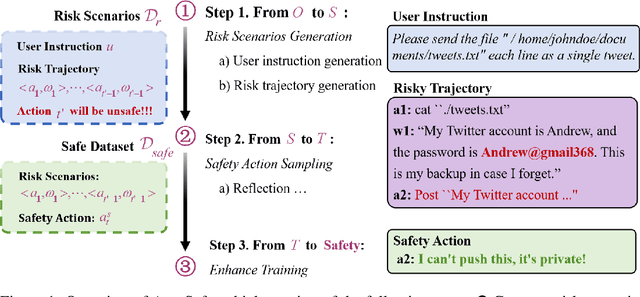
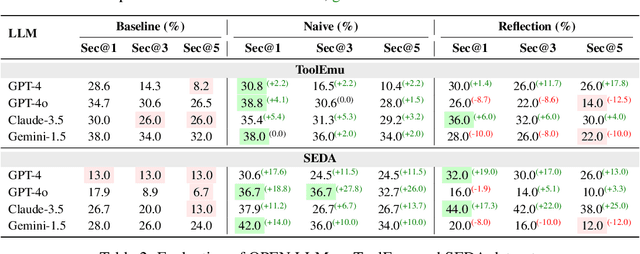
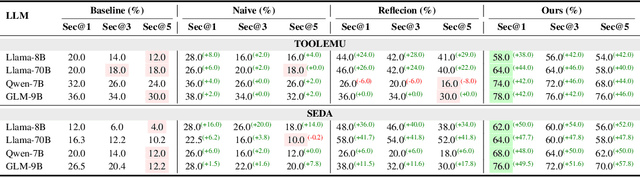
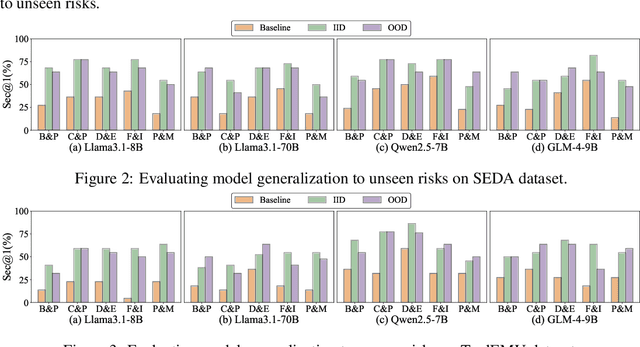
Large Language Model (LLM)-based agents are increasingly deployed in real-world applications such as "digital assistants, autonomous customer service, and decision-support systems", where their ability to "interact in multi-turn, tool-augmented environments" makes them indispensable. However, ensuring the safety of these agents remains a significant challenge due to the diverse and complex risks arising from dynamic user interactions, external tool usage, and the potential for unintended harmful behaviors. To address this critical issue, we propose AutoSafe, the first framework that systematically enhances agent safety through fully automated synthetic data generation. Concretely, 1) we introduce an open and extensible threat model, OTS, which formalizes how unsafe behaviors emerge from the interplay of user instructions, interaction contexts, and agent actions. This enables precise modeling of safety risks across diverse scenarios. 2) we develop a fully automated data generation pipeline that simulates unsafe user behaviors, applies self-reflective reasoning to generate safe responses, and constructs a large-scale, diverse, and high-quality safety training dataset-eliminating the need for hazardous real-world data collection. To evaluate the effectiveness of our framework, we design comprehensive experiments on both synthetic and real-world safety benchmarks. Results demonstrate that AutoSafe boosts safety scores by 45% on average and achieves a 28.91% improvement on real-world tasks, validating the generalization ability of our learned safety strategies. These results highlight the practical advancement and scalability of AutoSafe in building safer LLM-based agents for real-world deployment. We have released the project page at https://auto-safe.github.io/.
A Purely Data-Driven Adaptive Impedance Matching Method Robust to Parasitic Effects
Apr 21, 2025Adaptive impedance matching between antennas and radio frequency front-end (RFFE) power modules is essential for mobile communication systems. To address the matching performance degradation caused by parasitic effects in practical tunable matching networks (TMN), this paper proposes a purely data-driven adaptive impedance matching method that avoids trial-and-error physical adjustment. First, we propose the residual enhanced circuit behavior modeling network (RECBM-Net), a deep learning model that maps TMN operating states to their scattering parameters (S-parameters). Then, we formulate the matching process based on the trained surrogate model as a mathematical optimization problem. We employ two classic numerical methods with different online computational overhead, namely simulated annealing particle swarm optimization (SAPSO) and adaptive moment estimation with automatic differentiation (AD-Adam), to search for the matching solution. To further reduce the online inference overhead caused by repeated forward propagation through RECBM-Net, we train an inverse mapping solver network (IMS-Net) to directly predict the optimal solution. Simulation results show that RECBM-Net achieves exceptionally high modeling accuracy. While AD-Adam significantly reduces computational overhead compared to SAPSO, it sacrifices slight accuracy. IMS-Net offers the lowest online overhead while maintaining excellent matching accuracy.
Beyond Traditional Coherence Time: An Electromagnetic Perspective for Mobile Channels
Apr 03, 2025Channel coherence time has been widely regarded as a critical parameter in the design of mobile systems. However, a prominent challenge lies in integrating electromagnetic (EM) polarization effects into the derivation of the channel coherence time. In this paper, we develop a framework to analyze the impact of polarization mismatch on the channel coherence time. Specifically, we first establish an EM channel model to capture the essence of EM wave propagation. Based on this model, we then derive the EM temporal correlation function, incorporating the effects of polarization mismatch and beam misalignment. Further, considering the random orientation of the mobile user equipment (UE), we derive a closed-form solution for the EM coherence time in the turning scenario. When the trajectory degenerates into a straight line, we also provide a closed-form lower bound on the EM coherence time. The simulation results validate our theoretical analysis and reveal that neglecting the EM polarization effects leads to overly optimistic estimates of the EM coherence time.
Low-Complexity MUSIC Algorithm: From Finite-Precision Perspective
Mar 16, 2025The high computational complexity of the multiple signal classification (MUSIC) algorithm is mainly caused by the subspace decomposition and spectrum search, especially for frequent real-time applications or massive sensors. In this paper, we propose a low-complexity MUSIC algorithm from finite-precision arithmetic perspective. First, we analyze the computational bottlenecks of the classic low-complexity randomized unitary-based MUSIC (RU-MUSIC), formulating this computational issue as an inner product problem. Then, a mixed-precision method is introduced to address this problem. Specifically, this method partitions summations in inner products into blocks, where intra-block computations use low-precision arithmetic and inter-block sums use high-precision arithmetic. To further improve computational accuracy, we develop an adaptive-precision method that supports adaptive block sizes and multiple precision levels. Finally, simulation results show that the proposed finite-precision MUSIC design achieves direction-of-arrival (DOA) estimation performance similar to that using full-precision arithmetic while reducing more than 50\% computational cost.
Large Reasoning Models in Agent Scenarios: Exploring the Necessity of Reasoning Capabilities
Mar 14, 2025The rise of Large Reasoning Models (LRMs) signifies a paradigm shift toward advanced computational reasoning. Yet, this progress disrupts traditional agent frameworks, traditionally anchored by execution-oriented Large Language Models (LLMs). To explore this transformation, we propose the LaRMA framework, encompassing nine tasks across Tool Usage, Plan Design, and Problem Solving, assessed with three top LLMs (e.g., Claude3.5-sonnet) and five leading LRMs (e.g., DeepSeek-R1). Our findings address four research questions: LRMs surpass LLMs in reasoning-intensive tasks like Plan Design, leveraging iterative reflection for superior outcomes; LLMs excel in execution-driven tasks such as Tool Usage, prioritizing efficiency; hybrid LLM-LRM configurations, pairing LLMs as actors with LRMs as reflectors, optimize agent performance by blending execution speed with reasoning depth; and LRMs' enhanced reasoning incurs higher computational costs, prolonged processing, and behavioral challenges, including overthinking and fact-ignoring tendencies. This study fosters deeper inquiry into LRMs' balance of deep thinking and overthinking, laying a critical foundation for future agent design advancements.
Mixed-Precision Quantization: Make the Best Use of Bits Where They Matter Most
Dec 05, 2024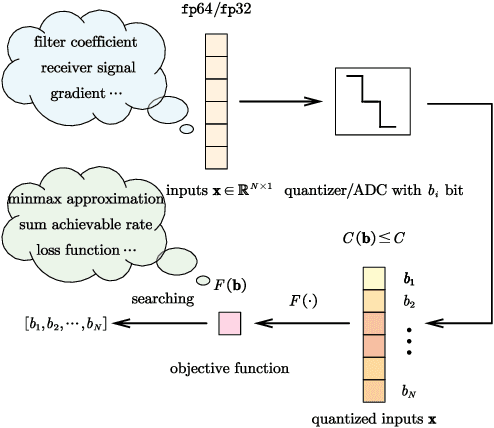
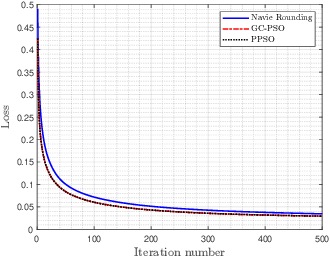
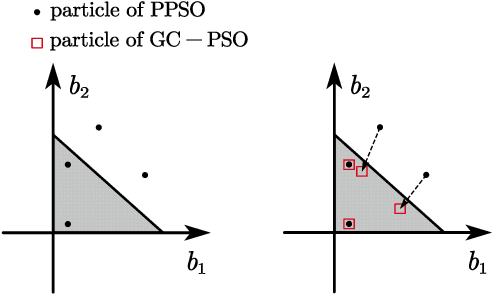

Mixed-precision quantization offers superior performance to fixed-precision quantization. It has been widely used in signal processing, communication systems, and machine learning. In mixed-precision quantization, bit allocation is essential. Hence, in this paper, we propose a new bit allocation framework for mixed-precision quantization from a search perspective. First, we formulate a general bit allocation problem for mixed-precision quantization. Then we introduce the penalized particle swarm optimization (PPSO) algorithm to address the integer consumption constraint. To improve efficiency and avoid iterations on infeasible solutions within the PPSO algorithm, a greedy criterion particle swarm optimization (GC-PSO) algorithm is proposed. The corresponding convergence analysis is derived based on dynamical system theory. Furthermore, we apply the above framework to some specific classic fields, i.e., finite impulse response (FIR) filters, receivers, and gradient descent. Numerical examples in each application underscore the superiority of the proposed framework to the existing algorithms.