 Add to Chrome
 Add to Firefox
 Add to Edge
GENCO - A Unified Neural Solver Embedded in a Development Framework for Steady-State Grid Analysis
Aug 10, 2026
Foundation models are transforming business workflows and boosting productivity, yet they remain largely absent from engineering domains such as power system analysis, where strict physical consistency must be enforced. We present GENCO (GEometric Neural Corrective Optimizer), a unified neural solver for steady-state transmission grid analysis that handles power flow (PF), optimal power flow (OPF), and state estimation (SE) within a single architecture and shared network representation. To support advances in neural power system solvers, we introduce the open-source GridFM Development Framework, which standardizes synthetic data generation and training in a low-code environment. We also release large-scale datasets with millions of PF and OPF scenarios across diverse grid topologies to support reproducible benchmarking. We evaluate GENCO on the PFDelta and OPFData benchmarks against state-of-the-art neural solvers and classical solvers, including Newton-Raphson and IPOPT, as well as on real-world Hydro-Québec SCADA data. For large-scale PF, GENCO recovers the full AC operating state, including voltage magnitudes and reactive power that DC-PF cannot provide, while matching DC-PF-level active power-balance residuals. It achieves up to 30x speedups over Newton-Raphson at only 2x the runtime of DC-PF. For OPF, it achieves up to 85x speedups over IPOPT while improving feasibility, optimality, and runtime over DC-OPF. For SE, GENCO is more robust than classical weighted least squares to noisy measurements and network parameter errors, and always returns a high-quality estimate even when weighted least squares fails to converge. Together, the unified architecture and development framework provide a new approach to large-scale steady-state grid analysis, lowering the barrier to entry for power system engineers and marking a step toward Grid Foundation Models.

gridfm-datakit-v1: A Python Library for Scalable and Realistic Power Flow and Optimal Power Flow Data Generation
Dec 16, 2025We introduce gridfm-datakit-v1, a Python library for generating realistic and diverse Power Flow (PF) and Optimal Power Flow (OPF) datasets for training Machine Learning (ML) solvers. Existing datasets and libraries face three main challenges: (1) lack of realistic stochastic load and topology perturbations, limiting scenario diversity; (2) PF datasets are restricted to OPF-feasible points, hindering generalization of ML solvers to cases that violate operating limits (e.g., branch overloads or voltage violations); and (3) OPF datasets use fixed generator cost functions, limiting generalization across varying costs. gridfm-datakit addresses these challenges by: (1) combining global load scaling from real-world profiles with localized noise and supporting arbitrary N-k topology perturbations to create diverse yet realistic datasets; (2) generating PF samples beyond operating limits; and (3) producing OPF data with varying generator costs. It also scales efficiently to large grids (up to 10,000 buses). Comparisons with OPFData, OPF-Learn, PGLearn, and PF$Δ$ are provided. Available on GitHub at https://github.com/gridfm/gridfm-datakit under Apache 2.0 and via `pip install gridfm-datakit`.
MXMap: A Multivariate Cross Mapping Framework for Causal Discovery in Dynamical Systems
Feb 06, 2025Convergent Cross Mapping (CCM) is a powerful method for detecting causality in coupled nonlinear dynamical systems, providing a model-free approach to capture dynamic causal interactions. Partial Cross Mapping (PCM) was introduced as an extension of CCM to address indirect causality in three-variable systems by comparing cross-mapping quality between direct cause-effect mapping and indirect mapping through an intermediate conditioning variable. However, PCM remains limited to univariate delay embeddings in its cross-mapping processes. In this work, we extend PCM to the multivariate setting, introducing multiPCM, which leverages multivariate embeddings to more effectively distinguish indirect causal relationships. We further propose a multivariate cross-mapping framework (MXMap) for causal discovery in dynamical systems. This two-phase framework combines (1) pairwise CCM tests to establish an initial causal graph and (2) multiPCM to refine the graph by pruning indirect causal connections. Through experiments on simulated data and the ERA5 Reanalysis weather dataset, we demonstrate the effectiveness of MXMap. Additionally, MXMap is compared against several baseline methods, showing advantages in accuracy and causal graph refinement.
Accelerating Quasi-Static Time Series Simulations with Foundation Models
Nov 13, 2024Quasi-static time series (QSTS) simulations have great potential for evaluating the grid's ability to accommodate the large-scale integration of distributed energy resources. However, as grids expand and operate closer to their limits, iterative power flow solvers, central to QSTS simulations, become computationally prohibitive and face increasing convergence issues. Neural power flow solvers provide a promising alternative, speeding up power flow computations by 3 to 4 orders of magnitude, though they are costly to train. In this paper, we envision how recently introduced grid foundation models could improve the economic viability of neural power flow solvers. Conceptually, these models amortize training costs by serving as a foundation for a range of grid operation and planning tasks beyond power flow solving, with only minimal fine-tuning required. We call for collaboration between the AI and power grid communities to develop and open-source these models, enabling all operators, even those with limited resources, to benefit from AI without building solutions from scratch.
A Perspective on Foundation Models for the Electric Power Grid
Jul 12, 2024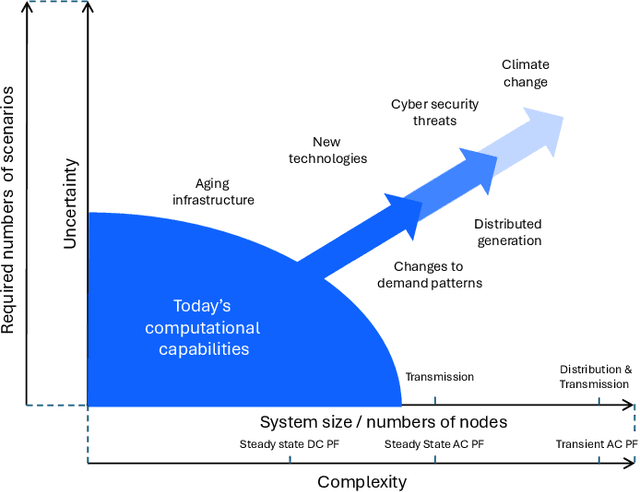
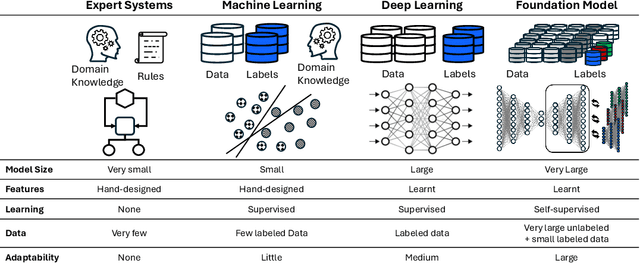
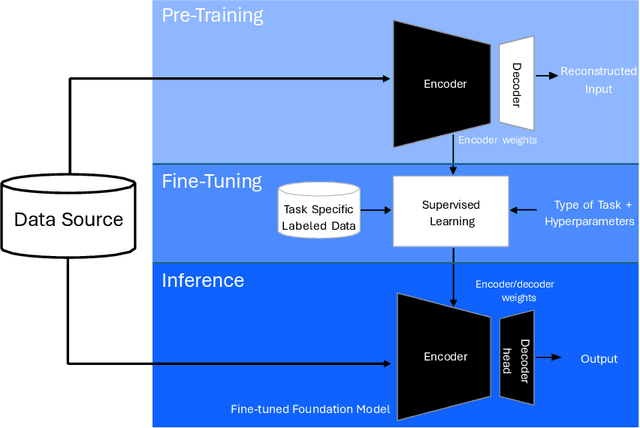
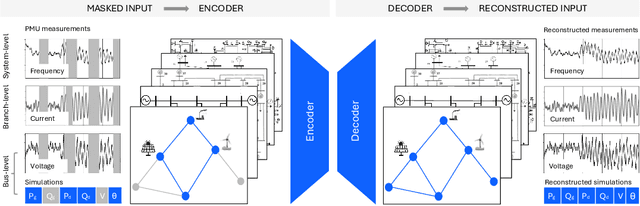
Foundation models (FMs) currently dominate news headlines. They employ advanced deep learning architectures to extract structural information autonomously from vast datasets through self-supervision. The resulting rich representations of complex systems and dynamics can be applied to many downstream applications. Therefore, FMs can find uses in electric power grids, challenged by the energy transition and climate change. In this paper, we call for the development of, and state why we believe in, the potential of FMs for electric grids. We highlight their strengths and weaknesses amidst the challenges of a changing grid. We argue that an FM learning from diverse grid data and topologies could unlock transformative capabilities, pioneering a new approach in leveraging AI to redefine how we manage complexity and uncertainty in the electric grid. Finally, we discuss a power grid FM concept, namely GridFM, based on graph neural networks and show how different downstream tasks benefit.