 Add to Chrome
 Add to Firefox
 Add to Edge
Improving Commonsense in Vision-Language Models via Knowledge Graph Riddles
Nov 29, 2022
This paper focuses on analyzing and improving the commonsense ability of recent popular vision-language (VL) models. Despite the great success, we observe that existing VL-models still lack commonsense knowledge/reasoning ability (e.g., "Lemons are sour"), which is a vital component towards artificial general intelligence. Through our analysis, we find one important reason is that existing large-scale VL datasets do not contain much commonsense knowledge, which motivates us to improve the commonsense of VL-models from the data perspective. Rather than collecting a new VL training dataset, we propose a more scalable strategy, i.e., "Data Augmentation with kNowledge graph linearization for CommonsensE capability" (DANCE). It can be viewed as one type of data augmentation technique, which can inject commonsense knowledge into existing VL datasets on the fly during training. More specifically, we leverage the commonsense knowledge graph (e.g., ConceptNet) and create variants of text description in VL datasets via bidirectional sub-graph sequentialization. For better commonsense evaluation, we further propose the first retrieval-based commonsense diagnostic benchmark. By conducting extensive experiments on some representative VL-models, we demonstrate that our DANCE technique is able to significantly improve the commonsense ability while maintaining the performance on vanilla retrieval tasks. The code and data are available at https://github.com/pleaseconnectwifi/DANCE

Empowering Language Models with Knowledge Graph Reasoning for Question Answering
Nov 15, 2022Answering open-domain questions requires world knowledge about in-context entities. As pre-trained Language Models (LMs) lack the power to store all required knowledge, external knowledge sources, such as knowledge graphs, are often used to augment LMs. In this work, we propose knOwledge REasOning empowered Language Model (OREO-LM), which consists of a novel Knowledge Interaction Layer that can be flexibly plugged into existing Transformer-based LMs to interact with a differentiable Knowledge Graph Reasoning module collaboratively. In this way, LM guides KG to walk towards the desired answer, while the retrieved knowledge improves LM. By adopting OREO-LM to RoBERTa and T5, we show significant performance gain, achieving state-of-art results in the Closed-Book setting. The performance enhancement is mainly from the KG reasoning's capacity to infer missing relational facts. In addition, OREO-LM provides reasoning paths as rationales to interpret the model's decision.
MACSum: Controllable Summarization with Mixed Attributes
Nov 09, 2022Controllable summarization allows users to generate customized summaries with specified attributes. However, due to the lack of designated annotations of controlled summaries, existing works have to craft pseudo datasets by adapting generic summarization benchmarks. Furthermore, most research focuses on controlling single attributes individually (e.g., a short summary or a highly abstractive summary) rather than controlling a mix of attributes together (e.g., a short and highly abstractive summary). In this paper, we propose MACSum, the first human-annotated summarization dataset for controlling mixed attributes. It contains source texts from two domains, news articles and dialogues, with human-annotated summaries controlled by five designed attributes (Length, Extractiveness, Specificity, Topic, and Speaker). We propose two simple and effective parameter-efficient approaches for the new task of mixed controllable summarization based on hard prompt tuning and soft prefix tuning. Results and analysis demonstrate that hard prompt models yield the best performance on all metrics and human evaluations. However, mixed-attribute control is still challenging for summarization tasks. Our dataset and code are available at https://github.com/psunlpgroup/MACSum.
Retrieval Augmentation for Commonsense Reasoning: A Unified Approach
Oct 23, 2022
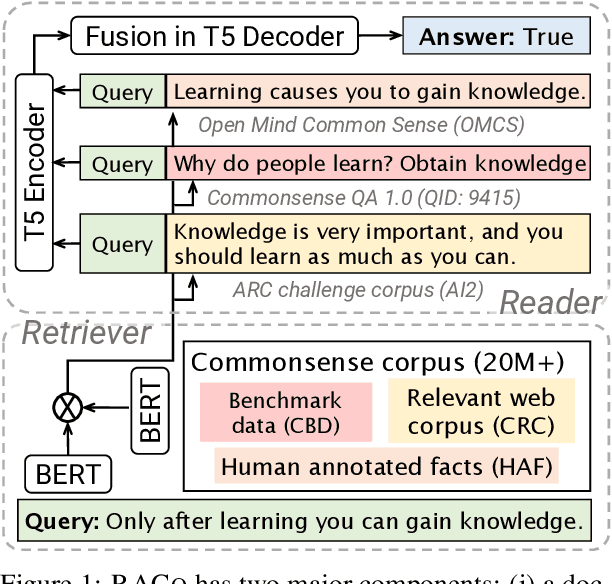
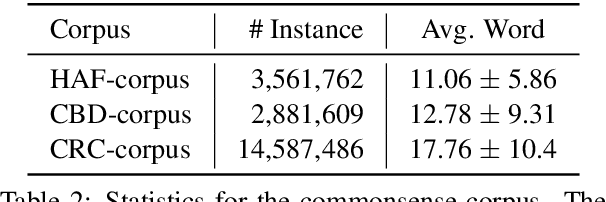
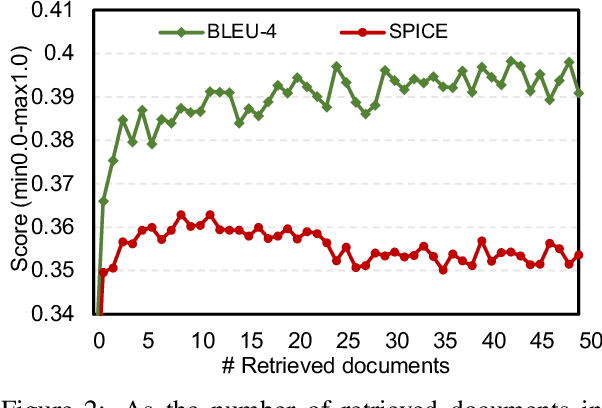
A common thread of retrieval-augmented methods in the existing literature focuses on retrieving encyclopedic knowledge, such as Wikipedia, which facilitates well-defined entity and relation spaces that can be modeled. However, applying such methods to commonsense reasoning tasks faces two unique challenges, i.e., the lack of a general large-scale corpus for retrieval and a corresponding effective commonsense retriever. In this paper, we systematically investigate how to leverage commonsense knowledge retrieval to improve commonsense reasoning tasks. We proposed a unified framework of retrieval-augmented commonsense reasoning (called RACo), including a newly constructed commonsense corpus with over 20 million documents and novel strategies for training a commonsense retriever. We conducted experiments on four different commonsense reasoning tasks. Extensive evaluation results showed that our proposed RACo can significantly outperform other knowledge-enhanced method counterparts, achieving new SoTA performance on the CommonGen and CREAK leaderboards.
Tail Batch Sampling: Approximating Global Contrastive Losses as Optimization over Batch Assignments
Oct 23, 2022Contrastive Learning has recently achieved state-of-the-art performance in a wide range of tasks. Many contrastive learning approaches use mined hard negatives to make batches more informative during training but these approaches are inefficient as they increase epoch length proportional to the number of mined negatives and require frequent updates of nearest neighbor indices or mining from recent batches. In this work, we provide an alternative to hard negative mining in supervised contrastive learning, Tail Batch Sampling (TBS), an efficient approximation to the batch assignment problem that upper bounds the gap between the global and training losses, $\mathcal{L}^{Global} - \mathcal{L}^{Train}$. TBS \textbf{improves state-of-the-art performance} in sentence embedding (+0.37 Spearman) and code-search tasks (+2.2\% MRR), is easy to implement - requiring only a few additional lines of code, does not maintain external data structures such as nearest neighbor indices, is more computationally efficient when compared to the most minimal hard negative mining approaches, and makes no changes to the model being trained.
Towards a Unified Multi-Dimensional Evaluator for Text Generation
Oct 13, 2022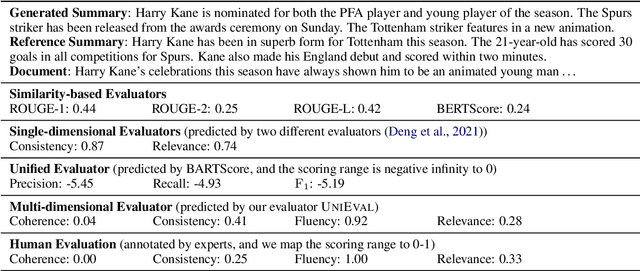
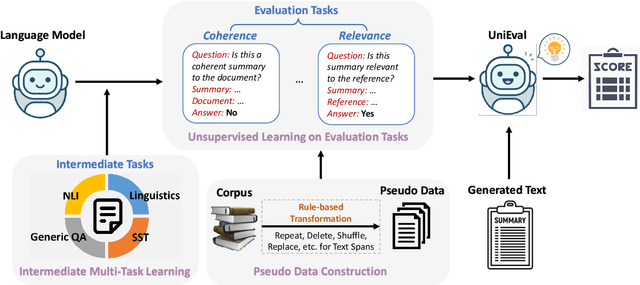
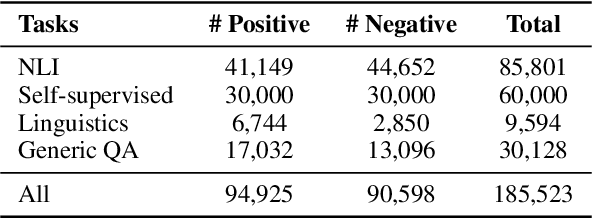
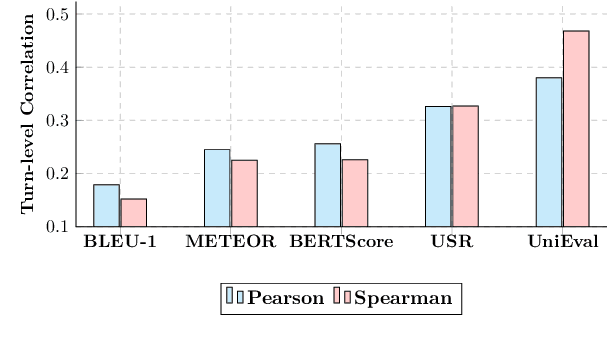
Multi-dimensional evaluation is the dominant paradigm for human evaluation in Natural Language Generation (NLG), i.e., evaluating the generated text from multiple explainable dimensions, such as coherence and fluency. However, automatic evaluation in NLG is still dominated by similarity-based metrics, and we lack a reliable framework for a more comprehensive evaluation of advanced models. In this paper, we propose a unified multi-dimensional evaluator UniEval for NLG. We re-frame NLG evaluation as a Boolean Question Answering (QA) task, and by guiding the model with different questions, we can use one evaluator to evaluate from multiple dimensions. Furthermore, thanks to the unified Boolean QA format, we are able to introduce an intermediate learning phase that enables UniEval to incorporate external knowledge from multiple related tasks and gain further improvement. Experiments on three typical NLG tasks show that UniEval correlates substantially better with human judgments than existing metrics. Specifically, compared to the top-performing unified evaluators, UniEval achieves a 23% higher correlation on text summarization, and over 43% on dialogue response generation. Also, UniEval demonstrates a strong zero-shot learning ability for unseen evaluation dimensions and tasks. Source code, data and all pre-trained evaluators are available on our GitHub repository (https://github.com/maszhongming/UniEval).
Task Compass: Scaling Multi-task Pre-training with Task Prefix
Oct 12, 2022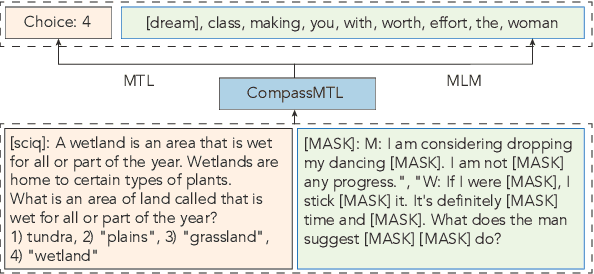
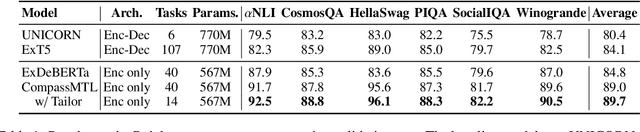
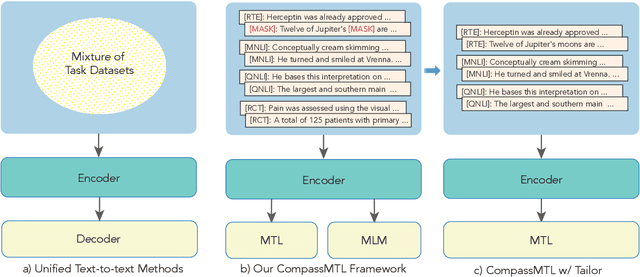
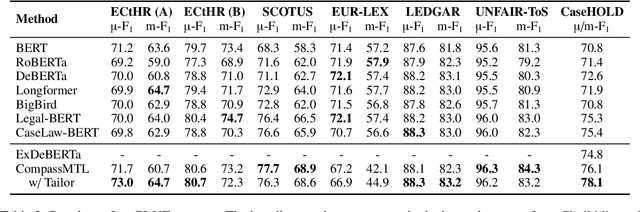
Leveraging task-aware annotated data as supervised signals to assist with self-supervised learning on large-scale unlabeled data has become a new trend in pre-training language models. Existing studies show that multi-task learning with large-scale supervised tasks suffers from negative effects across tasks. To tackle the challenge, we propose a task prefix guided multi-task pre-training framework to explore the relationships among tasks. We conduct extensive experiments on 40 datasets, which show that our model can not only serve as the strong foundation backbone for a wide range of tasks but also be feasible as a probing tool for analyzing task relationships. The task relationships reflected by the prefixes align transfer learning performance between tasks. They also suggest directions for data augmentation with complementary tasks, which help our model achieve human-parity results on commonsense reasoning leaderboards. Code is available at https://github.com/cooelf/CompassMTL
A Unified Encoder-Decoder Framework with Entity Memory
Oct 07, 2022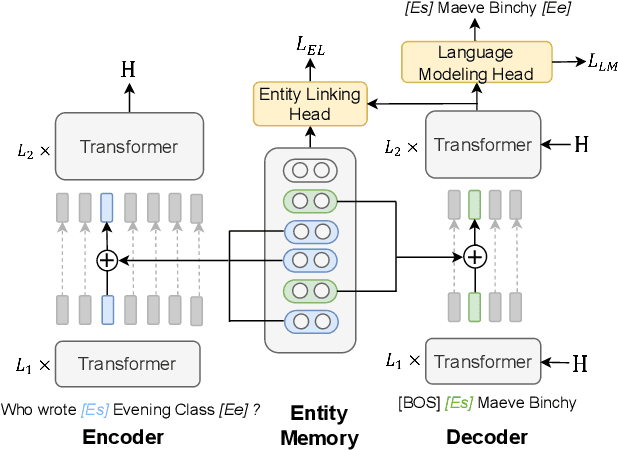
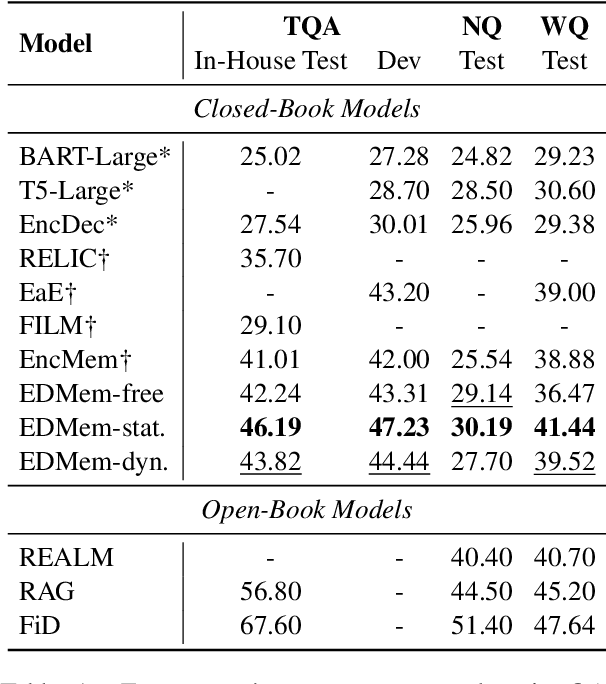
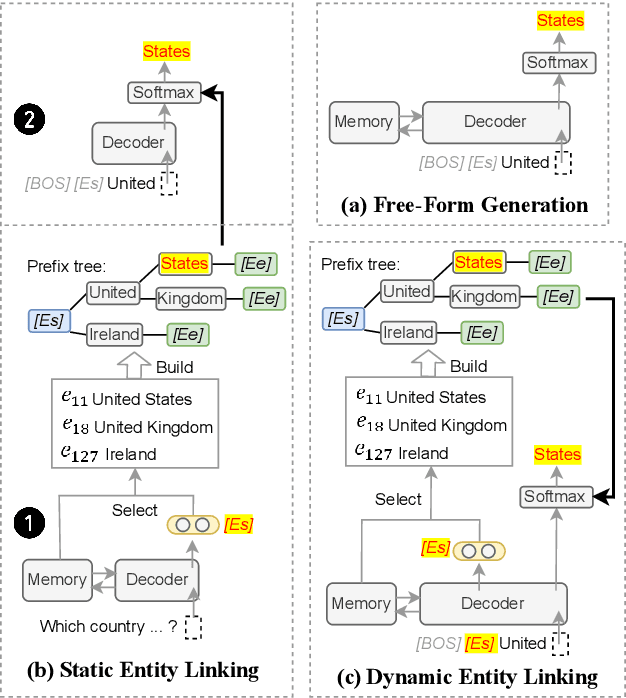
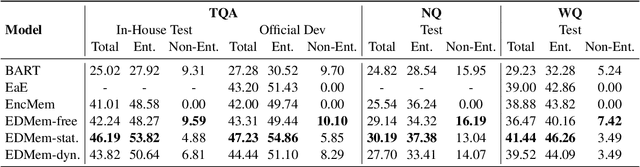
Entities, as important carriers of real-world knowledge, play a key role in many NLP tasks. We focus on incorporating entity knowledge into an encoder-decoder framework for informative text generation. Existing approaches tried to index, retrieve, and read external documents as evidence, but they suffered from a large computational overhead. In this work, we propose an encoder-decoder framework with an entity memory, namely EDMem. The entity knowledge is stored in the memory as latent representations, and the memory is pre-trained on Wikipedia along with encoder-decoder parameters. To precisely generate entity names, we design three decoding methods to constrain entity generation by linking entities in the memory. EDMem is a unified framework that can be used on various entity-intensive question answering and generation tasks. Extensive experimental results show that EDMem outperforms both memory-based auto-encoder models and non-memory encoder-decoder models.
FAST: Improving Controllability for Text Generation with Feedback Aware Self-Training
Oct 06, 2022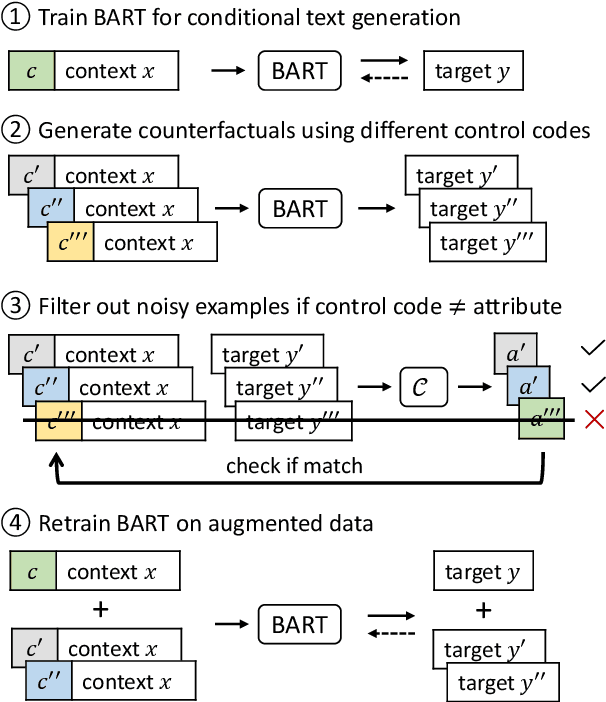
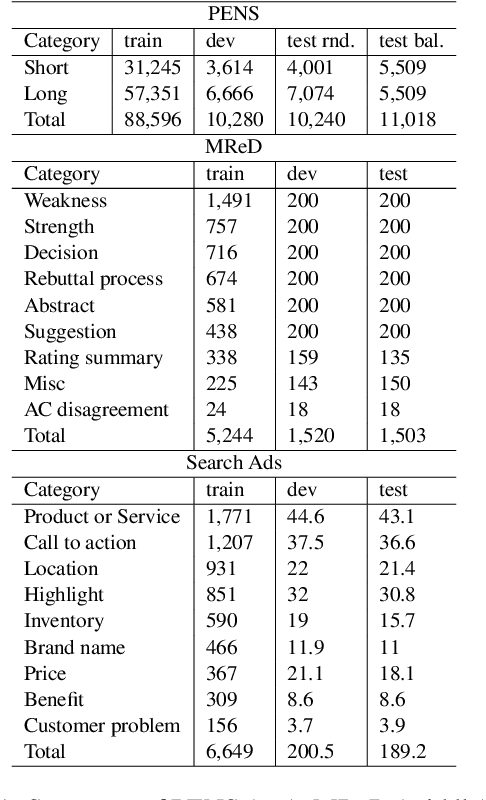
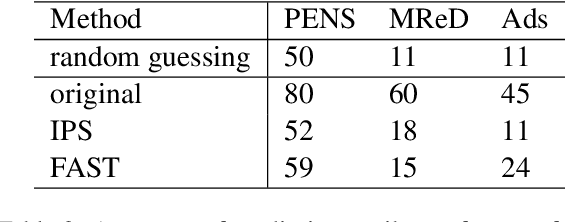
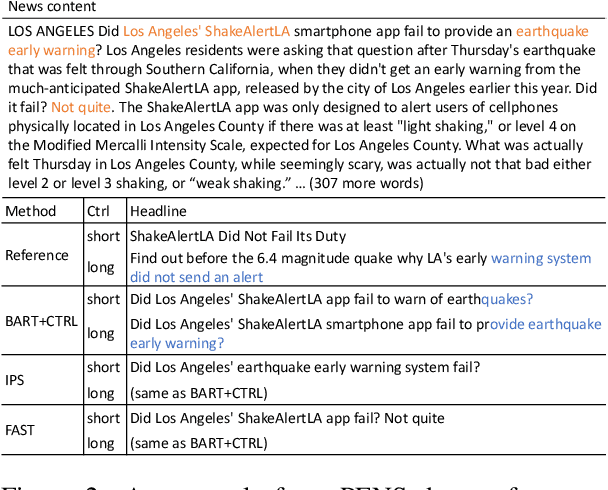
Controllable text generation systems often leverage control codes to direct various properties of the output like style and length. Inspired by recent work on causal inference for NLP, this paper reveals a previously overlooked flaw in these control code-based conditional text generation algorithms. Spurious correlations in the training data can lead models to incorrectly rely on parts of the input other than the control code for attribute selection, significantly undermining downstream generation quality and controllability. We demonstrate the severity of this issue with a series of case studies and then propose two simple techniques to reduce these correlations in training sets. The first technique is based on resampling the data according to an example's propensity towards each linguistic attribute (IPS). The second produces multiple counterfactual versions of each example and then uses an additional feedback mechanism to remove noisy examples (feedback aware self-training, FAST). We evaluate on 3 tasks -- news headline, meta review, and search ads generation -- and demonstrate that FAST can significantly improve the controllability and language quality of generated outputs when compared to state-of-the-art controllable text generation approaches.
Generate rather than Retrieve: Large Language Models are Strong Context Generators
Sep 29, 2022
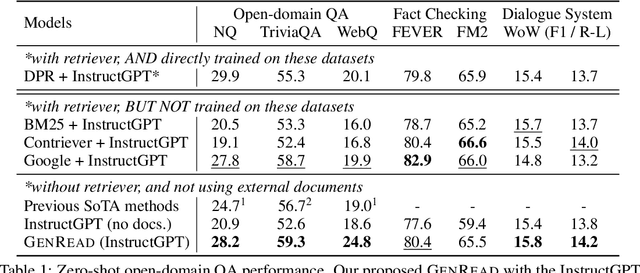
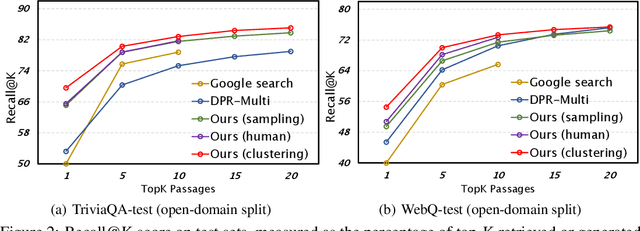
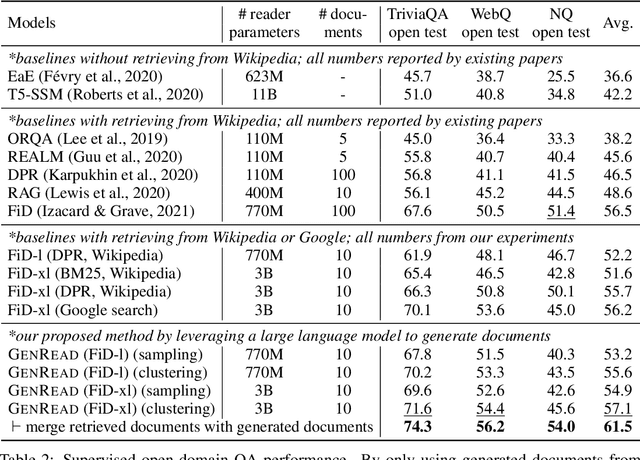
Knowledge-intensive tasks, such as open-domain question answering (QA), require access to a large amount of world or domain knowledge. A common approach for knowledge-intensive tasks is to employ a retrieve-then-read pipeline that first retrieves a handful of relevant contextual documents from an external corpus such as Wikipedia and then predicts an answer conditioned on the retrieved documents. In this paper, we present a novel perspective for solving knowledge-intensive tasks by replacing document retrievers with large language model generators. We call our method generate-then-read (GenRead), which first prompts a large language model to generate contextutal documents based on a given question, and then reads the generated documents to produce the final answer. Furthermore, we propose a novel clustering-based prompting method that selects distinct prompts, resulting in the generated documents that cover different perspectives, leading to better recall over acceptable answers. We conduct extensive experiments on three different knowledge-intensive tasks, including open-domain QA, fact checking, and dialogue system. Notably, GenRead achieves 71.6 and 54.4 exact match scores on TriviaQA and WebQ, significantly outperforming the state-of-the-art retrieve-then-read pipeline DPR-FiD by +4.0 and +3.9, without retrieving any documents from any external knowledge source. Lastly, we demonstrate the model performance can be further improved by combining retrieval and generation.