 Add to Chrome
 Add to Firefox
 Add to Edge
Tracailer: An Efficient Trajectory Planner for Tractor-Trailer Vehicles in Unstructured Environments
Feb 27, 2025
The tractor-trailer vehicle (robot) consists of a drivable tractor and one or more non-drivable trailers connected via hitches. Compared to typical car-like robots, the addition of trailers provides greater transportation capability. However, this also complicates motion planning due to the robot's complex kinematics, high-dimensional state space, and deformable structure. To efficiently plan safe, time-optimal trajectories that adhere to the kinematic constraints of the robot and address the challenges posed by its unique features, this paper introduces a lightweight, compact, and high-order smooth trajectory representation for tractor-trailer robots. Based on it, we design an efficiently solvable spatio-temporal trajectory optimization problem. To deal with deformable structures, which leads to difficulties in collision avoidance, we fully leverage the collision-free regions of the environment, directly applying deformations to trajectories in continuous space. This approach not requires constructing safe regions from the environment using convex approximations through collision-free seed points before each optimization, avoiding the loss of the solution space, thus reducing the dependency of the optimization on initial values. Moreover, a multi-terminal fast path search algorithm is proposed to generate the initial values for optimization. Extensive simulation experiments demonstrate that our approach achieves several-fold improvements in efficiency compared to existing algorithms, while also ensuring lower curvature and trajectory duration. Real-world experiments involving the transportation, loading and unloading of goods in both indoor and outdoor scenarios further validate the effectiveness of our method. The source code is accessible at https://github.com/ZJU-FAST-Lab/tracailer/.

LAM: Large Avatar Model for One-shot Animatable Gaussian Head
Feb 25, 2025We present LAM, an innovative Large Avatar Model for animatable Gaussian head reconstruction from a single image. Unlike previous methods that require extensive training on captured video sequences or rely on auxiliary neural networks for animation and rendering during inference, our approach generates Gaussian heads that are immediately animatable and renderable. Specifically, LAM creates an animatable Gaussian head in a single forward pass, enabling reenactment and rendering without additional networks or post-processing steps. This capability allows for seamless integration into existing rendering pipelines, ensuring real-time animation and rendering across a wide range of platforms, including mobile phones. The centerpiece of our framework is the canonical Gaussian attributes generator, which utilizes FLAME canonical points as queries. These points interact with multi-scale image features through a Transformer to accurately predict Gaussian attributes in the canonical space. The reconstructed canonical Gaussian avatar can then be animated utilizing standard linear blend skinning (LBS) with corrective blendshapes as the FLAME model did and rendered in real-time on various platforms. Our experimental results demonstrate that LAM outperforms state-of-the-art methods on existing benchmarks.
Primitive-Swarm: An Ultra-lightweight and Scalable Planner for Large-scale Aerial Swarms
Feb 24, 2025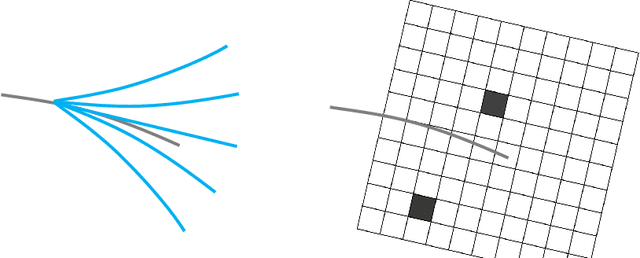
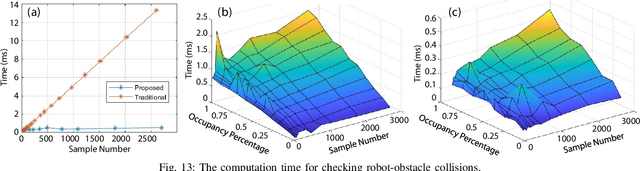
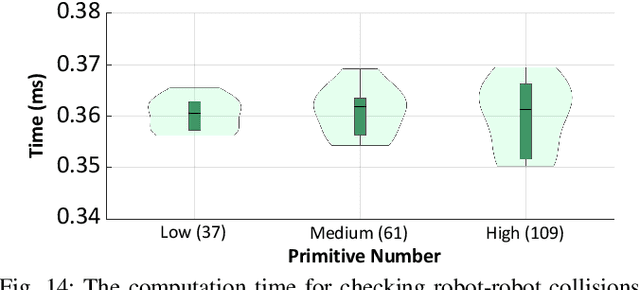
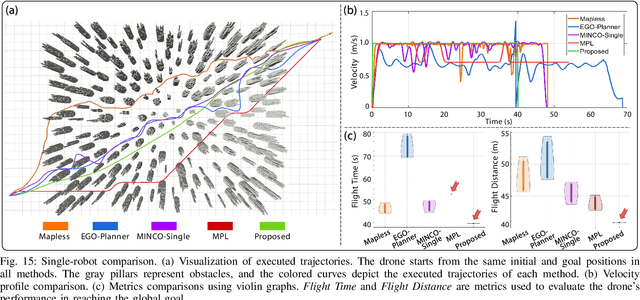
Achieving large-scale aerial swarms is challenging due to the inherent contradictions in balancing computational efficiency and scalability. This paper introduces Primitive-Swarm, an ultra-lightweight and scalable planner designed specifically for large-scale autonomous aerial swarms. The proposed approach adopts a decentralized and asynchronous replanning strategy. Within it is a novel motion primitive library consisting of time-optimal and dynamically feasible trajectories. They are generated utlizing a novel time-optimial path parameterization algorithm based on reachability analysis (TOPP-RA). Then, a rapid collision checking mechanism is developed by associating the motion primitives with the discrete surrounding space according to conflicts. By considering both spatial and temporal conflicts, the mechanism handles robot-obstacle and robot-robot collisions simultaneously. Then, during a replanning process, each robot selects the safe and minimum cost trajectory from the library based on user-defined requirements. Both the time-optimal motion primitive library and the occupancy information are computed offline, turning a time-consuming optimization problem into a linear-complexity selection problem. This enables the planner to comprehensively explore the non-convex, discontinuous 3-D safe space filled with numerous obstacles and robots, effectively identifying the best hidden path. Benchmark comparisons demonstrate that our method achieves the shortest flight time and traveled distance with a computation time of less than 1 ms in dense environments. Super large-scale swarm simulations, involving up to 1000 robots, running in real-time, verify the scalability of our method. Real-world experiments validate the feasibility and robustness of our approach. The code will be released to foster community collaboration.
Safe and Agile Transportation of Cable-Suspended Payload via Multiple Aerial Robots
Jan 25, 2025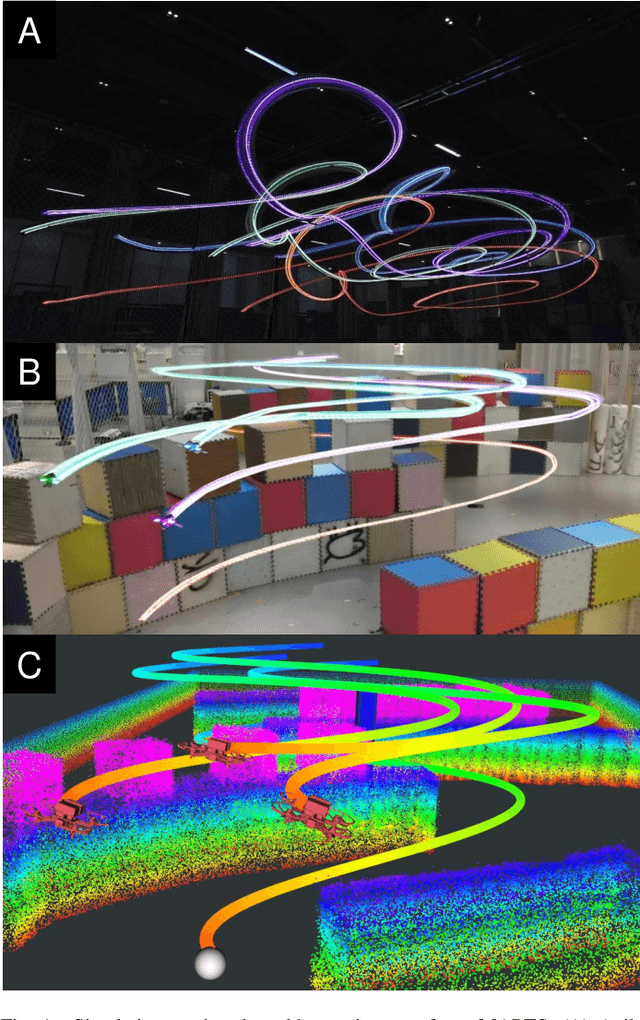
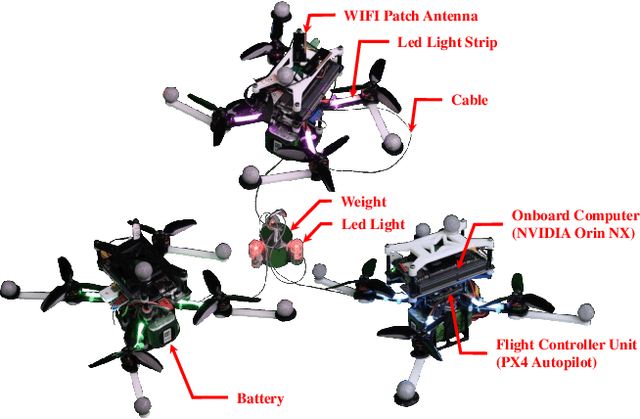
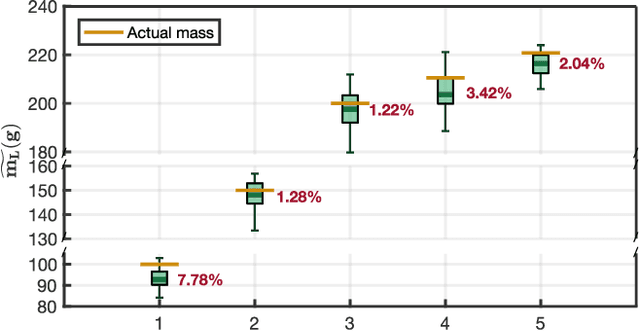
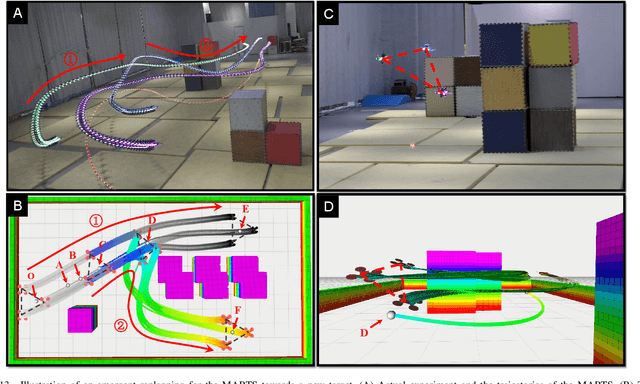
Transporting a heavy payload using multiple aerial robots (MARs) is an efficient manner to extend the load capacity of a single aerial robot. However, existing schemes for the multiple aerial robots transportation system (MARTS) still lack the capability to generate a collision-free and dynamically feasible trajectory in real-time and further track an agile trajectory especially when there are no sensors available to measure the states of payload and cable. Therefore, they are limited to low-agility transportation in simple environments. To bridge the gap, we propose complete planning and control schemes for the MARTS, achieving safe and agile aerial transportation (SAAT) of a cable-suspended payload in complex environments. Flatness maps for the aerial robot considering the complete kinematical constraint and the dynamical coupling between each aerial robot and payload are derived. To improve the responsiveness for the generation of the safe, dynamically feasible, and agile trajectory in complex environments, a real-time spatio-temporal trajectory planning scheme is proposed for the MARTS. Besides, we break away from the reliance on the state measurement for both the payload and cable, as well as the closed-loop control for the payload, and propose a fully distributed control scheme to track the agile trajectory that is robust against imprecise payload mass and non-point mass payload. The proposed schemes are extensively validated through benchmark comparisons, ablation studies, and simulations. Finally, extensive real-world experiments are conducted on a MARTS integrated by three aerial robots with onboard computers and sensors. The result validates the efficiency and robustness of our proposed schemes for SAAT in complex environments.
CDMA/OTFS Sensing Outperforms Pure OTFS at the Same Communication Throughput
Jan 20, 2025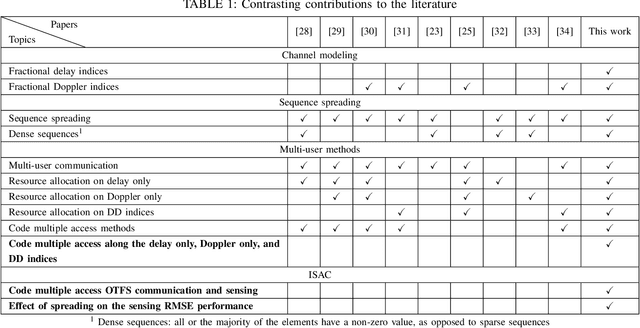
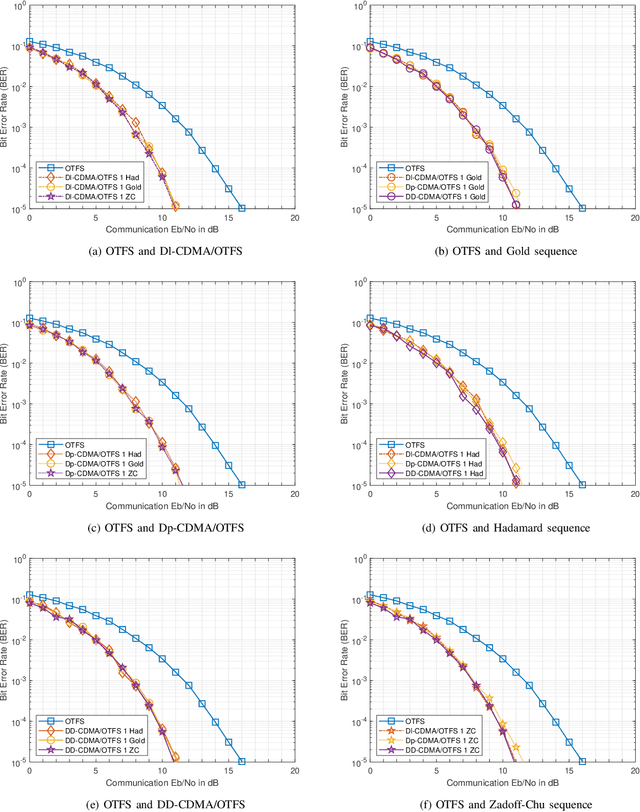
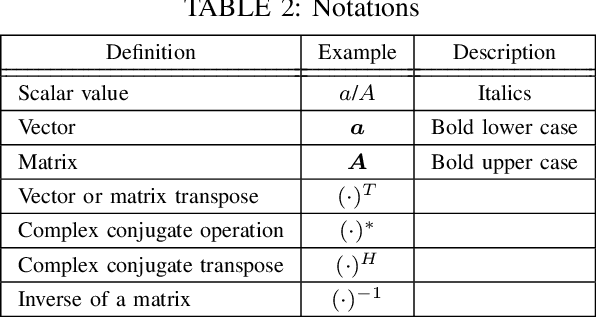

There is a dearth of publications on the subject of spreading-aided Orthogonal Time Frequency Space (OTFS) solutions, especially for Integrated Sensing and Communication (ISAC), even though Code Division Multiple Access (CDMA) assisted multi-user OTFS (CDMA/OTFS) exhibits tangible benefits. Hence, this work characterises both the communication Bit Error Rate (BER) and sensing Root Mean Square Error (RMSE) performance of CDMA/OTFS, and contrasts them to pure OTFS. Three CDMA/OTFS configurations are considered: Delay Code Division Multiple Access OTFS (Dl-CDMA/OTFS), Doppler Code Division Multiple Access OTFS (Dp-CDMA/OTFS), and Delay Doppler Code Division Multiple Access OTFS (DD-CDMA/OTFS), which harness direct sequence spreading along the delay axis, Doppler axis, and DD domains respectively. For each configuration, the performance of Gold, Hadamard, and Zadoff-Chu sequences is investigated. The results demonstrate that Zadoff-Chu Dl-CDMA/OTFS and DD-CDMA/OTFS consistently outperform pure OTFS sensing, whilst maintaining a similar communication performance at the same throughput. The extra modulation complexity of CDMA/OTFS is similar to that of other OTFS multi-user methodologies, but the demodulation complexity of CDMA/OTFS is lower than that of some other OTFS multi-user methodologies. CDMA/OTFS sensing can also consistently outperform OTFS sensing whilst not requiring any additional complexity for target parameter estimation. Therefore, CDMA/OTFS is an appealing candidate for implementing multi-user OTFS ISAC.
Holographic Metasurface-Based Beamforming for Multi-Altitude LEO Satellite Networks
Jan 07, 2025


Low Earth Orbit (LEO) satellite networks are capable of improving the global Internet service coverage. In this context, we propose a hybrid beamforming design for holographic metasurface based terrestrial users in multi-altitude LEO satellite networks. Firstly, the holographic beamformer is optimized by maximizing the downlink channel gain from the serving satellite to the terrestrial user. Then, the digital beamformer is designed by conceiving a minimum mean square error (MMSE) based detection algorithm for mitigating the interference arriving from other satellites. To dispense with excessive overhead of full channel state information (CSI) acquisition of all satellites, we propose a low-complexity MMSE beamforming algorithm that only relies on the distribution of the LEO satellite constellation harnessing stochastic geometry, which can achieve comparable throughput to that of the algorithm based on the full CSI in the case of a dense LEO satellite deployment. Furthermore, it outperforms the maximum ratio combining (MRC) algorithm, thanks to its inter-satellite interference mitigation capacity. The simulation results show that our proposed holographic metasurface based hybrid beamforming architecture is capable of outperforming the state-of-the-art antenna array architecture in terms of its throughput, given the same physical size of the transceivers. Moreover, we demonstrate that the beamforming performance attained can be substantially improved by taking into account the mutual coupling effect, imposed by the dense placement of the holographic metasurface elements.
DiC: Rethinking Conv3x3 Designs in Diffusion Models
Dec 31, 2024


Diffusion models have shown exceptional performance in visual generation tasks. Recently, these models have shifted from traditional U-Shaped CNN-Attention hybrid structures to fully transformer-based isotropic architectures. While these transformers exhibit strong scalability and performance, their reliance on complicated self-attention operation results in slow inference speeds. Contrary to these works, we rethink one of the simplest yet fastest module in deep learning, 3x3 Convolution, to construct a scaled-up purely convolutional diffusion model. We first discover that an Encoder-Decoder Hourglass design outperforms scalable isotropic architectures for Conv3x3, but still under-performing our expectation. Further improving the architecture, we introduce sparse skip connections to reduce redundancy and improve scalability. Based on the architecture, we introduce conditioning improvements including stage-specific embeddings, mid-block condition injection, and conditional gating. These improvements lead to our proposed Diffusion CNN (DiC), which serves as a swift yet competitive diffusion architecture baseline. Experiments on various scales and settings show that DiC surpasses existing diffusion transformers by considerable margins in terms of performance while keeping a good speed advantage. Project page: https://github.com/YuchuanTian/DiC
Space-Air-Ground Integrated Networks: Their Channel Model and Performance Analysis
Dec 21, 2024Given their extensive geographic coverage, low Earth orbit (LEO) satellites are envisioned to find their way into next-generation (6G) wireless communications. This paper explores space-air-ground integrated networks (SAGINs) leveraging LEOs to support terrestrial and non-terrestrial users. We first propose a practical satellite-ground channel model that incorporates five key aspects: 1) the small-scale fading characterized by the Shadowed-Rician distribution in terms of the Rician factor K, 2) the path loss effect of bending rays due to atmospheric refraction, 3) the molecular absorption modelled by the Beer-Lambert law, 4) the Doppler effects including the Earth's rotation, and 5) the impact of weather conditions according to the International Telecommunication Union Recommendations (ITU-R). Harnessing the proposed model, we analyze the long-term performance of the SAGIN considered. Explicitly, the closed-form expressions of both the outage probability and of the ergodic rates are derived. Additionally, the upper bounds of bit-error rates and of the Goodput are investigated. The numerical results yield the following insights: 1) The shadowing effect and the ratio between the line-of-sight and scattering components can be conveniently modeled by the factors of K and m in the proposed Shadowed-Rician small-scale fading model. 2) The atmospheric refraction has a modest effect on the path loss. 3) When calculating the transmission distance of waves, Earth's curvature and its geometric relationship with the satellites must be considered, particularly at small elevation angles. 3) High-frequency carriers suffer from substantial path loss, and 4) the Goodput metric is eminently suitable for characterizing the performance of different coding as well as modulation methods and of the estimation error of the Doppler effects.
AniSora: Exploring the Frontiers of Animation Video Generation in the Sora Era
Dec 19, 2024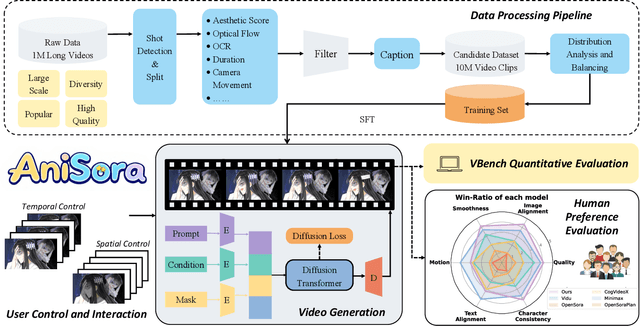


Animation has gained significant interest in the recent film and TV industry. Despite the success of advanced video generation models like Sora, Kling, and CogVideoX in generating natural videos, they lack the same effectiveness in handling animation videos. Evaluating animation video generation is also a great challenge due to its unique artist styles, violating the laws of physics and exaggerated motions. In this paper, we present a comprehensive system, AniSora, designed for animation video generation, which includes a data processing pipeline, a controllable generation model, and an evaluation dataset. Supported by the data processing pipeline with over 10M high-quality data, the generation model incorporates a spatiotemporal mask module to facilitate key animation production functions such as image-to-video generation, frame interpolation, and localized image-guided animation. We also collect an evaluation benchmark of 948 various animation videos, the evaluation on VBench and human double-blind test demonstrates consistency in character and motion, achieving state-of-the-art results in animation video generation. Our evaluation benchmark will be publicly available at https://github.com/bilibili/Index-anisora.
MCMat: Multiview-Consistent and Physically Accurate PBR Material Generation
Dec 18, 2024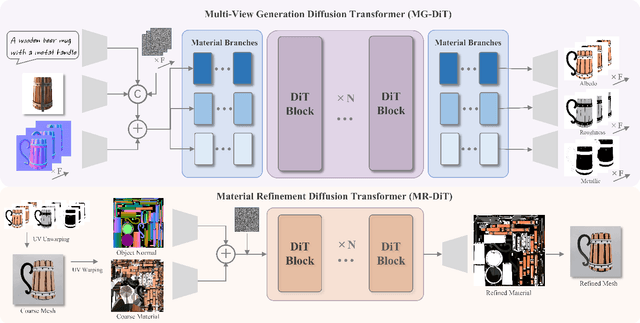
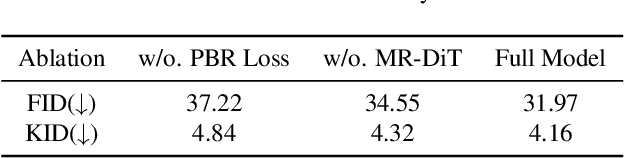
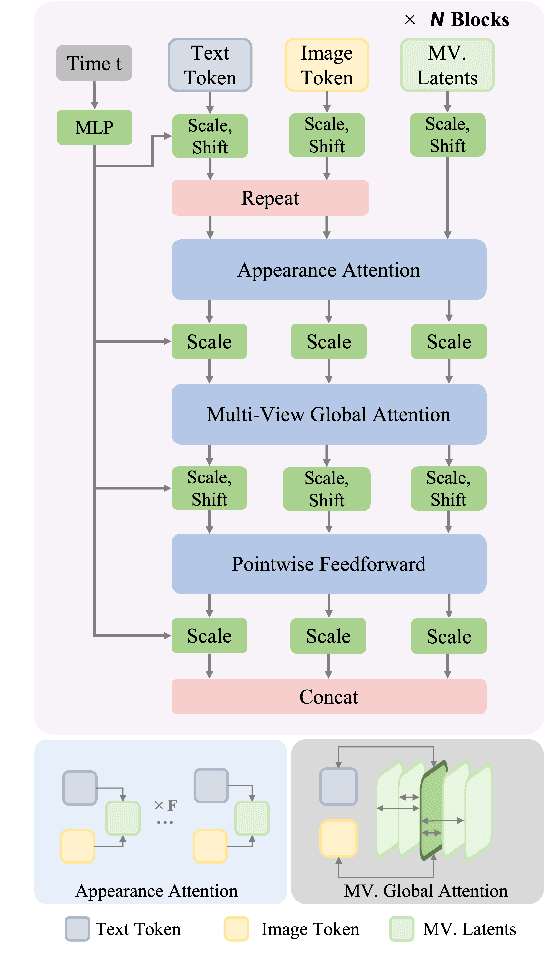
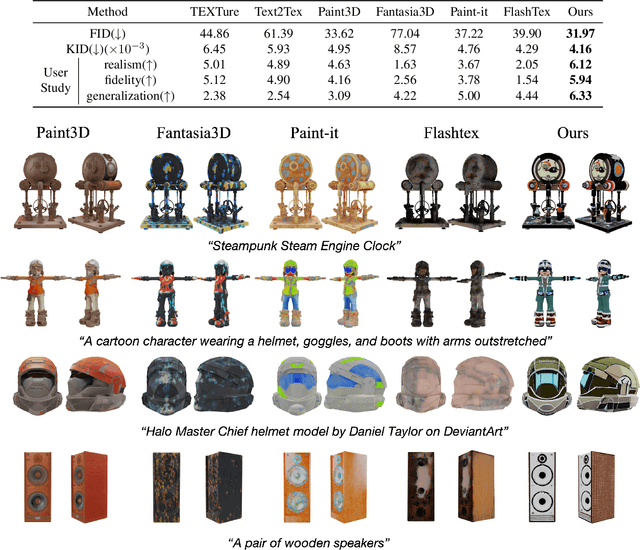
Existing 2D methods utilize UNet-based diffusion models to generate multi-view physically-based rendering (PBR) maps but struggle with multi-view inconsistency, while some 3D methods directly generate UV maps, encountering generalization issues due to the limited 3D data. To address these problems, we propose a two-stage approach, including multi-view generation and UV materials refinement. In the generation stage, we adopt a Diffusion Transformer (DiT) model to generate PBR materials, where both the specially designed multi-branch DiT and reference-based DiT blocks adopt a global attention mechanism to promote feature interaction and fusion between different views, thereby improving multi-view consistency. In addition, we adopt a PBR-based diffusion loss to ensure that the generated materials align with realistic physical principles. In the refinement stage, we propose a material-refined DiT that performs inpainting in empty areas and enhances details in UV space. Except for the normal condition, this refinement also takes the material map from the generation stage as an additional condition to reduce the learning difficulty and improve generalization. Extensive experiments show that our method achieves state-of-the-art performance in texturing 3D objects with PBR materials and provides significant advantages for graphics relighting applications. Project Page: https://lingtengqiu.github.io/2024/MCMat/