 Add to Chrome
 Add to Firefox
 Add to Edge
AeroDPO: Unleashing Lightweight UAV Navigation with High-Fidelity Perception and Automated Preference Optimization
Aug 02, 2026
Vision-Language Navigation for Unmanned Aerial Vehicles (UAV-VLN) requires rapid and reactive control in complex 3D environments. Recent minimalist end-to-end paradigms show great promise but typically rely on massive language models containing billions of parameters, incurring prohibitive latency for real-world edge deployment. In this paper, we challenge this parameter-heavy reliance. Comprehensive cross-scale evaluations reveal the critical insight that perception quality fundamentally outweighs language reasoning capacity. We demonstrate that a lightweight 2B model equipped with high-fidelity visual inputs completely matches the overall success rates of massive 7B baselines. However, this minimalist policy exposes a fundamental robustness flaw inherent to pure Behavior Cloning (BC). Lacking explicit negative feedback, the agent fails to internalize robust spatial constraints and exhibits alarming collision rates in out-of-distribution (OOD) scenarios. To overcome this vulnerability without relying on unscalable human annotations, we propose AeroDPO, a zero-cost automated Direct Preference Optimization pipeline driven by deterministic physical simulation state rollback. Upon detecting collisions, the system autonomously rewinds the environment to extract causal reasoning errors as rejected actions, applies decoupled privileged interventions to synthesize collision-avoidance preferred maneuvers, and leverages an offline vision language inspector to filter visual ambiguities. By equipping our 2B model with this automated data flywheel, AeroDPO boosts success rates to 49.16% on unmapped scenarios while drastically suppressing collision rates, establishing a new SOTA for autonomous aerial agents.

TACG: Trajectory-Aware Commit Gating for Diffusion Language Model Decoding
Jul 03, 2026Diffusion language models (DLLMs) generate text by iteratively denoising masked positions, exposing a trajectory of predictive distributions rather than a single instantaneous belief. Most existing decoders ignore this trajectory and commit tokens from the current snapshot alone, conflating confidence with commitment readiness: a transient top-1 peak under incomplete context can be locked in, while candidates with consistent cross-step support are delayed. We propose Trajectory-Aware Commit Gating (TACG), a training-free gate-level decoder that anchors token identities to the base posterior and uses trajectory-aware signals only to decide whether the current proposal is ready to commit. TACG combines Temporal Implicit Logits Guidance (TILG), which keeps an exponential moving average of past logits as a self-reference and contrasts the current logits against this reference in natural-parameter space, with a History Gate (HG) that enforces short-term proposal persistence before commitment. Together with a capped extra-promotion budget, these components yield a stability-constrained commit rule without auxiliary networks or extra forward passes. We evaluate TACG on LLaDA, Dream, and LLaDA2-Mini across code (HumanEval, MBPP) and math (GSM8K, MATH500) benchmarks; it typically improves or preserves accuracy while reducing denoising steps and increasing tokens per forward (TPF). The code is publicly available at https://github.com/Clarence-CV/TACG-DLLM.
From Question Answering to Task Completion: A Survey on Agent System and Harness Design
Jun 14, 2026LLM-based agents mark a shift from passive question answering to active task completion: they perceive environments, invoke tools, maintain state, and act over extended horizons. As agent systems have evolved from prompt engineering to workflows and context engineering, harness engineering, and agent-native training with co-evolution, a central question has become increasingly important: where does the bottleneck in agent performance reside, in the foundation model, in the execution harness, or in the coupling between them? This survey examines LLM-based agents through a model-harness lens. We first clarify the functional definition of agents and the implementation view of an LLM-based agent as a foundation model coupled with an execution harness. We then analyze the limits of model-centric scaling, trace four paradigms of agent engineering, and decompose the execution harness into six coupled runtime responsibilities: observation, context, control, action, state, and verification. Using this decomposition, we map task properties and domain pressures to harness configurations, review benchmark and evaluation practices, and synthesize model-harness evidence on how runtime design affects long-horizon task completion, efficiency, and reliability. Finally, we identify open challenges in value-aware evaluation, safety, harness generalization, and model-harness co-evolution. Rather than treating agents as models with auxiliary tools, this survey argues that agent quality -- including success, efficiency, safety, and generalization -- emerges from the interaction between model capability, runtime infrastructure, task structure, and evaluation design. A collection of papers discussed in this survey is provided in https://github.com/ggjy/Awesome-Agent-Engineering.
Sibyl-AutoResearch: Autonomous Research Needs Self-Evolving Trial-and-Error Harnesses, Not Paper Generators
May 21, 2026Autonomous research systems increasingly make the scientific workflow executable: agents can propose ideas, run code, inspect results, and draft papers. But executable workflows do not by themselves produce research judgment. We analyze where current systems lose trial experience: weak evidence becomes prose, pilot signals become broad claims, memory remains textual, and recurring process failures do not change later behavior. We introduce Sibyl-AutoResearch, a self-evolving AutoResearch framework built around Scientific Trial-and-Error Harnesses. A harness lets agents run bounded trials, preserve positive and negative outcomes, and route lessons into later planning, validation, claim scope, scheduling, critique, writing, and harness repair. We formalize this through two auditable conversion units: trial-to-behavior conversion, which links trial signals to later research actions, and trial-to-harness-behavior conversion, which links recurring process failures to system updates. We implement the framework in SIBYL, a file-backed autonomous research system that exposes the state, roles, memory, gates, and artifact traces needed to inspect these conversion paths. A retrospective audit identifies eight high-confidence conversion events, with a median latency of one iteration and a maximum latency of three iterations. A recovered-failure registry further shows how five naturally occurring failure classes, including duplicate results, stale numbers, and unsupported statistics, were blocked, downgraded, or routed into later repair. These traces do not establish a comparative performance claim; they show that the proposed conversion units are recoverable from realistic autonomous-research workspaces. The SIBYL framework and system are available at https://github.com/Sibyl-Research-Team/AutoResearch-SibylSystem.
ExpressMind: A Multimodal Pretrained Large Language Model for Expressway Operation
Mar 17, 2026The current expressway operation relies on rule-based and isolated models, which limits the ability to jointly analyze knowledge across different systems. Meanwhile, Large Language Models (LLMs) are increasingly applied in intelligent transportation, advancing traffic models from algorithmic to cognitive intelligence. However, general LLMs are unable to effectively understand the regulations and causal relationships of events in unconventional scenarios in the expressway field. Therefore, this paper constructs a pre-trained multimodal large language model (MLLM) for expressways, ExpressMind, which serves as the cognitive core for intelligent expressway operations. This paper constructs the industry's first full-stack expressway dataset, encompassing traffic knowledge texts, emergency reasoning chains, and annotated video events to overcome data scarcity. This paper proposes a dual-layer LLM pre-training paradigm based on self-supervised training and unsupervised learning. Additionally, this study introduces a Graph-Augmented RAG framework to dynamically index the expressway knowledge base. To enhance reasoning for expressway incident response strategies, we develop a RL-aligned Chain-of-Thought (RL-CoT) mechanism that enforces consistency between model reasoning and expert problem-solving heuristics for incident handling. Finally, ExpressMind integrates a cross-modal encoder to align the dynamic feature sequences under the visual and textual channels, enabling it to understand traffic scenes in both video and image modalities. Extensive experiments on our newly released multi-modal expressway benchmark demonstrate that ExpressMind comprehensively outperforms existing baselines in event detection, safety response generation, and complex traffic analysis. The code and data are available at: https://wanderhee.github.io/ExpressMind/.
Circle-RoPE: Cone-like Decoupled Rotary Positional Embedding for Large Vision-Language Models
May 22, 2025Rotary Position Embedding (RoPE) is a widely adopted technique for encoding relative positional information in large language models (LLMs). However, when extended to large vision-language models (LVLMs), its variants introduce unintended cross-modal positional biases. Specifically, they enforce relative positional dependencies between text token indices and image tokens, causing spurious alignments. This issue arises because image tokens representing the same content but located at different spatial positions are assigned distinct positional biases, leading to inconsistent cross-modal associations. To address this, we propose Per-Token Distance (PTD) - a simple yet effective metric for quantifying the independence of positional encodings across modalities. Informed by this analysis, we introduce Circle-RoPE, a novel encoding scheme that maps image token indices onto a circular trajectory orthogonal to the linear path of text token indices, forming a cone-like structure. This configuration ensures that each text token maintains an equal distance to all image tokens, reducing artificial cross-modal biases while preserving intra-image spatial information. To further enhance performance, we propose a staggered layer strategy that applies different RoPE variants across layers. This design leverages the complementary strengths of each RoPE variant, thereby enhancing the model's overall performance. Our experimental results demonstrate that our method effectively preserves spatial information from images while reducing relative positional bias, offering a more robust and flexible positional encoding framework for LVLMs. The code is available at [https://github.com/lose4578/CircleRoPE](https://github.com/lose4578/CircleRoPE).
DiC: Rethinking Conv3x3 Designs in Diffusion Models
Dec 31, 2024


Diffusion models have shown exceptional performance in visual generation tasks. Recently, these models have shifted from traditional U-Shaped CNN-Attention hybrid structures to fully transformer-based isotropic architectures. While these transformers exhibit strong scalability and performance, their reliance on complicated self-attention operation results in slow inference speeds. Contrary to these works, we rethink one of the simplest yet fastest module in deep learning, 3x3 Convolution, to construct a scaled-up purely convolutional diffusion model. We first discover that an Encoder-Decoder Hourglass design outperforms scalable isotropic architectures for Conv3x3, but still under-performing our expectation. Further improving the architecture, we introduce sparse skip connections to reduce redundancy and improve scalability. Based on the architecture, we introduce conditioning improvements including stage-specific embeddings, mid-block condition injection, and conditional gating. These improvements lead to our proposed Diffusion CNN (DiC), which serves as a swift yet competitive diffusion architecture baseline. Experiments on various scales and settings show that DiC surpasses existing diffusion transformers by considerable margins in terms of performance while keeping a good speed advantage. Project page: https://github.com/YuchuanTian/DiC
DenseMamba: State Space Models with Dense Hidden Connection for Efficient Large Language Models
Mar 05, 2024

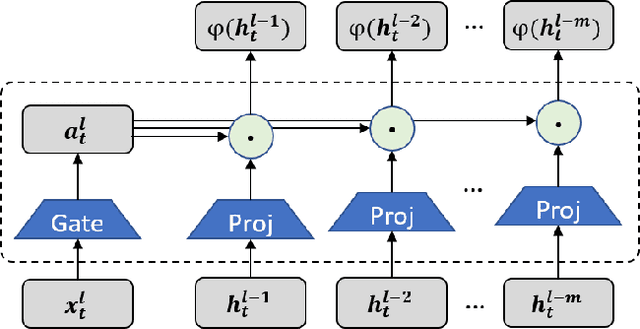

Large language models (LLMs) face a daunting challenge due to the excessive computational and memory requirements of the commonly used Transformer architecture. While state space model (SSM) is a new type of foundational network architecture offering lower computational complexity, their performance has yet to fully rival that of Transformers. This paper introduces DenseSSM, a novel approach to enhance the flow of hidden information between layers in SSMs. By selectively integrating shallowlayer hidden states into deeper layers, DenseSSM retains fine-grained information crucial for the final output. Dense connections enhanced DenseSSM still maintains the training parallelizability and inference efficiency. The proposed method can be widely applicable to various SSM types like RetNet and Mamba. With similar model size, DenseSSM achieves significant improvements, exemplified by DenseRetNet outperforming the original RetNet with up to 5% accuracy improvement on public benchmarks. code is avalaible at https://github.com/WailordHe/DenseSSM
A robust audio deepfake detection system via multi-view feature
Mar 04, 2024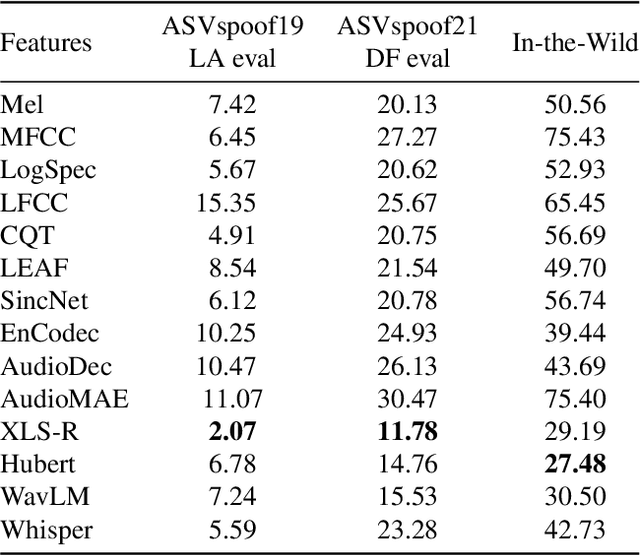
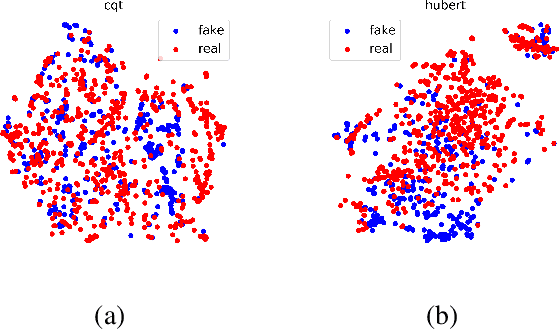
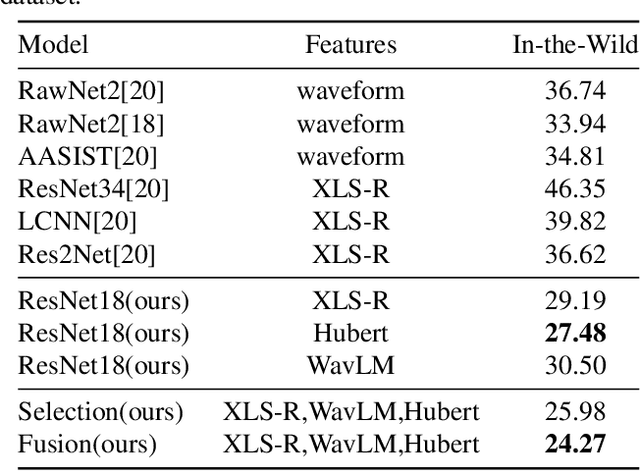
With the advancement of generative modeling techniques, synthetic human speech becomes increasingly indistinguishable from real, and tricky challenges are elicited for the audio deepfake detection (ADD) system. In this paper, we exploit audio features to improve the generalizability of ADD systems. Investigation of the ADD task performance is conducted over a broad range of audio features, including various handcrafted features and learning-based features. Experiments show that learning-based audio features pretrained on a large amount of data generalize better than hand-crafted features on out-of-domain scenarios. Subsequently, we further improve the generalizability of the ADD system using proposed multi-feature approaches to incorporate complimentary information from features of different views. The model trained on ASV2019 data achieves an equal error rate of 24.27\% on the In-the-Wild dataset.
SAM-DiffSR: Structure-Modulated Diffusion Model for Image Super-Resolution
Feb 27, 2024Diffusion-based super-resolution (SR) models have recently garnered significant attention due to their potent restoration capabilities. But conventional diffusion models perform noise sampling from a single distribution, constraining their ability to handle real-world scenes and complex textures across semantic regions. With the success of segment anything model (SAM), generating sufficiently fine-grained region masks can enhance the detail recovery of diffusion-based SR model. However, directly integrating SAM into SR models will result in much higher computational cost. In this paper, we propose the SAM-DiffSR model, which can utilize the fine-grained structure information from SAM in the process of sampling noise to improve the image quality without additional computational cost during inference. In the process of training, we encode structural position information into the segmentation mask from SAM. Then the encoded mask is integrated into the forward diffusion process by modulating it to the sampled noise. This adjustment allows us to independently adapt the noise mean within each corresponding segmentation area. The diffusion model is trained to estimate this modulated noise. Crucially, our proposed framework does NOT change the reverse diffusion process and does NOT require SAM at inference. Experimental results demonstrate the effectiveness of our proposed method, showcasing superior performance in suppressing artifacts, and surpassing existing diffusion-based methods by 0.74 dB at the maximum in terms of PSNR on DIV2K dataset. The code and dataset are available at https://github.com/lose4578/SAM-DiffSR.