 Add to Chrome
 Add to Firefox
 Add to Edge
Disturbance-Aware Flight for Aerial Robots in Narrow Space
Jul 20, 2026
Autonomous flight of aerial robots in narrow space remains challenging due to strong aerodynamic disturbances and limited flying space. Existing approaches mainly address aerodynamic disturbances at the control level, while motion planning typically relies on geometric constraints and fixed speed limits, leading to conservative or unsafe behaviors in confined environments. This paper presents a disturbance-aware planning and control framework (DAPCF) that integrates online disturbance estimation into the planning-control loop for quadrotor flight in narrow space. First, the dual-loop observers estimate 6-degree-of-freedom disturbance forces and torques in real time based on odometry and motor speed measurements. Then, a disturbance risk function is introduced that adaptively modulates the reference speed of the planner based on disturbance estimation, reducing velocity when disturbances exceed a threshold and restoring it under low-disturbance conditions. Finally, a motor-dynamics-based nonlinear model predictive controller (MDNMPC) with disturbance compensation is designed to ensure robust trajectory tracking under perturbed conditions. Experiments demonstrate that a quadrotor with a diagonal length of 0.39~m can traverse straight, sloped, and curved tunnels as narrow as 0.6~m, outperforming human pilots in both success rate and flight efficiency.

Configuration-Induced Passive Self-Rotation for Perception-Enhanced Autonomous Flight
Jul 20, 2026Autonomous flight in confined and cluttered environments is fundamentally limited by the restricted field of view (FoV) of onboard sensors. Passive self-rotation expands sensing coverage without additional sensors but introduces a tradeoff between swept-FoV refresh rate and flight performance. This letter presents a configuration-induced passively self-rotating tricopter for perception-enhanced autonomous flight. Firstly, the rear-arm configuration parameter is exploited to regulate the passive self-rotation operating point, providing an airframe-level mechanism for balancing swept-FoV refresh rate and flight performance. Secondly, a hierarchical autonomy framework integrating planning and control is developed to enable agile and robust autonomous flight under continuous passive self-rotation. For waypoint-based inspection, guide-point replanning is further used to improve task-level coverage. Extensive real-world experiments, including high-speed trajectory tracking, disturbance-rejection tests, and autonomous navigation in representative cluttered environments, demonstrate the effectiveness of the proposed approach for perception-enhanced autonomous flight.
A Self-Rotating Tri-Rotor UAV for Field of View Expansion and Autonomous Flight
Mar 30, 2026Unmanned Aerial Vehicles (UAVs) perception relies on onboard sensors like cameras and LiDAR, which are limited by the narrow field of view (FoV). We present Self-Perception INertial Navigation Enabled Rotorcraft (SPINNER), a self-rotating tri-rotor UAV for the FoV expansion and autonomous flight. Without adding extra sensors or energy consumption, SPINNER significantly expands the FoV of onboard camera and LiDAR sensors through continuous spin motion, thereby enhancing environmental perception efficiency. SPINNER achieves full 3-dimensional position and roll--pitch attitude control using only three brushless motors, while adjusting the rotation speed via anti-torque plates design. To address the strong coupling, severe nonlinearity, and complex disturbances induced by spinning flight, we develop a disturbance compensation control framework that combines nonlinear model predictive control (MPC) with incremental nonlinear dynamic inversion. Experimental results demonstrate that SPINNER maintains robust flight under wind disturbances up to 4.8 \,m/s and achieves high-precision trajectory tracking at a maximum speed of 2.0\,m/s. Moreover, tests in parking garages and forests show that the rotational perception mechanism substantially improves FoV coverage and enhances perception capability of SPINNER.
Safe and Agile Transportation of Cable-Suspended Payload via Multiple Aerial Robots
Jan 25, 2025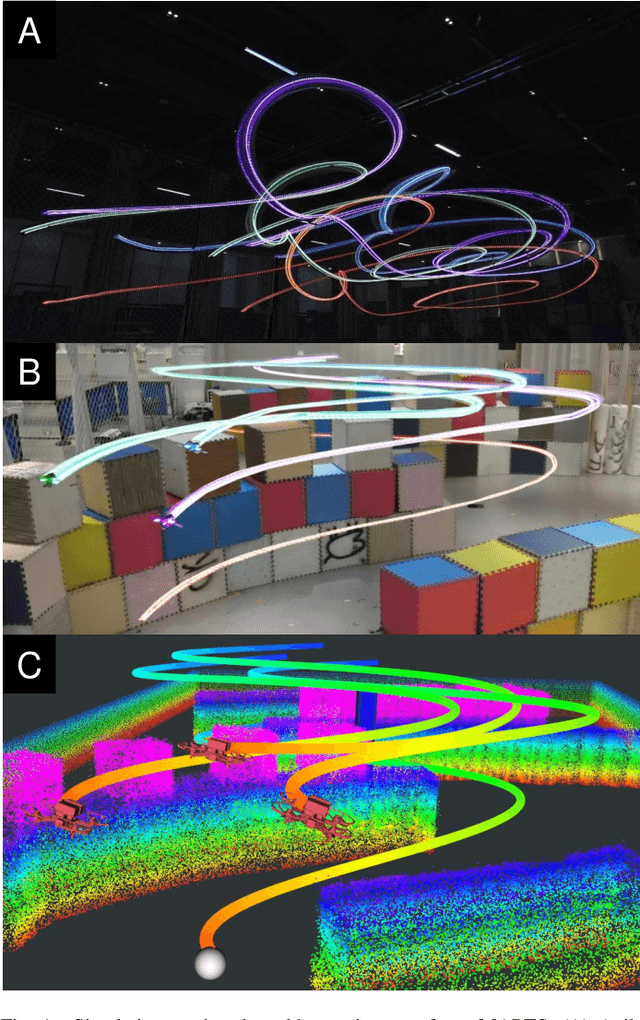
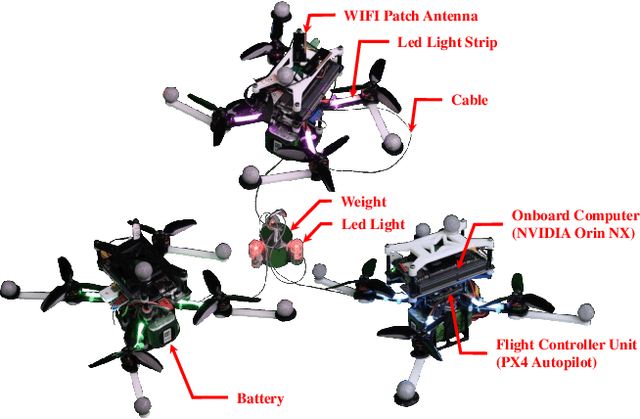
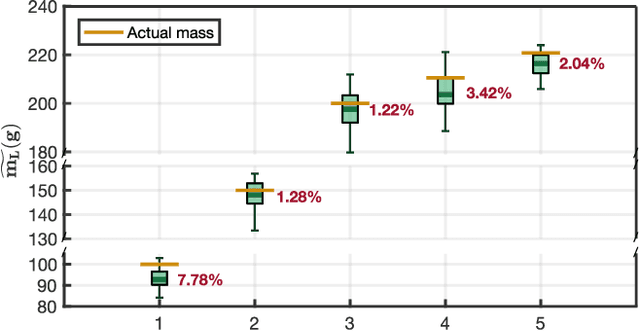
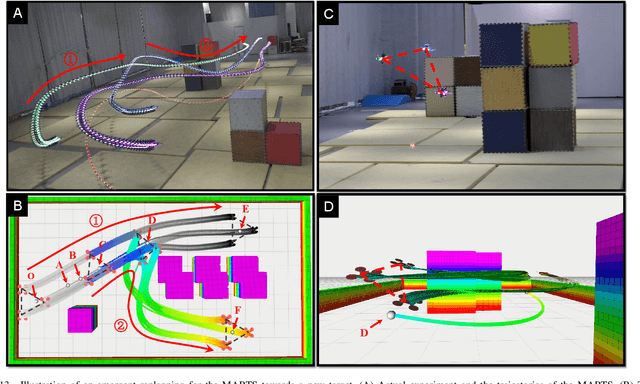
Transporting a heavy payload using multiple aerial robots (MARs) is an efficient manner to extend the load capacity of a single aerial robot. However, existing schemes for the multiple aerial robots transportation system (MARTS) still lack the capability to generate a collision-free and dynamically feasible trajectory in real-time and further track an agile trajectory especially when there are no sensors available to measure the states of payload and cable. Therefore, they are limited to low-agility transportation in simple environments. To bridge the gap, we propose complete planning and control schemes for the MARTS, achieving safe and agile aerial transportation (SAAT) of a cable-suspended payload in complex environments. Flatness maps for the aerial robot considering the complete kinematical constraint and the dynamical coupling between each aerial robot and payload are derived. To improve the responsiveness for the generation of the safe, dynamically feasible, and agile trajectory in complex environments, a real-time spatio-temporal trajectory planning scheme is proposed for the MARTS. Besides, we break away from the reliance on the state measurement for both the payload and cable, as well as the closed-loop control for the payload, and propose a fully distributed control scheme to track the agile trajectory that is robust against imprecise payload mass and non-point mass payload. The proposed schemes are extensively validated through benchmark comparisons, ablation studies, and simulations. Finally, extensive real-world experiments are conducted on a MARTS integrated by three aerial robots with onboard computers and sensors. The result validates the efficiency and robustness of our proposed schemes for SAAT in complex environments.