 Add to Chrome
 Add to Firefox
 Add to Edge
DriveX: Omni Scene Modeling for Learning Generalizable World Knowledge in Autonomous Driving
May 25, 2025
Data-driven learning has advanced autonomous driving, yet task-specific models struggle with out-of-distribution scenarios due to their narrow optimization objectives and reliance on costly annotated data. We present DriveX, a self-supervised world model that learns generalizable scene dynamics and holistic representations (geometric, semantic, and motion) from large-scale driving videos. DriveX introduces Omni Scene Modeling (OSM), a module that unifies multimodal supervision-3D point cloud forecasting, 2D semantic representation, and image generation-to capture comprehensive scene evolution. To simplify learning complex dynamics, we propose a decoupled latent world modeling strategy that separates world representation learning from future state decoding, augmented by dynamic-aware ray sampling to enhance motion modeling. For downstream adaptation, we design Future Spatial Attention (FSA), a unified paradigm that dynamically aggregates spatiotemporal features from DriveX's predictions to enhance task-specific inference. Extensive experiments demonstrate DriveX's effectiveness: it achieves significant improvements in 3D future point cloud prediction over prior work, while attaining state-of-the-art results on diverse tasks including occupancy prediction, flow estimation, and end-to-end driving. These results validate DriveX's capability as a general-purpose world model, paving the way for robust and unified autonomous driving frameworks.

Doc-CoB: Enhancing Multi-Modal Document Understanding with Visual Chain-of-Boxes Reasoning
May 24, 2025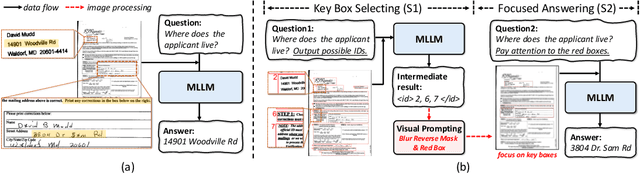
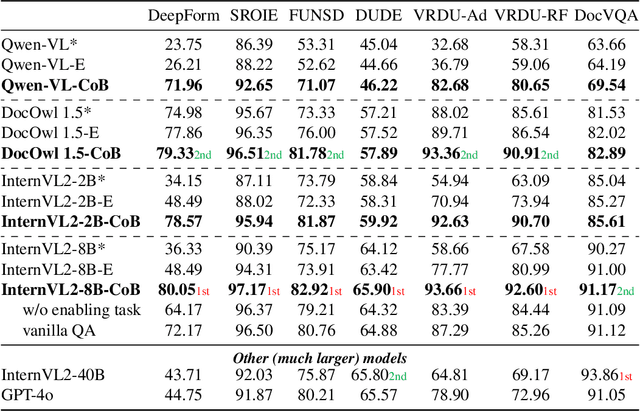
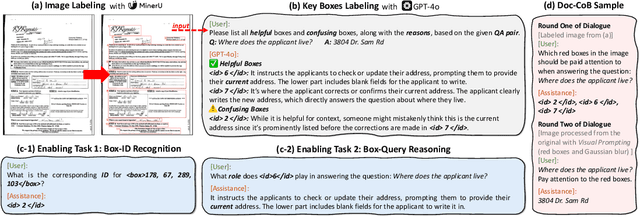

Multimodal large language models (MLLMs) have made significant progress in document understanding. However, the information-dense nature of document images still poses challenges, as most queries depend on only a few relevant regions, with the rest being redundant. Existing one-pass MLLMs process entire document images without considering query relevance, often failing to focus on critical regions and producing unfaithful responses. Inspired by the human coarse-to-fine reading pattern, we introduce Doc-CoB (Chain-of-Box), a simple-yet-effective mechanism that integrates human-style visual reasoning into MLLM without modifying its architecture. Our method allows the model to autonomously select the set of regions (boxes) most relevant to the query, and then focus attention on them for further understanding. We first design a fully automatic pipeline, integrating a commercial MLLM with a layout analyzer, to generate 249k training samples with intermediate visual reasoning supervision. Then we incorporate two enabling tasks that improve box identification and box-query reasoning, which together enhance document understanding. Extensive experiments on seven benchmarks with four popular models show that Doc-CoB significantly improves performance, demonstrating its effectiveness and wide applicability. All code, data, and models will be released publicly.
QwenLong-CPRS: Towards $\infty$-LLMs with Dynamic Context Optimization
May 23, 2025This technical report presents QwenLong-CPRS, a context compression framework designed for explicit long-context optimization, addressing prohibitive computation overhead during the prefill stage and the "lost in the middle" performance degradation of large language models (LLMs) during long sequence processing. Implemented through a novel dynamic context optimization mechanism, QwenLong-CPRS enables multi-granularity context compression guided by natural language instructions, achieving both efficiency gains and improved performance. Evolved from the Qwen architecture series, QwenLong-CPRS introduces four key innovations: (1) Natural language-guided dynamic optimization, (2) Bidirectional reasoning layers for enhanced boundary awareness, (3) Token critic mechanisms with language modeling heads, and (4) Window-parallel inference. Comprehensive evaluations across five benchmarks (4K-2M word contexts) demonstrate QwenLong-CPRS's threefold effectiveness: (1) Consistent superiority over other context management methods like RAG and sparse attention in both accuracy and efficiency. (2) Architecture-agnostic integration with all flagship LLMs, including GPT-4o, Gemini2.0-pro, Claude3.7-sonnet, DeepSeek-v3, and Qwen2.5-max, achieves 21.59$\times$ context compression alongside 19.15-point average performance gains; (3) Deployed with Qwen2.5-32B-Instruct, QwenLong-CPRS surpasses leading proprietary LLMs by 4.85 and 10.88 points on Ruler-128K and InfiniteBench, establishing new SOTA performance.
NovelSeek: When Agent Becomes the Scientist -- Building Closed-Loop System from Hypothesis to Verification
May 22, 2025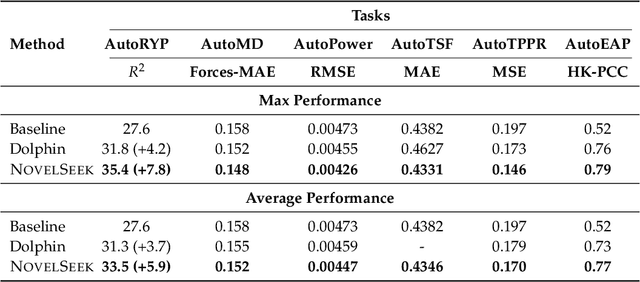
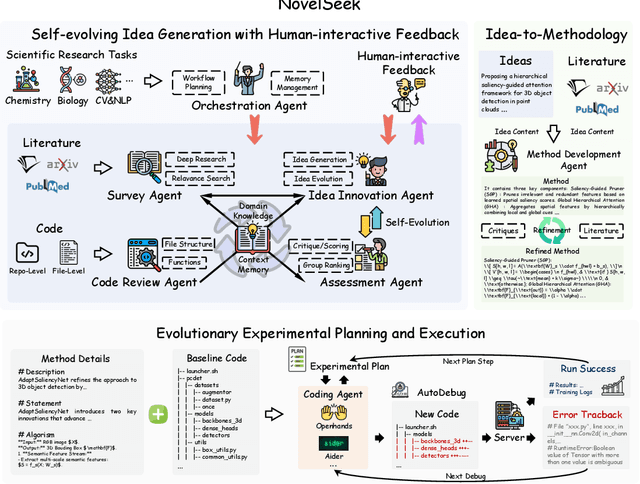
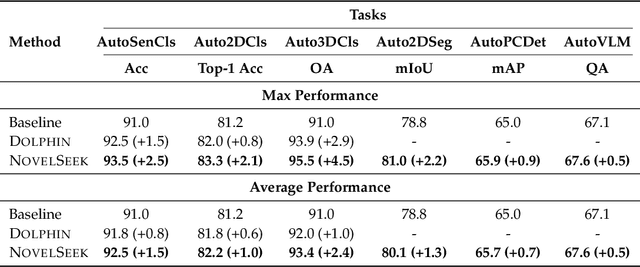
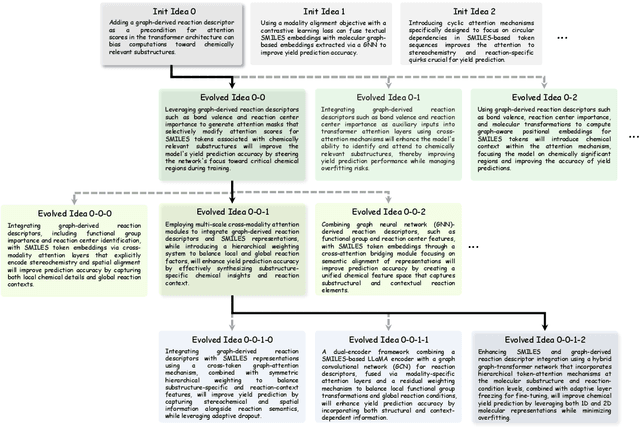
Artificial Intelligence (AI) is accelerating the transformation of scientific research paradigms, not only enhancing research efficiency but also driving innovation. We introduce NovelSeek, a unified closed-loop multi-agent framework to conduct Autonomous Scientific Research (ASR) across various scientific research fields, enabling researchers to tackle complicated problems in these fields with unprecedented speed and precision. NovelSeek highlights three key advantages: 1) Scalability: NovelSeek has demonstrated its versatility across 12 scientific research tasks, capable of generating innovative ideas to enhance the performance of baseline code. 2) Interactivity: NovelSeek provides an interface for human expert feedback and multi-agent interaction in automated end-to-end processes, allowing for the seamless integration of domain expert knowledge. 3) Efficiency: NovelSeek has achieved promising performance gains in several scientific fields with significantly less time cost compared to human efforts. For instance, in reaction yield prediction, it increased from 27.6% to 35.4% in just 12 hours; in enhancer activity prediction, accuracy rose from 0.52 to 0.79 with only 4 hours of processing; and in 2D semantic segmentation, precision advanced from 78.8% to 81.0% in a mere 30 hours.
LENS: Multi-level Evaluation of Multimodal Reasoning with Large Language Models
May 21, 2025Multimodal Large Language Models (MLLMs) have achieved significant advances in integrating visual and linguistic information, yet their ability to reason about complex and real-world scenarios remains limited. The existing benchmarks are usually constructed in the task-oriented manner without guarantee that different task samples come from the same data distribution, thus they often fall short in evaluating the synergistic effects of lower-level perceptual capabilities on higher-order reasoning. To lift this limitation, we contribute Lens, a multi-level benchmark with 3.4K contemporary images and 60K+ human-authored questions covering eight tasks and 12 daily scenarios, forming three progressive task tiers, i.e., perception, understanding, and reasoning. One feature is that each image is equipped with rich annotations for all tasks. Thus, this dataset intrinsically supports to evaluate MLLMs to handle image-invariable prompts, from basic perception to compositional reasoning. In addition, our images are manully collected from the social media, in which 53% were published later than Jan. 2025. We evaluate 15+ frontier MLLMs such as Qwen2.5-VL-72B, InternVL3-78B, GPT-4o and two reasoning models QVQ-72B-preview and Kimi-VL. These models are released later than Dec. 2024, and none of them achieve an accuracy greater than 60% in the reasoning tasks. Project page: https://github.com/Lens4MLLMs/lens. ICCV 2025 workshop page: https://lens4mllms.github.io/mars2-workshop-iccv2025/
Flash-VL 2B: Optimizing Vision-Language Model Performance for Ultra-Low Latency and High Throughput
May 14, 2025In this paper, we introduce Flash-VL 2B, a novel approach to optimizing Vision-Language Models (VLMs) for real-time applications, targeting ultra-low latency and high throughput without sacrificing accuracy. Leveraging advanced architectural enhancements and efficient computational strategies, Flash-VL 2B is designed to maximize throughput by reducing processing time while maintaining competitive performance across multiple vision-language benchmarks. Our approach includes tailored architectural choices, token compression mechanisms, data curation, training schemes, and a novel image processing technique called implicit semantic stitching that effectively balances computational load and model performance. Through extensive evaluations on 11 standard VLM benchmarks, we demonstrate that Flash-VL 2B achieves state-of-the-art results in both speed and accuracy, making it a promising solution for deployment in resource-constrained environments and large-scale real-time applications.
GDI-Bench: A Benchmark for General Document Intelligence with Vision and Reasoning Decoupling
Apr 30, 2025The rapid advancement of multimodal large language models (MLLMs) has profoundly impacted the document domain, creating a wide array of application scenarios. This progress highlights the need for a comprehensive benchmark to evaluate these models' capabilities across various document-specific tasks. However, existing benchmarks often fail to locate specific model weaknesses or guide systematic improvements. To bridge this gap, we introduce a General Document Intelligence Benchmark (GDI-Bench), featuring 1.9k images across 9 key scenarios and 19 document-specific tasks. By decoupling visual complexity and reasoning complexity, the GDI-Bench structures graded tasks that allow performance assessment by difficulty, aiding in model weakness identification and optimization guidance. We evaluate the GDI-Bench on various open-source and closed-source models, conducting decoupled analyses in the visual and reasoning domains. For instance, the GPT-4o model excels in reasoning tasks but exhibits limitations in visual capabilities. To address the diverse tasks and domains in the GDI-Bench, we propose a GDI Model that mitigates the issue of catastrophic forgetting during the supervised fine-tuning (SFT) process through a intelligence-preserving training strategy. Our model achieves state-of-the-art performance on previous benchmarks and the GDI-Bench. Both our benchmark and model will be open source.
TrustGeoGen: Scalable and Formal-Verified Data Engine for Trustworthy Multi-modal Geometric Problem Solving
Apr 22, 2025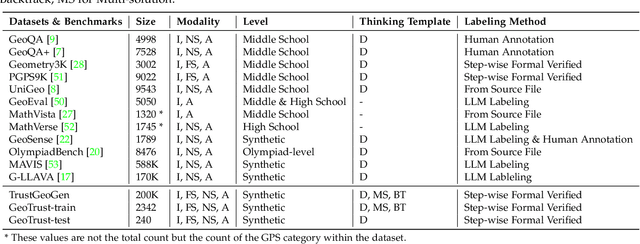
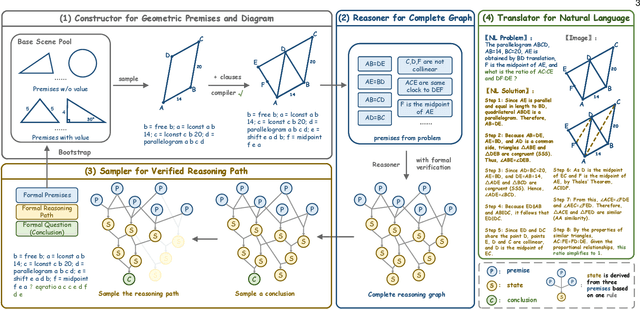
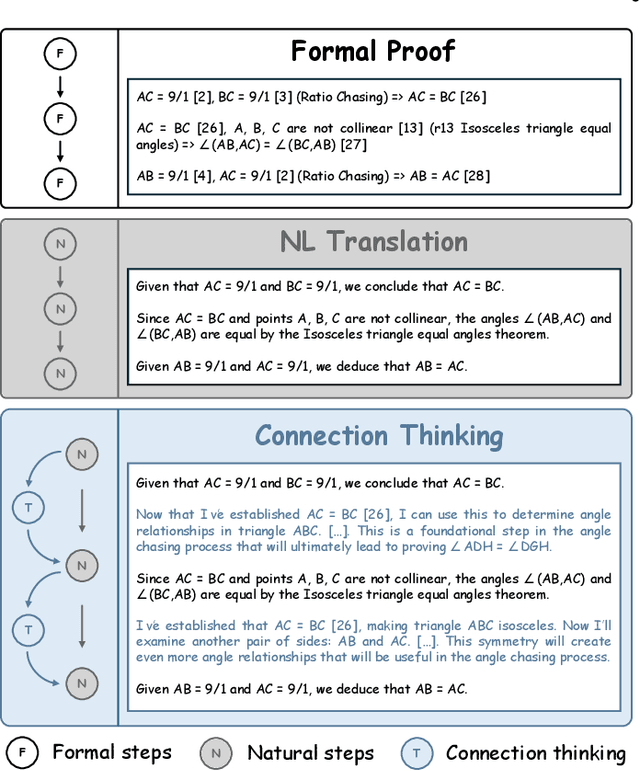
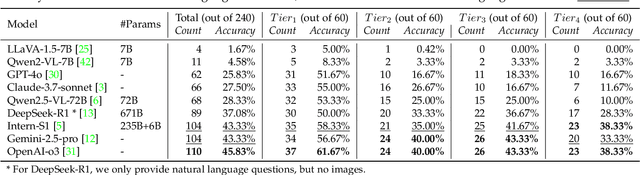
Mathematical geometric problem solving (GPS) often requires effective integration of multimodal information and verifiable logical coherence. Despite the fast development of large language models in general problem solving, it remains unresolved regarding with both methodology and benchmarks, especially given the fact that exiting synthetic GPS benchmarks are often not self-verified and contain noise and self-contradicted information due to the illusion of LLMs. In this paper, we propose a scalable data engine called TrustGeoGen for problem generation, with formal verification to provide a principled benchmark, which we believe lays the foundation for the further development of methods for GPS. The engine synthesizes geometric data through four key innovations: 1) multimodal-aligned generation of diagrams, textual descriptions, and stepwise solutions; 2) formal verification ensuring rule-compliant reasoning paths; 3) a bootstrapping mechanism enabling complexity escalation via recursive state generation and 4) our devised GeoExplore series algorithms simultaneously produce multi-solution variants and self-reflective backtracking traces. By formal logical verification, TrustGeoGen produces GeoTrust-200K dataset with guaranteed modality integrity, along with GeoTrust-test testset. Experiments reveal the state-of-the-art models achieve only 49.17\% accuracy on GeoTrust-test, demonstrating its evaluation stringency. Crucially, models trained on GeoTrust achieve OOD generalization on GeoQA, significantly reducing logical inconsistencies relative to pseudo-label annotated by OpenAI-o1. Our code is available at https://github.com/Alpha-Innovator/TrustGeoGen
Stochastic Gradient Descent in Non-Convex Problems: Asymptotic Convergence with Relaxed Step-Size via Stopping Time Methods
Apr 17, 2025Stochastic Gradient Descent (SGD) is widely used in machine learning research. Previous convergence analyses of SGD under the vanishing step-size setting typically require Robbins-Monro conditions. However, in practice, a wider variety of step-size schemes are frequently employed, yet existing convergence results remain limited and often rely on strong assumptions. This paper bridges this gap by introducing a novel analytical framework based on a stopping-time method, enabling asymptotic convergence analysis of SGD under more relaxed step-size conditions and weaker assumptions. In the non-convex setting, we prove the almost sure convergence of SGD iterates for step-sizes $ \{ \epsilon_t \}_{t \geq 1} $ satisfying $\sum_{t=1}^{+\infty} \epsilon_t = +\infty$ and $\sum_{t=1}^{+\infty} \epsilon_t^p < +\infty$ for some $p > 2$. Compared with previous studies, our analysis eliminates the global Lipschitz continuity assumption on the loss function and relaxes the boundedness requirements for higher-order moments of stochastic gradients. Building upon the almost sure convergence results, we further establish $L_2$ convergence. These significantly relaxed assumptions make our theoretical results more general, thereby enhancing their applicability in practical scenarios.
Object Placement for Anything
Apr 16, 2025Object placement aims to determine the appropriate placement (\emph{e.g.}, location and size) of a foreground object when placing it on the background image. Most previous works are limited by small-scale labeled dataset, which hinders the real-world application of object placement. In this work, we devise a semi-supervised framework which can exploit large-scale unlabeled dataset to promote the generalization ability of discriminative object placement models. The discriminative models predict the rationality label for each foreground placement given a foreground-background pair. To better leverage the labeled data, under the semi-supervised framework, we further propose to transfer the knowledge of rationality variation, \emph{i.e.}, whether the change of foreground placement would result in the change of rationality label, from labeled data to unlabeled data. Extensive experiments demonstrate that our framework can effectively enhance the generalization ability of discriminative object placement models.