 Add to Chrome
 Add to Firefox
 Add to Edge
MaS-VQA: A Mask-and-Select Framework for Knowledge-Based Visual Question Answering
Feb 17, 2026
Knowledge-based Visual Question Answering (KB-VQA) requires models to answer questions by integrating visual information with external knowledge. However, retrieved knowledge is often noisy, partially irrelevant, or misaligned with the visual content, while internal model knowledge is difficult to control and interpret. Naive aggregation of these sources limits reasoning effectiveness and reduces answer accuracy. To address this, we propose MaS-VQA, a selection-driven framework that tightly couples explicit knowledge filtering with implicit knowledge reasoning. MaS-VQA first retrieves candidate passages and applies a Mask-and-Select mechanism to jointly prune irrelevant image regions and weakly relevant knowledge fragments, producing compact, high-signal multimodal knowledge . This filtered knowledge then guides the activation of internal knowledge in a constrained semantic space, enabling complementary co-modeling of explicit and implicit knowledge for robust answer prediction. Experiments on Encyclopedic-VQA and InfoSeek demonstrate consistent performance gains across multiple MLLM backbones, and ablations verify that the selection mechanism effectively reduces noise and enhances knowledge utilization.

REAL: Resolving Knowledge Conflicts in Knowledge-Intensive Visual Question Answering via Reasoning-Pivot Alignment
Feb 15, 2026Knowledge-intensive Visual Question Answering (KI-VQA) frequently suffers from severe knowledge conflicts caused by the inherent limitations of open-domain retrieval. However, existing paradigms face critical limitations due to the lack of generalizable conflict detection and intra-model constraint mechanisms to handle conflicting evidence. To address these challenges, we propose the REAL (Reasoning-Pivot Alignment) framework centered on the novel concept of the Reasoning-Pivot. Distinct from reasoning steps that prioritize internal self-derivation, a reasoning-pivot serves as an atomic unit (node or edge) in the reasoning chain that emphasizes knowledge linkage, and it typically relies on external evidence to complete the reasoning. Supported by our constructed REAL-VQA dataset, our approach integrates Reasoning-Pivot Aware SFT (RPA-SFT) to train a generalizable discriminator by aligning conflicts with pivot extraction, and employs Reasoning-Pivot Guided Decoding (RPGD), an intra-model decoding strategy that leverages these pivots for targeted conflict mitigation. Extensive experiments across diverse benchmarks demonstrate that REAL significantly enhances discrimination accuracy and achieves state-of-the-art performance, validating the effectiveness of our pivot-driven resolution paradigm.
Doc-CoB: Enhancing Multi-Modal Document Understanding with Visual Chain-of-Boxes Reasoning
May 24, 2025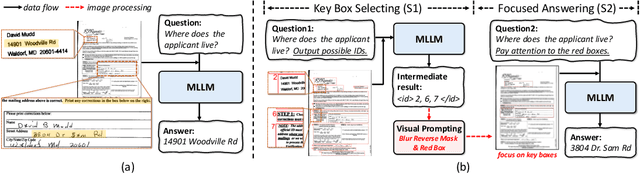
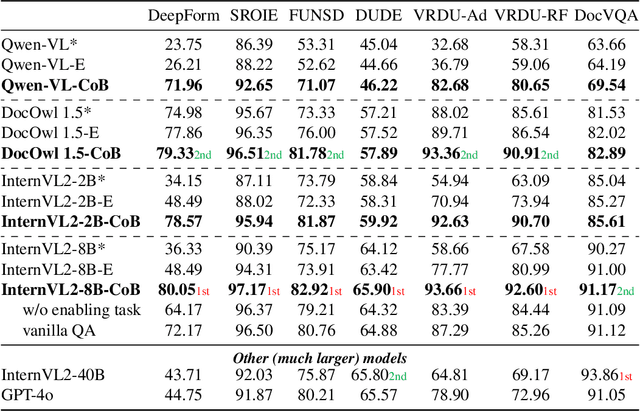
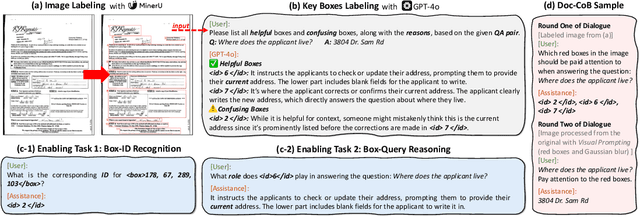

Multimodal large language models (MLLMs) have made significant progress in document understanding. However, the information-dense nature of document images still poses challenges, as most queries depend on only a few relevant regions, with the rest being redundant. Existing one-pass MLLMs process entire document images without considering query relevance, often failing to focus on critical regions and producing unfaithful responses. Inspired by the human coarse-to-fine reading pattern, we introduce Doc-CoB (Chain-of-Box), a simple-yet-effective mechanism that integrates human-style visual reasoning into MLLM without modifying its architecture. Our method allows the model to autonomously select the set of regions (boxes) most relevant to the query, and then focus attention on them for further understanding. We first design a fully automatic pipeline, integrating a commercial MLLM with a layout analyzer, to generate 249k training samples with intermediate visual reasoning supervision. Then we incorporate two enabling tasks that improve box identification and box-query reasoning, which together enhance document understanding. Extensive experiments on seven benchmarks with four popular models show that Doc-CoB significantly improves performance, demonstrating its effectiveness and wide applicability. All code, data, and models will be released publicly.