 Add to Chrome
 Add to Firefox
 Add to Edge
Longhorn: State Space Models are Amortized Online Learners
Jul 19, 2024
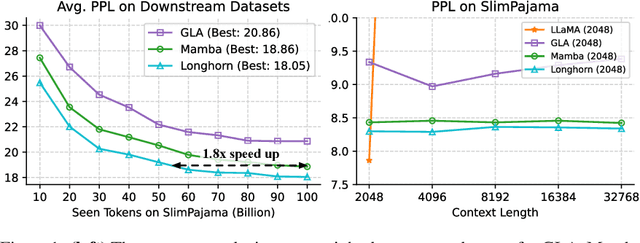
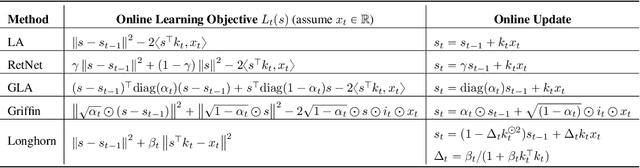
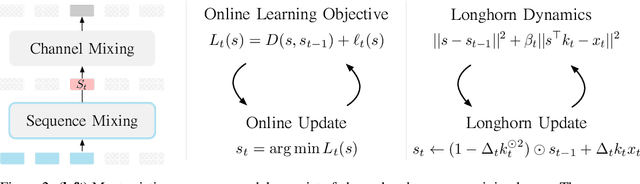

The most fundamental capability of modern AI methods such as Large Language Models (LLMs) is the ability to predict the next token in a long sequence of tokens, known as ``sequence modeling." Although the Transformers model is the current dominant approach to sequence modeling, its quadratic computational cost with respect to sequence length is a significant drawback. State-space models (SSMs) offer a promising alternative due to their linear decoding efficiency and high parallelizability during training. However, existing SSMs often rely on seemingly ad hoc linear recurrence designs. In this work, we explore SSM design through the lens of online learning, conceptualizing SSMs as meta-modules for specific online learning problems. This approach links SSM design to formulating precise online learning objectives, with state transition rules derived from optimizing these objectives. Based on this insight, we introduce a novel deep SSM architecture based on the implicit update for optimizing an online regression objective. Our experimental results show that our models outperform state-of-the-art SSMs, including the Mamba model, on standard sequence modeling benchmarks and language modeling tasks.

Data, Data Everywhere: A Guide for Pretraining Dataset Construction
Jul 08, 2024The impressive capabilities of recent language models can be largely attributed to the multi-trillion token pretraining datasets that they are trained on. However, model developers fail to disclose their construction methodology which has lead to a lack of open information on how to develop effective pretraining sets. To address this issue, we perform the first systematic study across the entire pipeline of pretraining set construction. First, we run ablations on existing techniques for pretraining set development to identify which methods translate to the largest gains in model accuracy on downstream evaluations. Then, we categorize the most widely used data source, web crawl snapshots, across the attributes of toxicity, quality, type of speech, and domain. Finally, we show how such attribute information can be used to further refine and improve the quality of a pretraining set. These findings constitute an actionable set of steps that practitioners can use to develop high quality pretraining sets.
QUEEN: Query Unlearning against Model Extraction
Jul 01, 2024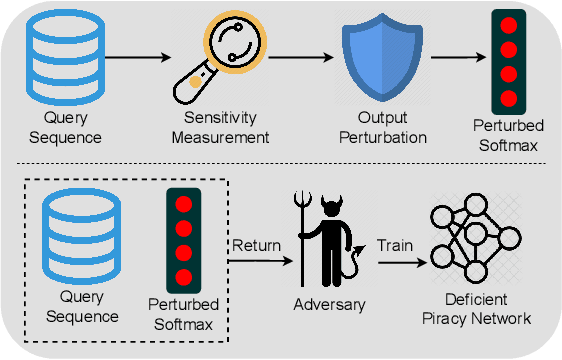
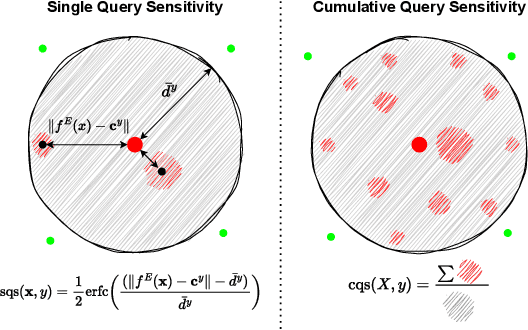
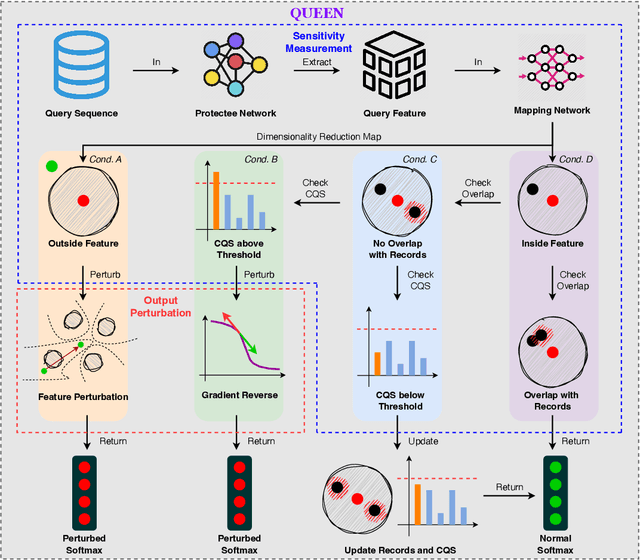
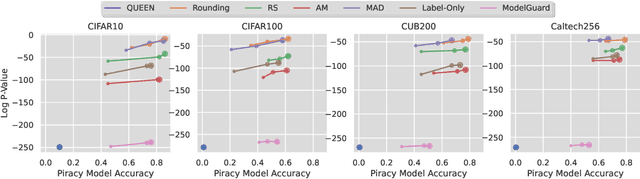
Model extraction attacks currently pose a non-negligible threat to the security and privacy of deep learning models. By querying the model with a small dataset and usingthe query results as the ground-truth labels, an adversary can steal a piracy model with performance comparable to the original model. Two key issues that cause the threat are, on the one hand, accurate and unlimited queries can be obtained by the adversary; on the other hand, the adversary can aggregate the query results to train the model step by step. The existing defenses usually employ model watermarking or fingerprinting to protect the ownership. However, these methods cannot proactively prevent the violation from happening. To mitigate the threat, we propose QUEEN (QUEry unlEarNing) that proactively launches counterattacks on potential model extraction attacks from the very beginning. To limit the potential threat, QUEEN has sensitivity measurement and outputs perturbation that prevents the adversary from training a piracy model with high performance. In sensitivity measurement, QUEEN measures the single query sensitivity by its distance from the center of its cluster in the feature space. To reduce the learning accuracy of attacks, for the highly sensitive query batch, QUEEN applies query unlearning, which is implemented by gradient reverse to perturb the softmax output such that the piracy model will generate reverse gradients to worsen its performance unconsciously. Experiments show that QUEEN outperforms the state-of-the-art defenses against various model extraction attacks with a relatively low cost to the model accuracy. The artifact is publicly available at https://anonymous.4open.science/r/queen implementation-5408/.
MCAD: Multi-modal Conditioned Adversarial Diffusion Model for High-Quality PET Image Reconstruction
Jun 19, 2024Radiation hazards associated with standard-dose positron emission tomography (SPET) images remain a concern, whereas the quality of low-dose PET (LPET) images fails to meet clinical requirements. Therefore, there is great interest in reconstructing SPET images from LPET images. However, prior studies focus solely on image data, neglecting vital complementary information from other modalities, e.g., patients' clinical tabular, resulting in compromised reconstruction with limited diagnostic utility. Moreover, they often overlook the semantic consistency between real SPET and reconstructed images, leading to distorted semantic contexts. To tackle these problems, we propose a novel Multi-modal Conditioned Adversarial Diffusion model (MCAD) to reconstruct SPET images from multi-modal inputs, including LPET images and clinical tabular. Specifically, our MCAD incorporates a Multi-modal conditional Encoder (Mc-Encoder) to extract multi-modal features, followed by a conditional diffusion process to blend noise with multi-modal features and gradually map blended features to the target SPET images. To balance multi-modal inputs, the Mc-Encoder embeds Optimal Multi-modal Transport co-Attention (OMTA) to narrow the heterogeneity gap between image and tabular while capturing their interactions, providing sufficient guidance for reconstruction. In addition, to mitigate semantic distortions, we introduce the Multi-Modal Masked Text Reconstruction (M3TRec), which leverages semantic knowledge extracted from denoised PET images to restore the masked clinical tabular, thereby compelling the network to maintain accurate semantics during reconstruction. To expedite the diffusion process, we further introduce an adversarial diffusive network with a reduced number of diffusion steps. Experiments show that our method achieves the state-of-the-art performance both qualitatively and quantitatively.
H-Fac: Memory-Efficient Optimization with Factorized Hamiltonian Descent
Jun 17, 2024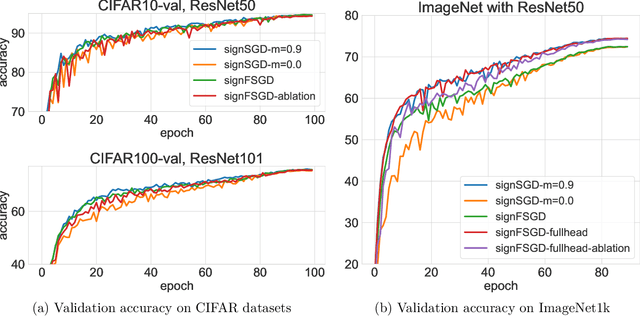
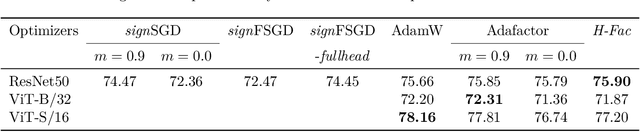
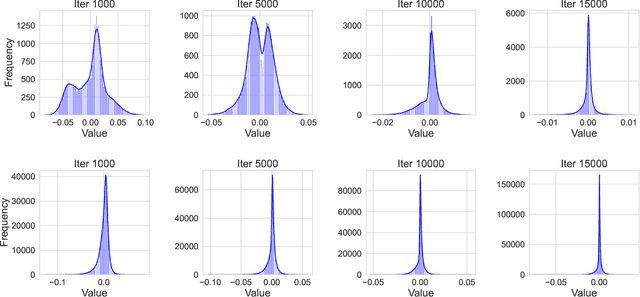
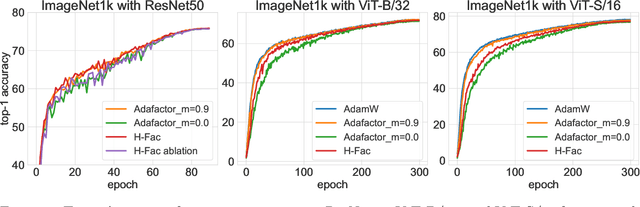
In this study, we introduce a novel adaptive optimizer, H-Fac, which incorporates a factorized approach to momentum and scaling parameters. Our algorithm demonstrates competitive performances on both ResNets and Vision Transformers, while achieving sublinear memory costs through the use of rank-1 parameterizations for moment estimators. We develop our algorithms based on principles derived from Hamiltonian dynamics, providing robust theoretical underpinnings. These optimization algorithms are designed to be both straightforward and adaptable, facilitating easy implementation in diverse settings.
ZeroPur: Succinct Training-Free Adversarial Purification
Jun 05, 2024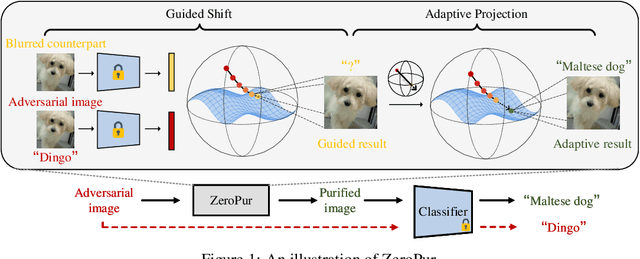
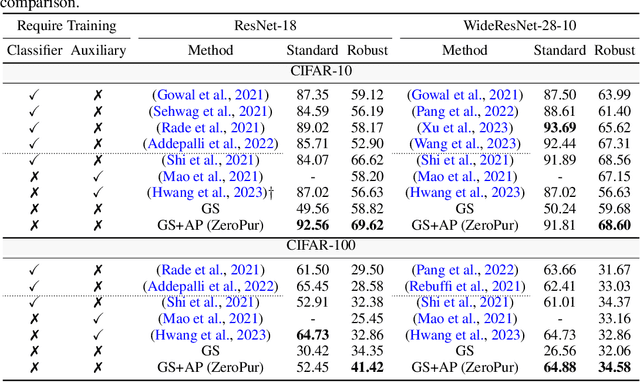
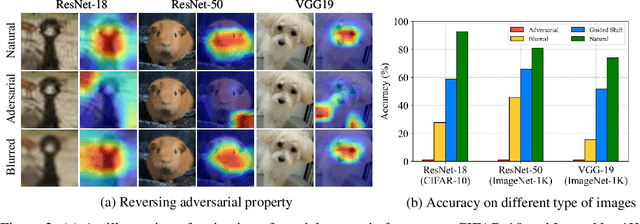

Adversarial purification is a kind of defense technique that can defend various unseen adversarial attacks without modifying the victim classifier. Existing methods often depend on external generative models or cooperation between auxiliary functions and victim classifiers. However, retraining generative models, auxiliary functions, or victim classifiers relies on the domain of the fine-tuned dataset and is computation-consuming. In this work, we suppose that adversarial images are outliers of the natural image manifold and the purification process can be considered as returning them to this manifold. Following this assumption, we present a simple adversarial purification method without further training to purify adversarial images, called ZeroPur. ZeroPur contains two steps: given an adversarial example, Guided Shift obtains the shifted embedding of the adversarial example by the guidance of its blurred counterparts; after that, Adaptive Projection constructs a directional vector by this shifted embedding to provide momentum, projecting adversarial images onto the manifold adaptively. ZeroPur is independent of external models and requires no retraining of victim classifiers or auxiliary functions, relying solely on victim classifiers themselves to achieve purification. Extensive experiments on three datasets (CIFAR-10, CIFAR-100, and ImageNet-1K) using various classifier architectures (ResNet, WideResNet) demonstrate that our method achieves state-of-the-art robust performance. The code will be publicly available.
EasyAnimate: A High-Performance Long Video Generation Method based on Transformer Architecture
May 29, 2024This paper presents EasyAnimate, an advanced method for video generation that leverages the power of transformer architecture for high-performance outcomes. We have expanded the DiT framework originally designed for 2D image synthesis to accommodate the complexities of 3D video generation by incorporating a motion module block. It is used to capture temporal dynamics, thereby ensuring the production of consistent frames and seamless motion transitions. The motion module can be adapted to various DiT baseline methods to generate video with different styles. It can also generate videos with different frame rates and resolutions during both training and inference phases, suitable for both images and videos. Moreover, we introduce slice VAE, a novel approach to condense the temporal axis, facilitating the generation of long duration videos. Currently, EasyAnimate exhibits the proficiency to generate videos with 144 frames. We provide a holistic ecosystem for video production based on DiT, encompassing aspects such as data pre-processing, VAE training, DiT models training (both the baseline model and LoRA model), and end-to-end video inference. Code is available at: https://github.com/aigc-apps/EasyAnimate. We are continuously working to enhance the performance of our method.
DeepSeek-Prover: Advancing Theorem Proving in LLMs through Large-Scale Synthetic Data
May 23, 2024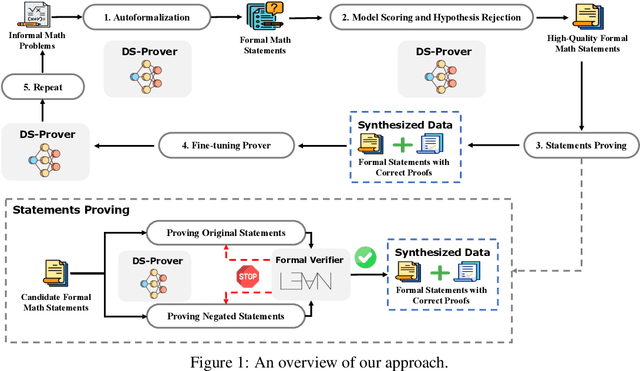
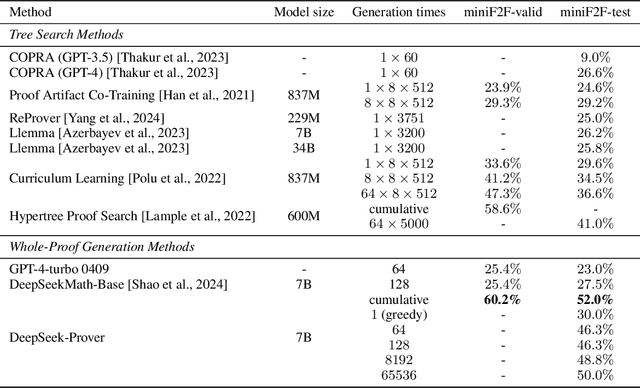


Proof assistants like Lean have revolutionized mathematical proof verification, ensuring high accuracy and reliability. Although large language models (LLMs) show promise in mathematical reasoning, their advancement in formal theorem proving is hindered by a lack of training data. To address this issue, we introduce an approach to generate extensive Lean 4 proof data derived from high-school and undergraduate-level mathematical competition problems. This approach involves translating natural language problems into formal statements, filtering out low-quality statements, and generating proofs to create synthetic data. After fine-tuning the DeepSeekMath 7B model on this synthetic dataset, which comprises 8 million formal statements with proofs, our model achieved whole-proof generation accuracies of 46.3% with 64 samples and 52% cumulatively on the Lean 4 miniF2F test, surpassing the baseline GPT-4 at 23.0% with 64 samples and a tree search reinforcement learning method at 41.0%. Additionally, our model successfully proved 5 out of 148 problems in the Lean 4 Formalized International Mathematical Olympiad (FIMO) benchmark, while GPT-4 failed to prove any. These results demonstrate the potential of leveraging large-scale synthetic data to enhance theorem-proving capabilities in LLMs. Both the synthetic dataset and the model will be made available to facilitate further research in this promising field.
3DSS-Mamba: 3D-Spectral-Spatial Mamba for Hyperspectral Image Classification
May 21, 2024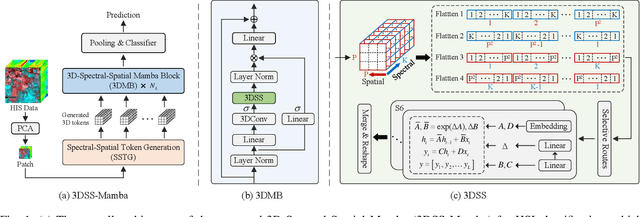
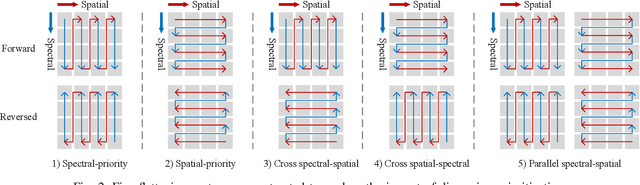
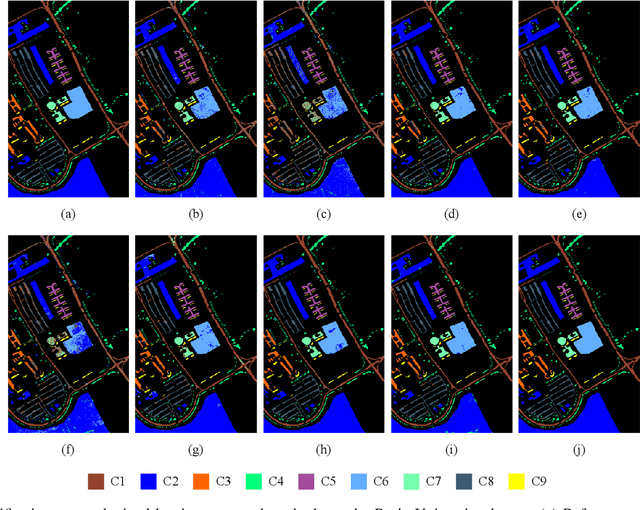
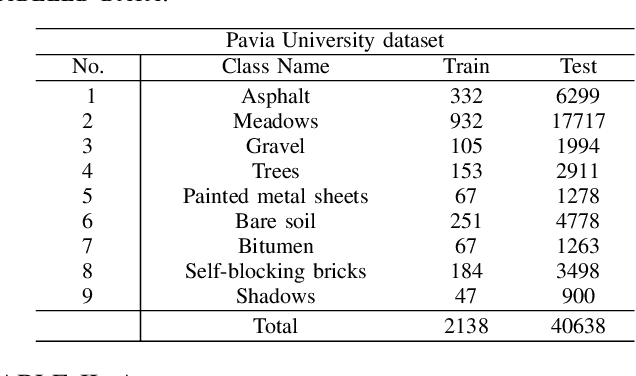
Hyperspectral image (HSI) classification constitutes the fundamental research in remote sensing fields. Convolutional Neural Networks (CNNs) and Transformers have demonstrated impressive capability in capturing spectral-spatial contextual dependencies. However, these architectures suffer from limited receptive fields and quadratic computational complexity, respectively. Fortunately, recent Mamba architectures built upon the State Space Model integrate the advantages of long-range sequence modeling and linear computational efficiency, exhibiting substantial potential in low-dimensional scenarios. Motivated by this, we propose a novel 3D-Spectral-Spatial Mamba (3DSS-Mamba) framework for HSI classification, allowing for global spectral-spatial relationship modeling with greater computational efficiency. Technically, a spectral-spatial token generation (SSTG) module is designed to convert the HSI cube into a set of 3D spectral-spatial tokens. To overcome the limitations of traditional Mamba, which is confined to modeling causal sequences and inadaptable to high-dimensional scenarios, a 3D-Spectral-Spatial Selective Scanning (3DSS) mechanism is introduced, which performs pixel-wise selective scanning on 3D hyperspectral tokens along the spectral and spatial dimensions. Five scanning routes are constructed to investigate the impact of dimension prioritization. The 3DSS scanning mechanism combined with conventional mapping operations forms the 3D-spectral-spatial mamba block (3DMB), enabling the extraction of global spectral-spatial semantic representations. Experimental results and analysis demonstrate that the proposed method outperforms the state-of-the-art methods on HSI classification benchmarks.
Context-Enhanced Video Moment Retrieval with Large Language Models
May 21, 2024Current methods for Video Moment Retrieval (VMR) struggle to align complex situations involving specific environmental details, character descriptions, and action narratives. To tackle this issue, we propose a Large Language Model-guided Moment Retrieval (LMR) approach that employs the extensive knowledge of Large Language Models (LLMs) to improve video context representation as well as cross-modal alignment, facilitating accurate localization of target moments. Specifically, LMR introduces a context enhancement technique with LLMs to generate crucial target-related context semantics. These semantics are integrated with visual features for producing discriminative video representations. Finally, a language-conditioned transformer is designed to decode free-form language queries, on the fly, using aligned video representations for moment retrieval. Extensive experiments demonstrate that LMR achieves state-of-the-art results, outperforming the nearest competitor by up to 3.28\% and 4.06\% on the challenging QVHighlights and Charades-STA benchmarks, respectively. More importantly, the performance gains are significantly higher for localization of complex queries.