 Add to Chrome
 Add to Firefox
 Add to Edge
CSC: Turning the Adversary's Poison against Itself
Apr 23, 2026
Poisoning-based backdoor attacks pose significant threats to deep neural networks by embedding triggers in training data, causing models to misclassify triggered inputs as adversary-specified labels while maintaining performance on clean data. Existing poison restraint-based defenses often suffer from inadequate detection against specific attack variants and compromise model utility through unlearning methods that lead to accuracy degradation. This paper conducts a comprehensive analysis of backdoor attack dynamics during model training, revealing that poisoned samples form isolated clusters in latent space early on, with triggers acting as dominant features distinct from benign ones. Leveraging these insights, we propose Cluster Segregation Concealment (CSC), a novel poison suppression defense. CSC first trains a deep neural network via standard supervised learning while segregating poisoned samples through feature extraction from early epochs, DBSCAN clustering, and identification of anomalous clusters based on class diversity and density metrics. In the concealment stage, identified poisoned samples are relabeled to a virtual class, and the model's classifier is fine-tuned using cross-entropy loss to replace the backdoor association with a benign virtual linkage, preserving overall accuracy. CSC was evaluated on four benchmark datasets against twelve poisoning-based attacks, CSC outperforms nine state-of-the-art defenses by reducing average attack success rates to near zero with minimal clean accuracy loss. Contributions include robust backdoor patterns identification, an effective concealment mechanism, and superior empirical validation, advancing trustworthy artificial intelligence.

Osmosis Distillation: Model Hijacking with the Fewest Samples
Mar 05, 2026Transfer learning is devised to leverage knowledge from pre-trained models to solve new tasks with limited data and computational resources. Meanwhile, dataset distillation has emerged to synthesize a compact dataset that preserves critical information from the original large dataset. Therefore, a combination of transfer learning and dataset distillation offers promising performance in evaluations. However, a non-negligible security threat remains undiscovered in transfer learning using synthetic datasets generated by dataset distillation methods, where an adversary can perform a model hijacking attack with only a few poisoned samples in the synthetic dataset. To reveal this threat, we propose Osmosis Distillation (OD) attack, a novel model hijacking strategy that targets deep learning models using the fewest samples. Comprehensive evaluations on various datasets demonstrate that the OD attack attains high attack success rates in hidden tasks while preserving high model utility in original tasks. Furthermore, the distilled osmosis set enables model hijacking across diverse model architectures, allowing model hijacking in transfer learning with considerable attack performance and model utility. We argue that awareness of using third-party synthetic datasets in transfer learning must be raised.
From Spark to Fire: Modeling and Mitigating Error Cascades in LLM-Based Multi-Agent Collaboration
Mar 04, 2026Large Language Model-based Multi-Agent Systems (LLM-MAS) are increasingly applied to complex collaborative scenarios. However, their collaborative mechanisms may cause minor inaccuracies to gradually solidify into system-level false consensus through iteration. Such risks are difficult to trace since errors can propagate and amplify through message dependencies. Existing protections often rely on single-agent validation or require modifications to the collaboration architecture, which can weaken effective information flow and may not align with natural collaboration processes in real tasks. To address this, we propose a propagation dynamics model tailored for LLM-MAS that abstracts collaboration as a directed dependency graph and provides an early-stage risk criterion to characterize amplification risk. Through experiments on six mainstream frameworks, we identify three vulnerability classes: cascade amplification, topological sensitivity, and consensus inertia. We further instantiate an attack where injecting just a single atomic error seed leads to widespread failure. In response, we introduce a genealogy-graph-based governance layer, implemented as a message-layer plugin, that suppresses both endogenous and exogenous error amplification without altering the collaboration architecture. Experiments show that this approach raises the defense success rate from a baseline of 0.32 to over 0.89 and significantly mitigates the cascading spread of minor errors.
Turning Black Box into White Box: Dataset Distillation Leaks
Mar 01, 2026Dataset distillation compresses a large real dataset into a small synthetic one, enabling models trained on the synthetic data to achieve performance comparable to those trained on the real data. Although synthetic datasets are assumed to be privacy-preserving, we show that existing distillation methods can cause severe privacy leakage because synthetic datasets implicitly encode the weight trajectories of the distilled model, they become over-informative and exploitable by adversaries. To expose this risk, we introduce the Information Revelation Attack (IRA) against state-of-the-art distillation techniques. Experiments show that IRA accurately predicts both the distillation algorithm and model architecture, and can successfully infer membership and recover sensitive samples from the real dataset.
Hide&Seek: Remove Image Watermarks with Negligible Cost via Pixel-wise Reconstruction
Mar 01, 2026Watermarking has emerged as a key defense against the misuse of machine-generated images (MGIs). Yet the robustness of these protections remains underexplored. To reveal the limits of SOTA proactive image watermarking defenses, we propose HIDE&SEEK (HS), a suite of versatile and cost-effective attacks that reliably remove embedded watermarks while preserving high visual fidelity.
DINO-Detect: A Simple yet Effective Framework for Blur-Robust AI-Generated Image Detection
Nov 18, 2025With growing concerns over image authenticity and digital safety, the field of AI-generated image (AIGI) detection has progressed rapidly. Yet, most AIGI detectors still struggle under real-world degradations, particularly motion blur, which frequently occurs in handheld photography, fast motion, and compressed video. Such blur distorts fine textures and suppresses high-frequency artifacts, causing severe performance drops in real-world settings. We address this limitation with a blur-robust AIGI detection framework based on teacher-student knowledge distillation. A high-capacity teacher (DINOv3), trained on clean (i.e., sharp) images, provides stable and semantically rich representations that serve as a reference for learning. By freezing the teacher to maintain its generalization ability, we distill its feature and logit responses from sharp images to a student trained on blurred counterparts, enabling the student to produce consistent representations under motion degradation. Extensive experiments benchmarks show that our method achieves state-of-the-art performance under both motion-blurred and clean conditions, demonstrating improved generalization and real-world applicability. Source codes will be released at: https://github.com/JiaLiangShen/Dino-Detect-for-blur-robust-AIGC-Detection.
QUEEN: Query Unlearning against Model Extraction
Jul 01, 2024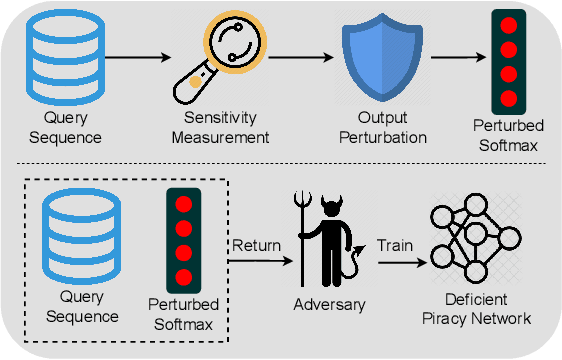
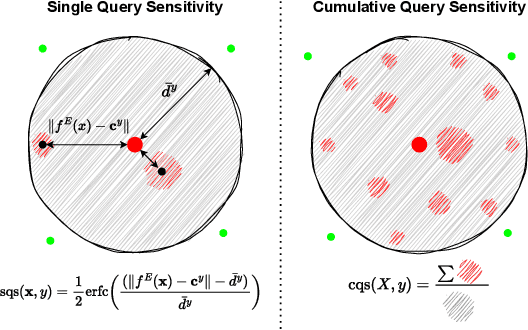
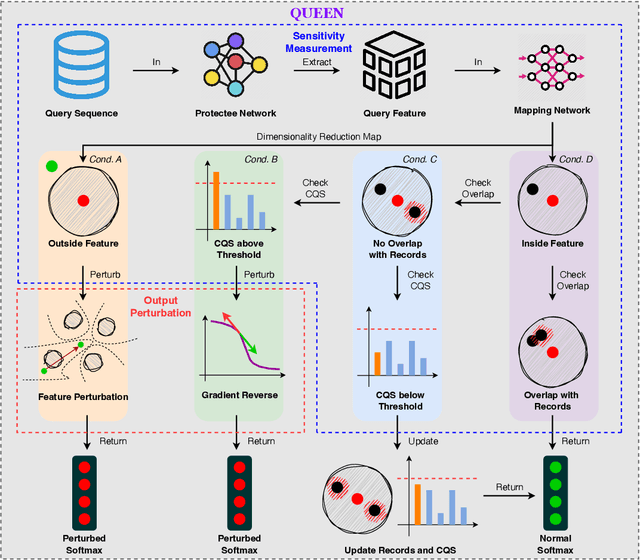
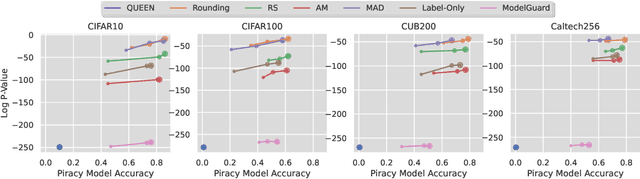
Model extraction attacks currently pose a non-negligible threat to the security and privacy of deep learning models. By querying the model with a small dataset and usingthe query results as the ground-truth labels, an adversary can steal a piracy model with performance comparable to the original model. Two key issues that cause the threat are, on the one hand, accurate and unlimited queries can be obtained by the adversary; on the other hand, the adversary can aggregate the query results to train the model step by step. The existing defenses usually employ model watermarking or fingerprinting to protect the ownership. However, these methods cannot proactively prevent the violation from happening. To mitigate the threat, we propose QUEEN (QUEry unlEarNing) that proactively launches counterattacks on potential model extraction attacks from the very beginning. To limit the potential threat, QUEEN has sensitivity measurement and outputs perturbation that prevents the adversary from training a piracy model with high performance. In sensitivity measurement, QUEEN measures the single query sensitivity by its distance from the center of its cluster in the feature space. To reduce the learning accuracy of attacks, for the highly sensitive query batch, QUEEN applies query unlearning, which is implemented by gradient reverse to perturb the softmax output such that the piracy model will generate reverse gradients to worsen its performance unconsciously. Experiments show that QUEEN outperforms the state-of-the-art defenses against various model extraction attacks with a relatively low cost to the model accuracy. The artifact is publicly available at https://anonymous.4open.science/r/queen implementation-5408/.
Equivariant Matrix Function Neural Networks
Oct 16, 2023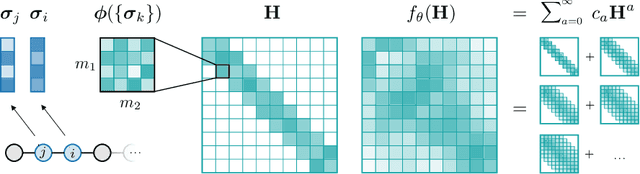

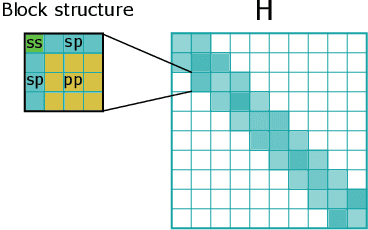

Graph Neural Networks (GNNs), especially message-passing neural networks (MPNNs), have emerged as powerful architectures for learning on graphs in diverse applications. However, MPNNs face challenges when modeling non-local interactions in systems such as large conjugated molecules, metals, or amorphous materials. Although Spectral GNNs and traditional neural networks such as recurrent neural networks and transformers mitigate these challenges, they often lack extensivity, adaptability, generalizability, computational efficiency, or fail to capture detailed structural relationships or symmetries in the data. To address these concerns, we introduce Matrix Function Neural Networks (MFNs), a novel architecture that parameterizes non-local interactions through analytic matrix equivariant functions. Employing resolvent expansions offers a straightforward implementation and the potential for linear scaling with system size. The MFN architecture achieves state-of-the-art performance in standard graph benchmarks, such as the ZINC and TU datasets, and is able to capture intricate non-local interactions in quantum systems, paving the way to new state-of-the-art force fields.
Low-frequency Image Deep Steganography: Manipulate the Frequency Distribution to Hide Secrets with Tenacious Robustness
Mar 23, 2023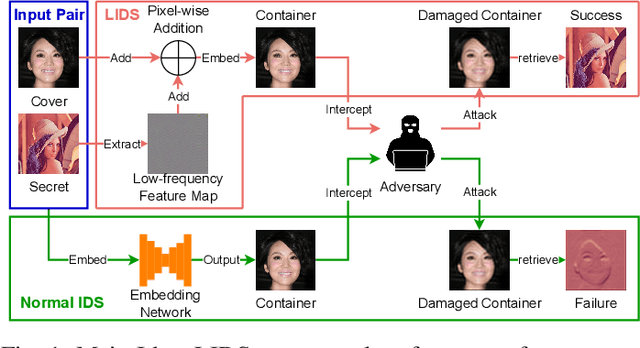
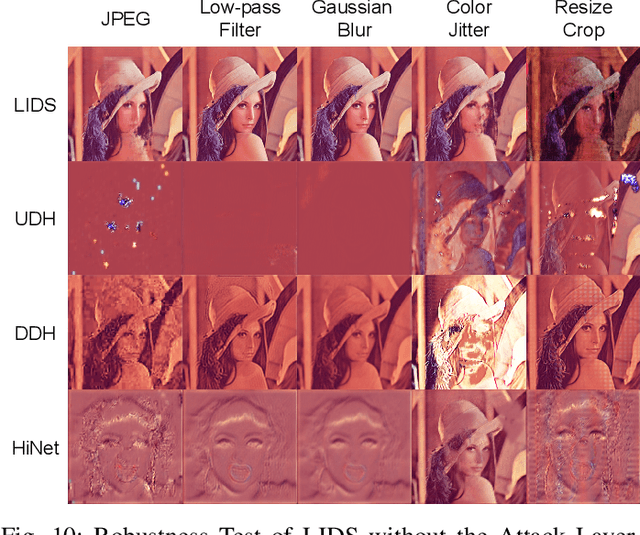


Image deep steganography (IDS) is a technique that utilizes deep learning to embed a secret image invisibly into a cover image to generate a container image. However, the container images generated by convolutional neural networks (CNNs) are vulnerable to attacks that distort their high-frequency components. To address this problem, we propose a novel method called Low-frequency Image Deep Steganography (LIDS) that allows frequency distribution manipulation in the embedding process. LIDS extracts a feature map from the secret image and adds it to the cover image to yield the container image. The container image is not directly output by the CNNs, and thus, it does not contain high-frequency artifacts. The extracted feature map is regulated by a frequency loss to ensure that its frequency distribution mainly concentrates on the low-frequency domain. To further enhance robustness, an attack layer is inserted to damage the container image. The retrieval network then retrieves a recovered secret image from a damaged container image. Our experiments demonstrate that LIDS outperforms state-of-the-art methods in terms of robustness, while maintaining high fidelity and specificity. By avoiding high-frequency artifacts and manipulating the frequency distribution of the embedded feature map, LIDS achieves improved robustness against attacks that distort the high-frequency components of container images.
Provable Convergence of Variational Monte Carlo Methods
Mar 19, 2023
The Variational Monte Carlo (VMC) is a promising approach for computing the ground state energy of many-body quantum problems and attracts more and more interests due to the development of machine learning. The recent paradigms in VMC construct neural networks as trial wave functions, sample quantum configurations using Markov chain Monte Carlo (MCMC) and train neural networks with stochastic gradient descent (SGD) method. However, the theoretical convergence of VMC is still unknown when SGD interacts with MCMC sampling given a well-designed trial wave function. Since MCMC reduces the difficulty of estimating gradients, it has inevitable bias in practice. Moreover, the local energy may be unbounded, which makes it harder to analyze the error of MCMC sampling. Therefore, we assume that the local energy is sub-exponential and use the Bernstein inequality for non-stationary Markov chains to derive error bounds of the MCMC estimator. Consequently, VMC is proven to have a first order convergence rate $O(\log K/\sqrt{n K})$ with $K$ iterations and a sample size $n$. It partially explains how MCMC influences the behavior of SGD. Furthermore, we verify the so-called correlated negative curvature condition and relate it to the zero-variance phenomena in solving eigenvalue functions. It is shown that VMC escapes from saddle points and reaches $(\epsilon,\epsilon^{1/4})$ -approximate second order stationary points or $\epsilon^{1/2}$-variance points in at least $O(\epsilon^{-11/2}\log^{2}(1/\epsilon) )$ steps with high probability. Our analysis enriches the understanding of how VMC converges efficiently and can be applied to general variational methods in physics and statistics.