 Add to Chrome
 Add to Firefox
 Add to Edge
EvoRubric: Self-Evolving Rubric-Driven RL for Open-Ended Generation
May 28, 2026
Reinforcement Learning (RL) has significantly advanced Large Language Models (LLMs) in verifiable domains, but aligning models for open-ended generation remains profoundly challenging due to the lack of definitive rewards. Current rubric-based RL methods mitigate this by employing explicit criteria; however, they rely heavily on static, human-annotated rubrics that inevitably cause policy lag, or expensive external proprietary models for dynamic updates. In this paper, we propose EvoRubric, a novel single-policy co-evolutionary RL framework that eliminates the reliance on static criteria and on external rubric generators. By unifying response generation and rubric generation under a single parameterized policy, EvoRubric dynamically alternates between a Reasoner and a Rubric Generator. To prevent reward hacking and ensure the reliability of generated signals, we introduce a multi-level verification pipeline featuring a meta-verifier, zero-variance pruning, and a Leave-One-Out peer consensus mechanism. Validated criteria are dynamically archived into a memory pool, yielding dense, multi-objective rewards to continuously co-optimize both roles. Extensive experiments across Medical, Writing, and Science domains demonstrate that EvoRubric consistently outperforms traditional static and external-LLM-driven alignment methods. Notably, our framework is compatible with human-expert priors. When initialized with expert-annotated rubrics, EvoRubric can further uncover novel, discriminative dimensions, achieving better performance than relying solely on static expert annotations.

ViewSAM: Learning View-aware Cross-modal Semantics for Weakly Supervised Cross-view Referring Multi-Object Tracking
May 04, 2026Cross-view Referring Multi-Object Tracking (CRMOT) aims to track multiple objects specified by natural language across multiple camera views, with globally consistent identities. Despite recent progress, existing methods rely heavily on costly frame-level spatial annotations and cross-view identity supervision. To reduce such reliance, we explore CRMOT under weak supervision by leveraging the capabilities of foundation models. However, our empirical study shows that directly applying foundation models such as SAM2 and SAM3, even with task-specific modifications, fails to accurately understand referring expressions and maintain consistent identities across views. Yet, they remain effective at producing reliable object tracklets that can serve as pseudo supervision. We therefore repurpose foundation models as pseudo-label generators and propose a two-stage framework for weakly supervised CRMOT, using only object category labels as coarse-grained supervision. In the first stage, we design an Affinity-guided Cross-view Re-prompting strategy to refine and associate SAM3-generated tracklets across cameras, producing reliable cross-view pseudo labels for subsequent training. In the second stage, we introduce ViewSAM, a CRMOT model built upon SAM2 that explicitly models view-aware cross-modal semantics. By formulating view-induced variations as learnable conditions, ViewSAM bridges the gap between view-variant visual observations and view-invariant textual expressions, enabling robust cross-view referring tracking with only approximately 10% additional parameters. Extensive experiments demonstrate that ViewSAM achieves SOTA performance under weak supervision and remains competitive with fully supervised methods.
Beyond Compliance: A Resistance-Informed Motivation Reasoning Framework for Challenging Psychological Client Simulation
Apr 12, 2026Psychological client simulators have emerged as a scalable solution for training and evaluating counselor trainees and psychological LLMs. Yet existing simulators exhibit unrealistic over-compliance, leaving counselors underprepared for the challenging behaviors common in real-world practice. To bridge this gap, we present ResistClient, which systematically models challenging client behaviors grounded in Client Resistance Theory by integrating external behaviors with underlying motivational mechanisms. To this end, we propose Resistance-Informed Motivation Reasoning (RIMR), a two-stage training framework. First, RIMR mitigates compliance bias via supervised fine-tuning on RPC, a large-scale resistance-oriented psychological conversation dataset covering diverse client profiles. Second, beyond surface-level response imitation, RIMR models psychologically coherent motivation reasoning before response generation, jointly optimizing motivation authenticity and response consistency via process-supervised reinforcement learning. Extensive automatic and expert evaluations show that ResistClient substantially outperforms existing simulators in challenge fidelity, behavioral plausibility, and reasoning coherence. Moreover, ResistClient facilities evaluation of psychological LLMs under challenging conditions, offering new optimization directions for mental health dialogue systems.
DyTopo: Dynamic Topology Routing for Multi-Agent Reasoning via Semantic Matching
Feb 05, 2026Multi-agent systems built from prompted large language models can improve multi-round reasoning, yet most existing pipelines rely on fixed, trajectory-wide communication patterns that are poorly matched to the stage-dependent needs of iterative problem solving. We introduce DyTopo, a manager-guided multi-agent framework that reconstructs a sparse directed communication graph at each round. Conditioned on the manager's round goal, each agent outputs lightweight natural-language query (need) and \key (offer) descriptors; DyTopo embeds these descriptors and performs semantic matching, routing private messages only along the induced edges. Across code generation and mathematical reasoning benchmarks and four LLM backbones, DyTopo consistently outperforms over the strongest baseline (avg. +6.2). Beyond accuracy, DyTopo yields an interpretable coordination trace via the evolving graphs, enabling qualitative inspection of how communication pathways reconfigure across rounds.
Evidence-Augmented Policy Optimization with Reward Co-Evolution for Long-Context Reasoning
Jan 15, 2026While Reinforcement Learning (RL) has advanced LLM reasoning, applying it to long-context scenarios is hindered by sparsity of outcome rewards. This limitation fails to penalize ungrounded "lucky guesses," leaving the critical process of needle-in-a-haystack evidence retrieval largely unsupervised. To address this, we propose EAPO (Evidence-Augmented Policy Optimization). We first establish the Evidence-Augmented Reasoning paradigm, validating via Tree-Structured Evidence Sampling that precise evidence extraction is the decisive bottleneck for long-context reasoning. Guided by this insight, EAPO introduces a specialized RL algorithm where a reward model computes a Group-Relative Evidence Reward, providing dense process supervision to explicitly improve evidence quality. To sustain accurate supervision throughout training, we further incorporate an Adaptive Reward-Policy Co-Evolution mechanism. This mechanism iteratively refines the reward model using outcome-consistent rollouts, sharpening its discriminative capability to ensure precise process guidance. Comprehensive evaluations across eight benchmarks demonstrate that EAPO significantly enhances long-context reasoning performance compared to SOTA baselines.
D^3ETOR: Debate-Enhanced Pseudo Labeling and Frequency-Aware Progressive Debiasing for Weakly-Supervised Camouflaged Object Detection with Scribble Annotations
Jan 06, 2026Weakly-Supervised Camouflaged Object Detection (WSCOD) aims to locate and segment objects that are visually concealed within their surrounding scenes, relying solely on sparse supervision such as scribble annotations. Despite recent progress, existing WSCOD methods still lag far behind fully supervised ones due to two major limitations: (1) the pseudo masks generated by general-purpose segmentation models (e.g., SAM) and filtered via rules are often unreliable, as these models lack the task-specific semantic understanding required for effective pseudo labeling in COD; and (2) the neglect of inherent annotation bias in scribbles, which hinders the model from capturing the global structure of camouflaged objects. To overcome these challenges, we propose ${D}^{3}$ETOR, a two-stage WSCOD framework consisting of Debate-Enhanced Pseudo Labeling and Frequency-Aware Progressive Debiasing. In the first stage, we introduce an adaptive entropy-driven point sampling method and a multi-agent debate mechanism to enhance the capability of SAM for COD, improving the interpretability and precision of pseudo masks. In the second stage, we design FADeNet, which progressively fuses multi-level frequency-aware features to balance global semantic understanding with local detail modeling, while dynamically reweighting supervision strength across regions to alleviate scribble bias. By jointly exploiting the supervision signals from both the pseudo masks and scribble semantics, ${D}^{3}$ETOR significantly narrows the gap between weakly and fully supervised COD, achieving state-of-the-art performance on multiple benchmarks.
${D}^{3}${ETOR}: ${D}$ebate-Enhanced Pseudo Labeling and Frequency-Aware Progressive ${D}$ebiasing for Weakly-Supervised Camouflaged Object ${D}$etection with Scribble Annotations
Dec 23, 2025Weakly-Supervised Camouflaged Object Detection (WSCOD) aims to locate and segment objects that are visually concealed within their surrounding scenes, relying solely on sparse supervision such as scribble annotations. Despite recent progress, existing WSCOD methods still lag far behind fully supervised ones due to two major limitations: (1) the pseudo masks generated by general-purpose segmentation models (e.g., SAM) and filtered via rules are often unreliable, as these models lack the task-specific semantic understanding required for effective pseudo labeling in COD; and (2) the neglect of inherent annotation bias in scribbles, which hinders the model from capturing the global structure of camouflaged objects. To overcome these challenges, we propose ${D}^{3}$ETOR, a two-stage WSCOD framework consisting of Debate-Enhanced Pseudo Labeling and Frequency-Aware Progressive Debiasing. In the first stage, we introduce an adaptive entropy-driven point sampling method and a multi-agent debate mechanism to enhance the capability of SAM for COD, improving the interpretability and precision of pseudo masks. In the second stage, we design FADeNet, which progressively fuses multi-level frequency-aware features to balance global semantic understanding with local detail modeling, while dynamically reweighting supervision strength across regions to alleviate scribble bias. By jointly exploiting the supervision signals from both the pseudo masks and scribble semantics, ${D}^{3}$ETOR significantly narrows the gap between weakly and fully supervised COD, achieving state-of-the-art performance on multiple benchmarks.
MaskSearch: A Universal Pre-Training Framework to Enhance Agentic Search Capability
May 27, 2025Retrieval-Augmented Language Models (RALMs) represent a classic paradigm where models enhance generative capabilities using external knowledge retrieved via a specialized module. Recent advancements in Agent techniques enable Large Language Models (LLMs) to autonomously utilize tools for retrieval, planning, and reasoning. While existing training-based methods show promise, their agentic abilities are limited by inherent characteristics of the task-specific data used during training. To further enhance the universal search capability of agents, we propose a novel pre-training framework, MaskSearch. In the pre-training stage, we introduce the Retrieval Augmented Mask Prediction (RAMP) task, where the model learns to leverage search tools to fill masked spans on a large number of pre-training data, thus acquiring universal retrieval and reasoning capabilities for LLMs. After that, the model is trained on downstream tasks to achieve further improvement. We apply both Supervised Fine-tuning (SFT) and Reinforcement Learning (RL) for training. For SFT, we combine agent-based and distillation-based methods to generate training data, starting with a multi-agent system consisting of a planner, rewriter, observer, and followed by a self-evolving teacher model. While for RL, we employ DAPO as the training framework and adopt a hybrid reward system consisting of answer rewards and format rewards. Additionally, we introduce a curriculum learning approach that allows the model to learn progressively from easier to more challenging instances based on the number of masked spans. We evaluate the effectiveness of our framework in the scenario of open-domain multi-hop question answering. Through extensive experiments, we demonstrate that MaskSearch significantly enhances the performance of LLM-based search agents on both in-domain and out-of-domain downstream tasks.
External Reliable Information-enhanced Multimodal Contrastive Learning for Fake News Detection
Mar 05, 2025With the rapid development of the Internet, the information dissemination paradigm has changed and the efficiency has been improved greatly. While this also brings the quick spread of fake news and leads to negative impacts on cyberspace. Currently, the information presentation formats have evolved gradually, with the news formats shifting from texts to multimodal contents. As a result, detecting multimodal fake news has become one of the research hotspots. However, multimodal fake news detection research field still faces two main challenges: the inability to fully and effectively utilize multimodal information for detection, and the low credibility or static nature of the introduced external information, which limits dynamic updates. To bridge the gaps, we propose ERIC-FND, an external reliable information-enhanced multimodal contrastive learning framework for fake news detection. ERIC-FND strengthens the representation of news contents by entity-enriched external information enhancement method. It also enriches the multimodal news information via multimodal semantic interaction method where the multimodal constrative learning is employed to make different modality representations learn from each other. Moreover, an adaptive fusion method is taken to integrate the news representations from different dimensions for the eventual classification. Experiments are done on two commonly used datasets in different languages, X (Twitter) and Weibo. Experiment results demonstrate that our proposed model ERIC-FND outperforms existing state-of-the-art fake news detection methods under the same settings.
Positive Text Reframing under Multi-strategy Optimization
Jul 27, 2024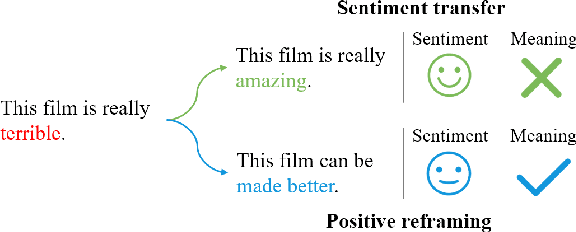
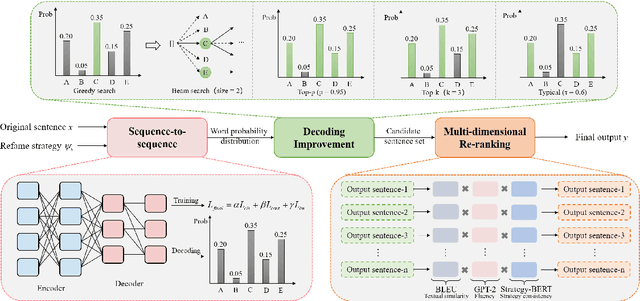
Differing from sentiment transfer, positive reframing seeks to substitute negative perspectives with positive expressions while preserving the original meaning. With the emergence of pre-trained language models (PLMs), it is possible to achieve acceptable results by fine-tuning PLMs. Nevertheless, generating fluent, diverse and task-constrained reframing text remains a significant challenge. To tackle this issue, a \textbf{m}ulti-\textbf{s}trategy \textbf{o}ptimization \textbf{f}ramework (MSOF) is proposed in this paper. Starting from the objective of positive reframing, we first design positive sentiment reward and content preservation reward to encourage the model to transform the negative expressions of the original text while ensuring the integrity and consistency of the semantics. Then, different decoding optimization approaches are introduced to improve the quality of text generation. Finally, based on the modeling formula of positive reframing, we propose a multi-dimensional re-ranking method that further selects candidate sentences from three dimensions: strategy consistency, text similarity and fluency. Extensive experiments on two Seq2Seq PLMs, BART and T5, demonstrate our framework achieves significant improvements on unconstrained and controlled positive reframing tasks.