 Add to Chrome
 Add to Firefox
 Add to Edge
Cosmos 3: Omnimodal World Models for Physical AI
Jun 01, 2026
We introduce Cosmos 3, a family of omnimodal world models designed to jointly process and generate language, image, video, audio, and action sequences within a unified mixture-of-transformers architecture. By supporting highly flexible input-output configurations, Cosmos 3 seamlessly unifies critical modalities for Physical AI -- effectively subsuming vision-language models, video generators, world simulators, and world-action models into a single framework. Our evaluation demonstrates that Cosmos 3 establishes a new state-of-the-art across a diverse suite of understanding and generation tasks, demonstrating omnimodal world models as scalable, general-purpose backbones for embodied agents. Our post-trained Cosmos 3 models were ranked as the best open-source Text-to-Image and Image-to-Video models by Artificial Analysis, and the best policy model by RoboArena at the time the technical report was written. To accelerate open research and deployment in Physical AI, we make our code, model checkpoints, curated synthetic datasets, and evaluation benchmark available under the Linux Foundation's OpenMDW-1.1 https://openmdw.ai/license/1-1/ License at https://github.com/nvidia/cosmos}{github.com/nvidia/cosmos and https://huggingface.co/collections/nvidia/cosmos3 . The project website is available at https://research.nvidia.com/labs/cosmos-lab/cosmos3 .

Introspective X Training: Feedback Conditioning Improves Scaling Across all LLM Training Stages
May 19, 2026We tackle the question of how to scale more efficiently across the many, ever-growing stages of current LLM training pipelines. Our guiding intuition stems from the fact that the dynamics of later stages of the pipeline, e.g. post-training, can be used to inform earlier stages such as pre-training. To this end, we propose Introspective Training (or IXT), inspired by offline reward-conditioned reinforcement learning and applicable to any stage of training. IXT uses a thinking reward model to annotate data with natural language critique based feedback, enabling quality aware training from the earliest stages of the pipeline. Models are then trained by prefix-conditioning the data with the generated feedback -- ensuring that not all tokens are treated equally starting much earlier in training than usual. Comprehensive experiments on 7.5-12B transformer-based dense LLMs trained from scratch all the way up to 18 Trillion tokens seen show that our method: bends scaling curves resulting in up to 2.8x more compute efficiency generally; and reaches performance levels unachievable for models trained otherwise in domains such as math and code.
Nemotron 3 Super: Open, Efficient Mixture-of-Experts Hybrid Mamba-Transformer Model for Agentic Reasoning
Apr 14, 2026We describe the pre-training, post-training, and quantization of Nemotron 3 Super, a 120 billion (active 12 billion) parameter hybrid Mamba-Attention Mixture-of-Experts model. Nemotron 3 Super is the first model in the Nemotron 3 family to 1) be pre-trained in NVFP4, 2) leverage LatentMoE, a new Mixture-of-Experts architecture that optimizes for both accuracy per FLOP and accuracy per parameter, and 3) include MTP layers for inference acceleration through native speculative decoding. We pre-trained Nemotron 3 Super on 25 trillion tokens followed by post-training using supervised fine tuning (SFT) and reinforcement learning (RL). The final model supports up to 1M context length and achieves comparable accuracy on common benchmarks, while also achieving up to 2.2x and 7.5x higher inference throughput compared to GPT-OSS-120B and Qwen3.5-122B, respectively. Nemotron 3 Super datasets, along with the base, post-trained, and quantized checkpoints, are open-sourced on HuggingFace.
Decompose, Mix, Adapt: A Unified Framework for Parameter-Efficient Neural Network Recombination and Compression
Mar 28, 2026Parameter Recombination (PR) methods aim to efficiently compose the weights of a neural network for applications like Parameter-Efficient FineTuning (PEFT) and Model Compression (MC), among others. Most methods typically focus on one application of PR, which can make composing them challenging. For example, when deploying a large model you may wish to compress the model and also quickly adapt to new settings. However, PEFT methods often can still contain millions of parameters. This may be small compared to the original model size, but can be problematic in resource constrained deployments like edge devices, where they take a larger portion of the compressed model's parameters. To address this, we present Coefficient-gated weight Recombination by Interpolated Shared basis Projections (CRISP), a general approach that seamlessly integrates multiple PR tasks within the same framework. CRISP accomplishes this by factorizing pretrained weights into basis matrices and their component mixing projections. Sharing basis matrices across layers and adjusting its size enables us to perform MC, whereas the mixer weight's small size (fewer than 200 in some experiments) enables CRISP to support PEFT. Experiments show CRISP outperforms methods from prior work capable of dual-task applications by 4-5\% while also outperforming the state-of-the-art in PEFT by 1.5\% and PEFT+MC combinations by 1\%. Our code is available on the repository: https://github.com/appledora/CRISP-CVPR26.
iGRPO: Self-Feedback-Driven LLM Reasoning
Feb 09, 2026Large Language Models (LLMs) have shown promise in solving complex mathematical problems, yet they still fall short of producing accurate and consistent solutions. Reinforcement Learning (RL) is a framework for aligning these models with task-specific rewards, improving overall quality and reliability. Group Relative Policy Optimization (GRPO) is an efficient, value-function-free alternative to Proximal Policy Optimization (PPO) that leverages group-relative reward normalization. We introduce Iterative Group Relative Policy Optimization (iGRPO), a two-stage extension of GRPO that adds dynamic self-conditioning through model-generated drafts. In Stage 1, iGRPO samples multiple exploratory drafts and selects the highest-reward draft using the same scalar reward signal used for optimization. In Stage 2, it appends this best draft to the original prompt and applies a GRPO-style update on draft-conditioned refinements, training the policy to improve beyond its strongest prior attempt. Under matched rollout budgets, iGRPO consistently outperforms GRPO across base models (e.g., Nemotron-H-8B-Base-8K and DeepSeek-R1 Distilled), validating its effectiveness on diverse reasoning benchmarks. Moreover, applying iGRPO to OpenReasoning-Nemotron-7B trained on AceReason-Math achieves new state-of-the-art results of 85.62\% and 79.64\% on AIME24 and AIME25, respectively. Ablations further show that the refinement wrapper generalizes beyond GRPO variants, benefits from a generative judge, and alters learning dynamics by delaying entropy collapse. These results underscore the potential of iterative, self-feedback-based RL for advancing verifiable mathematical reasoning.
NVIDIA Nemotron 3: Efficient and Open Intelligence
Dec 24, 2025We introduce the Nemotron 3 family of models - Nano, Super, and Ultra. These models deliver strong agentic, reasoning, and conversational capabilities. The Nemotron 3 family uses a Mixture-of-Experts hybrid Mamba-Transformer architecture to provide best-in-class throughput and context lengths of up to 1M tokens. Super and Ultra models are trained with NVFP4 and incorporate LatentMoE, a novel approach that improves model quality. The two larger models also include MTP layers for faster text generation. All Nemotron 3 models are post-trained using multi-environment reinforcement learning enabling reasoning, multi-step tool use, and support granular reasoning budget control. Nano, the smallest model, outperforms comparable models in accuracy while remaining extremely cost-efficient for inference. Super is optimized for collaborative agents and high-volume workloads such as IT ticket automation. Ultra, the largest model, provides state-of-the-art accuracy and reasoning performance. Nano is released together with its technical report and this white paper, while Super and Ultra will follow in the coming months. We will openly release the model weights, pre- and post-training software, recipes, and all data for which we hold redistribution rights.
Nemotron 3 Nano: Open, Efficient Mixture-of-Experts Hybrid Mamba-Transformer Model for Agentic Reasoning
Dec 23, 2025We present Nemotron 3 Nano 30B-A3B, a Mixture-of-Experts hybrid Mamba-Transformer language model. Nemotron 3 Nano was pretrained on 25 trillion text tokens, including more than 3 trillion new unique tokens over Nemotron 2, followed by supervised fine tuning and large-scale RL on diverse environments. Nemotron 3 Nano achieves better accuracy than our previous generation Nemotron 2 Nano while activating less than half of the parameters per forward pass. It achieves up to 3.3x higher inference throughput than similarly-sized open models like GPT-OSS-20B and Qwen3-30B-A3B-Thinking-2507, while also being more accurate on popular benchmarks. Nemotron 3 Nano demonstrates enhanced agentic, reasoning, and chat abilities and supports context lengths up to 1M tokens. We release both our pretrained Nemotron 3 Nano 30B-A3B Base and post-trained Nemotron 3 Nano 30B-A3B checkpoints on Hugging Face.
NVIDIA Nemotron Nano 2: An Accurate and Efficient Hybrid Mamba-Transformer Reasoning Model
Aug 21, 2025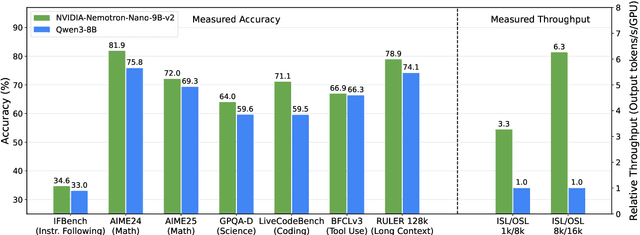

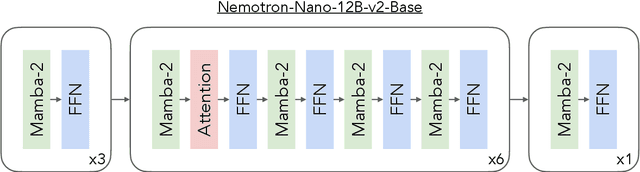
We introduce Nemotron-Nano-9B-v2, a hybrid Mamba-Transformer language model designed to increase throughput for reasoning workloads while achieving state-of-the-art accuracy compared to similarly-sized models. Nemotron-Nano-9B-v2 builds on the Nemotron-H architecture, in which the majority of the self-attention layers in the common Transformer architecture are replaced with Mamba-2 layers, to achieve improved inference speed when generating the long thinking traces needed for reasoning. We create Nemotron-Nano-9B-v2 by first pre-training a 12-billion-parameter model (Nemotron-Nano-12B-v2-Base) on 20 trillion tokens using an FP8 training recipe. After aligning Nemotron-Nano-12B-v2-Base, we employ the Minitron strategy to compress and distill the model with the goal of enabling inference on up to 128k tokens on a single NVIDIA A10G GPU (22GiB of memory, bfloat16 precision). Compared to existing similarly-sized models (e.g., Qwen3-8B), we show that Nemotron-Nano-9B-v2 achieves on-par or better accuracy on reasoning benchmarks while achieving up to 6x higher inference throughput in reasoning settings like 8k input and 16k output tokens. We are releasing Nemotron-Nano-9B-v2, Nemotron-Nano12B-v2-Base, and Nemotron-Nano-9B-v2-Base checkpoints along with the majority of our pre- and post-training datasets on Hugging Face.
Nemotron-CC-Math: A 133 Billion-Token-Scale High Quality Math Pretraining Dataset
Aug 20, 2025Pretraining large language models (LLMs) on high-quality, structured data such as mathematics and code substantially enhances reasoning capabilities. However, existing math-focused datasets built from Common Crawl suffer from degraded quality due to brittle extraction heuristics, lossy HTML-to-text conversion, and the failure to reliably preserve mathematical structure. In this work, we introduce Nemotron-CC-Math, a large-scale, high-quality mathematical corpus constructed from Common Crawl using a novel, domain-agnostic pipeline specifically designed for robust scientific text extraction. Unlike previous efforts, our pipeline recovers math across various formats (e.g., MathJax, KaTeX, MathML) by leveraging layout-aware rendering with lynx and a targeted LLM-based cleaning stage. This approach preserves the structural integrity of equations and code blocks while removing boilerplate, standardizing notation into LaTeX representation, and correcting inconsistencies. We collected a large, high-quality math corpus, namely Nemotron-CC-Math-3+ (133B tokens) and Nemotron-CC-Math-4+ (52B tokens). Notably, Nemotron-CC-Math-4+ not only surpasses all prior open math datasets-including MegaMath, FineMath, and OpenWebMath-but also contains 5.5 times more tokens than FineMath-4+, which was previously the highest-quality math pretraining dataset. When used to pretrain a Nemotron-T 8B model, our corpus yields +4.8 to +12.6 gains on MATH and +4.6 to +14.3 gains on MBPP+ over strong baselines, while also improving general-domain performance on MMLU and MMLU-Stem. We present the first pipeline to reliably extract scientific content--including math--from noisy web-scale data, yielding measurable gains in math, code, and general reasoning, and setting a new state of the art among open math pretraining corpora. To support open-source efforts, we release our code and datasets.
Prismatic Synthesis: Gradient-based Data Diversification Boosts Generalization in LLM Reasoning
May 26, 2025Effective generalization in language models depends critically on the diversity of their training data. Yet existing diversity metrics often fall short of this goal, relying on surface-level heuristics that are decoupled from model behavior. This motivates us to ask: What kind of diversity in training data actually drives generalization in language models -- and how can we measure and amplify it? Through large-scale empirical analyses spanning over 300 training runs, carefully controlled for data scale and quality, we show that data diversity can be a strong predictor of generalization in LLM reasoning -- as measured by average model performance on unseen out-of-distribution benchmarks. We introduce G-Vendi, a metric that quantifies diversity via the entropy of model-induced gradients. Despite using a small off-the-shelf proxy model for gradients, G-Vendi consistently outperforms alternative measures, achieving strong correlation (Spearman's $\rho \approx 0.9$) with out-of-distribution (OOD) performance on both natural language inference (NLI) and math reasoning tasks. Building on this insight, we present Prismatic Synthesis, a framework for generating diverse synthetic data by targeting underrepresented regions in gradient space. Experimental results show that Prismatic Synthesis consistently improves model performance as we scale synthetic data -- not just on in-distribution test but across unseen, out-of-distribution benchmarks -- significantly outperforming state-of-the-art models that rely on 20 times larger data generator than ours. For example, PrismMath-7B, our model distilled from a 32B LLM, outperforms R1-Distill-Qwen-7B -- the same base model trained on proprietary data generated by 671B R1 -- on 6 out of 7 challenging benchmarks.