 Add to Chrome
 Add to Firefox
 Add to Edge
Qwen-CUA: Native Computer Use for (almost) Everything
Aug 03, 2026
Native computer use offers a general interface for agents to operate almost any software available to people, but requires long-horizon state tracking, large-scale interactive experience, and learning from sparse yet verifiable outcomes. We introduce Qwen-CUA, a native computer-use agent with a 397B-A17B Qwen mixture-of-experts backbone. It observes only screenshots and acts through keyboard and mouse events, without DOM trees, accessibility metadata, or task-specific APIs. Its scaffold maintains up to 20 active screenshots and folds older visual history in fixed-size blocks to retain recent evidence while preserving reusable prompt prefixes. For training, we build a cloud rollout fleet with access to nearly 100,000 vCPUs and tens of thousands of concurrent environments, construct approximately 40,000 verifiable tasks, and collect personalized long-horizon workflows across everyday and professional software. We optimize complete trajectories with verifiable rewards and trajectory slicing, while iterative training runs refresh supervised data and recalibrate reinforcement-learning tasks. Across eight benchmarks, Qwen-CUA outperforms Qwen3.7 and remains competitive with leading proprietary systems, reaching 86.2 on OSWorld-Verified and 18.5/48.4 binary/partial completion on OSWorld 2.0. Scaling the same recipe to a model with over one trillion parameters yields Qwen-CUA-Max, improving these scores to 87.6 and 21.2/53.3. Qwen-CUA also reduces RedTeamCUA attack success from 36.6 to 16.4 relative to Qwen3.7. Efficiency analyses, a browser deployment, and Bash-augmented experiments further characterize practical behavior. These results establish native computer use as a broadly capable agent foundation and highlight scalable verifiable interaction and hybrid tool use as key directions.

TAP: Accelerating Large-Scale DNN Training Through Tensor Automatic Parallelisation
Feb 01, 2023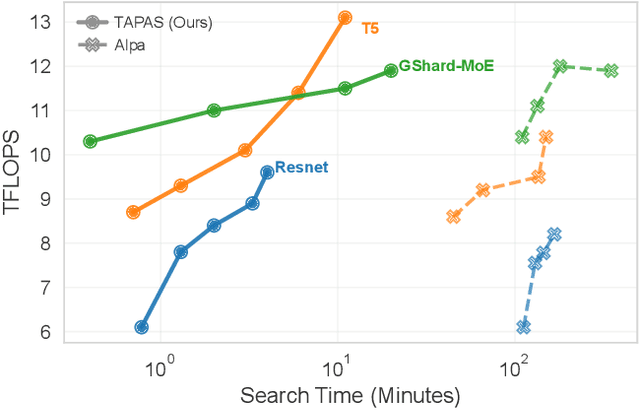

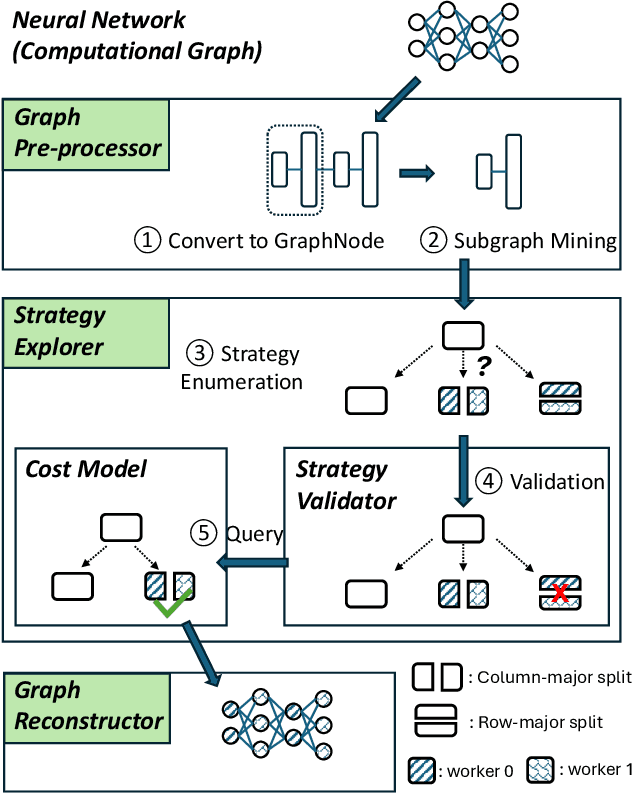
Model parallelism has become necessary to train large neural networks. However, finding a suitable model parallel schedule for an arbitrary neural network is a non-trivial task due to the exploding search space. In this work, we present a model parallelism framework TAP that automatically searches for the best data and tensor parallel schedules. Leveraging the key insight that a neural network can be represented as a directed acyclic graph, within which may only exist a limited set of frequent subgraphs, we design a graph pruning algorithm to fold the search space efficiently. TAP runs at sub-linear complexity concerning the neural network size. Experiments show that TAP is $20\times- 160\times$ faster than the state-of-the-art automatic parallelism framework, and the performance of its discovered schedules is competitive with the expert-engineered ones.