 Add to Chrome
 Add to Firefox
 Add to Edge
Clarity Contrast and Similarity Selection for Multi-Focus Image Fusion
Aug 04, 2026
Multi-focus image fusion (MFIF) aims to generate an all-in-focus image from multiple images of the same scene focused at different regions. Most existing deep learning-based methods lack explicit interaction between the source images, which limits their performance and interpretability. This paper presents a novel Clarity Contrast and Similarity Selection Network (CSNet), to bridge direct information exchange for MFIF. Specifically, by contrasting the clarity differences between source images within our proposed Clarity Contrast Attention Module (CCAM), we mutually enhance sharp features while suppressing blurry ones. This allows us to identify the exactly focused regions in each source and locate the focused-defocused boundaries. Moreover, the Defocus Spread Effect (DSE) degrades pixels in all source images around the boundaries. To further refine these ambiguous areas, we introduce a Similarity Selection Strategy, which reconstructs an initial clear image from source images and selects optimal pixels by comparing the similarity among them. Through this interactive approach, CSNet effectively preserves focused regions as well as recovering natural boundaries to fuse an all-in-focus output. Extensive experiments demonstrate that our method achieves state-of-the-art performance both quantitatively and qualitatively. Our code is available on Github: https://github.com/ZYC-HUST/CSNet.

Focusing on What Matters: Saliency-Harnessing Accurate Routing for Diffusion MoE
Jun 25, 2026Mixture-of-Experts (MoE) architectures have emerged as a powerful paradigm for scaling diffusion models in visual generation. Recent advancements have focused on adaptively allocating computational resources across diverse tokens to improve efficiency and performance. However, we identify a routing assignment problem in existing diffusion MoE frameworks: the router fails to accurately allocate more computational resources to salient tokens. Our analysis attributes this failure to the router's reliance on noise-corrupted latent features throughout the denoising process. Such stochastic noise obscures the critical structural and textural information, thereby preventing the router from effectively distinguishing salient tokens. To address this, we propose SharpMoE, a post-training framework with a saliency-harnessing accurate routing mechanism, which utilizes clean latent features as a noise-free guidance signal for routing. By bypassing the noise-distorted inputs, SharpMoE provides the router with clear saliency guidance, enabling the identification of salient tokens even in high-noise stages. Furthermore, we introduce a trajectory routing loss to constrain the compute allocation throughout the multi-step denoising trajectory, ensuring precise resource allocation along the generation rollout. Extensive experiments demonstrate that SharpMoE serves as a versatile, plug-and-play solution that further enhances the pretrained, converged MoE models, achieving state-of-the-art performance in visual generation.
Wan-Image: Pushing the Boundaries of Generative Visual Intelligence
Apr 21, 2026We present Wan-Image, a unified visual generation system explicitly engineered to paradigm-shift image generation models from casual synthesizers into professional-grade productivity tools. While contemporary diffusion models excel at aesthetic generation, they frequently encounter critical bottlenecks in rigorous design workflows that demand absolute controllability, complex typography rendering, and strict identity preservation. To address these challenges, Wan-Image features a natively unified multi-modal architecture by synergizing the cognitive capabilities of large language models with the high-fidelity pixel synthesis of diffusion transformers, which seamlessly translates highly nuanced user intents into precise visual outputs. It is fundamentally powered by large-scale multi-modal data scaling, a systematic fine-grained annotation engine, and curated reinforcement learning data to surpass basic instruction following and unlock expert-level professional capabilities. These include ultra-long complex text rendering, hyper-diverse portrait generation, palette-guided generation, multi-subject identity preservation, coherent sequential visual generation, precise multi-modal interactive editing, native alpha-channel generation, and high-efficiency 4K synthesis. Across diverse human evaluations, Wan-Image exceeds Seedream 5.0 Lite and GPT Image 1.5 in overall performance, reaching parity with Nano Banana Pro in challenging tasks. Ultimately, Wan-Image revolutionizes visual content creation across e-commerce, entertainment, education, and personal productivity, redefining the boundaries of professional visual synthesis.
DenseGRPO: From Sparse to Dense Reward for Flow Matching Model Alignment
Jan 28, 2026Recent GRPO-based approaches built on flow matching models have shown remarkable improvements in human preference alignment for text-to-image generation. Nevertheless, they still suffer from the sparse reward problem: the terminal reward of the entire denoising trajectory is applied to all intermediate steps, resulting in a mismatch between the global feedback signals and the exact fine-grained contributions at intermediate denoising steps. To address this issue, we introduce \textbf{DenseGRPO}, a novel framework that aligns human preference with dense rewards, which evaluates the fine-grained contribution of each denoising step. Specifically, our approach includes two key components: (1) we propose to predict the step-wise reward gain as dense reward of each denoising step, which applies a reward model on the intermediate clean images via an ODE-based approach. This manner ensures an alignment between feedback signals and the contributions of individual steps, facilitating effective training; and (2) based on the estimated dense rewards, a mismatch drawback between the uniform exploration setting and the time-varying noise intensity in existing GRPO-based methods is revealed, leading to an inappropriate exploration space. Thus, we propose a reward-aware scheme to calibrate the exploration space by adaptively adjusting a timestep-specific stochasticity injection in the SDE sampler, ensuring a suitable exploration space at all timesteps. Extensive experiments on multiple standard benchmarks demonstrate the effectiveness of the proposed DenseGRPO and highlight the critical role of the valid dense rewards in flow matching model alignment.
Is Nano Banana Pro a Low-Level Vision All-Rounder? A Comprehensive Evaluation on 14 Tasks and 40 Datasets
Dec 19, 2025The rapid evolution of text-to-image generation models has revolutionized visual content creation. While commercial products like Nano Banana Pro have garnered significant attention, their potential as generalist solvers for traditional low-level vision challenges remains largely underexplored. In this study, we investigate the critical question: Is Nano Banana Pro a Low-Level Vision All-Rounder? We conducted a comprehensive zero-shot evaluation across 14 distinct low-level tasks spanning 40 diverse datasets. By utilizing simple textual prompts without fine-tuning, we benchmarked Nano Banana Pro against state-of-the-art specialist models. Our extensive analysis reveals a distinct performance dichotomy: while \textbf{Nano Banana Pro demonstrates superior subjective visual quality}, often hallucinating plausible high-frequency details that surpass specialist models, it lags behind in traditional reference-based quantitative metrics. We attribute this discrepancy to the inherent stochasticity of generative models, which struggle to maintain the strict pixel-level consistency required by conventional metrics. This report identifies Nano Banana Pro as a capable zero-shot contender for low-level vision tasks, while highlighting that achieving the high fidelity of domain specialists remains a significant hurdle.
Learning Unpaired Image Dehazing with Physics-based Rehazy Generation
Jun 15, 2025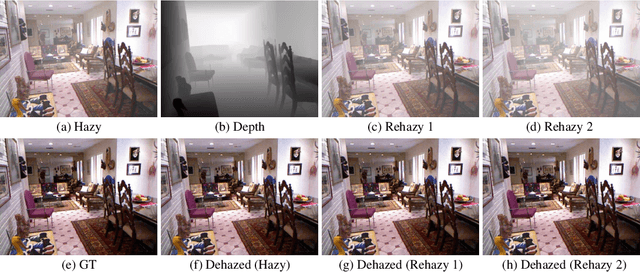
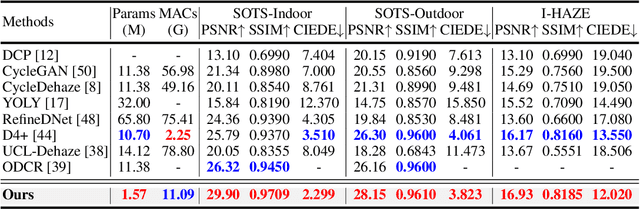
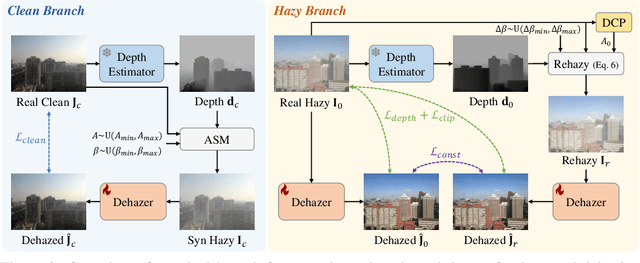
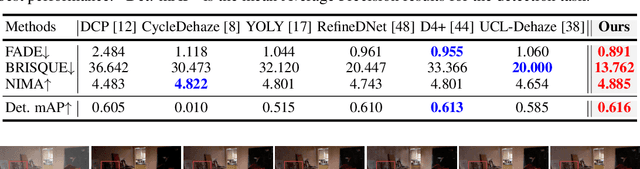
Overfitting to synthetic training pairs remains a critical challenge in image dehazing, leading to poor generalization capability to real-world scenarios. To address this issue, existing approaches utilize unpaired realistic data for training, employing CycleGAN or contrastive learning frameworks. Despite their progress, these methods often suffer from training instability, resulting in limited dehazing performance. In this paper, we propose a novel training strategy for unpaired image dehazing, termed Rehazy, to improve both dehazing performance and training stability. This strategy explores the consistency of the underlying clean images across hazy images and utilizes hazy-rehazy pairs for effective learning of real haze characteristics. To favorably construct hazy-rehazy pairs, we develop a physics-based rehazy generation pipeline, which is theoretically validated to reliably produce high-quality rehazy images. Additionally, leveraging the rehazy strategy, we introduce a dual-branch framework for dehazing network training, where a clean branch provides a basic dehazing capability in a synthetic manner, and a hazy branch enhances the generalization ability with hazy-rehazy pairs. Moreover, we design a new dehazing network within these branches to improve the efficiency, which progressively restores clean scenes from coarse to fine. Extensive experiments on four benchmarks demonstrate the superior performance of our approach, exceeding the previous state-of-the-art methods by 3.58 dB on the SOTS-Indoor dataset and by 1.85 dB on the SOTS-Outdoor dataset in PSNR. Our code will be publicly available.