 Add to Chrome
 Add to Firefox
 Add to Edge
Viton
Papers and Code
Semi-supervised Latent Disentangled Diffusion Model for Textile Pattern Generation
Mar 17, 2026
Textile pattern generation (TPG) aims to synthesize fine-grained textile pattern images based on given clothing images. Although previous studies have not explicitly investigated TPG, existing image-to-image models appear to be natural candidates for this task. However, when applied directly, these methods often produce unfaithful results, failing to preserve fine-grained details due to feature confusion between complex textile patterns and the inherent non-rigid texture distortions in clothing images. In this paper, we propose a novel method, SLDDM-TPG, for faithful and high-fidelity TPG. Our method consists of two stages: (1) a latent disentangled network (LDN) that resolves feature confusion in clothing representations and constructs a multi-dimensional, independent clothing feature space; and (2) a semi-supervised latent diffusion model (S-LDM), which receives guidance signals from LDN and generates faithful results through semi-supervised diffusion training, combined with our designed fine-grained alignment strategy. Extensive evaluations show that SLDDM-TPG reduces FID by 4.1 and improves SSIM by up to 0.116 on our CTP-HD dataset, and also demonstrate good generalization on the VITON-HD dataset.

A$^2$-Edit: Precise Reference-Guided Image Editing of Arbitrary Objects and Ambiguous Masks
Mar 11, 2026We propose \textbf{A$^2$-Edit}, a unified inpainting framework for arbitrary object categories, which allows users to replace any target region with a reference object using only a coarse mask. To address the issues of severe homogenization and limited category coverage in existing datasets, we construct a large-scale, multi-category dataset \textbf{UniEdit-500K}, which includes 8 major categories, 209 fine-grained subcategories, and a total of 500,104 image pairs. Such rich category diversity poses new challenges for the model, requiring it to automatically learn semantic relationships and distinctions across categories. To this end, we introduce the \textbf{Mixture of Transformer} module, which performs differentiated modeling of various object categories through dynamic expert selection, and further enhances cross-category semantic transfer and generalization through collaboration among experts. In addition, we propose a \textbf{Mask Annealing Training Strategy} (MATS) that progressively relaxes mask precision during training, reducing the model's reliance on accurate masks and improving robustness across diverse editing tasks. Extensive experiments on benchmarks such as VITON-HD and AnyInsertion demonstrate that A$^2$-Edit consistently outperforms existing approaches across all metrics, providing a new and efficient solution for arbitrary object editing.
Mobile-VTON: High-Fidelity On-Device Virtual Try-On
Mar 03, 2026Virtual try-on (VTON) has recently achieved impressive visual fidelity, but most existing systems require uploading personal photos to cloud-based GPUs, raising privacy concerns and limiting on-device deployment. To address this, we present Mobile-VTON, a high-quality, privacy-preserving framework that enables fully offline virtual try-on on commodity mobile devices using only a single user image and a garment image. Mobile-VTON introduces a modular TeacherNet-GarmentNet-TryonNet (TGT) architecture that integrates knowledge distillation, garment-conditioned generation, and garment alignment into a unified pipeline optimized for on-device efficiency. Within this framework, we propose a Feature-Guided Adversarial (FGA) Distillation strategy that combines teacher supervision with adversarial learning to better match real-world image distributions. GarmentNet is trained with a trajectory-consistency loss to preserve garment semantics across diffusion steps, while TryonNet uses latent concatenation and lightweight cross-modal conditioning to enable robust garment-to-person alignment without large-scale pretraining. By combining these components, Mobile-VTON achieves high-fidelity generation with low computational overhead. Experiments on VITON-HD and DressCode at 1024 x 768 show that it matches or outperforms strong server-based baselines while running entirely offline. These results demonstrate that high-quality VTON is not only feasible but also practical on-device, offering a secure solution for real-world applications.
* The project page is available at: https://zhenchenwan.github.io/Mobile-VTON/
MuGa-VTON: Multi-Garment Virtual Try-On via Diffusion Transformers with Prompt Customization
Aug 11, 2025Virtual try-on seeks to generate photorealistic images of individuals in desired garments, a task that must simultaneously preserve personal identity and garment fidelity for practical use in fashion retail and personalization. However, existing methods typically handle upper and lower garments separately, rely on heavy preprocessing, and often fail to preserve person-specific cues such as tattoos, accessories, and body shape-resulting in limited realism and flexibility. To this end, we introduce MuGa-VTON, a unified multi-garment diffusion framework that jointly models upper and lower garments together with person identity in a shared latent space. Specifically, we proposed three key modules: the Garment Representation Module (GRM) for capturing both garment semantics, the Person Representation Module (PRM) for encoding identity and pose cues, and the A-DiT fusion module, which integrates garment, person, and text-prompt features through a diffusion transformer. This architecture supports prompt-based customization, allowing fine-grained garment modifications with minimal user input. Extensive experiments on the VITON-HD and DressCode benchmarks demonstrate that MuGa-VTON outperforms existing methods in both qualitative and quantitative evaluations, producing high-fidelity, identity-preserving results suitable for real-world virtual try-on applications.
Two-Way Garment Transfer: Unified Diffusion Framework for Dressing and Undressing Synthesis
Aug 06, 2025
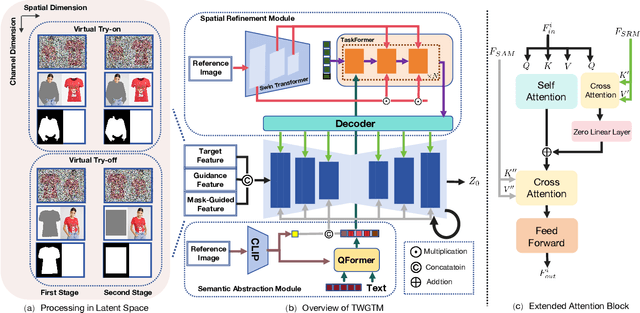

While recent advances in virtual try-on (VTON) have achieved realistic garment transfer to human subjects, its inverse task, virtual try-off (VTOFF), which aims to reconstruct canonical garment templates from dressed humans, remains critically underexplored and lacks systematic investigation. Existing works predominantly treat them as isolated tasks: VTON focuses on garment dressing while VTOFF addresses garment extraction, thereby neglecting their complementary symmetry. To bridge this fundamental gap, we propose the Two-Way Garment Transfer Model (TWGTM), to the best of our knowledge, the first unified framework for joint clothing-centric image synthesis that simultaneously resolves both mask-guided VTON and mask-free VTOFF through bidirectional feature disentanglement. Specifically, our framework employs dual-conditioned guidance from both latent and pixel spaces of reference images to seamlessly bridge the dual tasks. On the other hand, to resolve the inherent mask dependency asymmetry between mask-guided VTON and mask-free VTOFF, we devise a phased training paradigm that progressively bridges this modality gap. Extensive qualitative and quantitative experiments conducted across the DressCode and VITON-HD datasets validate the efficacy and competitive edge of our proposed approach.
VITON-DRR: Details Retention Virtual Try-on via Non-rigid Registration
May 29, 2025Image-based virtual try-on aims to fit a target garment to a specific person image and has attracted extensive research attention because of its huge application potential in the e-commerce and fashion industries. To generate high-quality try-on results, accurately warping the clothing item to fit the human body plays a significant role, as slight misalignment may lead to unrealistic artifacts in the fitting image. Most existing methods warp the clothing by feature matching and thin-plate spline (TPS). However, it often fails to preserve clothing details due to self-occlusion, severe misalignment between poses, etc. To address these challenges, this paper proposes a detail retention virtual try-on method via accurate non-rigid registration (VITON-DRR) for diverse human poses. Specifically, we reconstruct a human semantic segmentation using a dual-pyramid-structured feature extractor. Then, a novel Deformation Module is designed for extracting the cloth key points and warping them through an accurate non-rigid registration algorithm. Finally, the Image Synthesis Module is designed to synthesize the deformed garment image and generate the human pose information adaptively. {Compared with} traditional methods, the proposed VITON-DRR can make the deformation of fitting images more accurate and retain more garment details. The experimental results demonstrate that the proposed method performs better than state-of-the-art methods.
Inverse Virtual Try-On: Generating Multi-Category Product-Style Images from Clothed Individuals
May 27, 2025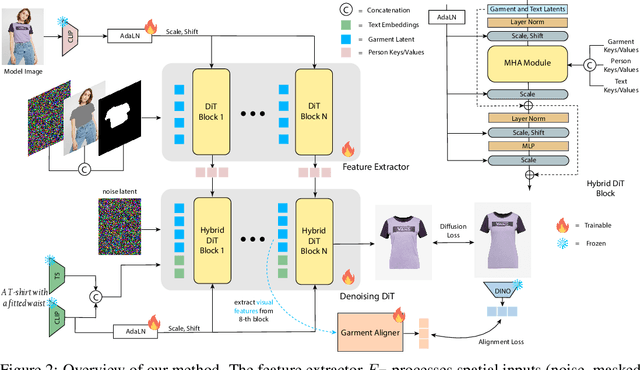
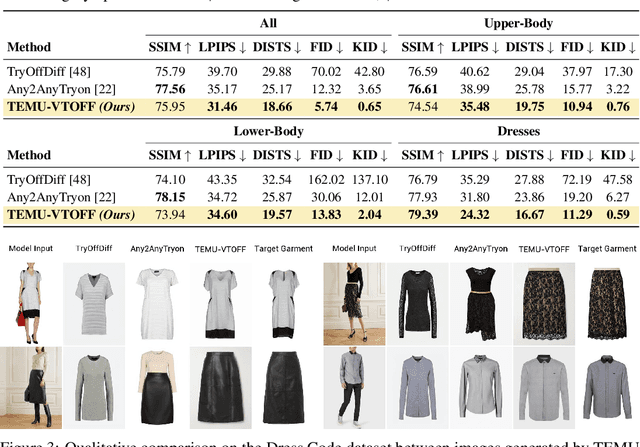
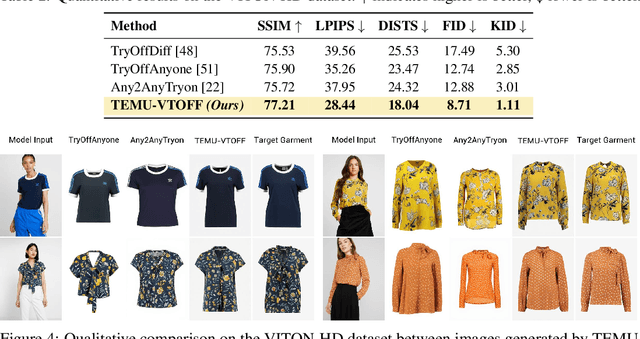
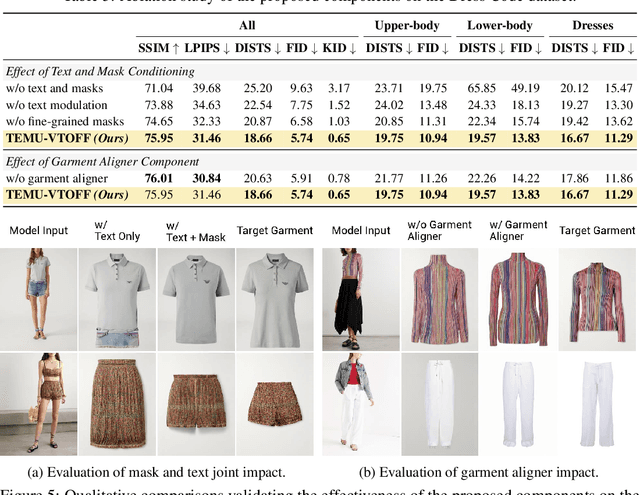
While virtual try-on (VTON) systems aim to render a garment onto a target person image, this paper tackles the novel task of virtual try-off (VTOFF), which addresses the inverse problem: generating standardized product images of garments from real-world photos of clothed individuals. Unlike VTON, which must resolve diverse pose and style variations, VTOFF benefits from a consistent and well-defined output format -- typically a flat, lay-down-style representation of the garment -- making it a promising tool for data generation and dataset enhancement. However, existing VTOFF approaches face two major limitations: (i) difficulty in disentangling garment features from occlusions and complex poses, often leading to visual artifacts, and (ii) restricted applicability to single-category garments (e.g., upper-body clothes only), limiting generalization. To address these challenges, we present Text-Enhanced MUlti-category Virtual Try-Off (TEMU-VTOFF), a novel architecture featuring a dual DiT-based backbone with a modified multimodal attention mechanism for robust garment feature extraction. Our architecture is designed to receive garment information from multiple modalities like images, text, and masks to work in a multi-category setting. Finally, we propose an additional alignment module to further refine the generated visual details. Experiments on VITON-HD and Dress Code datasets show that TEMU-VTOFF sets a new state-of-the-art on the VTOFF task, significantly improving both visual quality and fidelity to the target garments.
HF-VTON: High-Fidelity Virtual Try-On via Consistent Geometric and Semantic Alignment
May 26, 2025Virtual try-on technology has become increasingly important in the fashion and retail industries, enabling the generation of high-fidelity garment images that adapt seamlessly to target human models. While existing methods have achieved notable progress, they still face significant challenges in maintaining consistency across different poses. Specifically, geometric distortions lead to a lack of spatial consistency, mismatches in garment structure and texture across poses result in semantic inconsistency, and the loss or distortion of fine-grained details diminishes visual fidelity. To address these challenges, we propose HF-VTON, a novel framework that ensures high-fidelity virtual try-on performance across diverse poses. HF-VTON consists of three key modules: (1) the Appearance-Preserving Warp Alignment Module (APWAM), which aligns garments to human poses, addressing geometric deformations and ensuring spatial consistency; (2) the Semantic Representation and Comprehension Module (SRCM), which captures fine-grained garment attributes and multi-pose data to enhance semantic representation, maintaining structural, textural, and pattern consistency; and (3) the Multimodal Prior-Guided Appearance Generation Module (MPAGM), which integrates multimodal features and prior knowledge from pre-trained models to optimize appearance generation, ensuring both semantic and geometric consistency. Additionally, to overcome data limitations in existing benchmarks, we introduce the SAMP-VTONS dataset, featuring multi-pose pairs and rich textual annotations for a more comprehensive evaluation. Experimental results demonstrate that HF-VTON outperforms state-of-the-art methods on both VITON-HD and SAMP-VTONS, excelling in visual fidelity, semantic consistency, and detail preservation.
Pursuing Temporal-Consistent Video Virtual Try-On via Dynamic Pose Interaction
May 22, 2025Video virtual try-on aims to seamlessly dress a subject in a video with a specific garment. The primary challenge involves preserving the visual authenticity of the garment while dynamically adapting to the pose and physique of the subject. While existing methods have predominantly focused on image-based virtual try-on, extending these techniques directly to videos often results in temporal inconsistencies. Most current video virtual try-on approaches alleviate this challenge by incorporating temporal modules, yet still overlook the critical spatiotemporal pose interactions between human and garment. Effective pose interactions in videos should not only consider spatial alignment between human and garment poses in each frame but also account for the temporal dynamics of human poses throughout the entire video. With such motivation, we propose a new framework, namely Dynamic Pose Interaction Diffusion Models (DPIDM), to leverage diffusion models to delve into dynamic pose interactions for video virtual try-on. Technically, DPIDM introduces a skeleton-based pose adapter to integrate synchronized human and garment poses into the denoising network. A hierarchical attention module is then exquisitely designed to model intra-frame human-garment pose interactions and long-term human pose dynamics across frames through pose-aware spatial and temporal attention mechanisms. Moreover, DPIDM capitalizes on a temporal regularized attention loss between consecutive frames to enhance temporal consistency. Extensive experiments conducted on VITON-HD, VVT and ViViD datasets demonstrate the superiority of our DPIDM against the baseline methods. Notably, DPIDM achieves VFID score of 0.506 on VVT dataset, leading to 60.5% improvement over the state-of-the-art GPD-VVTO approach.
Incorporating Visual Correspondence into Diffusion Model for Virtual Try-On
May 22, 2025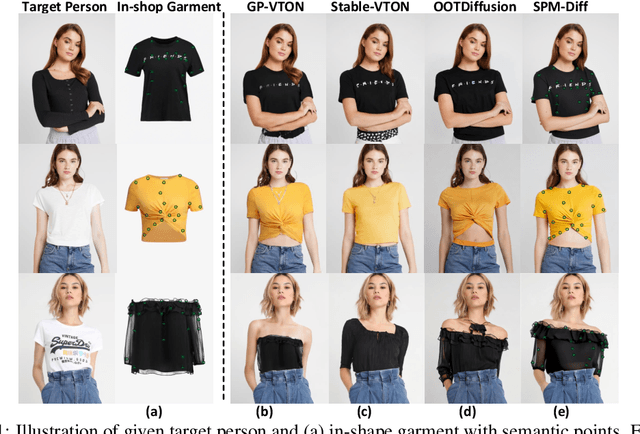
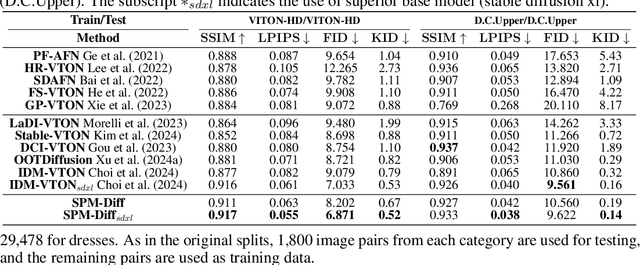
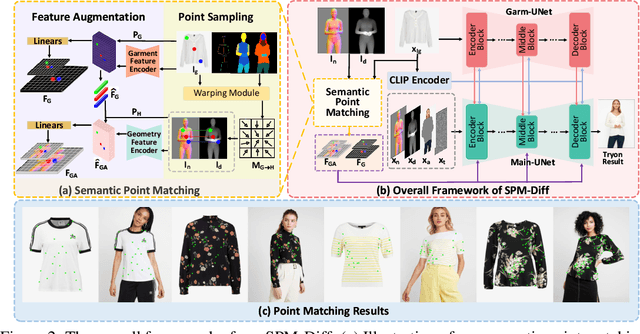
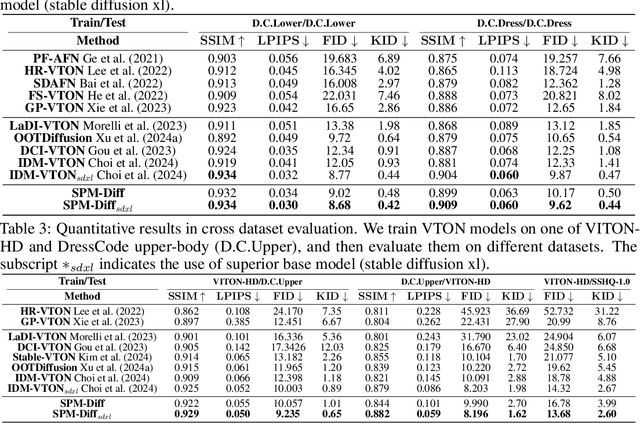
Diffusion models have shown preliminary success in virtual try-on (VTON) task. The typical dual-branch architecture comprises two UNets for implicit garment deformation and synthesized image generation respectively, and has emerged as the recipe for VTON task. Nevertheless, the problem remains challenging to preserve the shape and every detail of the given garment due to the intrinsic stochasticity of diffusion model. To alleviate this issue, we novelly propose to explicitly capitalize on visual correspondence as the prior to tame diffusion process instead of simply feeding the whole garment into UNet as the appearance reference. Specifically, we interpret the fine-grained appearance and texture details as a set of structured semantic points, and match the semantic points rooted in garment to the ones over target person through local flow warping. Such 2D points are then augmented into 3D-aware cues with depth/normal map of target person. The correspondence mimics the way of putting clothing on human body and the 3D-aware cues act as semantic point matching to supervise diffusion model training. A point-focused diffusion loss is further devised to fully take the advantage of semantic point matching. Extensive experiments demonstrate strong garment detail preservation of our approach, evidenced by state-of-the-art VTON performances on both VITON-HD and DressCode datasets. Code is publicly available at: https://github.com/HiDream-ai/SPM-Diff.