 Add to Chrome
 Add to Firefox
 Add to Edge
Dress-ED: Instruction-Guided Editing for Virtual Try-On and Try-Off
Mar 23, 2026
Recent advances in Virtual Try-On (VTON) and Virtual Try-Off (VTOFF) have greatly improved photo-realistic fashion synthesis and garment reconstruction. However, existing datasets remain static, lacking instruction-driven editing for controllable and interactive fashion generation. In this work, we introduce the Dress Editing Dataset (Dress-ED), the first large-scale benchmark that unifies VTON, VTOFF, and text-guided garment editing within a single framework. Each sample in Dress-ED includes an in-shop garment image, the corresponding person image wearing the garment, their edited counterparts, and a natural-language instruction of the desired modification. Built through a fully automated multimodal pipeline that integrates MLLM-based garment understanding, diffusion-based editing, and LLM-guided verification, Dress-ED comprises over 146k verified quadruplets spanning three garment categories and seven edit types, including both appearance (e.g., color, pattern, material) and structural (e.g., sleeve length, neckline) modifications. Based on this benchmark, we further propose a unified multimodal diffusion framework that jointly reasons over linguistic instructions and visual garment cues, serving as a strong baseline for instruction-driven VTON and VTOFF. Dataset and code will be made publicly available.

Inverse Virtual Try-On: Generating Multi-Category Product-Style Images from Clothed Individuals
May 27, 2025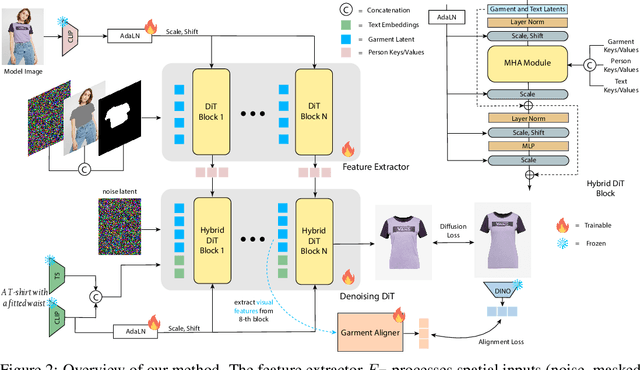
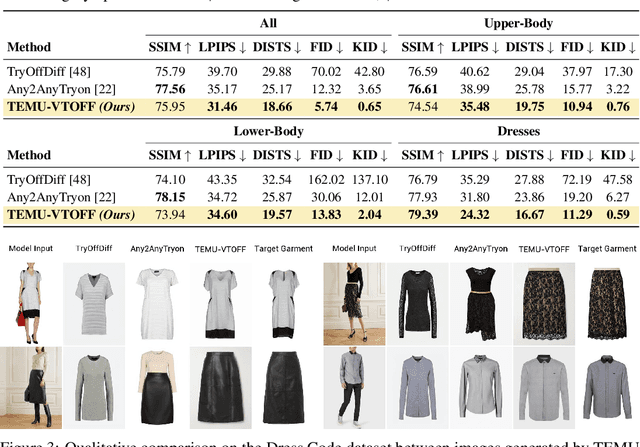
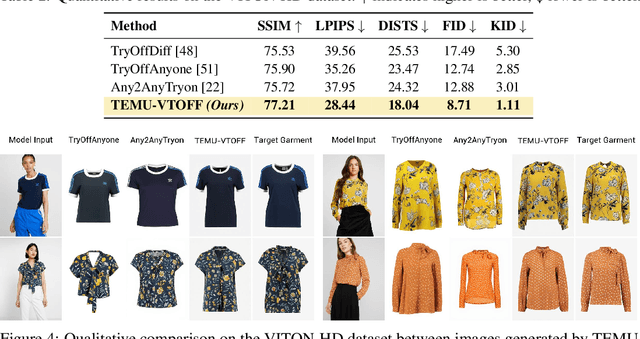
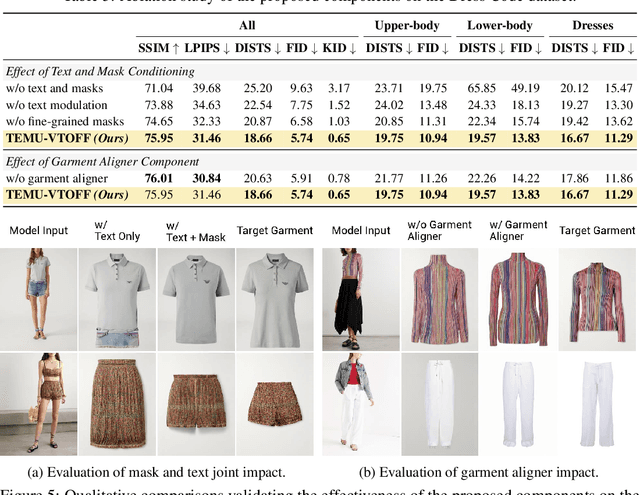
While virtual try-on (VTON) systems aim to render a garment onto a target person image, this paper tackles the novel task of virtual try-off (VTOFF), which addresses the inverse problem: generating standardized product images of garments from real-world photos of clothed individuals. Unlike VTON, which must resolve diverse pose and style variations, VTOFF benefits from a consistent and well-defined output format -- typically a flat, lay-down-style representation of the garment -- making it a promising tool for data generation and dataset enhancement. However, existing VTOFF approaches face two major limitations: (i) difficulty in disentangling garment features from occlusions and complex poses, often leading to visual artifacts, and (ii) restricted applicability to single-category garments (e.g., upper-body clothes only), limiting generalization. To address these challenges, we present Text-Enhanced MUlti-category Virtual Try-Off (TEMU-VTOFF), a novel architecture featuring a dual DiT-based backbone with a modified multimodal attention mechanism for robust garment feature extraction. Our architecture is designed to receive garment information from multiple modalities like images, text, and masks to work in a multi-category setting. Finally, we propose an additional alignment module to further refine the generated visual details. Experiments on VITON-HD and Dress Code datasets show that TEMU-VTOFF sets a new state-of-the-art on the VTOFF task, significantly improving both visual quality and fidelity to the target garments.