 Add to Chrome
 Add to Firefox
 Add to Edge
Feeling the Unexpected: ResTacVLA for Contact-Rich Manipulation via Residual Tactile Representation
Jul 03, 2026
Tactile perception is indispensable for contact-rich manipulation, yet integrating it into Vision-Language-Action (VLA) models often induces modality collapse, where high-bandwidth visual features overshadow sparse tactile cues. Inspired by Predictive Coding, a neural mechanism where the brain attenuates predictable inputs to prioritize surprising stimuli, we propose ResTacVLA. Rather than treating tactile data as raw input, we reformulate it as a Residual Tactile Representation capturing the discrepancy between visual priors and physical sensations. By filtering out visually predictable dynamics, this formulation transforms sparse tactile signals into dense, high-value information gain, thereby inherently resolving the bandwidth mismatch. These residuals are discretized through a Vector Quantized (VQ) bottleneck into Latent Contact Primitives that capture critical events missed by vision. Analogous to the neural surprise signal, we leverage the uncertainty of the visual prior to adaptively gate tactile integration, prioritizing residuals specifically during visually unreliable phases to explicitly prevent visual dominance. Experimental results show that ResTacVLA consistently outperforms all baselines on a diverse set of contact-rich manipulation tasks, while remaining robust to unexpected dynamic disturbances. Project page: https://awilekong.github.io/ResTacVLA-Website/

Ink3D: Sculpting 3D Assets with Extremely Complex Textures via Video Generative Models
Jul 01, 2026Recent 3D generative models can synthesize high-quality geometry but often struggle to reproduce intricate textures from reference images, largely due to the scarcity of large-scale 3D training data with rich surface appearance. In contrast, visual generative models are trained on datasets several orders of magnitude larger and excel at modeling complex visual patterns. Motivated by this gap, we introduce Ink3D, a framework that bridges 3D generation with large-scale video generative models to synthesize extremely complex textures. Ink3D first reconstructs a white-mesh geometry using an off-the-shelf 3D generation model. It then employs OrbitPainter, a conditional video generative model, to produce dense orbit-scan videos capturing object appearance across viewpoints. To convert these views into coherent textures, we introduce TextureOptimizer, a neural baking module that integrates dense multi-view observations while mitigating geometry inconsistencies arising from video generation. By decoupling geometry and texture synthesis and leveraging large-scale pretrained video priors, Ink3D enables significantly richer and more faithful texture generation than prior approaches.
MAD: Mapping-Aware World Models for Agile Quadrotor Flight
Jun 03, 2026Agile quadrotor flight in cluttered scenes requires more than a reactive mapping from a depth image to a control command: the vehicle must remember which regions have been observed, infer nearby occupied space, and act under partial visibility and tight latency. In this paper, we present Mapping-Aware Dreamer (MAD), a geometry-aware world model for vision-based quadrotor flight. Instead of using raw-image reconstruction as the main self-supervised objective, MAD learns recurrent latent dynamics that reconstruct robocentric occupancy and visibility grid maps together with proprioceptive states. This design forces the latent state to encode local geometry, visibility history, and ego-motion in a form that is directly relevant to collision avoidance. MAD is trained in DiffAero using a GPU-parallel map-construction module that provides high-throughput supervision for occupancy and visibility. The learned representation is used in three policy-learning modes: imagination-based MAD-Dreamer and feature-extractor variants based on PPO and SHAC. Across visual navigation and racing tasks, MAD-based agents achieve higher success rates, faster flight, and better cross-task transfer than corresponding vision-only baselines. The model also produces interpretable map predictions and accurate ego-motion estimates from depth observations. We further deploy the learned policy on a physical quadrotor with an Intel RealSense D435i and demonstrate safe indoor and outdoor flight under limited sensing, reaching 9.66 m/s in simulation and 5.05 m/s in real-world forest experiments. These results show that mapping-aware world models provide a practical middle ground between modular aerial navigation and end-to-end learning.
Adversarial Training for Robust Coverage Network under Worst-case Facility Losses
May 26, 2026The Maximal Covering Location-Interdiction Problem (MCLIP) is a classic bi-level optimization problem, which is fundamental to resilient infrastructure planning yet remains computationally intractable. Specifically, the upper level determines facility locations to maximize coverage, while the lower level executes worst-case interdiction to minimize the coverage. The strong coupling between the upper and lower levels, combined with their respective high combinatorial complexity, renders traditional methods ineffective. To bridge this gap, we propose a Dual-Agent Deep Reinforcement Learning (DADRL) framework based on adversarial learning, comprising a location agent corresponding to the upper level and an interdiction agent corresponding to the lower level. Our contributions are threefold: (1) The location agent is trained simultaneously against an evolving interdiction agent, making it effectively capture the dynamic competitive interplay between the upper and lower levels; (2) To fully exploit the learned capabilities of the interdiction agent, we propose a Surrogate-based Ensemble Inference Strategy that utilizes the trained interdiction agent as a high-fidelity surrogate to guide the decisions of location agent; (3) Extensive experiments on synthetic and real-world datasets demonstrate that our approach achieves superior computational efficiency while maintaining highly competitive solution quality compared to other baselines. Furthermore, our DADRL framework is model-agnostic to network structures, while its underlying adversarial learning paradigm demonstrates strong potential for solving other bi-level optimization problems.
Towards Generalization-Oriented Models for Vehicle Routing Problems with Mixture-of-Experts
May 26, 2026In recent years, Deep Reinforcement Learning (DRL) has achieved substantial progress on Vehicle Routing Problems (VRPs). However, existing DRL-based methods are typically trained on instances generated from a uniform distribution, which limits their performance under real-world distribution shifts. In this paper, we aim to develop a generalization-oriented model that partitions the policy network into multiple modules and adaptively recombines modules to form specific policies during inference. Specifically, we propose Residual Refined Experts with Instance-level Gating (R2E-IG) to improve cross-distribution generalization. Our contributions are threefold: (1) We introduce a Residual Refined Expert (R2E) architecture that enhance expert expressiveness via residual refinement; (2) We design an instance-level gating mechanism that learns distribution-aware instance representations and routes inputs to suitable modules; (3) We propose a mixed-distribution training mechanism equipped with Dynamic Weight Adaption (DWA), which dynamically reweights training data from different distributions to emphasize more informative ones. Extensive experiments show that R2E-IG achieves competitive performance against state-of-the-art baselines on both in-distribution and out-of-distribution instances across synthetic and benchmark datasets. Moreover, R2E-IG is generic and can be easily integrated into existing DRL-based methods to further improve performance.
Catching Every Ripple: Enhanced Anomaly Awareness via Dynamic Concept Adaptation
Apr 16, 2026Online anomaly detection (OAD) plays a pivotal role in real-time analytics and decision-making for evolving data streams. However, existing methods often rely on costly retraining and rigid decision boundaries, limiting their ability to adapt both effectively and efficiently to concept drift in dynamic environments. To address these challenges, we propose DyMETER, a dynamic concept adaptation framework for OAD that unifies on-the-fly parameter shifting and dynamic thresholding within a single online paradigm. DyMETER first learns a static detector on historical data to capture recurring central concepts, and then transitions to a dynamic mode to adapt to new concepts as drift occurs. Specifically, DyMETER employs a novel dynamic concept adaptation mechanism that leverages a hypernetwork to generate instance-aware parameter shifts for the static detector, thereby enabling efficient and effective adaptation without retraining or fine-tuning. To achieve robust and interpretable adaptation, DyMETER introduces a lightweight evolution controller to estimate instance-level concept uncertainty for adaptive updates. Further, DyMETER employs a dynamic threshold optimization module to adaptively recalibrates the decision boundary by maintaining a candidate window of uncertain samples, which ensures continuous alignment with evolving concepts. Extensive experiments demonstrate that DyMETER significantly outperforms existing OAD approaches across a wide spectrum of application scenarios.
VitaTouch: Property-Aware Vision-Tactile-Language Model for Robotic Quality Inspection in Manufacturing
Apr 02, 2026Quality inspection in smart manufacturing requires identifying intrinsic material and surface properties beyond visible geometry, yet vision-only methods remain vulnerable to occlusion and reflection. We propose VitaTouch, a property-aware vision-tactile-language model for material-property inference and natural-language attribute description. VitaTouch uses modality-specific encoders and a dual Q-Former to extract language-relevant visual and tactile features, which are compressed into prefix tokens for a large language model. We align each modality with text and explicitly couple vision and touch through contrastive learning. We also construct VitaSet, a multimodal dataset with 186 objects, 52k images, and 5.1k human-verified instruction-answer pairs. VitaTouch achieves the best performance on HCT and the overall TVL benchmark, while remaining competitive on SSVTP. On VitaSet, it reaches 88.89% hardness accuracy, 75.13% roughness accuracy, and 54.81% descriptor recall; the material-description task further achieves a peak semantic similarity of 0.9009. With LoRA-based fine-tuning, VitaTouch attains 100.0%, 96.0%, and 92.0% accuracy for 2-, 3-, and 5-category defect recognition, respectively, and delivers 94.0% closed-loop recognition accuracy and 94.0% end-to-end sorting success in 100 laboratory robotic trials. More details are available at the project page: https://vitatouch.github.io/
Outlier-robust Autocovariance Least Square Estimation via Iteratively Reweighted Least Square
Mar 09, 2026The autocovariance least squares (ALS) method is a computationally efficient approach for estimating noise covariances in Kalman filters without requiring specific noise models. However, conventional ALS and its variants rely on the classic least mean squares (LMS) criterion, making them highly sensitive to measurement outliers and prone to severe performance degradation. To overcome this limitation, this paper proposes a novel outlier-robust ALS algorithm, termed ALS-IRLS, based on the iteratively reweighted least squares (IRLS) framework. Specifically, the proposed approach introduces a two-tier robustification strategy. First, an innovation-level adaptive thresholding mechanism is employed to filter out heavily contaminated data. Second, the outlier-contaminated autocovariance is formulated using an $ε$-contamination model, where the standard LMS criterion is replaced by the Huber cost function. The IRLS method is then utilized to iteratively adjust data weights based on estimation deviations, effectively mitigating the influence of residual outliers. Comparative simulations demonstrate that ALS-IRLS reduces the root-mean-square error (RMSE) of noise covariance estimates by over two orders of magnitude compared to standard ALS. Furthermore, it significantly enhances downstream state estimation accuracy, outperforming existing outlier-robust Kalman filters and achieving performance nearly equivalent to the ideal Oracle lower bound in the presence of noisy and anomalous data.
Two-Way Garment Transfer: Unified Diffusion Framework for Dressing and Undressing Synthesis
Aug 06, 2025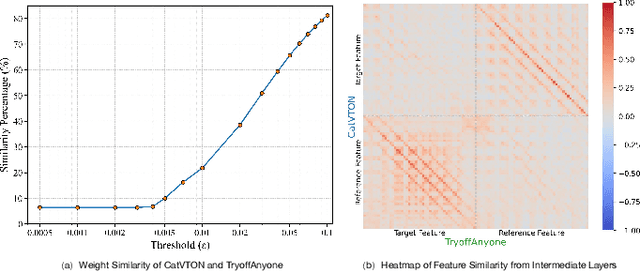
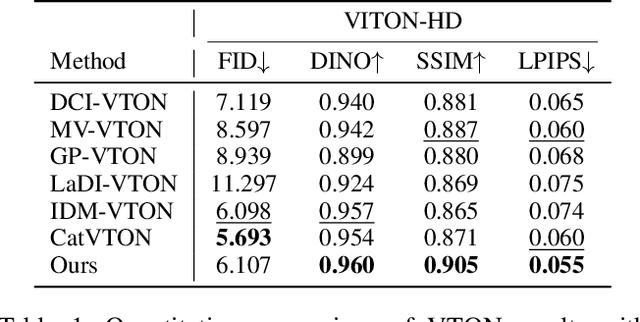
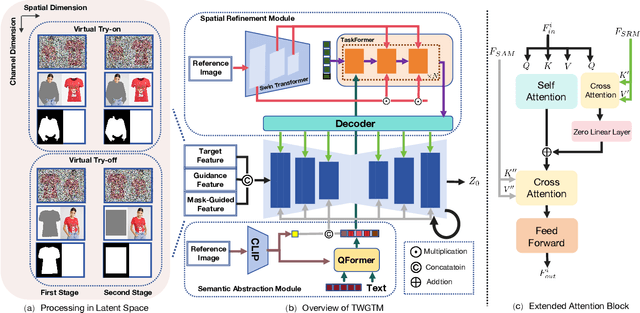

While recent advances in virtual try-on (VTON) have achieved realistic garment transfer to human subjects, its inverse task, virtual try-off (VTOFF), which aims to reconstruct canonical garment templates from dressed humans, remains critically underexplored and lacks systematic investigation. Existing works predominantly treat them as isolated tasks: VTON focuses on garment dressing while VTOFF addresses garment extraction, thereby neglecting their complementary symmetry. To bridge this fundamental gap, we propose the Two-Way Garment Transfer Model (TWGTM), to the best of our knowledge, the first unified framework for joint clothing-centric image synthesis that simultaneously resolves both mask-guided VTON and mask-free VTOFF through bidirectional feature disentanglement. Specifically, our framework employs dual-conditioned guidance from both latent and pixel spaces of reference images to seamlessly bridge the dual tasks. On the other hand, to resolve the inherent mask dependency asymmetry between mask-guided VTON and mask-free VTOFF, we devise a phased training paradigm that progressively bridges this modality gap. Extensive qualitative and quantitative experiments conducted across the DressCode and VITON-HD datasets validate the efficacy and competitive edge of our proposed approach.
In-Context Adaptation to Concept Drift for Learned Database Operations
May 07, 2025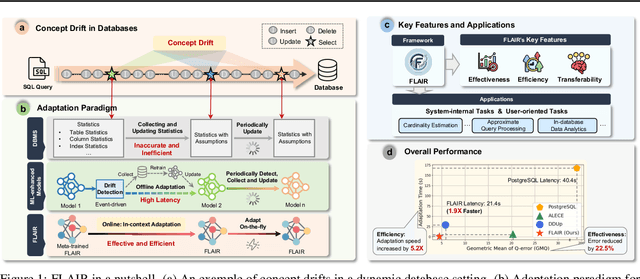
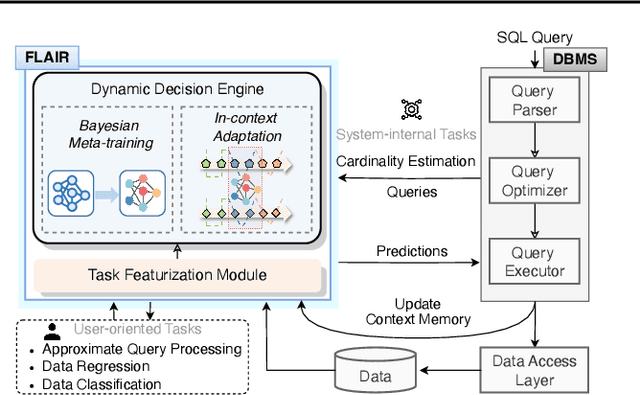
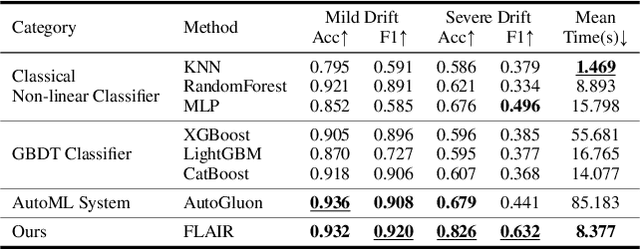
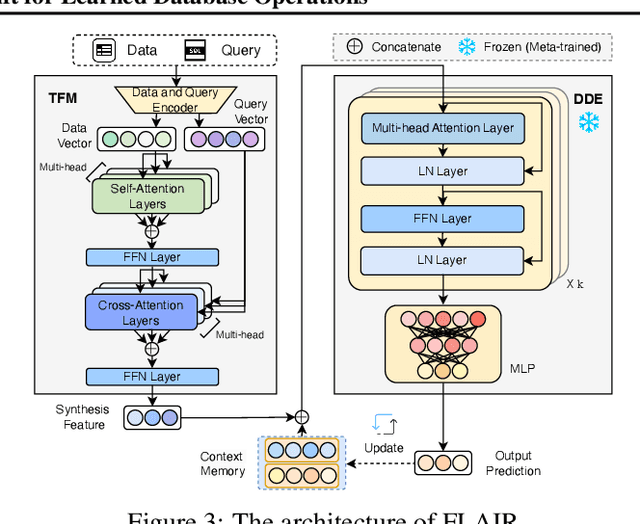
Machine learning has demonstrated transformative potential for database operations, such as query optimization and in-database data analytics. However, dynamic database environments, characterized by frequent updates and evolving data distributions, introduce concept drift, which leads to performance degradation for learned models and limits their practical applicability. Addressing this challenge requires efficient frameworks capable of adapting to shifting concepts while minimizing the overhead of retraining or fine-tuning. In this paper, we propose FLAIR, an online adaptation framework that introduces a new paradigm called \textit{in-context adaptation} for learned database operations. FLAIR leverages the inherent property of data systems, i.e., immediate availability of execution results for predictions, to enable dynamic context construction. By formalizing adaptation as $f:(\mathbf{x} \,| \,\mathcal{C}_t) \to \mathbf{y}$, with $\mathcal{C}_t$ representing a dynamic context memory, FLAIR delivers predictions aligned with the current concept, eliminating the need for runtime parameter optimization. To achieve this, FLAIR integrates two key modules: a Task Featurization Module for encoding task-specific features into standardized representations, and a Dynamic Decision Engine, pre-trained via Bayesian meta-training, to adapt seamlessly using contextual information at runtime. Extensive experiments across key database tasks demonstrate that FLAIR outperforms state-of-the-art baselines, achieving up to 5.2x faster adaptation and reducing error by 22.5% for cardinality estimation.