 Add to Chrome
 Add to Firefox
 Add to Edge
VGS-Decoding: Visual Grounding Score Guided Decoding for Hallucination Mitigation in Medical VLMs
Mar 19, 2026
Medical Vision-Language Models (VLMs) often hallucinate by generating responses based on language priors rather than visual evidence, posing risks in clinical applications. We propose Visual Grounding Score Guided Decoding (VGS-Decoding), a training-free method to mitigate hallucinations during inference. Our key insight is that hallucinated tokens maintain or increase their probability when visual information is degraded, while visually grounded tokens decrease in probability. We introduce the Visual Grounding Score (VGS), which measures each token's visual dependency by comparing distributions from original and distorted images. During decoding, we reweight probabilities by amplifying visually grounded tokens while suppressing hallucinations. Unlike fixed-weight contrastive methods, VGS-Decoding provides per-token adaptive control. Experiments on MIMIC-Diff-VQA and VQA-RAD across LLaVA-Med, CheXagent, and MedGemma demonstrate consistent improvements, with up to +9.12% overall gain and $+8.98\%$ in open-ended recall, while introducing only $2\times$ inference overhead and no additional training, making it practical for clinical deployment. Upon acceptance, code will be released publicly to facilitate reproducibility.

Refining 3D Medical Segmentation with Verbal Instruction
Mar 15, 2026Accurate 3D anatomical segmentation is essential for clinical diagnosis and surgical planning. However, automated models frequently generate suboptimal shape predictions due to factors such as limited and imbalanced training data, inadequate labeling quality, and distribution shifts between training and deployment settings. A natural solution is to iteratively refine the predicted shape based on the radiologists' verbal instructions. However, this is hindered by the scarcity of paired data that explicitly links erroneous shapes to corresponding corrective instructions. As an initial step toward addressing this limitation, we introduce CoWTalk, a benchmark comprising 3D arterial anatomies with controllable synthesized anatomical errors and their corresponding repairing instructions. Building on this benchmark, we further propose an iterative refinement model that represents 3D shapes as vector sets and interacts with textual instructions to progressively update the target shape. Experimental results demonstrate that our method achieves significant improvements over corrupted inputs and competitive baselines, highlighting the feasibility of language-driven clinician-in-the-loop refinement for 3D medical shapes modeling.
Learning to Read Where to Look: Disease-Aware Vision-Language Pretraining for 3D CT
Mar 02, 2026Recent 3D CT vision-language models align volumes with reports via contrastive pretraining, but typically rely on limited public data and provide only coarse global supervision. We train a 3D CT vision-language model on 98k report-volume pairs (50k patients) collected at a single hospital, combined with public datasets, using SigLIP-style contrastive pretraining together with prompt-based disease supervision in the shared vision-text embedding space. On CT-RATE, our model achieves state-of-the-art text-to-image retrieval (R@10 31.5 vs. 22.2) and competitive disease classification (AUC 83.8 vs. 83.8), with consistent results on Rad-ChestCT (AUC 77.0 vs. 77.3). We further observe that radiologists routinely reference specific images within their reports (e.g., ``series X, image Y''), linking textual descriptions to precise axial locations. We automatically mine 262k such snippet-slice pairs and introduce the task of intra-scan snippet localization -- predicting the axial depth referred to by a text snippet -- reducing mean absolute error to 36.3 mm at 12 mm feature resolution, compared with 67.0 mm for the best baseline. Adding this localization objective leaves retrieval and classification broadly unchanged within confidence bounds, yielding a single unified model for retrieval, classification, and intra-scan grounding.
LATA: Laplacian-Assisted Transductive Adaptation for Conformal Uncertainty in Medical VLMs
Feb 19, 2026Medical vision-language models (VLMs) are strong zero-shot recognizers for medical imaging, but their reliability under domain shift hinges on calibrated uncertainty with guarantees. Split conformal prediction (SCP) offers finite-sample coverage, yet prediction sets often become large (low efficiency) and class-wise coverage unbalanced-high class-conditioned coverage gap (CCV), especially in few-shot, imbalanced regimes; moreover, naively adapting to calibration labels breaks exchangeability and voids guarantees. We propose \texttt{\textbf{LATA}} (Laplacian-Assisted Transductive Adaptation), a \textit{training- and label-free} refinement that operates on the joint calibration and test pool by smoothing zero-shot probabilities over an image-image k-NN graph using a small number of CCCP mean-field updates, preserving SCP validity via a deterministic transform. We further introduce a \textit{failure-aware} conformal score that plugs into the vision-language uncertainty (ViLU) framework, providing instance-level difficulty and label plausibility to improve prediction set efficiency and class-wise balance at fixed coverage. \texttt{\textbf{LATA}} is black-box (no VLM updates), compute-light (windowed transduction, no backprop), and includes an optional prior knob that can run strictly label-free or, if desired, in a label-informed variant using calibration marginals once. Across \textbf{three} medical VLMs and \textbf{nine} downstream tasks, \texttt{\textbf{LATA}} consistently reduces set size and CCV while matching or tightening target coverage, outperforming prior transductive baselines and narrowing the gap to label-using methods, while using far less compute. Comprehensive ablations and qualitative analyses show that \texttt{\textbf{LATA}} sharpens zero-shot predictions without compromising exchangeability.
MuGa-VTON: Multi-Garment Virtual Try-On via Diffusion Transformers with Prompt Customization
Aug 11, 2025Virtual try-on seeks to generate photorealistic images of individuals in desired garments, a task that must simultaneously preserve personal identity and garment fidelity for practical use in fashion retail and personalization. However, existing methods typically handle upper and lower garments separately, rely on heavy preprocessing, and often fail to preserve person-specific cues such as tattoos, accessories, and body shape-resulting in limited realism and flexibility. To this end, we introduce MuGa-VTON, a unified multi-garment diffusion framework that jointly models upper and lower garments together with person identity in a shared latent space. Specifically, we proposed three key modules: the Garment Representation Module (GRM) for capturing both garment semantics, the Person Representation Module (PRM) for encoding identity and pose cues, and the A-DiT fusion module, which integrates garment, person, and text-prompt features through a diffusion transformer. This architecture supports prompt-based customization, allowing fine-grained garment modifications with minimal user input. Extensive experiments on the VITON-HD and DressCode benchmarks demonstrate that MuGa-VTON outperforms existing methods in both qualitative and quantitative evaluations, producing high-fidelity, identity-preserving results suitable for real-world virtual try-on applications.
ReservoirTTA: Prolonged Test-time Adaptation for Evolving and Recurring Domains
May 20, 2025This paper introduces ReservoirTTA, a novel plug-in framework designed for prolonged test-time adaptation (TTA) in scenarios where the test domain continuously shifts over time, including cases where domains recur or evolve gradually. At its core, ReservoirTTA maintains a reservoir of domain-specialized models -- an adaptive test-time model ensemble -- that both detects new domains via online clustering over style features of incoming samples and routes each sample to the appropriate specialized model, and thereby enables domain-specific adaptation. This multi-model strategy overcomes key limitations of single model adaptation, such as catastrophic forgetting, inter-domain interference, and error accumulation, ensuring robust and stable performance on sustained non-stationary test distributions. Our theoretical analysis reveals key components that bound parameter variance and prevent model collapse, while our plug-in TTA module mitigates catastrophic forgetting of previously encountered domains. Extensive experiments on the classification corruption benchmarks, including ImageNet-C and CIFAR-10/100-C, as well as the Cityscapes$\rightarrow$ACDC semantic segmentation task, covering recurring and continuously evolving domain shifts, demonstrate that ReservoirTTA significantly improves adaptation accuracy and maintains stable performance across prolonged, recurring shifts, outperforming state-of-the-art methods.
Slide-Level Prompt Learning with Vision Language Models for Few-Shot Multiple Instance Learning in Histopathology
Mar 21, 2025In this paper, we address the challenge of few-shot classification in histopathology whole slide images (WSIs) by utilizing foundational vision-language models (VLMs) and slide-level prompt learning. Given the gigapixel scale of WSIs, conventional multiple instance learning (MIL) methods rely on aggregation functions to derive slide-level (bag-level) predictions from patch representations, which require extensive bag-level labels for training. In contrast, VLM-based approaches excel at aligning visual embeddings of patches with candidate class text prompts but lack essential pathological prior knowledge. Our method distinguishes itself by utilizing pathological prior knowledge from language models to identify crucial local tissue types (patches) for WSI classification, integrating this within a VLM-based MIL framework. Our approach effectively aligns patch images with tissue types, and we fine-tune our model via prompt learning using only a few labeled WSIs per category. Experimentation on real-world pathological WSI datasets and ablation studies highlight our method's superior performance over existing MIL- and VLM-based methods in few-shot WSI classification tasks. Our code is publicly available at https://github.com/LTS5/SLIP.
A Simple Framework for Open-Vocabulary Zero-Shot Segmentation
Jun 23, 2024


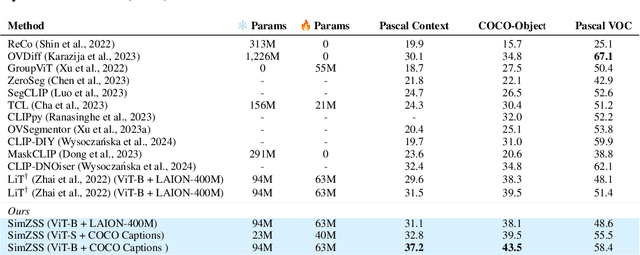
Zero-shot classification capabilities naturally arise in models trained within a vision-language contrastive framework. Despite their classification prowess, these models struggle in dense tasks like zero-shot open-vocabulary segmentation. This deficiency is often attributed to the absence of localization cues in captions and the intertwined nature of the learning process, which encompasses both image representation learning and cross-modality alignment. To tackle these issues, we propose SimZSS, a Simple framework for open-vocabulary Zero-Shot Segmentation. The method is founded on two key principles: i) leveraging frozen vision-only models that exhibit spatial awareness while exclusively aligning the text encoder and ii) exploiting the discrete nature of text and linguistic knowledge to pinpoint local concepts within captions. By capitalizing on the quality of the visual representations, our method requires only image-caption pairs datasets and adapts to both small curated and large-scale noisy datasets. When trained on COCO Captions across 8 GPUs, SimZSS achieves state-of-the-art results on 7 out of 8 benchmark datasets in less than 15 minutes.
Un-Mixing Test-Time Normalization Statistics: Combatting Label Temporal Correlation
Jan 16, 2024

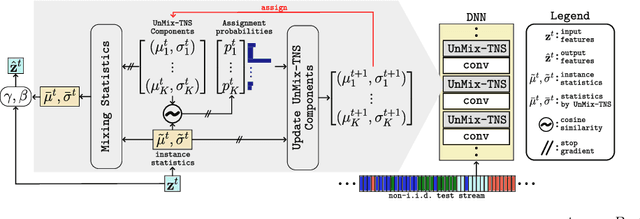

In an era where test-time adaptation methods increasingly rely on the nuanced manipulation of batch normalization (BN) parameters, one critical assumption often goes overlooked: that of independently and identically distributed (i.i.d.) test batches with respect to unknown labels. This assumption culminates in biased estimates of BN statistics and jeopardizes system stability under non-i.i.d. conditions. This paper pioneers a departure from the i.i.d. paradigm by introducing a groundbreaking strategy termed "Un-Mixing Test-Time Normalization Statistics" (UnMix-TNS). UnMix-TNS re-calibrates the instance-wise statistics used to normalize each instance in a batch by mixing it with multiple unmixed statistics components, thus inherently simulating the i.i.d. environment. The key lies in our innovative online unmixing procedure, which persistently refines these statistics components by drawing upon the closest instances from an incoming test batch. Remarkably generic in its design, UnMix-TNS seamlessly integrates with an array of state-of-the-art test-time adaptation methods and pre-trained architectures equipped with BN layers. Empirical evaluations corroborate the robustness of UnMix-TNS under varied scenarios ranging from single to continual and mixed domain shifts. UnMix-TNS stands out when handling test data streams with temporal correlation, including those with corrupted real-world non-i.i.d. streams, sustaining its efficacy even with minimal batch sizes and individual samples. Our results set a new standard for test-time adaptation, demonstrating significant improvements in both stability and performance across multiple benchmarks.
CrIBo: Self-Supervised Learning via Cross-Image Object-Level Bootstrapping
Oct 11, 2023


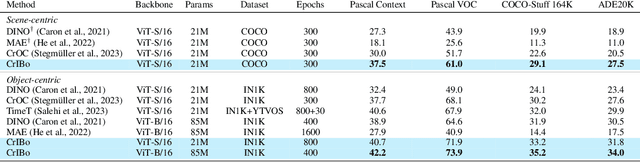
Leveraging nearest neighbor retrieval for self-supervised representation learning has proven beneficial with object-centric images. However, this approach faces limitations when applied to scene-centric datasets, where multiple objects within an image are only implicitly captured in the global representation. Such global bootstrapping can lead to undesirable entanglement of object representations. Furthermore, even object-centric datasets stand to benefit from a finer-grained bootstrapping approach. In response to these challenges, we introduce a novel Cross-Image Object-Level Bootstrapping method tailored to enhance dense visual representation learning. By employing object-level nearest neighbor bootstrapping throughout the training, CrIBo emerges as a notably strong and adequate candidate for in-context learning, leveraging nearest neighbor retrieval at test time. CrIBo shows state-of-the-art performance on the latter task while being highly competitive in more standard downstream segmentation tasks. Our code and pretrained models will be publicly available upon acceptance.